

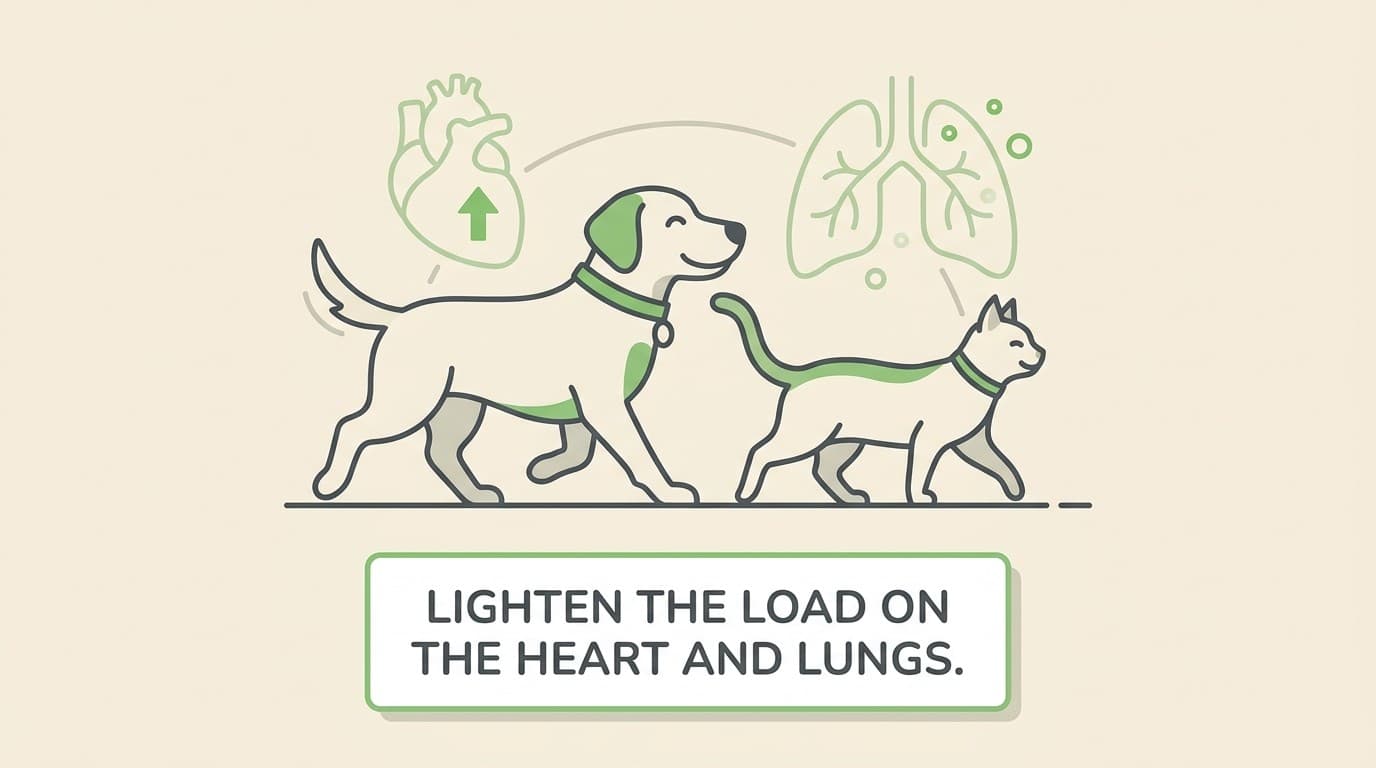
Weight, the heart and breathing: lightening the load
Alastair Greenway
BVM&S MRCVS
Extra weight is extra work for the heart and lungs
Every extra pound your pet carries is dead weight, and the heart has to push blood all the way around it while the chest has to lift it with each breath. That cost doesn't sit somewhere off in the future as a number on a chart. It is work, right now, on this morning's walk.
So start with what changes soonest. A leaner pet breathes a little easier and tires a little less doing exactly the same things, and that often shows up within weeks of the weight starting to come off, not years. The dog that was flopping down halfway round the block makes it to the end. The cat that was puffing on the stairs takes them without the pause at the top. That is the prize, and it arrives early.
None of this means your pet has a heart or lung problem. Most overweight pets don't. It means a body that's carrying extra has to work harder to do ordinary things, and taking some of that load off makes the ordinary things easier. That holds for a perfectly healthy heart, and it holds doubly for one that's already under strain.
You are also in very normal company. Around half of UK dogs and cats are above their ideal weight (PDSA, 2024), and the gain creeps on so gradually that most owners genuinely can't see it on their own pet. This isn't a telling-off. It's the one lever that quietly makes breathing and moving easier, and it's almost entirely in your hands.
What the weight does to the heart
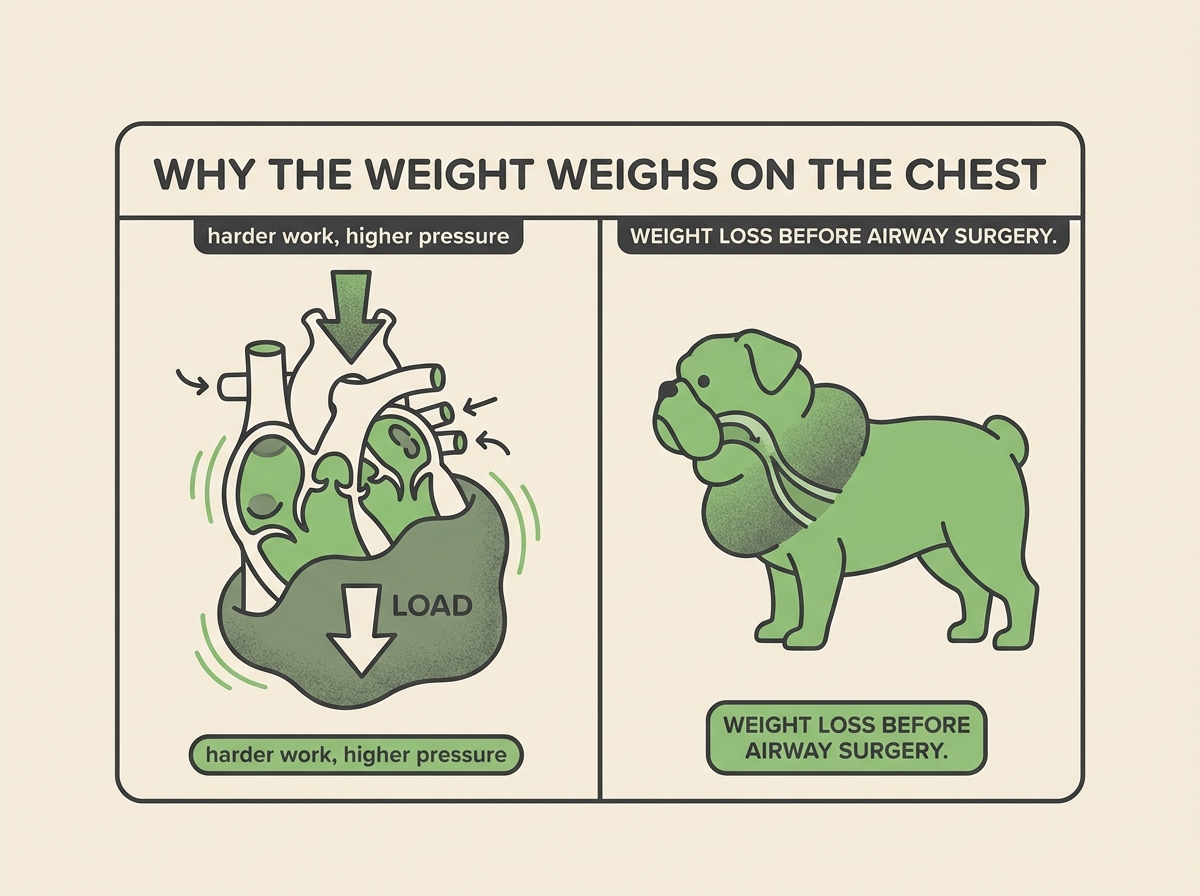
The heart is a pump, and like any pump it has to work harder to move blood around a bigger, heavier body. That extra demand doesn't stay invisible. Overweight dogs are more likely to have raised blood pressure, and obesity is linked to structural change in the heart muscle itself, including a thickening of the wall that should be doing the pumping (Tropf et al., 2017). A thicker, harder-working heart is a less efficient one, and that is strain you can't feel from the outside but the heart feels constantly.
The encouraging half of that finding is worth holding onto. Those changes are at least partly reversible. In dogs, the wall thickness measured on a scan falls again as the weight comes off (Tropf et al., 2017). The same picture holds in cats, where obesity drives an increase in heart-wall thickness and a stiffening of the way the heart relaxes between beats, and both improve with successful weight loss (Partington et al., 2024). Take the load off, and a heart that was working too hard gets to ease back.
One line matters above the rest here. Losing weight eases the work the heart has to do, but it does not cure heart disease. If your pet has been diagnosed with something like degenerative mitral valve disease in a dog, or hypertrophic cardiomyopathy in a cat, slimming will not undo that underlying condition. What it does is stop piling an extra, avoidable burden on top of a heart that's already coping with one. Think of fat as a load on a healthy heart and a second job for a diseased one. You can lift the load, but you can't fix the valve by lifting it. Both of those things are true at once, and an overweight pet with a heart murmur benefits from the first even though the second still needs the vet.
What the weight does to the breathing (and the flat-faced catch)
Breathing is physical work too, and fat makes it harder. Fat laid down around the chest wall, in the belly pressing up against the diaphragm, and in the soft tissues around the airway all make each breath cost a little more effort. For any pet, a leaner frame is a frame that breathes more freely.
For flat-faced breeds, this stops being a general truth and becomes a specific, pressing one. Pugs, French bulldogs and bulldogs are already born with a squashed-faced airway, the bundle of problems vets call brachycephalic obstructive airway syndrome, or BOAS. Pack extra fat into the tissues around an airway that's narrow to begin with, and you narrow it further. The University of Cambridge's veterinary team put it plainly: obesity (a body condition score of 7 or more out of 9) is significantly associated with BOAS, and fat tissue within the airway tract can further narrow the lumen (University of Cambridge, n.d.). It isn't just that heavy flat-faced dogs happen to breathe badly. The fat is sitting in the worst possible place and making a tight airway tighter.
This is where the genuinely useful clinical point lands. For an overweight flat-faced dog facing airway surgery, weight loss is usually asked for first. Cambridge's guidance is that for obese dogs with mild to moderate BOAS signs, weight loss is suggested before surgical intervention (University of Cambridge, n.d.), and in some of those milder cases slimming eases the signs enough on its own that it changes the whole picture. So if your pug or Frenchie has been booked in, or you're weighing it up, getting the weight off isn't a delaying tactic. It is part of the treatment, and occasionally a large part of it.
The scope is the same as it was for the heart. Slimming helps the airway do its job with less effort, but it cannot un-squash the face. A flat-faced dog will still have a flat-faced dog's anatomy at target weight, and the most severe cases will still need surgery. What weight loss does is take away the one part of the problem that's avoidable, and for mild to moderate cases that can be enough to matter.
When losing weight is a warning, not a win (cardiac cachexia)
Everything so far has been about weight coming off on purpose, on a plan, and that's a good thing. There is one situation where weight coming off is the opposite of good news, and a pet with heart disease is exactly where it shows up.
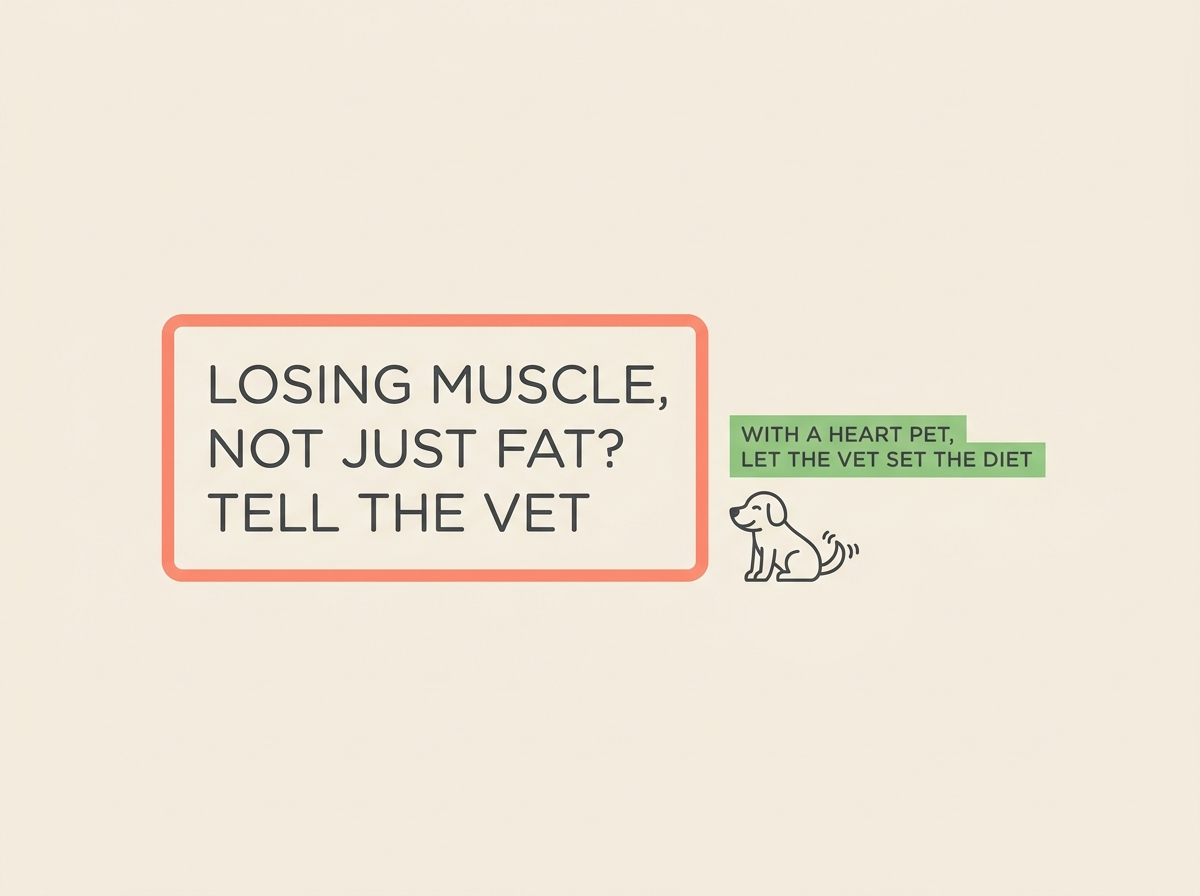
A pet that is in, or sliding towards, heart failure can start to lose weight and muscle as part of the disease itself. Vets call it cardiac cachexia, and it is a wasting that the failing heart drives. It is common. Roughly half of dogs with congestive heart failure show it, with one study finding muscle loss in about 48% of cases (Ineson et al., 2019), and a similar picture in cats, where around 42% with congestive heart failure show muscle loss (Santiago et al., 2020). It carries a worse outlook in both, with shorter survival times once it sets in. The cruel part is that the muscle can start melting away before the scales move much, and it can happen even while a pet still looks overweight on the outside (Santiago et al., 2020). So a heart patient quietly losing condition is not a diet succeeding. It is a warning sign.
That gives you a clear rule. If your pet has known heart disease and the weight is coming off without you deliberately setting out to make it happen, that's a "tell the vet today", not a quiet win. And the flip side is just as firm: a diagnosed heart patient's diet is the vet's call, never a do-it-yourself crash. A heart that's already struggling, and a body that may be prone to losing the very muscle it needs, is not a body to experiment on with a sudden food cut. If there's a heart diagnosis in the picture, the slimming plan is built with the vet, full stop.
Lightening the load, safely, and where to go next
The reassuring thing about easing this particular load is that you don't have to exercise a breathless or cardiac pet hard to do it. Most of weight loss comes from the bowl, not the lead. That is genuinely good news here, because the pets who'd most benefit from losing weight, the breathless flat-faced dog and the heart patient, are often the ones who can least afford a punishing exercise plan. You can take the load off mostly by measuring and gently cutting back the food they already have, which means you can start helping the heart and the lungs without asking the chest to do more first.
Do it slowly. Aim for around 1 to 2% of body weight a week for a dog, and a gentler 0.5 to 1% a week for a cat, and never crash a cat onto too little food. Slow is both safer and the pace that actually sticks. And if there's a diagnosed heart condition anywhere in the picture, this is one to run with your vet rather than solo, both because the diet has to suit the heart and because the muscle-loss risk means someone needs to be watching what kind of weight is coming off.
So if your pet is carrying extra and the heart or the breathing is part of why you're here, the next steps are short. Work out how much they actually need and turn it into grams with the Feeding Calculator, then log the weight as it comes off with the Healthy Weight Tracker so you can see the trend rather than the daily wobble. Read more about the heart side in the Heart Health space and the airway side in the Breathing space, the two places we go deep on what the weight is actually loading. If the weight is coming off on its own rather than on a plan, start instead with losing weight without trying, because that changes the whole question. And if there's stiffness or limping alongside the breathlessness, weight and arthritis is the other big win sitting right next to this one.
References
- PDSA (2024). PAW Report 2024 (PDSA Animal Wellbeing Report).
- Tropf M, Nelson OL, Lee PM, Weng HY, et al. (2017). Cardiac and Metabolic Variables in Obese Dogs. Journal of Veterinary Internal Medicine 31(4):1000-1007.
- Partington C, Hodgkiss-Geere H, Dukes-McEwan J, German AJ, et al. (2024). The effect of obesity and subsequent weight reduction on cardiac morphology and function in cats. BMC Veterinary Research 20:154.
- University of Cambridge, Department of Veterinary Medicine (n.d.). BOAS: Management and Treatment.
- Ineson DL, Freeman LM, Rush JE (2019). Clinical and laboratory findings and survival time associated with cardiac cachexia in dogs with congestive heart failure. Journal of Veterinary Internal Medicine 33(5):1902-1908.
- Santiago SL, Rush JE, Freeman LM, et al. (2020). Cardiac cachexia in cats with congestive heart failure: Prevalence and clinical, laboratory, and survival findings. Journal of Veterinary Internal Medicine 34(1):35-44.
Keep track of how your pet is doing
The owners who cope best are the ones who notice changes early. A simple health log shows you what is working, and what is not, before the next vet visit.
Start tracking, freeYou're not doing this alone
Compare treatment journeys and talk to owners managing weight management. Free to join.
Join PetsLikeMine