

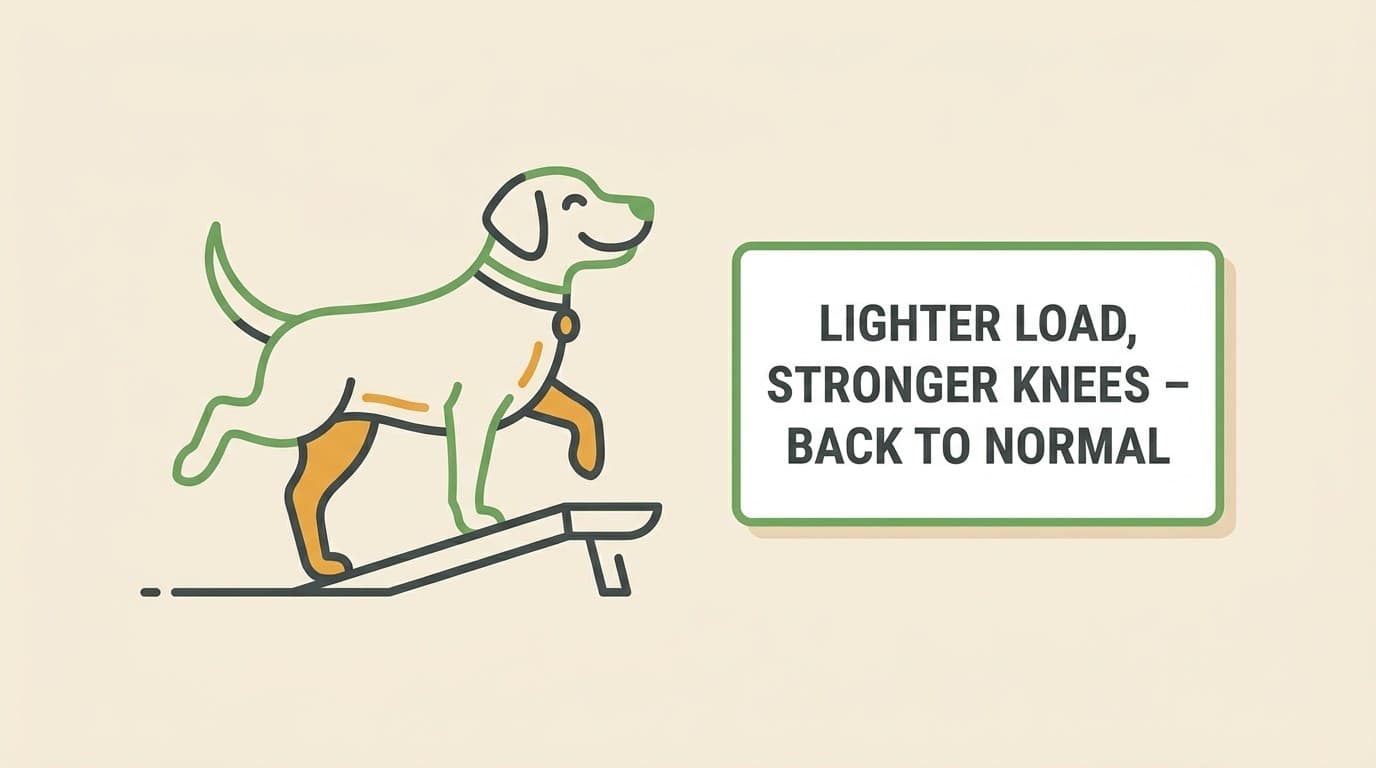
Weight and the cruciate: protecting the knees
Alastair Greenway
BVM&S MRCVS
Back on four legs: why weight is one of the best things you can do
A dog with a freshly torn cruciate is usually a dog whose owner has one picture in their head: back on the walk they love, back into the car without a heave, back up the stairs without a thought. Keep that picture. It's closer than it feels right now.
A cruciate rupture is one of the most common orthopaedic injuries dogs get, and it's very recoverable. Most dogs come back to a full, happy life on that leg. So before anything else, take the pressure off yourself: this isn't a verdict on you, and the fact that your dog is food motivated and a bit heavy doesn't make you a bad owner. Over half of UK dogs are above their ideal weight, so if yours is one of them, you're in good company, not in trouble.
Of everything you'll read about cruciate disease, weight control sits among the highest-value and lowest-cost options, and it's one of the few you fully control yourself. You can't change your dog's breed or the shape of their knee, but you can change what goes in the bowl. Getting your dog lean protects the knee they've just hurt, protects the good knee on the other side, and helps everything else you do work better. It costs nothing, you can start today, and it's squarely in your hands.
Weight and the cruciate: the link most owners miss
Plenty of owners are surprised that weight comes into a knee injury at all. It feels like bad luck, or a sudden wrong step. Often the rupture does happen in a single moment, but the ligament has usually been quietly weakening for a while, and excess weight is one of the biggest things that pushes it along.
The evidence here is strong. In UK first-opinion practice, dogs in the heaviest third of bodyweight were around 3.4 times more likely to be diagnosed with cruciate disease than lighter dogs (Taylor-Brown, 2015). Looking specifically at obesity, one UK study found it almost quadrupled the risk of cruciate rupture. Those aren't small numbers. Excess weight is one of the clearest modifiable risk factors we have for this injury, which is exactly why it's worth your attention.
So why does carrying extra weight hurt the knee? It works in two ways at once. There's the obvious mechanical part: every extra kilo is extra load going through a joint that's already under strain, every step, every jump off the sofa. Then there's the part most people don't know. Fat isn't a quiet padding that just sits there. It's an active tissue that releases low-grade inflammatory signals around the body, including into the joints (ACVS). So extra weight loads the stifle and stokes the inflammation that wears the ligament down. It hurts the knee twice over.
How the ligament degenerates, and why one knee gives way, is a deeper story that belongs to the Cruciate space, which covers the disease and the surgery in full. For our purposes the headline is enough: weight is a real, named, fixable part of why this happened, and it's the part you can act on.
Protecting the second knee
Now the higher-stakes point, the one I'd most want you to take away. When a dog ruptures one cruciate, the other one is at real risk of going too. Across the research the chance sits somewhere in the region of 40 to 60%, and it often happens within a year of the first (PLOS One, 2014). Many owners are blindsided by a second rupture on the "good" leg a few months later, and it doesn't have to be a surprise.
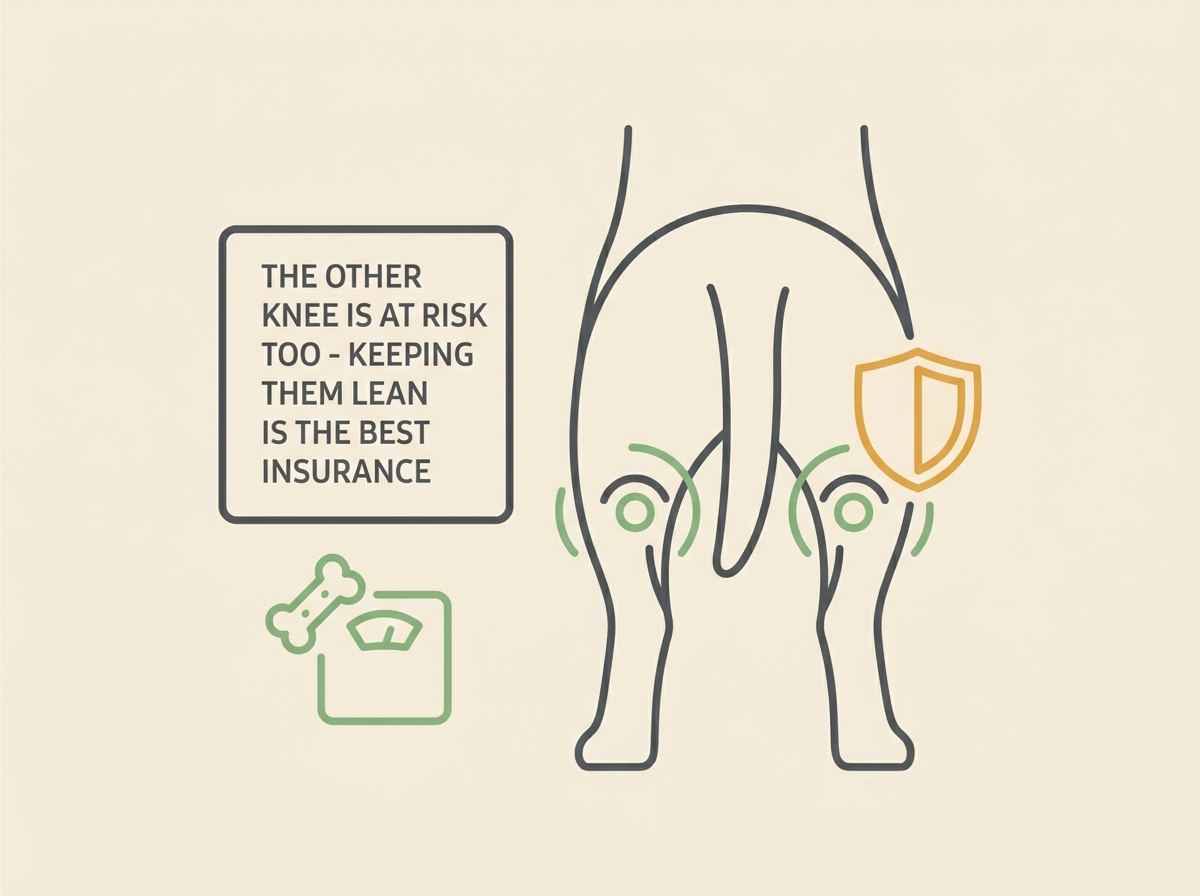
The same lever moves both knees. Weight is a modifiable risk factor for the second cruciate just as it was for the first, so keeping your dog lean is the cheapest insurance you can buy for the leg that's still sound. There's a grim logic to it too: while one leg is recovering, the good leg is carrying more than its usual share, so the last thing it needs is extra bodyweight piled on top. Getting the weight off protects the leg that's quietly doing the heavy lifting right now.
If you want the full detail on how likely a second rupture is and what raises it, the contralateral risk has its own dedicated piece in the Cruciate space. For here, the message is simple. State it once and act on it: lean is how you give the good knee its best chance.
After surgery (or on a conservative plan): why lean speeds recovery
Whether your dog is heading for surgery or being managed conservatively without an operation, one thing is true of every cruciate knee once the ligament has gone: it carries arthritis. That's not a scare, it's just the biology. Once the cruciate fails, the joint becomes unstable and arthritis sets in, and it's effectively universal from then on (Hurley, 2007). Surgery limits it, but no operation prevents it entirely. The good news running alongside that is real: with good management, the large majority of dogs get back toward normal function on the leg.
Weight does some of its most useful work here, and it's where the evidence is cleanest. Losing weight measurably improves arthritis lameness. In dogs with osteoarthritis, a significant reduction in lameness showed up after losing as little as around 6% of bodyweight (Marshall, 2010). A lighter frame means less load on a joint that's now arthritic, it lets pain relief work properly rather than fighting a losing battle, and it eases the return to normal movement. The same weight-led joint management runs through both treatment paths, surgical and conservative alike, so this matters whichever route your dog is on (Wucherer, 2013). Don't let anyone leave you with the idea that weight only counts if you operate. Named orthopaedic guidance puts maintaining a lean body mass squarely in cruciate care for exactly this reason (ACVS).
There's a genuine awkwardness to face, though. You can't exercise the weight off a sore, resting, post-operative dog. For weeks they may be on crate rest or strictly limited lead walks, which is the opposite of a fitness regime. So how do you slim a dog who isn't allowed to move? You don't do it with the lead. You do it with the bowl. The great majority of weight loss comes from feeding less, not from burning more, which means you can start slimming straight away, before your dog is moving freely again. And it gets better: as the weight comes off, moving gets easier, so by the time gentle, vet-guided exercise is back on the table, there's less of your dog to haul around. Diet does the heavy lifting; movement follows.
One trap is worth naming plainly, because it catches a lot of well-meaning owners. Crate rest plus the same dinners they always had plus a few extra "poorly dog" treats to cheer them up is a recipe for fast weight gain, at the precise moment the joint can least afford it. A resting body burns less, so the old ration is now too much. This is the moment to lower the food, not to hold it steady and certainly not to top it up out of sympathy. The begging look from the crate is biology, not a request you're obliged to grant.
How to do it: the bowl, the tools, the cross-links
So, practically, how do you take the weight off a recovering dog? It comes down to the bowl, and the numbers are friendlier than you'd think.
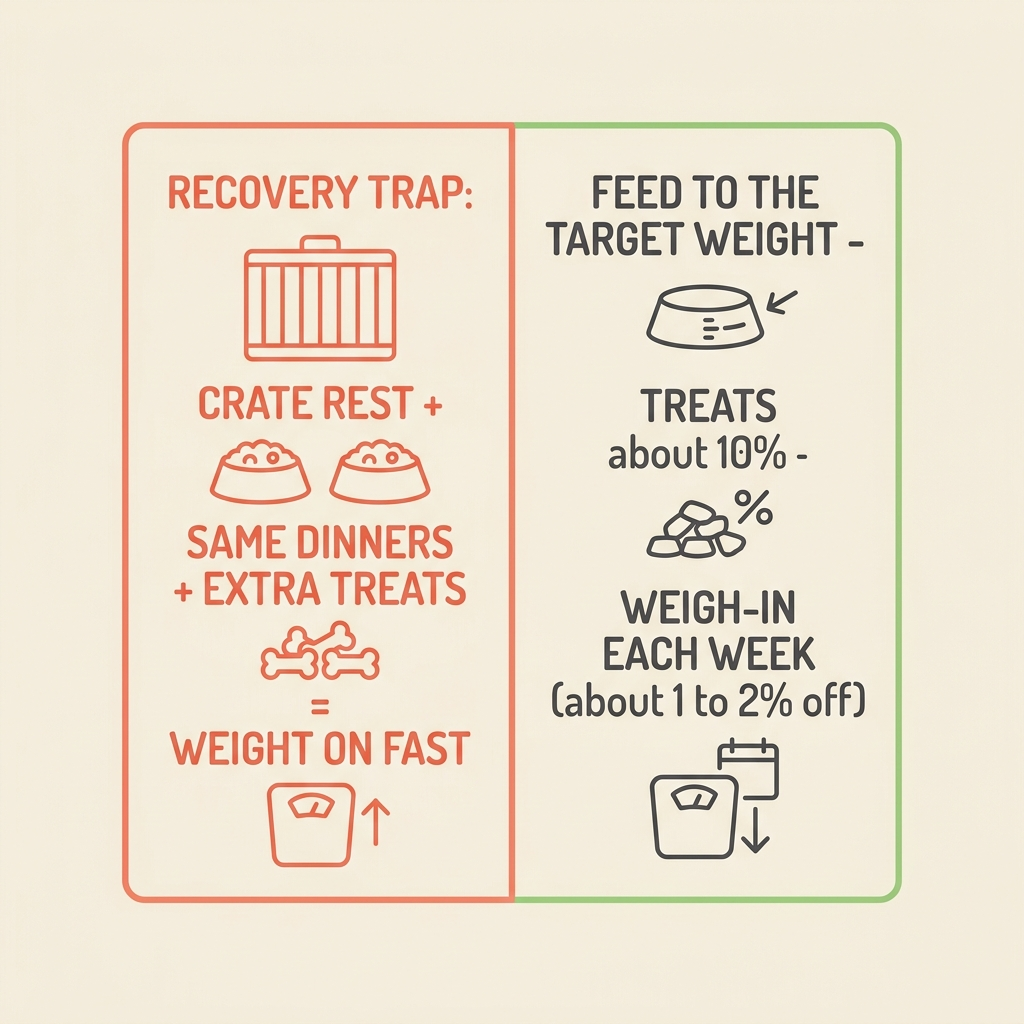
Feed to the target weight, not today's. The big shift is to stop feeding the dog your dog is now and start feeding the dog you're aiming for. Work out the calories for the ideal weight, convert that to grams of the food already in your cupboard, and you're done. You don't need a special diet to start; you very often just need less of what you already buy, weighed properly. Our Feeding Calculator does this in about ten seconds, turning the target weight into grams a day of your current food.
Budget the treats to around 10%. You don't have to stop treating your recovering dog, and you shouldn't have to feel guilty about the ones you give. Just keep treats to roughly 10% of the day's calories and count them in, so the comfort snacks don't quietly undo the deficit. How to keep treats without blowing the diet walks through the swaps that keep the ritual and lose the calories.
Weigh and body-condition score across the recovery weeks. Recovery is a perfect window to track, because you're already keeping a close eye on your dog. Weigh regularly and run a body-condition score so you can see the trend, not just guess at it. The Healthy Weight Tracker plots the weight and stores the score and a photo, so you can watch the shape change. A safe pace for a dog is around 1 to 2% of bodyweight a week. Slow is both safer and far more likely to stick, so let the scales lead, not the scoop.
If you've landed here straight off a fresh diagnosis and want the disease and the surgery-versus-conservative decision laid out properly, start with the Cruciate space. For the angles that sit next to this one, see the weight as a cruciate risk factor piece, the other-leg risk deep-dive, and the weight and muscle long game after surgery. Because every post-cruciate knee carries arthritis, the Osteoarthritis space and the Mobility Check are worth a look too, and if your dog's mobility is genuinely limited right now, slimming when movement is limited is written for exactly that situation.
One last thing, kept where it belongs, as a footnote rather than the headline. Lean dogs lived a median of around 1.8 years longer than their overweight littermates. That's a lovely bonus, but it isn't the reason to start today. The reason to start today is the leg in front of you: getting the weight off is how the repair lasts, how the good knee stays good, and how your dog gets back on their feet sooner. Pick up the food scoop, work out the grams, and you've already done the highest-value thing on the list.
References
- Taylor-Brown FE, et al. (2015). Epidemiology of cranial cruciate ligament disease diagnosis in dogs attending primary-care veterinary practices in England. Veterinary Surgery 44(7):777-783.
- Adams TS, et al. (2011). Influence of signalment on developing cranial cruciate rupture in dogs in the UK. Journal of Small Animal Practice 52(7):347-352.
- American College of Veterinary Surgeons (ACVS). Cranial Cruciate Ligament Disease (owner factsheet).
- PLOS One (2014). Risk factors for contralateral cranial cruciate ligament rupture in dogs.
- Hurley CR, et al. (2007). Progression of radiographic evidence of osteoarthritis following tibial plateau leveling osteotomy in dogs with cranial cruciate ligament rupture. Journal of the American Veterinary Medical Association 230(11):1674-1679.
- Marshall WG, et al. (2010). The effect of weight loss on lameness in obese dogs with osteoarthritis. Veterinary Research Communications 34(3):241-253.
- Wucherer KL, et al. (2013). Short-term and long-term outcomes for overweight dogs with cranial cruciate ligament rupture treated surgically or nonsurgically. Journal of the American Veterinary Medical Association 242(10):1364-1372.
- Kealy RD, et al. (2002). Effects of diet restriction on life span and age-related changes in dogs. Journal of the American Veterinary Medical Association 220(9):1315-1320.
Keep track of how your pet is doing
The owners who cope best are the ones who notice changes early. A simple health log shows you what is working, and what is not, before the next vet visit.
Start tracking, freeYou're not doing this alone
Compare treatment journeys and talk to owners managing weight management. Free to join.
Join PetsLikeMine