

Weight and Arthritis: The Single Best Thing You Can Do
Alastair Greenway
BVM&S MRCVS
A dog who's slowing down, struggling on the stairs or cutting their walk short usually gets the same explanation: it's "just their age" or "just the arthritis". Both might be true. But there's one thing you can do that helps more than any supplement, any joint chew, and very nearly anything else in your control. If your pet is carrying extra weight, taking some of it off is the single most effective thing an owner can do for arthritis.
That's not a slimming-industry slogan. It's what the evidence shows, and it's worth saying plainly, because most owners never connect the spare tyre to the limp. They're two halves of the same problem.
The real prize is how they move now
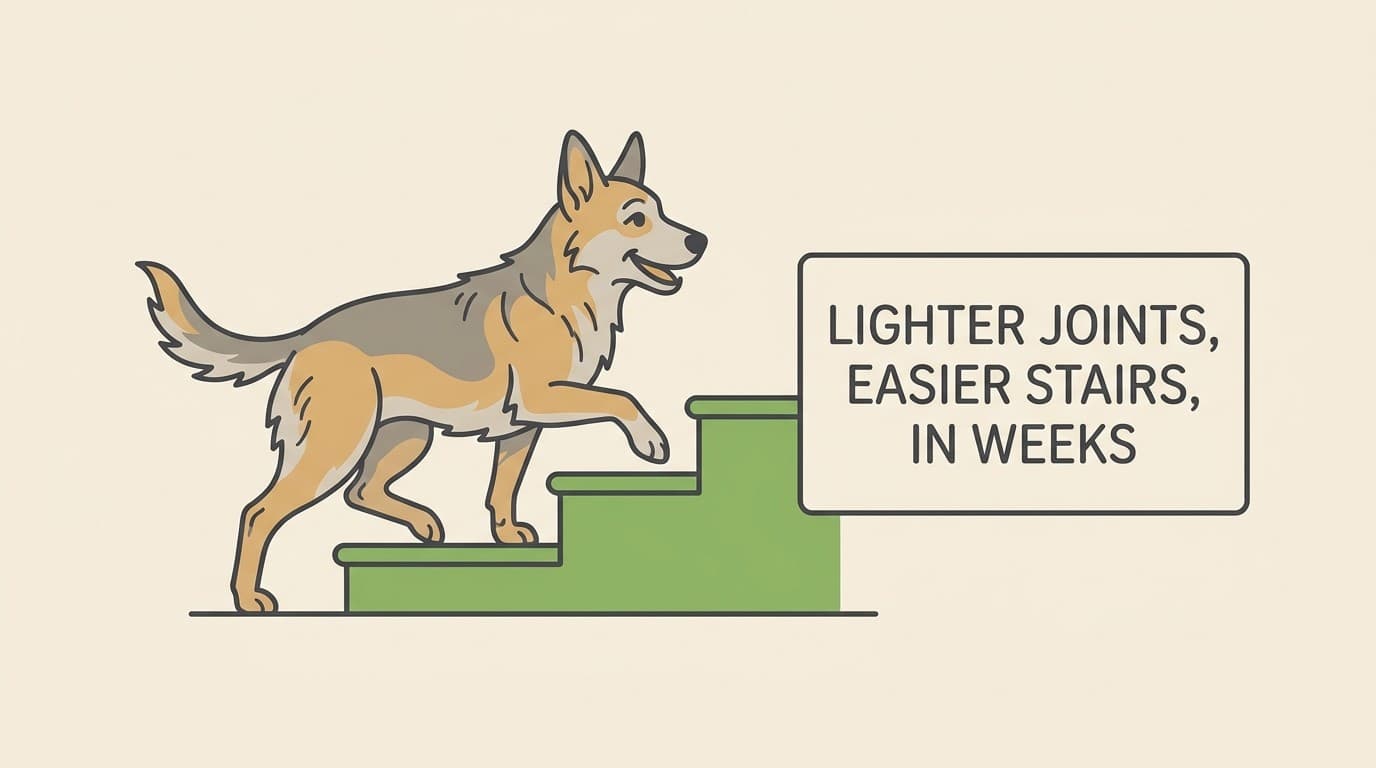
Let's start where it actually matters. The reward for slimming an arthritic pet isn't an abstract "they'll live longer". It's that they move better, and soon. Owners often notice a difference within weeks: back up the stairs without that pause at the bottom, into the car without the run-up, onto the sofa again, finishing the walk they'd been turning round halfway through.
That's the prize. A stiff, sore dog who can get going again. A cat who jumps back up to the windowsill she'd quietly given up on. We lead with this on purpose, because it's the thing that genuinely motivates people, far more than any number on a chart about lifespan.
One more thing before we go further. If your pet is overweight, you are in very normal company. Over half of UK dogs and cats are above their ideal weight. The gain creeps on slowly, it's genuinely hard to see on your own pet, and the begging face that helped put it there is biology, not bad ownership. This isn't a telling-off. It's the most useful lever you've got, and it's entirely in your hands.
Weight hurts joints twice over
There's a part of this most owners never hear. Extra weight doesn't just press down on sore joints, although it does that too. It harms joints in two separate ways.
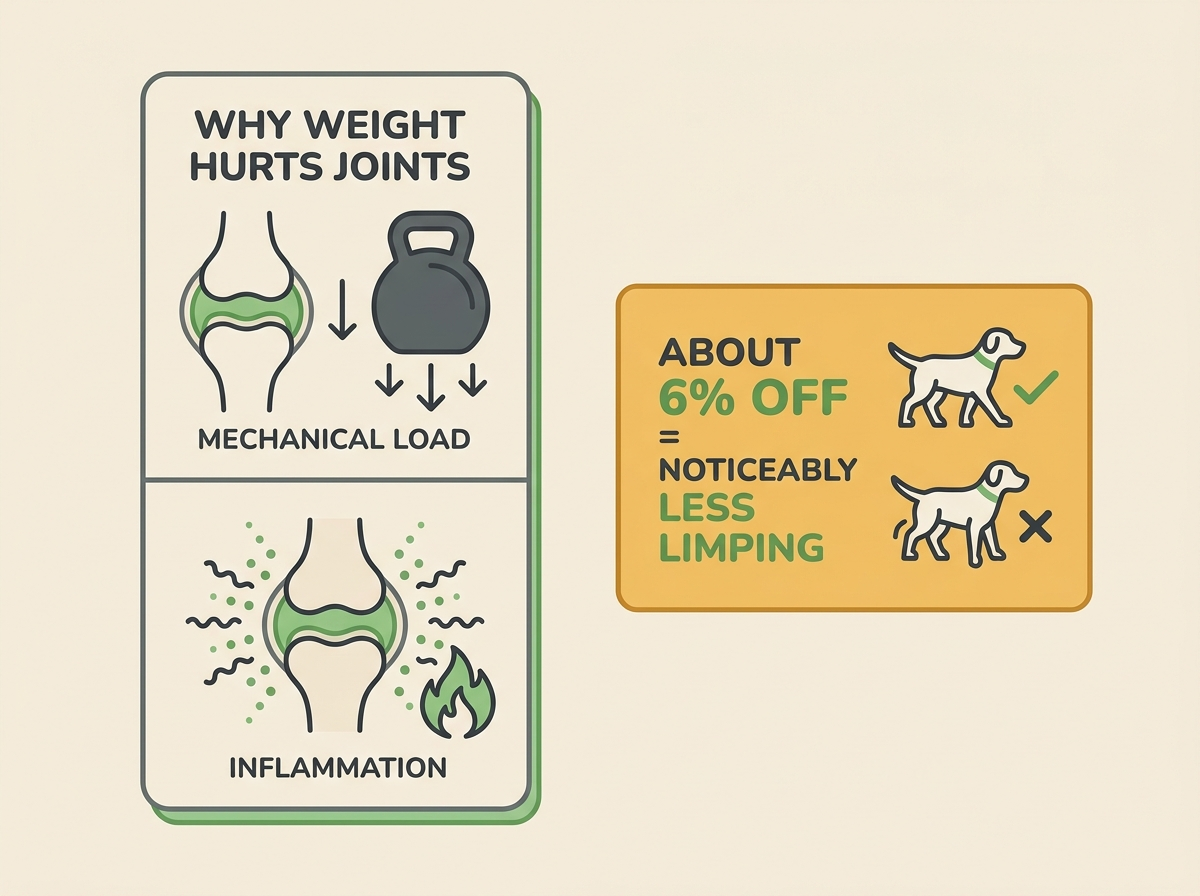
The first is the obvious one: load. Every extra pound is more force going through hips, knees and elbows that are already worn and inflamed. On a frame that's hurting, less weight to carry means less pain with every step.
The second is the one almost nobody knows about. Body fat isn't an inert cushion sitting quietly under the skin. It's an active organ that pumps out inflammatory signals of its own. Fat tissue is now recognised as a hormone-producing organ, releasing a stream of inflammatory messengers (German et al., 2010). So an overweight pet is running a low, simmering level of inflammation everywhere, all the time, and that adds to the inflammation already grinding away in an arthritic joint.
That's why losing weight does more than any supplement can. You're not just lightening the load on the joint, you're turning down the background inflammation feeding the pain. It also means that any pain relief your pet is prescribed has a better chance of working. The same medication does more on a lighter, less inflamed frame. To be clear, slimming doesn't replace prescribed pain relief, and you shouldn't stop anything your vet has put your pet on. It makes that pain relief work better.
The number worth pinning to the fridge: about 6%
Here's the figure to hold on to. Losing as little as about 6% of body weight gives a measurable improvement in lameness.
That comes from a study of overweight dogs with diagnosed arthritis, put on a controlled weight-loss diet and assessed over sixteen weeks. Lameness improved significantly once the dogs had lost around 6% of their body weight, and the researchers concluded that weight loss should be treated as an important arthritis treatment in its own right (Marshall et al., 2010). A separate study of dogs with hip arthritis found the same direction of travel: weight reduction alone produced a substantial improvement in lameness (Impellizeri et al., 2000).
Six percent is the bit that should give you hope. For a 30kg Labrador that's under 2kg. For a 6kg cat it's under 400g. That's not a dramatic transformation, it's a target most owners can genuinely hit, and the improvement you get back is real and noticeable.
How do you exercise a pet who's too sore to move?
This is the catch every owner hits, and it's a fair one. The usual advice is "exercise more to lose weight", but your pet is limping. You can't march a sore dog round the block to slim them, and pushing a painful joint can make things worse, not better.
The way out of the loop is this: most of the weight comes off through the bowl, not the lead. Veterinary weight-management guidance is clear that the calorie side, the food going in, is the foundation of weight loss, with activity as a helpful supporting partner (Cline et al., 2021). That's genuinely good news for a sore pet, because it means you can start slimming them straight away, before they're moving freely. You don't have to wait until they can exercise.
And it tends to snowball in your favour. As the weight comes off, the joints hurt less, so moving gets easier, so they do a little more, which helps the weight come off, and so on. Diet does the heavy lifting first; gentle, joint-kind movement follows once they're more comfortable. If your pet's mobility is genuinely limited by arthritis, heart trouble or age, there's a whole approach to slimming them without relying on exercise, and we cover it in slimming when exercise is limited.
The best part is what this lever costs you: very often, nothing extra. You can usually just measure and cut back the food you already buy, feeding to your pet's target weight rather than the weight they are now. A prescription weight-loss diet is one useful option, not a requirement, and we'll come back to when it's worth it. For most owners the first move is simply working out how much your pet actually needs and weighing it out, which is exactly what the Feeding Calculator is for.
A note for cat owners
Almost all the hard lameness evidence above comes from dogs, and it's only fair to say so. But the logic carries straight over to cats. The mechanics are the same, the inflammatory fat is the same, and a lean cat moves better than a heavy one. Feline arthritis is badly underdiagnosed precisely because cats hide it, so a stiff older cat who's stopped jumping up is very often a sore one, and weight is part of that picture.
The one rule that's different for cats: slimming has to be slow and food must never be withdrawn. Cats can't be crash-dieted the way the internet sometimes implies. Cutting a cat's food too hard, or a cat going off its food, can trigger a dangerous liver condition. Aim for slow, steady loss, and treat a cat who refuses food for 24 to 48 hours as a same-day emergency, not a successful diet. We walk through the safe way to do it in never crash-diet a cat.
And yes, they'll probably live longer too
There is a longevity payoff, and it's a good one. It just isn't the headline. In a long-running study that followed Labradors through their whole lives, the leaner-fed dogs lived a median of about 1.8 years longer than their overweight littermates, and developed arthritis later (Kealy et al., 2002).
Nearly two extra years, and more of those years spent comfortable rather than stiff. But file it as a bonus, not the reason. The reason is the dog who trots up the stairs again next month, and the cat back on the windowsill. That's the prize you're actually playing for.
If you want to know exactly how that extra weight is loading the joints, the Arthritis hub goes deep on managing the condition itself, and the 2-Minute Mobility Check gives you a clear read on how your pet is moving right now, so you've got a baseline to beat. When you're ready to act on the weight, how much should I actually feed? and the Feeding Calculator turn the plan into real grams of your own food, and the Healthy Weight Tracker plots the trend so you can watch them get lighter, and watch them move better with it.
References
- German AJ, Ryan VH, German AC, Wood IS, Trayhurn P, et al. (2010). Obesity, its associated disorders and the role of inflammatory adipokines in companion animals. The Veterinary Journal.
- Marshall WG, Hazewinkel HAW, Mullen D, De Meyer G, Baert K, Carmichael S, et al. (2010). The effect of weight loss on lameness in obese dogs with osteoarthritis. Veterinary Research Communications.
- Impellizeri JA, Tetrick MA, Muir P, et al. (2000). Effect of weight reduction on clinical signs of lameness in dogs with hip osteoarthritis. Journal of the American Veterinary Medical Association.
- Cline MG, Burns KM, Coe JB, et al. (2021). 2021 AAHA Nutrition and Weight Management Guidelines for Dogs and Cats. Journal of the American Animal Hospital Association.
- Kealy RD, Lawler DF, Ballam JM, et al. (2002). Effects of diet restriction on life span and age-related changes in dogs. Journal of the American Veterinary Medical Association.
Keep track of how your pet is doing
The owners who cope best are the ones who notice changes early. A simple health log shows you what is working, and what is not, before the next vet visit.
Start tracking, freeYou're not doing this alone
Compare treatment journeys and talk to owners managing weight management. Free to join.
Join PetsLikeMine