

Weighing your pet at home: scales, tricks and how often
Alastair Greenway
BVM&S MRCVS
A weight is feedback, not a verdict
A lot of owners dread the scales, so let's clear that up first. The number isn't a verdict on you, and it isn't a monthly telling-off. It's feedback. Used properly, it's the single most reassuring tool you've got, because it's proof you're feeding enough and permission to hold the line against the begging face.
Most owners get this backwards. They weigh, they feel judged by the figure, and they stop weighing. But a weight you can trust does two quiet jobs at once. It tells you the plan is working when your eyes can't, because we all acclimatise to our own pet, and to a "normal" that's slowly drifted heavier. And on the days the begging is relentless and you're wondering whether you're being cruel, it's the evidence that you're not: a steady or gently falling weight on a measured ration is your pet telling you they're fine.
One caveat up front. A weight in kilograms only means something against your own pet's trend. Breeds vary enormously, ideal weights aren't one-size-fits-all, and a single figure tells you very little, which is exactly why the hands-on body condition score matters too, more on that later. So the goal here isn't a magic number. It's a weight you can compare, fairly, week after week, and that really comes down to consistency, so the change you see is real change and not the method wobbling.
Big dogs: stand them on the scales
Let's start with the easy case. A dog that'll stand reasonably still can go straight onto a flat platform or floor scale, and you read the number off. No tricks needed.
The gold-standard version of this is free, and it's at your vet's. Most clinics have a large walk-on scale in the waiting room, and the great majority are perfectly happy for you to drop in and use it between appointments. It's accurate, it's the same scale every time if you always use that practice, and it turns a stiff or wriggly big dog into a five-second job. For a Labrador or any Lab-sized dog, this is the best option going. Ring ahead the first time to check it's fine, then make it a habit.
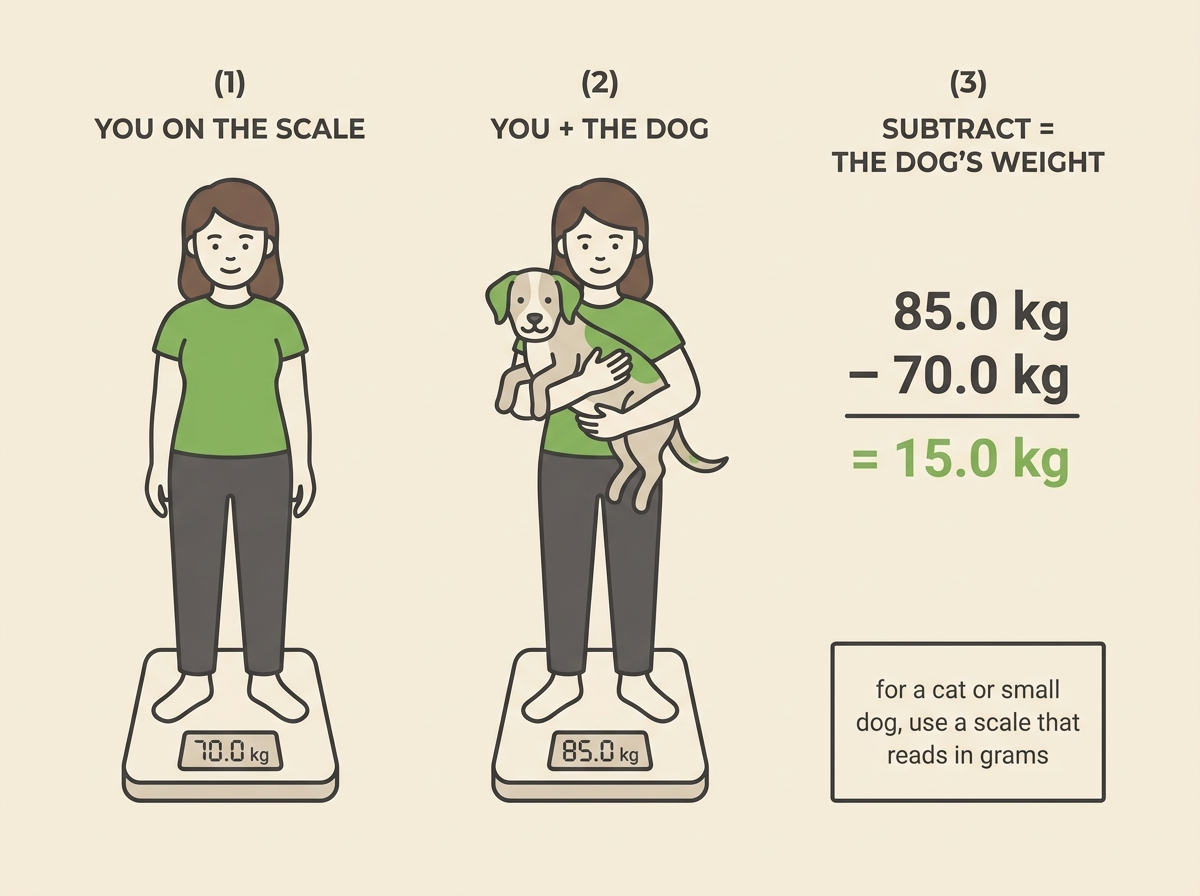
At home, the problem with a big dog is simply lifting them. If your dog is too heavy to pick up safely, use the weigh-by-difference trick on your own bathroom scales: stand on the scale alone and note your weight, then pick the dog up (or have them held), read the new figure, and subtract the first from the second. The difference is the dog.
It works, and for a big dog's trend it's good enough. But be clear about its limits. You're reading a small difference between two larger numbers, on a scale with its own margin of error, while holding a moving animal. For a 30kg dog losing weight slowly, that's fine. For a Chihuahua, it's hopeless: the wobble in the method is bigger than the change you're trying to measure. If your dog is small, skip straight to the next section.
Cats and small dogs: the difference trick and better scales
Here's the precision problem. For a 5kg cat, half a pound either way is a meaningful change, but a human bathroom scale can't reliably see a change that small. When researchers tested home bathroom scales against certified calibration weights, digital scales did well, but older dial scales were significantly out, and even a good scale's normal margin of error is a sizeable fraction of a small cat's whole healthy weight (Yorkin et al., 2013). Stand a 5kg cat on a scale built for an 80kg adult and you're asking it to spot a rounding error.
So for cats and small dogs, the bathroom scale and the weigh-yourself-holding-them method are the least precise option you've got. Reach instead for one of two better home methods.
The first costs nothing extra: the carrier or tare trick. Weigh the empty carrier (or a basket, or a folded towel) and note it, then put your cat inside, weigh the lot, and subtract the empty weight. Better still, if your scale has a tare or zero button, sit the empty carrier on the scale, press tare so it reads zero, then add the cat and read their weight straight off with no maths at all (Exclusively Cats Veterinary Hospital, 2023). A carrier is ideal because most cats settle in one, and a cat that feels secure stays still long enough for a reading.
The second is the single best buy for a cat or small dog, and it's cheap: a digital scale that reads in grams. A baby scale, a kitchen scale, or even a little hanging luggage scale will all do it, and they're accurate to grams rather than to the nearest half-kilo (Exclusively Cats Veterinary Hospital, 2023; Hepper, 2023). The better ones pick up changes of just a few grams, exactly the resolution a small pet's trend needs, so a cheap kitchen scale with a folded towel on top will tell you more than any bathroom scale ever could. Don't worry about the brand or anything clever: cheap and "reads in grams" is the whole specification.
How often, and keeping the numbers comparable
Now the question everyone asks: how often? The reassuring answer is that you don't need to weigh daily, and you shouldn't obsess over the day-to-day figure. A pet's weight bounces around from one day to the next for reasons that have nothing to do with fat: gut contents, how much they've drunk, a full bladder, the time of day. That's noise, and chasing it just hides the real picture underneath, which is its own topic, reading the trend rather than the daily figure. Weighing at home about once a week, if it reassures you, is plenty. It's a comfort check, not a clinical test.
The picture that actually matters, and that any change to the ration is based on, comes from the longer trend. Your vet works to a recheck every two to four weeks during active weight loss, easing to monthly once your pet is holding steady, adjusting the food by watching both the weight and the body condition score (AAHA, 2021). Other guidance frames the owner cadence as every one to three months, with a proper condition check at least every three months (Cornell Riney Canine Health Center; APOP). So weigh about weekly at home if it settles your nerves, but judge progress on the two-to-four-week trend.
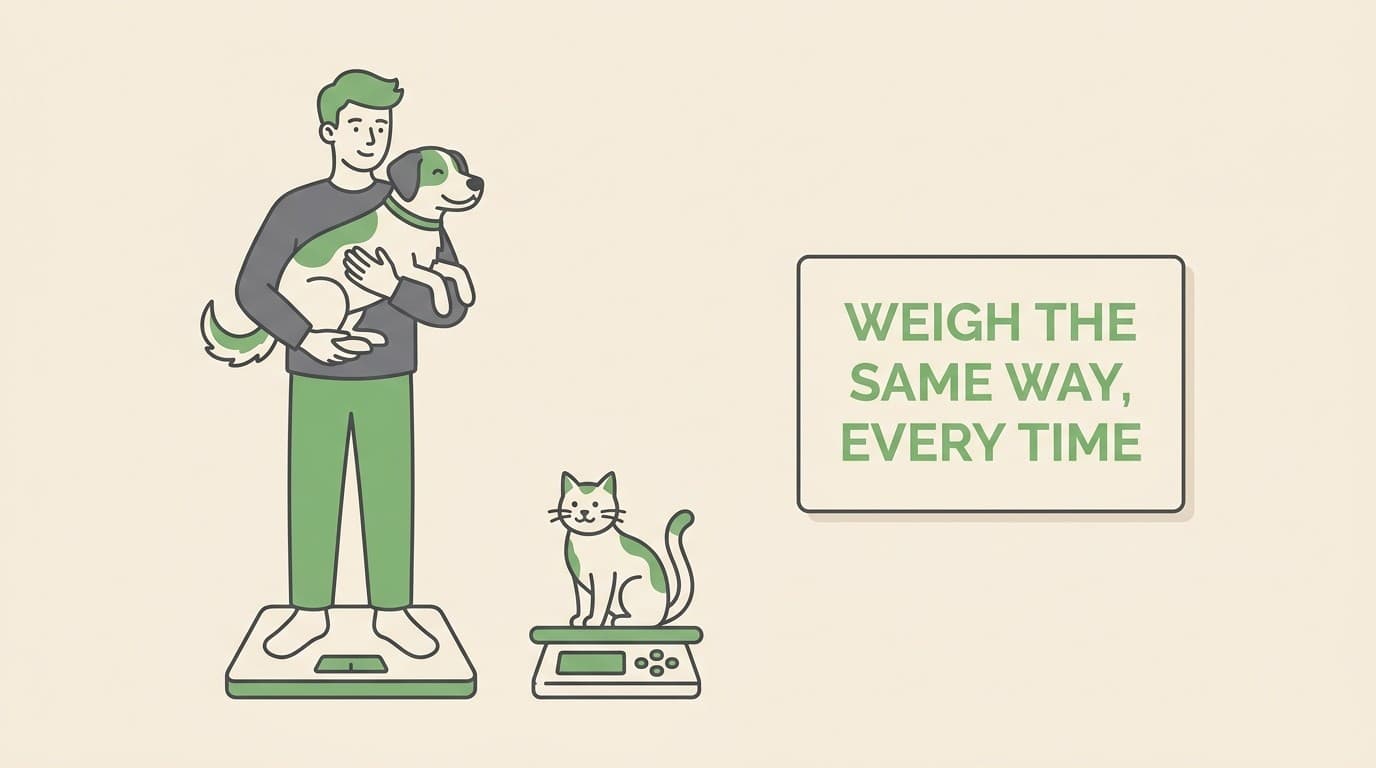
Whatever cadence you pick, one rule makes or breaks the whole thing: weigh the same way every time. The same scale, at the same time of day, before feeding, is what keeps the variability down so the change you see is real (VCA Animal Hospitals). Switch scales, weigh after a big breakfast one week and before it the next, and the wobble in your method will swamp the actual progress. A full stomach and bladder can easily account for more than a week's worth of genuine loss.
And expect a sensible pace, not a crash. A safe rate of loss is about 1 to 2% of body weight a week for a dog, and about 0.5 to 1% a week for a cat: deliberately gentle, because slow loss is both safer and more likely to stick. On a 30kg dog, half a kilo a week is doing well. On a 5kg cat, you're looking for only about 25 to 50 grams a week. Faster isn't better, and for a cat it's a genuine red flag rather than a win, so if the scale is moving quicker than that, ease off rather than pushing harder.
Write it down, or let the tracker do it
A number you don't record is a number you forget, and a single weigh-in on its own tells you almost nothing. It's the run of weigh-ins, lined up over the weeks, that becomes a trend you can read and act on. So write it down: a note on the fridge, a list in your phone, a weight-and-date column, anything you'll come back to in the same place each time. The point is to build the line, because the line is where the answer lives.
Better still, let the Healthy Weight Tracker do the work. It stores each weigh-in alongside the body condition score and a photo, plots the trend, and reads the line so you don't have to. It flags a cat that's losing too fast, spots a plateau, and tells you when the weight is genuinely moving rather than just twitching, keeping you on the trend instead of the daily number.
And pair each weight with two other things: a body condition score and a photo (the how-to for scoring at home is its own short guide). The scale and your hands answer different questions. The scale tells you how much there is; your hands, feeling for ribs and waist, tell you how much of it is fat. A photo taken side-on and top-down in the same spot each time catches changes a number hides. Three months of "she looks about the same" dissolves the moment you put two photos side by side.
When the number worries you
Most of the time, weighed regularly, the scale is the friend that quietly confirms the plan is working. But two patterns are worth knowing, and both call for a level head rather than alarm.
If the line is going up despite sensible, measured feeding, that's not a failure and it's almost never a "slow metabolism". It's a portions-and-treats audit. Re-weigh the food, count the treats properly, and check who else in the house is feeding: the answer is usually a heavier scoop or a generous family member, both very fixable. The food guides and the treat budget are the place to start.
If the line is going down and you didn't put your pet on a diet, that's the one to take seriously. Weight that comes off by itself is a clue, not a win, and it's worth a vet visit to find out why (the warning-sign guide covers what unplanned loss can mean). And one situation deserves a phone call today rather than wait-and-see: a cat that's losing weight quickly, or that's gone off its food, needs a vet now. Cats that stop eating can become genuinely unwell within a day or two, so that's a same-day call, not a Monday-morning one (the feline safety guide explains why).
Beyond those two, the scale is on your side. Weighed the same way and written down so you can see the line, it stops being something to dread and becomes the thing that tells you, week by week, that you're getting it right.
References
- Yorkin RC, et al. (2013). Accuracy and consistency of weights provided by home bathroom scales. BMC Public Health 13:1194.
- Exclusively Cats Veterinary Hospital (2023). Troubleshooting: weighing your cat at home.
- Hepper (2023). How to Weigh a Cat at Home: 5 Vet Approved Tips.
- American Animal Hospital Association (AAHA) (2021). 2021 AAHA Nutrition and Weight Management Guidelines for Dogs and Cats.
- Cornell University Riney Canine Health Center. Obesity and weight management tips.
- Association for Pet Obesity Prevention (APOP). Dog Weight Loss Information.
- VCA Animal Hospitals. Tips for Successful Weight Loss in Dogs and Cats.
Keep track of how your pet is doing
The owners who cope best are the ones who notice changes early. A simple health log shows you what is working, and what is not, before the next vet visit.
Start tracking, freeYou're not doing this alone
Compare treatment journeys and talk to owners managing weight management. Free to join.
Join PetsLikeMine