

Weeing in the House: Telling a Medical Problem from Marking and Behaviour
Alastair Greenway
BVM&S MRCVS
A wet patch by the back door, a puddle on the bath mat, that unmistakable smell off the side of the sofa. When a previously spotless cat or dog starts going in the house, most owners land on the same question underneath the irritation: are they doing this at me? It's a very natural thought, and it's almost always the wrong one.
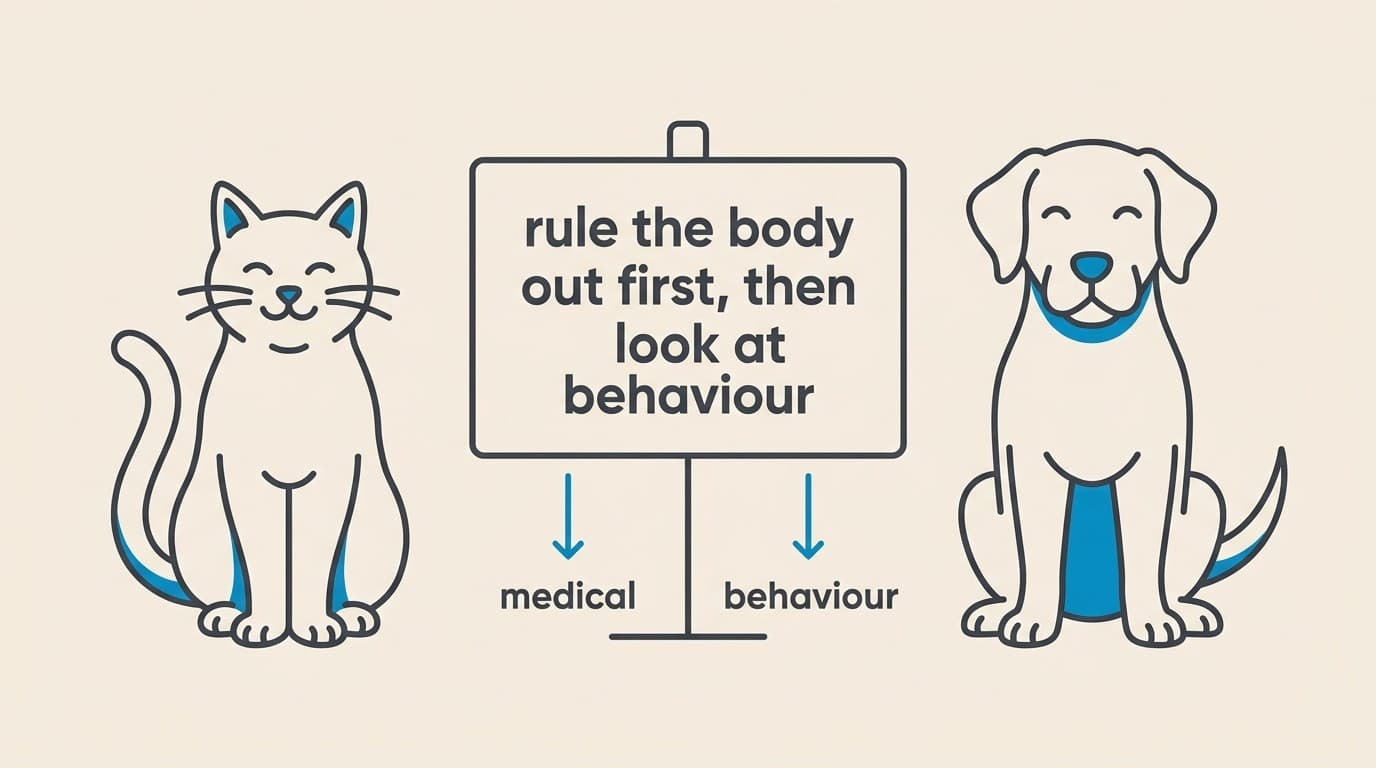
A pet weeing where it shouldn't isn't being spiteful, dirty or vindictive. It's telling you something is off, and the single most important thing to get right is the order you investigate it in. "Weeing in the house" splits into two very different worlds, a medical one and a behavioural one, and the rule that runs this whole space is that you rule the body out first, every time. Get that order wrong and you can spend weeks training a problem that was never about training, while a treatable, sometimes serious, illness goes unaddressed.
Check the body before you call it naughty
One principle sits above everything else here, and it applies to both species: an animal that was reliably clean and has started having accidents needs a medical check before anyone calls it "naughty". The feline behaviour guidelines put it plainly, that any cat house-soiling should have a thorough medical evaluation before a behavioural diagnosis is reached, and that the behaviour is "not due to spite or anger towards the owner, but because the cat's physical, social or medical needs are not being met" (AAFP/ISFM House-Soiling Guidelines, Carney et al. 2014). The same logic holds for dogs: a vet should assess any dog that's started soiling, and a medical work-up is specifically indicated for an adult dog that's begun weeing indoors, or a puppy whose house-training just won't stick (Today's Veterinary Practice).
Why? Because a long list of medical problems makes a pet wee more often, more urgently, more painfully, or with less control, and any of those can show up as a puddle in the wrong place. In cats the usual suspects are feline idiopathic cystitis (the stress-linked, sterile bladder inflammation we cover in feline idiopathic cystitis), bladder stones, and, less often than people think, a true infection (the full story is in "is it a UTI?"). In dogs it's a urine infection, stones, a weakening bladder-neck muscle in a spayed bitch, or drinking and weeing far more than usual because something bigger is brewing. The thread running through all of them: telling your pet off won't fix a body that's misbehaving, and it can make a frightened animal a great deal worse.
So the first move isn't a behaviourist or a spray bottle. It's a vet visit and a urine sample. Our guide on how to describe urinary signs to your vet and the urine sample collection how-to download make that visit far more useful.
When a straining male cat can't wait
Before we go any further, one hard line that overrides this entire page. If the "accident" is a male cat going to the tray over and over, straining, crying, and passing little or nothing, that is not a behaviour problem and it is not a fussy-toileting problem. It can be a urethral blockage, a genuine emergency that can be fatal within about a day, and it needs a vet today, out of hours if needed. Don't wait to see if he settles, and don't assume he's sulking about a dirty tray. Read is this an emergency? straight away, or run our Blocked-Cat triage tool, if that sounds like your cat. Everything else on this page can wait for a normal appointment. That cannot.
Cats: pain in the bladder often reads as "going off the tray"
For cats specifically, there's a link that catches owners out, because it makes a medical problem look exactly like a behavioural one. When a cat's bladder hurts, the discomfort tends to strike while it's in the tray, and cats are quick to blame the place rather than the body. So a cat with cystitis or stones starts weeing on the cool tiles, in the bath, or on a pile of washing, not because it's protesting, but because it's formed a "this spot hurts me" association with the litter tray. As the feline behaviour literature puts it, FIC should always be considered, because pain on passing urine can create negative associations with the litter box and drive the cat to go elsewhere (Heath 2019). That's why a cat suddenly avoiding the tray earns a urine test before a litter overhaul.
Indoor elimination is, for what it's worth, one of the commonest reasons cat owners ever seek behavioural help (Heath 2019), and a leading reason cats are given up to shelters (AAFP/ISFM, Carney et al. 2014), so if you're at the end of your tether, you're in very large company. Once your vet has cleared the body, the feline behaviour picture sorts into two genuinely different things, and telling them apart changes everything you do next.
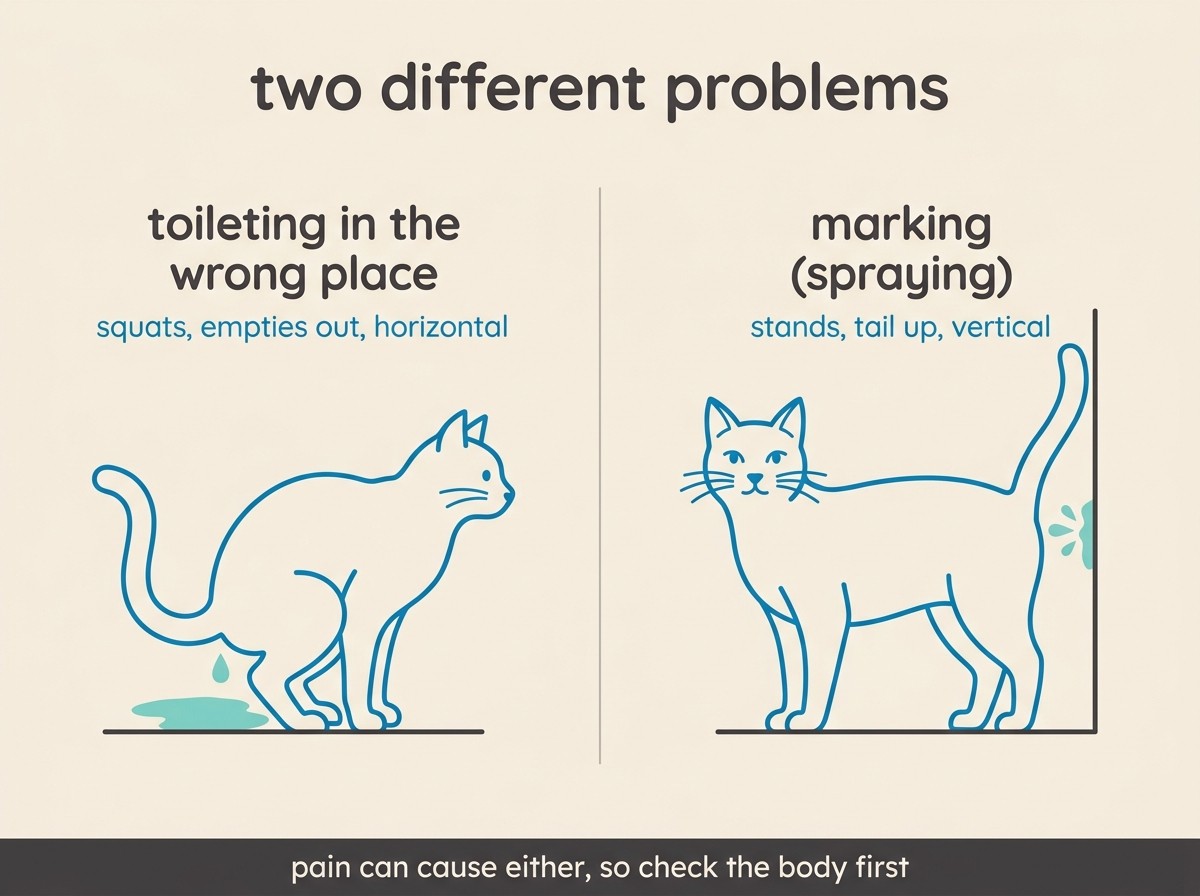
Toileting in the wrong place (inappropriate elimination). This is a cat emptying its bladder, squatting in the normal toileting posture, on horizontal surfaces, just not in the tray. It usually points at something about the litter set-up the cat dislikes: a tray that's too dirty, in the wrong place, the wrong type, or a litter it finds unpleasant. A telling sign is a cat that balances on the very edge of the tray with one or two feet in, or stops digging and covering, which suggests it doesn't like the litter or the soiled box (AAFP/ISFM, Carney et al. 2014).
Marking (spraying). This is communication, not toileting, and it looks completely different. A spraying cat backs up to a vertical surface, stands tall with its tail upright and quivering, and deposits a small squirt of urine, often while still using its tray perfectly normally for actual wees (AAFP/ISFM, Carney et al. 2014; VCA). Marking is most common in entire (un-neutered) cats, and neutering stops or greatly reduces it in most. Even so, around one in ten neutered males and roughly one in twenty spayed females will still mark, usually when something's winding them up, a new cat, tension in a multi-cat home, or the sight of a strange cat through the window (VCA). The trigger is stress and territory, which is why the answer is rarely punishment and usually about reducing the threat.
Helpfully, the same litter-tray rules that calm a cystitis cat also fix most fussy-toileting: one tray per cat plus one spare, spread around the home rather than lined up in a row, big and uncovered, filled with a fine, unscented clumping litter and scooped daily, kept away from food, water and noisy appliances (AAFP/ISFM, Carney et al. 2014). Cat litter, as the guidelines drily note, is marketed to people, not to cats. We walk through the full set-up, plus the wider stress-reduction that settles a marking cat, in managing FIC with MEMO, and the FIC home-care and MEMO checklist download lays it out as a tick-list.
Dogs: house-training, marking, or a wee they can't help
Dogs split a similar way once the vet has ruled out an infection, stones, a leak or excess thirst. There are a few distinct behavioural patterns, and again, each needs a different response (Today's Veterinary Practice).
Incomplete house-training. Common in puppies and in rehomed adults who never fully learned, or who picked up a preference for going indoors because outdoor chances were too few. The fix is patient, consistent training and frequent trips out, not telling off after the event.
Marking. As in cats, this is small dabs of urine on upright surfaces to leave a message, classically more common in entire males, though neutered males and spayed females do it too (Today's Veterinary Practice). The small volume and the vertical target are the giveaways that this is communication, not a full toilet trip.
Submissive and excitement weeing. A dog that dribbles when greeted, fussed, reached over, or told off isn't being disobedient, it's an appeasement reflex, often with a lowered head and tail. The crucial point: punishment makes submissive weeing worse, not better, because it adds exactly the pressure that triggers it (Today's Veterinary Practice). These usually ease with calm, low-key greetings and time, and most puppies grow out of them.
Watch too for a senior-dog twist that's easy to mistake for stubbornness. An older dog that's started having accidents, especially alongside seeming confused, pacing at night, or getting disorientated in familiar rooms, may be developing canine cognitive dysfunction, the dog version of dementia, where loss of house-training is one of the recognised signs (the "H" in the DISHA pattern: disorientation, interaction changes, sleep-wake disruption, house-soiling and altered activity). It's common and badly under-recognised, with one survey finding around 14% of older dogs affected but only about 2% formally diagnosed, because owners write the changes off as "just old age" (Salvin et al. 2010). It's worth raising with your vet, because there's help available, and because it's a medical change, not a discipline problem.
When "weeing more" means look higher up
One pattern deserves singling out in both species, because it's the one most likely to be hiding a serious illness behind what looks like a toilet-training lapse. If your pet is suddenly drinking a lot more and producing a lot more urine, even a perfectly normal bladder can be overwhelmed and leak or have accidents, especially overnight. But the real question then isn't the bladder at all, it's why is it drinking so much.
In an older cat or dog, that "drinking more, weeing more, maybe losing weight and a bit off" picture points up the urinary tract or further afield, towards kidney disease, diabetes or, in dogs, Cushing's disease, not at a simple bladder or behaviour problem. The bladder is not the kidney, and this is a flag to look past the puddle. If that sounds like your pet, the right next step is a vet check with bloods, not a behaviour plan. Our bladder or kidneys? article covers exactly when urinary signs are really pointing somewhere else, and hands you on to the kidney (CKD) guidance if that's where it leads.
Working out which world you're in
You don't have to solve this alone, and a few days of quiet observation will tell you, and your vet, an enormous amount. Before the appointment, jot down:
- Who and what. Is the pet squatting and emptying out (toileting), standing to dab a vertical surface (marking), or dribbling without seeming to notice (a possible leak, more so in a spayed bitch, see my spayed dog is leaking urine)?
- Where and when. Soft horizontal spots versus walls and furniture; while resting and asleep versus up and active; during greetings or tellings-off.
- What else. Straining, blood, more frequent trips, obvious extra thirst, weight change, or an out-of-sorts animal, all of which push firmly towards the medical side. Any straining male cat passing little or nothing is the emergency above.
Then bring a fresh urine sample if you can. Your vet will examine your pet, run a urinalysis and, where it's warranted, a culture to settle whether there's a genuine infection, check for crystals and blood, and add bloodwork or imaging if the history calls for it (AAFP/ISFM, Carney et al. 2014; Today's Veterinary Practice). If everything comes back clear, that's genuinely useful news, not a dead end: it means the cause really is behavioural or environmental, and now you can tackle the right problem with the right tools.
That's the shape of all of this. Weeing in the house is a message, not a misdemeanour. Rule the body out first, because a surprising amount of it is medical and fixable, and never punish a pet for it, since the commonest behavioural causes, fear, stress and a tray or routine that isn't working, only get worse under pressure. Start with a vet visit and a sample, and if it does turn out to be behaviour, you'll be solving the right problem from solid ground. If you're unsure how urgent your pet's signs are, our Blocked-Cat / Straining-Cat triage tool will help you tell a today problem from a this-week one.
References
- Carney HC, Sadek TP, Curtis TM, et al. *AAFP and ISFM Guidelines for Diagnosing and Solving House-Soiling Behavior in Cats.* Journal of Feline Medicine and Surgery, 2014;16(7):579-598. (Four diagnostic categories of house-soiling; medical evaluation before behavioural diagnosis; marking vs inappropriate elimination posture and surface; litter box aversions and the n+1 / unscented / scoop-daily recommendations; "not due to spite"; house-soiling as a leading reason for relinquishment.) (open-access PDF: https://catvets.com/resource/aafp-isfm-house-soiling-guidelines/)
- Heath S. *Common feline problem behaviours: Unacceptable indoor elimination.* Journal of Feline Medicine and Surgery, 2019;21(3):199-208. (Indoor elimination as a common reason owners seek advice; latrine elimination vs marking; FIC and pain creating negative litter-box associations; full clinical examination as the first step; the five pillars of feline environmental needs.) (open access: https://pmc.ncbi.nlm.nih.gov/articles/PMC11373752/ ; PMID 30810090)
- VCA Animal Hospitals. *Cat Behavior Problems: Marking and Spraying Behavior.* (Spraying posture, vertical surfaces and small volume; commonest in intact males; ~10% of neutered males and ~5% of spayed females continue to mark; multi-cat and outdoor-cat triggers; rule out medical causes.)
- Today's Veterinary Practice. *Canine House Soiling: Back to Basics.* (Medical work-up indicated for adult-onset soiling and refractory puppy soiling; behavioural categories of incomplete house-training, marking, submissive and excitement urination, and separation-related soiling; marking small volume on vertical surfaces, commonest in intact males; punishment worsens submissive urination; cognitive dysfunction in senior dogs.)
- Salvin HE, McGreevy PD, Sachdev PS, Valenzuela MJ. *Under diagnosis of canine cognitive dysfunction: A cross-sectional survey of older companion dogs.* The Veterinary Journal, 2010;184(3):277-281. (Cognitive impairment in ~14.2% of older dogs by questionnaire vs 1.9% diagnosed by a veterinarian; house-soiling / loss of house-training as a sign of canine cognitive dysfunction, the "H" in DISHA.) (PMID 20005753; DOI 10.1016/j.tvjl.2009.11.007)
- International Society for Companion Animal Infectious Diseases (ISCAID). Weese JS, Blondeau J, Boothe D, et al. *ISCAID guidelines for the diagnosis and management of bacterial urinary tract infections in dogs and cats.* The Veterinary Journal, 2019;247:8-25. (Most cats with lower urinary signs do not have bacterial cystitis; primary/bacterial UTI is rare in cats and should not be diagnosed without a positive culture; test before treating.) (open-access PDF: https://www.iscaid.org/guidelines)
- International Cat Care (iCatCare / ISFM). *Feline idiopathic cystitis (FIC) in cats* and *Thinking outside the box: problem urination in cats.* (FIC as a sterile, stress-linked syndrome; litter facility provision; pain-driven litter avoidance.)
Keep track of how your pet is doing
The owners who cope best are the ones who notice changes early. A simple health log shows you what is working, and what is not, before the next vet visit.
Start tracking, freeYou're not doing this alone
Compare treatment journeys and talk to owners managing urinary health. Free to join.
Join PetsLikeMine