

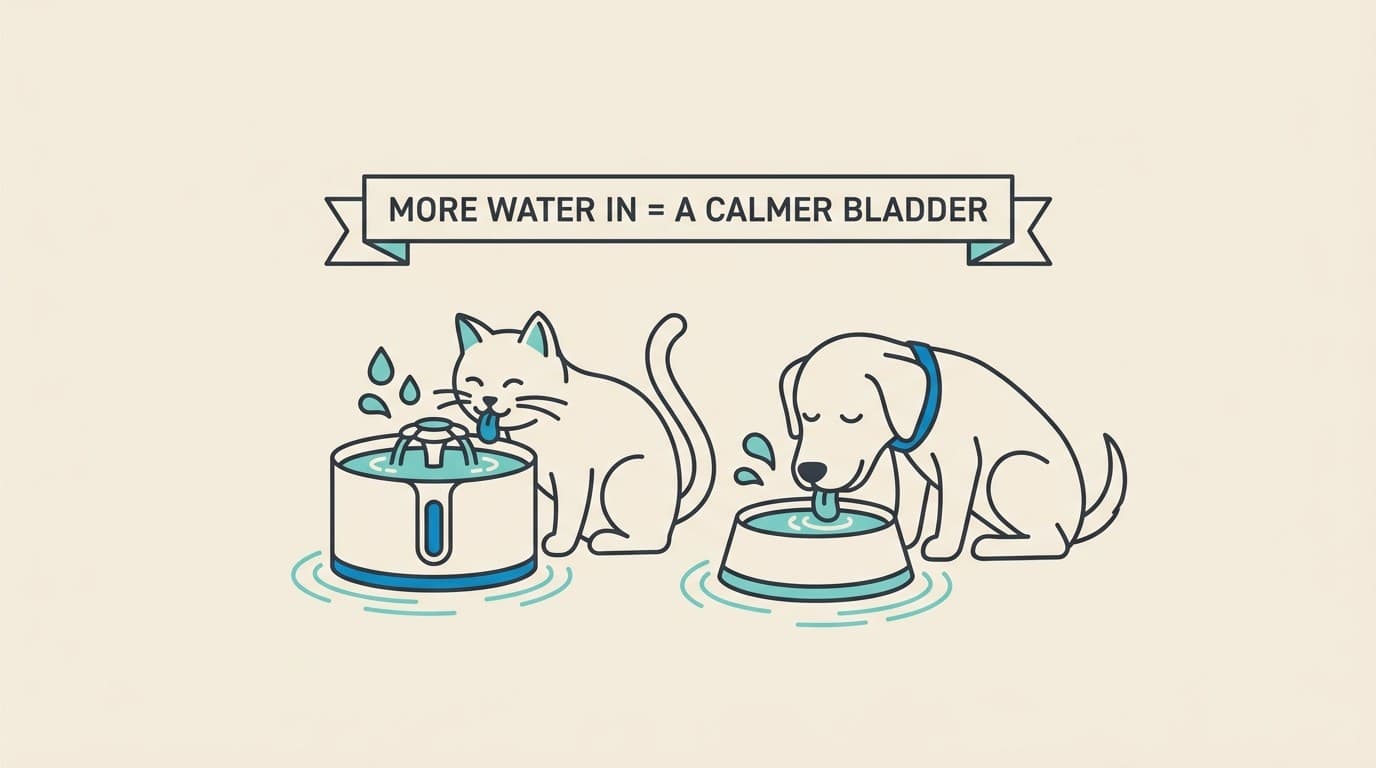
Why Getting More Water in Is the Best Thing You Can Do for Your Pet's Bladder
Alastair Greenway
BVM&S MRCVS
"Get more water into" your cat or dog is one of the first things a vet says after a urinary scare, and it's one of the easiest to dismiss. Cats in particular are famously hopeless drinkers, so it's tempting to file "drink more water" alongside the other vague advice and move on to the real treatment.
Please don't. Across almost everything that goes wrong with a bladder, more water genuinely is the real treatment, or a large part of it. It's the cheapest thing you can do. It's the one lever that helps a sore bladder, a stone-forming bladder and a cat at risk of blocking, and the evidence behind it is better than for most of the supplements and special diets that cost a great deal more. This page is about why that's true, and exactly how to do it.
Water as medicine, not a throwaway tip
The logic is simple, and it's the same whatever the diagnosis. The more water a pet takes in, the more dilute its urine becomes, and the more often it empties its bladder. Dilute urine is gentler on an inflamed bladder lining. It holds the minerals that form crystals and stones in solution instead of letting them drop out, and frequent flushing clears irritants and grit before they can settle. So getting more water in works on three of the commonest problems in this whole space at once.
Take feline idiopathic cystitis (the stress-linked, sterile bladder inflammation that is by far the commonest reason a cat strains, and almost never an infection, more in our feline idiopathic cystitis article). Here, diluting the urine is one of the genuinely evidence-based changes that reduces how often flares come back. In a year-long study, signs of idiopathic cystitis came back in only about 1 in 9 cats fed a wet version of a urinary diet, compared with around 4 in 10 fed the identical food as dry biscuits, because the wet-fed cats produced more dilute urine (Markwell et al., 1999). A more recent study of a therapeutic urinary diet found the same direction of travel (Naarden & Corbee, 2020).
With bladder stones, urine dilution is, as the UC Davis veterinary teaching hospital puts it, likely the single most important factor in preventing them, whatever the stone type, because dilute urine can't hold as much stone-forming material (UC Davis Veterinary Medicine). The expert consensus on stones in dogs and cats says the same, putting increased water intake and high-moisture food at the centre of prevention and setting a target of dilute urine to aim for (Lulich et al., 2016). And it isn't only a pet thing. In people, a classic five-year trial showed that simply drinking more water roughly halved the rate at which kidney stones came back, from about 27% to 12% (Borghi et al., 1996).
And the blocked cat, the male cat whose urethra plugs with grit and mucus (the one true emergency in this space, see is this an emergency?), forms fewer of the crystals and plugs that block the exit when the urine is dilute. That's why "more water" sits at the top of every re-block prevention plan after a cat comes home (more in will it happen again?).
So this isn't a tip to tack on at the end. For most urinary patients it's the foundation everything else is built on.
Wet food is the biggest lever
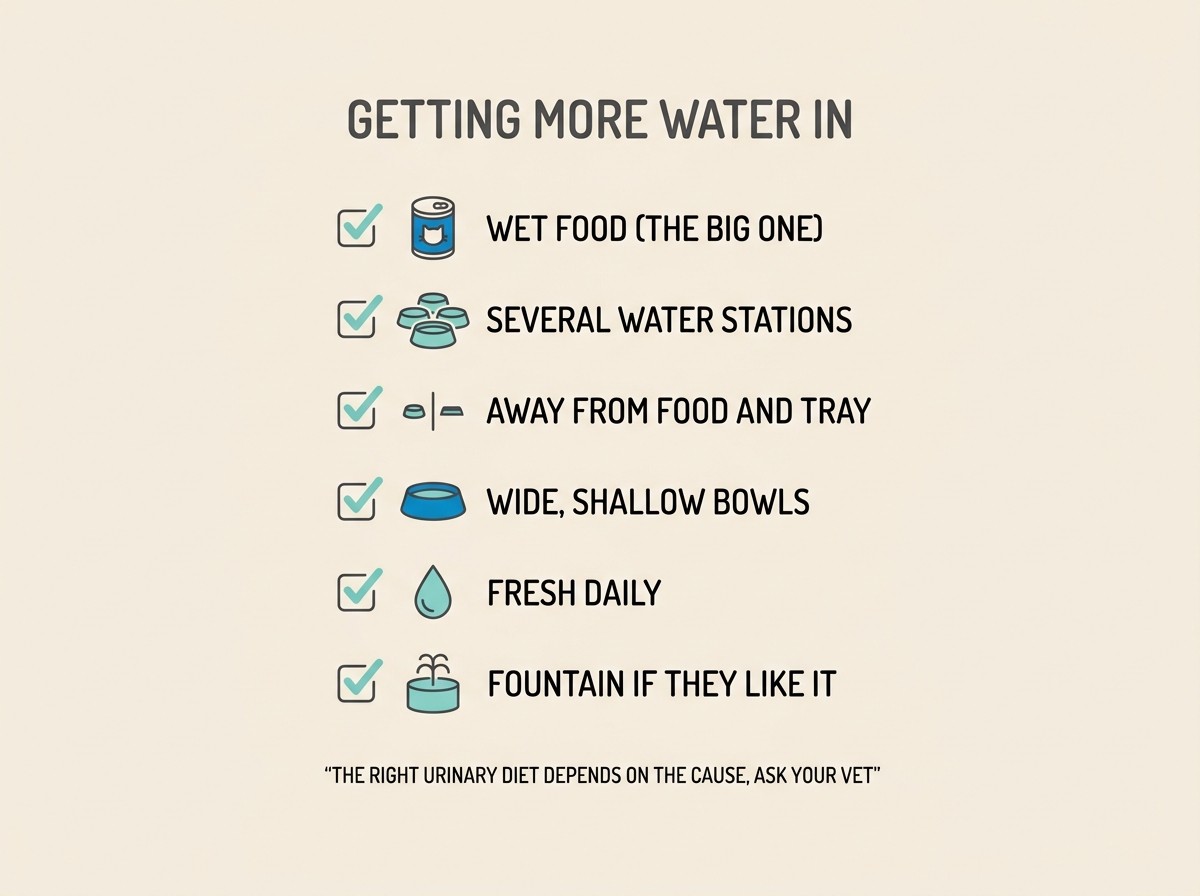
If you change one thing, change this. Wet food (tins, pouches, trays) is roughly 70 to 80% water, while dry biscuits are closer to 8 to 10%. A pet living mainly on dry food has to drink a great deal at the bowl just to break even, and most won't. Shifting some or all of the diet to wet, or simply adding water to it, raises total water intake far more reliably than nagging your pet to visit the bowl (International Cat Care).
That Markwell study above is the clearest illustration: same diet, same minerals, but the wet version produced more dilute urine and a quarter of the recurrences. Wet food does quietly what no fountain or flavouring can match.
If your pet is dry-fed, move across slowly over a week or two, mixing increasing amounts of wet in with the dry so a fussy eater (or a sensitive tummy) has time to adjust. You can also add a tablespoon or two of warm water to wet food to push intake higher still.
Coaxing a reluctant drinker
Wet food does the heavy lifting, but a few small changes to the actual water make a difference too, especially for cats, who can be oddly particular.
- Several water stations, away from the food and the litter tray. Cats instinctively avoid drinking right next to where they eat or toilet, so a bowl tucked beside the food often goes ignored. Spread water around the home, including upstairs.
- Wide, shallow bowls. Many cats dislike their whisker tips brushing the sides of a narrow bowl. A wide ceramic or glass bowl, filled near the brim, is more inviting than a deep plastic one.
- Fresh water, daily. Stale or dusty water is off-putting. A clean bowl topped up daily beats a neglected fountain every time.
- A fountain, if your pet likes moving water, but with realistic expectations. Some cats clearly drink more from a fountain, and the filtration keeps the water fresh. But the evidence is mixed: one study found cats appeared to drink more from a fountain, yet their urine was no more dilute than from a bowl, possibly because a lot of the "extra" was splashing and play rather than swallowing (Grant, 2010). So a fountain is worth trying for a cat who snubs still water, but it's a nice-to-have, not a substitute for wet food. Don't feel you've failed if your cat ignores it.
Cats are individuals, so experiment, and keep whatever your pet actually uses.
What about a special "urinary diet"?
You'll see prescription urinary diets recommended a lot, and for the right pet they earn their place: they're formulated to dilute the urine and to control the minerals and acidity that drive specific problems. But two points the marketing tends to skip.
First, there is no single "urinary diet". The right one depends entirely on the diagnosis. A diet built to dissolve a struvite stone is the wrong diet for preventing a calcium oxalate stone, because the two behave in opposite ways (this is the whole point of our bladder stones article). So a urinary diet is a decision to make with your vet once you know what you're treating, not a tub to grab off the shelf.
Second, the wet version usually beats the dry version of the same diet, for the dilution reasons above. If your vet recommends one, ask whether a wet form is available and suitable.
What to skip, and the one warning to carry
A couple of things to leave on the shelf. Cranberry products and human cystitis sachets are aimed at a bacterial infection, which cats with urinary signs usually don't have in the first place (see "is it a UTI?"), so they're solving a problem your cat probably hasn't got. And don't pile on supplements without advice. More isn't better, and some can shift urine chemistry the wrong way for your particular pet.
There is one genuine exception to the whole "more water" message, and it's why this article covers both species rather than just cats. A leaking spayed dog is different. If your dog is dribbling urine in her sleep, the usual cause is a weak bladder-neck muscle, not a concentration problem, and pushing extra water can simply mean more in the bladder to leak out. That doesn't mean you should restrict her water (never do that without your vet, since drinking more can itself be a sign of other illness). It means water isn't the treatment for that problem. A daily medicine usually is, and it's a very treatable one (see my spayed dog is leaking urine). For everything else on this page, more water is the goal.
Measure it, so you can see it working
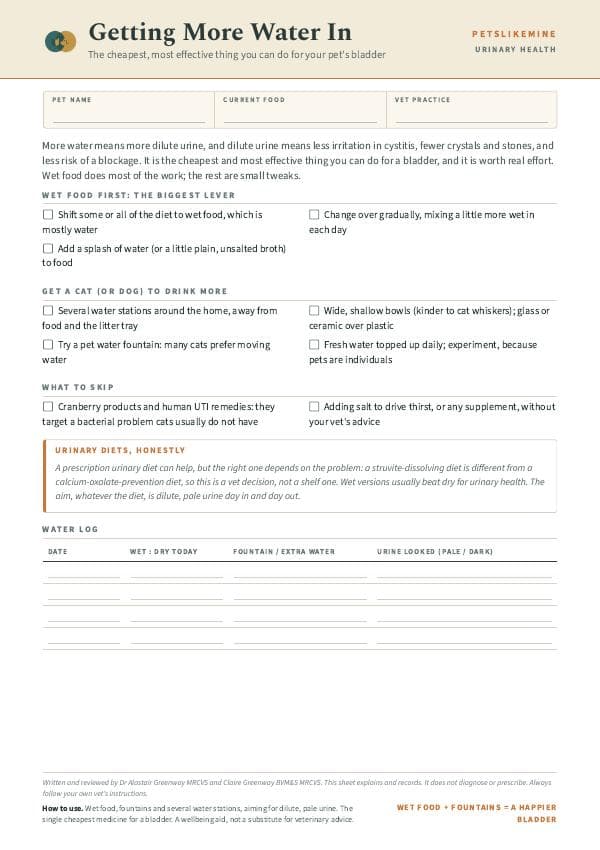
The quiet advantage of getting more water in is that you can watch it pay off. Track roughly how much your pet is taking in, the wet-to-dry ratio, fountain or bowl use, or actual millilitres if you can, alongside any flares or signs, using the FIC Flare & Water-Intake tracker. Over a few weeks you'll often see the two lines move together: intake climbing, flares thinning out. That feedback is genuinely motivating on the days a fussy cat is testing your patience, and it gives your vet something concrete to work with.
If you want it on paper, our water-intake boosting guide has the wet-feeding tips, the bowl and fountain tricks and some rough intake targets in one printable place. Start with the wet food, add a couple of water stations, and give it a fortnight. For most bladders, it's the single most useful thing you'll do, and it costs next to nothing.
References
- International Cat Care (iCatCare/ISFM). *Feline idiopathic cystitis (FIC) in cats* (multimodal management; wet diet and increasing water intake to dilute urine).
- International Cat Care (iCatCare/ISFM). *How to encourage your cat to drink* (wet food, water-station placement, bowl type, fountains).
- Markwell PJ, Buffington CA, Chew DJ, Kendall MS, Harte JG, DiBartola SP. *Clinical evaluation of commercially available urinary acidification diets in the management of idiopathic cystitis in cats.* Journal of the American Veterinary Medical Association, 1999;214(3):361-365. PMID: 10023397. (Signs did not recur in 16/18 cats fed the canned diet vs 17/28 fed the dry diet; the moist diet produced more dilute urine.)
- Naarden B, Corbee RJ. *The effect of a therapeutic urinary stress diet on the short-term recurrence of feline idiopathic cystitis.* Veterinary Medicine and Science, 2020;6(1):32-38. doi:10.1002/vms3.197.
- Lulich JP, Berent AC, Adams LG, Westropp JL, Bartges JW, Osborne CA. *ACVIM Small Animal Consensus Recommendations on the Treatment and Prevention of Uroliths in Dogs and Cats.* Journal of Veterinary Internal Medicine, 2016;30(5):1564-1574. PMID: 27611724. doi:10.1111/jvim.14559. (Increasing water intake and feeding moist food central to urolith prevention.)
- University of California, Davis, School of Veterinary Medicine. *Nutritional Management of Uroliths* (urine dilution as likely the most important factor in prevention; moisture and specific-gravity targets).
- Borghi L, Meschi T, Amato F, Briganti A, Novarini A, Giannini A. *Urinary volume, water and recurrences in idiopathic calcium nephrolithiasis: a 5-year randomized prospective study.* The Journal of Urology, 1996;155(3):839-843. PMID: 8632203. (Human RCT: increased water intake reduced 5-year stone recurrence from ~27% to ~12%.)
- Grant DC. *Effect of water source on intake and urine concentration in healthy cats.* Journal of Feline Medicine and Surgery, 2010;12(6):431-434. doi:10.1016/j.jfms.2009.10.008. (Measured intake higher from a fountain, but urine concentration not significantly different; does not support replacing a bowl with a fountain to dilute urine.)
- Weese JS, Blondeau J, Boothe D, et al. *International Society for Companion Animal Infectious Diseases (ISCAID) guidelines for the diagnosis and management of bacterial urinary tract infections in dogs and cats.* The Veterinary Journal, 2019;247:8-25. doi:10.1016/j.tvjl.2019.02.008. (True bacterial UTI uncommon in cats; antimicrobials/cranberry not indicated without a confirmed infection.)
- Cornell Feline Health Center. *Feline lower urinary tract disease* (FLUTD ~1-3% of cats per year; water intake and dilution in management).
Free downloads
Companion worksheets to put what you've read into practice. Free PDFs, print at home.
Keep track of how your pet is doing
The owners who cope best are the ones who notice changes early. A simple health log shows you what is working, and what is not, before the next vet visit.
Start tracking, freeYou're not doing this alone
Compare treatment journeys and talk to owners managing urinary health. Free to join.
Join PetsLikeMine