

How to Describe Urinary Signs to Your Vet, and How to Collect a Urine Sample
Alastair Greenway
BVM&S MRCVS
Two things move your pet towards the right treatment faster than almost anything else you can do at home: a clear description of what you've seen, and, if your vet has asked for it, a fresh urine sample to bring along. Both are easy to get wrong by accident, and both are easy to get right with a little preparation. So between booking the appointment and walking through the door, this is where to put your effort.
This page walks you through both. It's written for cat and dog owners alike, with the differences flagged as we go.
First, the one thing that can't wait
One scenario overrides everything else on this page. If you have a male cat who is going to the tray over and over, straining, crying, and passing little or nothing, do not wait to collect a sample and do not wait for your appointment. That can be a urethral obstruction, a blocked bladder, which is a genuine life-threatening emergency and is fatal within about a day if it isn't relieved. It is not constipation, and it is not a simple urine infection. Ring your vet or the emergency service now, tonight, and take your cat straight in. (See [Is this an emergency? The blocked-cat signs you must not wait on], and use the [Blocked-Cat / Straining-Cat triage tool] if you're unsure.)
For everyone else, a comfortable pet who is passing urine but with signs that worry you, read on. A description and a sample are exactly what's needed, and a little preparation goes a long way.
Describing the signs: what your vet is actually listening for
When you sit down with your vet, you'll get asked a string of questions. They aren't random. Each one helps sort the likely cause, because a straining cat could have feline idiopathic cystitis, stones, the start of a block or, much less often, a true infection, and the picture you paint helps point to which. (For the full picture of what's going on, see [My cat is straining in the litter tray: what's going on, and what to do].)
Here's what's worth watching for and noting down before you go.
Is urine actually coming out, and roughly how much? This is the most important single observation. There's a world of difference between a cat or dog who is straining but producing normal-sized puddles or clumps, and one who is straining and producing only a few drops, or nothing. The first has some time; the second, especially in a male cat, is an emergency. If you can, count the clumps in a cat's tray over a day, or note how often your dog is actually emptying versus just posturing.
How often, and how much each time? Lots of tiny wees is different from a few normal ones. Vets call frequent small urinations "pollakiuria", and it's a classic sign of an irritated, inflamed bladder. Tell your vet how many times a day this is, and whether each is a full wee or a dribble.
Is there straining, and does it look painful? Straining (the vet word is "stranguria") and obvious discomfort (crying out, an awkward posture, taking a long time) matter. Note whether the straining comes before, during or after urine appears.
Any blood? A pink tinge, rusty colour, or obvious red all count. Where you see it matters too, blood throughout the wee points somewhere different from a few drops at the end. (See [Blood in your pet's urine: what it means and how worried to be].) If you can photograph the tray or a damp patch on a pale floor, do.
Where is it happening? A cat weeing just outside the tray, or in odd spots around the house, is often telling you the tray has become associated with pain, not that it's being "naughty". Vets call weeing in unusual places "periuria", and it's a real clinical sign, not a behaviour problem to be told off. Note any new spots and when they started. (See [Weeing in the house: telling a medical problem from marking and behaviour].)
Drinking and general health. How much is your pet drinking, and has that changed? Any weight loss, being off food, vomiting, or just not being themselves? This is where the bladder-versus-kidney line gets drawn: a lot more drinking plus weight loss in an older cat points higher up the system, towards the kidneys, and changes the whole conversation. (See [Bladder or kidneys? When urinary signs point higher up].)
When did it start, and is it the first time? A timeline helps enormously. First episode or the fifth? Did anything change in the household, a new pet, building work, a house move, a cattery stay, just before it began? In cats especially, stress is often the trigger, so that detail is genuinely useful.
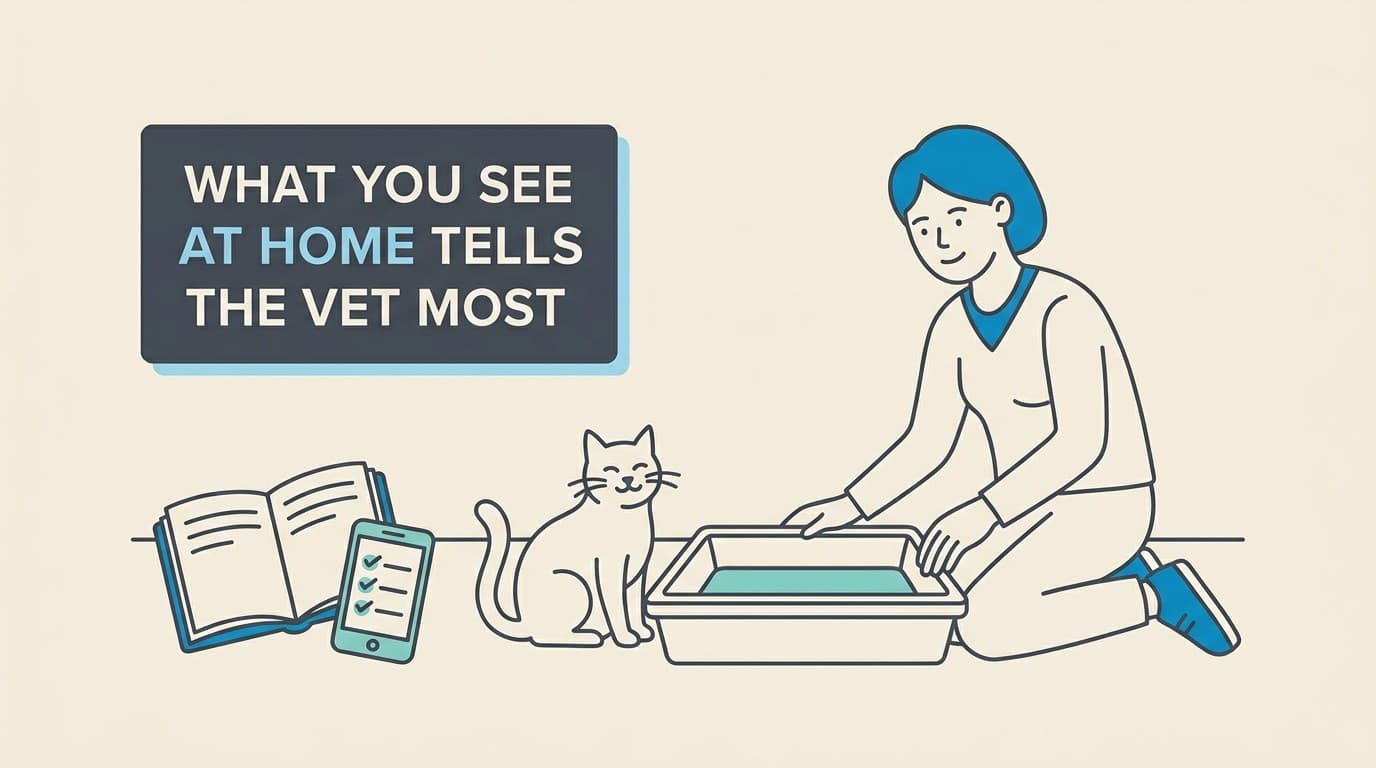
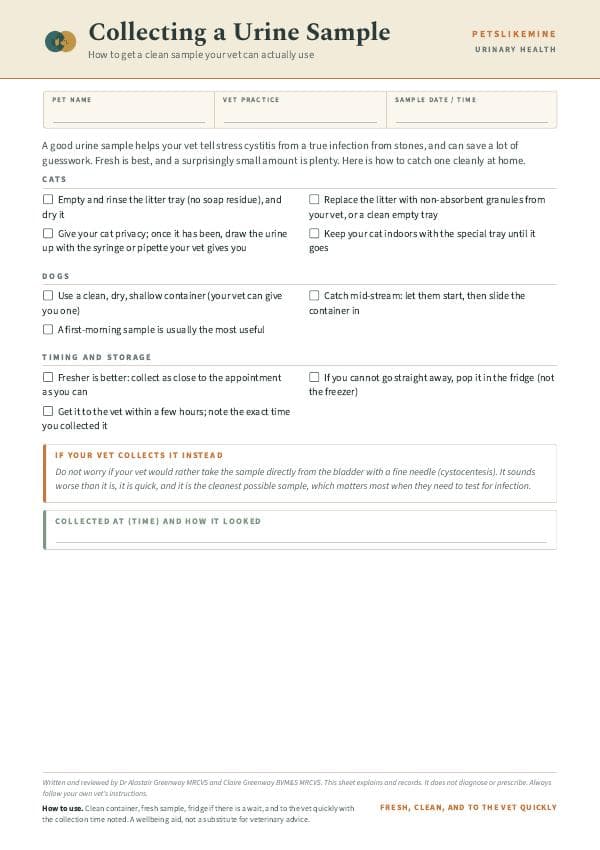
A simple way to capture all of this is to jot a few notes on your phone over a day or two, or to log it in the [FIC Flare & Water-Intake tracker], which is built around exactly these observations and gives your vet a clear record rather than a half-remembered "she's been a bit off". The [urine sample collection how-to download] also includes a short checklist of what to note.
Why your vet wants a sample, and what it tells them
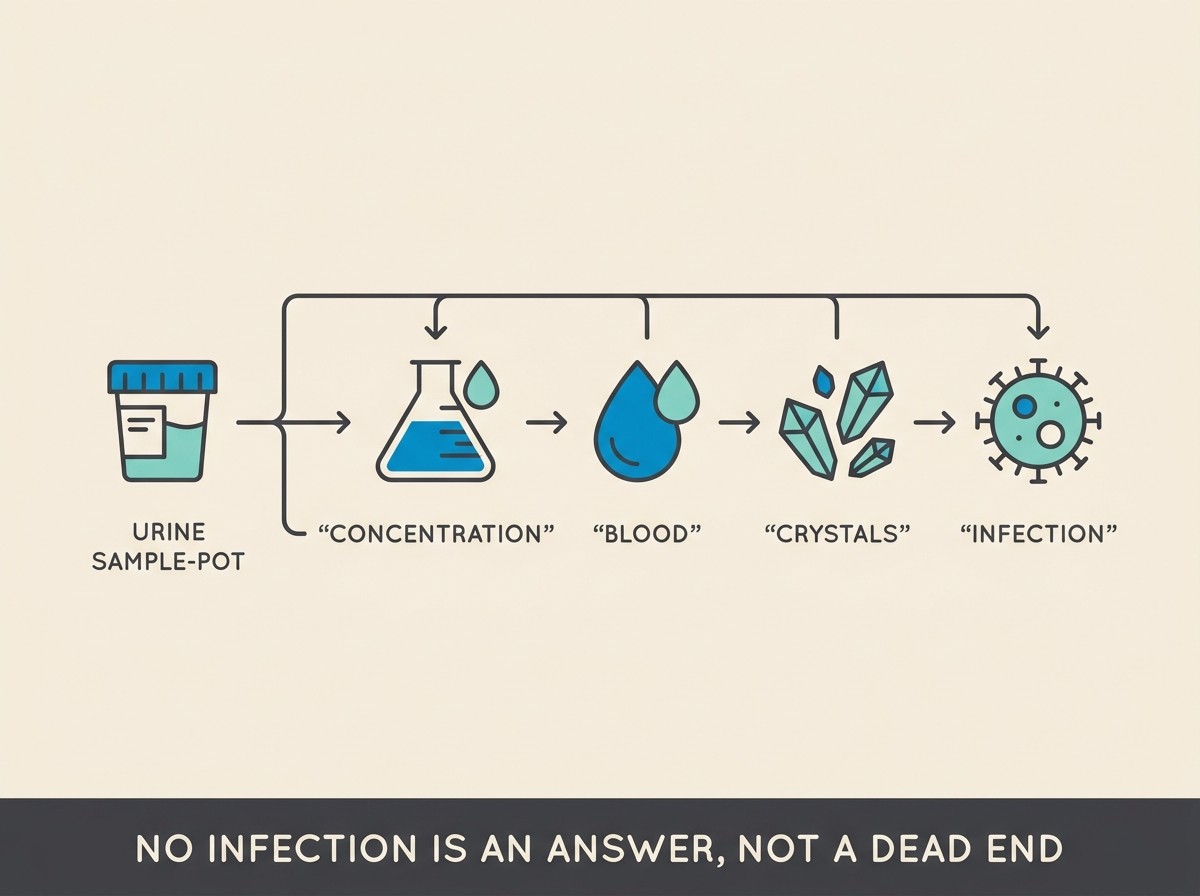
A urine test is one of the most informative, least invasive tests in the whole urinary world. From a few millilitres your vet can read how concentrated the urine is (a window onto the kidneys and hydration), whether there's blood, protein or glucose, the pH, and, under the microscope, whether there are crystals, white cells or bacteria.
That last point is where a sample really earns its keep, because it's how the big myth gets busted. In cats, a true bacterial infection is uncommon: more than 95% of young cats with lower urinary signs have sterile urine, with no infection to treat. Most have feline idiopathic cystitis, a stress-linked, sterile inflammation that is the commonest cause of these signs (somewhere around 54 to 79% of cats across the main studies). So a urine test that comes back showing no infection isn't a dead end, it's the answer, and it's what steers your vet away from antibiotics your cat doesn't need and towards water and environment, which is the real treatment. (See ["Is it a UTI?" Why your cat probably hasn't got one (and your dog might)] and [Feline idiopathic cystitis: why stress gives your cat a sore bladder].)
Dogs are different: they genuinely do get bacterial infections, especially bitches, so in a dog a sample often does point to one, and a culture confirms it and guides which antibiotic.
One thing worth knowing: your vet may want to take the most reliable sample themselves, by gently drawing it straight from the bladder with a fine needle (a "cystocentesis"). It sounds alarming but it's quick, well tolerated, and it's the gold standard for a culture because it avoids the contamination a caught sample picks up on the way out. So don't be surprised, or feel you've wasted your effort, if your vet collects their own as well. A home sample is still valuable for the basic checks and for getting things moving.
Collecting a sample at home: cats
Cats make you work for it, but it's very doable.
- Start with a clean, dry tray. Empty it, wash it with warm water and a little washing-up liquid (no bleach or strong disinfectant), rinse well and dry it completely. Any leftover dirt, chemical or even water can throw the results off.
- Use a non-absorbent litter. The easiest option is a purpose-made non-absorbent litter from your vet or online (brands like Katkor, NoSorb or Kit4Cat). No luck getting hold of any? Improvise with washed and dried aquarium gravel, clean plastic beads or packing pieces, or shredded paper from a glossy magazine (it resists soaking up the wee and doesn't bleed ink like newspaper).
- Put the tray back and wait. Keep an eye on it. As soon as your cat has been, collect the sample as quickly as you can, ideally within 15 to 30 minutes, by drawing the pooled urine up with a clean syringe or a pipette (your vet will usually give you one, along with a sterile pot). Tilting the tray so the urine collects in one corner makes this easier.
- You need less than you think. A vet needs only a small amount, around 6 ml (a bit over a teaspoon) covers analysis and a culture, though more is always welcome.
If you've got more than one cat and can't tell who produced what, shut the patient in a room with the prepared tray for a while, or separate them at the times they usually go.
Collecting a sample at home: dogs
Dogs are usually easier, because you can catch it as it happens.
- Catch it midstream. When your dog squats or cocks a leg, slide a clean, shallow container into the stream. Let the first second or two go past, then collect, the "midstream" portion is cleaner and gives a better result. A long-handled container, a soup ladle, or a shallow tub taped to a stick saves your dignity and your aim, and for a leg-cocker you'll want to come in from the side.
- Aim for the first wee of the morning. It's the most concentrated, so it gives your vet the most to read.
- Use a clean pot, not whatever's to hand. Decant into a sterile container from your vet rather than reusing a food tub or jar; residues in improvised containers can skew the test. Pop the lid on straight away.
- A second pair of hands helps. One person to walk the dog on the lead, one to do the catching, makes the whole thing far less of a comedy. If your dog clams up with you hovering, give them a moment and try again at the next wee.
Getting it to the vet: fresh matters
Urine starts to change the moment it leaves the body, so timing matters more than people expect. Left standing, crystals can form in the sample that were never in your pet, which can mislead the test, and bacteria can multiply and muddy a culture.
- Sooner is better. Ideally the sample is looked at within a couple of hours of collection.
- If there's a delay, refrigerate. Pop the labelled, sealed pot in the fridge (not the freezer) and keep it cool on the way in. As a rule of thumb, get it tested within about 24 hours, and try not to rely on a sample that's been sitting more than a few hours even refrigerated, because the longer it stands, the more those artificial crystals can appear.
- Label it. Your pet's name, the date, and the time you collected it. If your vet asked for a "first morning" sample, note that too.
Don't worry if you simply can't get one. Plenty of cats and dogs refuse to perform on demand, and your vet would far rather see your pet, and take their own sample if needed, than have you miss the appointment chasing a wee. Bring your notes, bring whatever you managed, and let the rest happen at the practice.
The short version
Watch for whether urine is actually coming out and how much, how often, any straining or pain, any blood, where it's happening, and any change in drinking or general health, then either jot it down or log it in the [FIC Flare & Water-Intake tracker]. If your vet wants a sample, use a clean tray and non-absorbent litter for a cat or a midstream catch for a dog, keep it fresh and cool, and get it in within a few hours. And if a male cat is straining and passing nothing, skip all of this and go straight to the vet, that one can't wait. (See [Is this an emergency? The blocked-cat signs you must not wait on] and grab the [urine sample collection how-to download] before your visit.)
References
- PDSA. How to collect a urine sample from your cat.
- Preventive Vet. How to Collect a Cat's Urine Sample (non-absorbent litter options; ~6 ml minimum; collect within 15 to 30 minutes; refrigerate, analyse within 24 hours).
- Preventive Vet. How to Collect Your Dog's Urine Sample (free-catch midstream; morning first void; sterile container; refrigerate and deliver within a couple of hours).
- American Kennel Club. How Do I Collect a Urine Sample From My Dog?
- dvm360. Catch the wave: Urine collection through voiding (midstream technique; first-void concentration; free-catch contamination limits).
- VCA Animal Hospitals. Urinalysis (what a urinalysis tests; crystals can form after collection if analysis is delayed; cystocentesis preferred for culture).
- Clinician's Brief. Performing Cystocentesis in Dogs & Cats (cystocentesis as the sterile sample for culture).
- Today's Veterinary Practice. Current Thoughts on Pathophysiology and Treatment of Feline Idiopathic Cystitis (FIC the most common diagnosis, 54% and 79% across studies; signs resolve within 7 days; diagnosis of exclusion).
- 2025 iCatCare consensus guidelines on the diagnosis and management of lower urinary tract diseases in cats. J Feline Med Surg (FIC the cause in roughly 55 to 65% of cats with lower urinary signs; true bacterial infection uncommon in otherwise-healthy adult cats, under 3%; cystocentesis preferred for culture; urethral obstruction life-threatening with metabolic derangements within 24 to 48 hours).
- Occult bacterial lower urinary tract infections in cats: urinalysis and culture findings. Vet Microbiol. 2009 (bacterial infection of the bladder is commoner in older female cats; supports the species-and-age split behind why young cats with signs are usually sterile).
- Merck Veterinary Manual. Lower Urinary Tract Disease in Cats (FIC commonest cause; urethral obstruction a male-cat emergency; diagnosis of exclusion).
- O'Neill DG, et al. Occurrence and clinical management of urethral obstruction in male cats under primary veterinary care in the United Kingdom in 2016 (UK 1-year incidence ~0.5% in male cats; most deaths within 48 hours of diagnosis). J Vet Intern Med.
- Cooper ES, et al. Treatment strategies for hyperkalemia secondary to urethral obstruction in male cats (hyperkalaemia as the life-threatening mechanism; good prognosis with prompt treatment).
- Albasan H, Lulich JP, Osborne CA, et al. Effects of storage time and temperature on pH, specific gravity, and crystal formation in urine samples from dogs and cats. J Am Vet Med Assoc. 2003;222(2):176-179 (samples should be analysed within 60 minutes of collection; crystals can form artefactually on standing or refrigeration).
Free downloads
Companion worksheets to put what you've read into practice. Free PDFs, print at home.
Keep track of how your pet is doing
The owners who cope best are the ones who notice changes early. A simple health log shows you what is working, and what is not, before the next vet visit.
Start tracking, freeYou're not doing this alone
Compare treatment journeys and talk to owners managing urinary health. Free to join.
Join PetsLikeMine