

The Other Stones: Urate, Cystine and the Breed and Liver Links
Alastair Greenway
BVM&S MRCVS
Most bladder stones are one of two kinds. Across cats and dogs, struvite and calcium oxalate together make up the great majority of all uroliths, and they're the two we cover in detail elsewhere (see "Bladder stones in cats and dogs: the two main types"). A minority are something else, though, and urate and cystine stones are the less-common corner where breed and family history suddenly matter a great deal.
This is the round-up of those other stones. The big principle still holds, the type decides the plan, but with these two the type also tells you something about why your pet formed a stone in the first place. Sometimes that "why" is the thing that actually needs treating, not the stone at all.
Urate stones: the Dalmatian, and the liver shunt
Urate stones (usually ammonium urate, if you see it written down) come from uric acid, a normal waste product of the body's protein chemistry [2]. Most dogs and cats process uric acid so efficiently that almost none reaches the urine. In a urate-forming pet, that handling has gone wrong, and there are two very different reasons it might have.
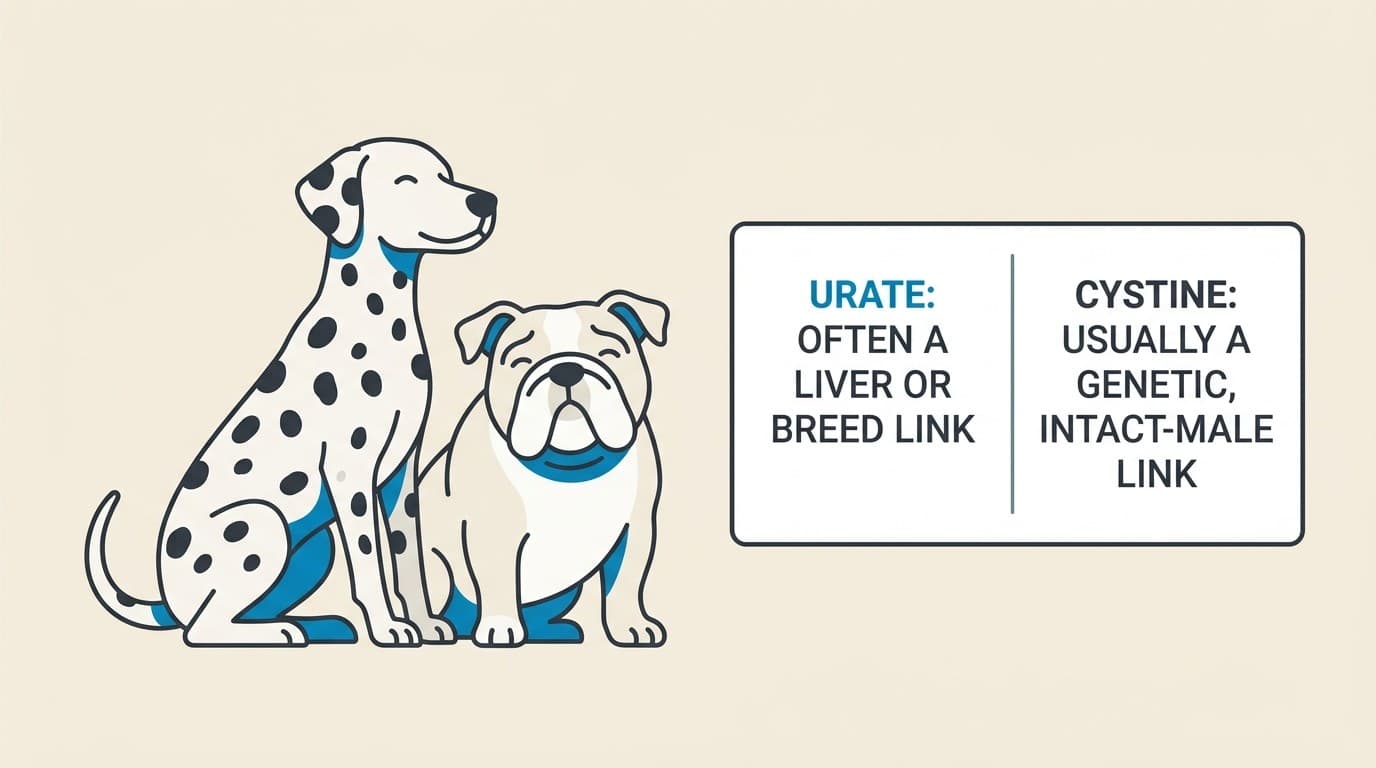
The breed reason. The famous one is the Dalmatian. Dalmatians carry an inherited quirk in how they transport uric acid, traced to a variant in a gene called SLC2A9, and it's so woven into the breed that essentially every Dalmatian carries it [1][2][4]. Not every Dalmatian forms stones, but the breed runs a serum uric acid level several times higher than other dogs, which is why urate is the Dalmatian stone. The variant is recessive, meaning a dog needs two copies to be at risk, and it's now testable, which matters for breeding [1][4]. The same mutation turns up in other breeds too, most notably the English Bulldog and the Black Russian Terrier [2][4]. As ever, the dangerous part is overwhelmingly a male problem, because a male's long, narrow urethra is where a stone gets stuck. Among Dalmatians who form urate stones, the great majority are male (around 97%, against 3% of females), and obstruction is far more common in males because of that anatomy [3][4].
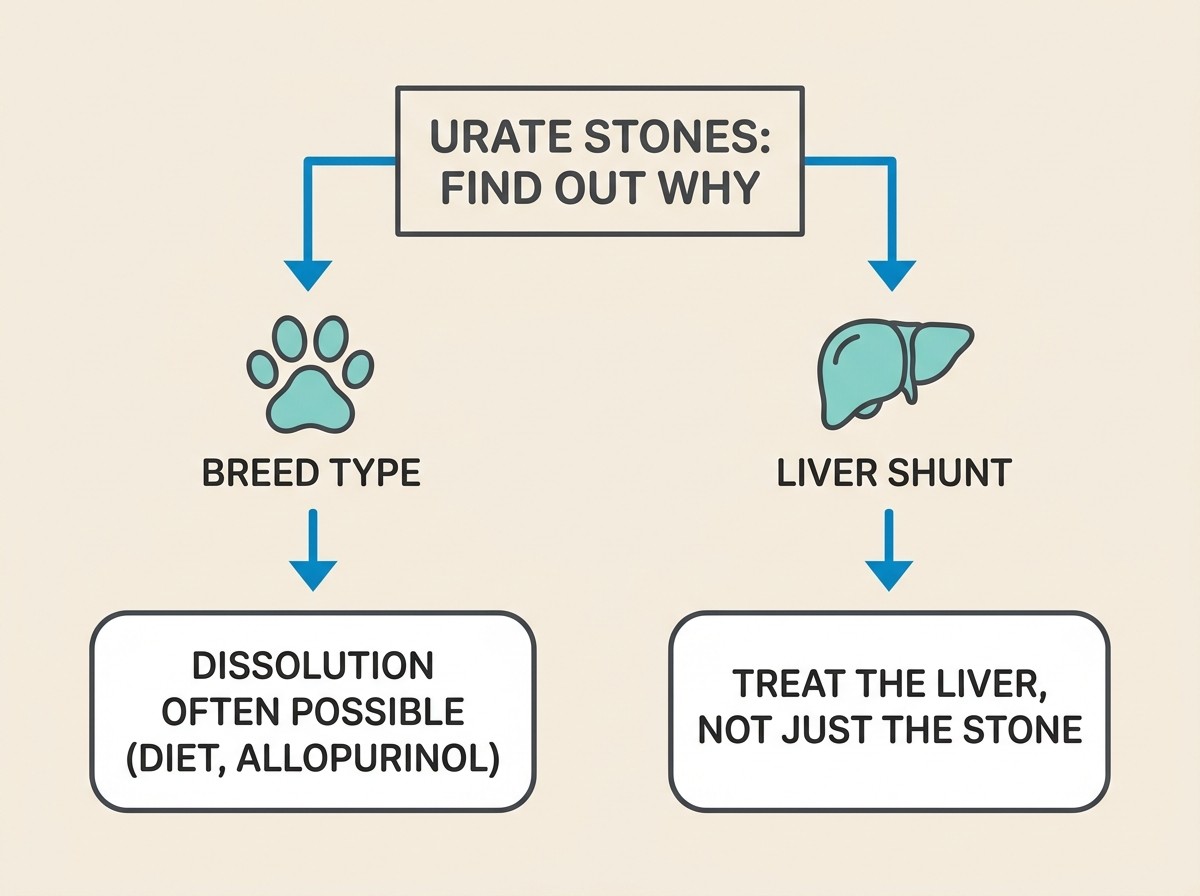
The liver reason. This is the part that makes urate stones genuinely important to spot. If urate stones show up in a pet that isn't a known urate breed, your vet's first thought should be the liver, specifically a portosystemic shunt, an abnormal blood vessel that lets blood bypass the liver instead of being cleaned by it [2][4]. A liver that's being bypassed can't process uric acid properly, so urate stones form as a side effect of the real problem. These pets are often young, frequently under a year old, and may be small or poorly grown, sometimes a bit dull or odd after meals [4][5]. This is the one situation in the whole stones section where the stone is a clue to something bigger, so if your vet suggests a blood test for bile acids or a scan of the liver after finding urate stones, that's exactly the right instinct, not over-testing.
Cats get urate stones too, though much less often, and the same split applies: in kittens and young cats a liver shunt is a leading cause, while in the wider cat population the reason often isn't clear at all, so urate stones can form without any liver problem we can find [6][7]. There's even a strong breed signal in the Egyptian Mau, which appears far more prone than other cats, though the gene behind it hasn't yet been pinned down [8].
Can urate stones be dissolved?
Sometimes, and it depends heavily on that "why". A true breed-type urate stone, in a dog whose liver is fine, can often be dissolved medically: a low-purine prescription diet to cut the raw material, a medicine called allopurinol to reduce uric acid production, and sometimes potassium citrate to shift the urine's acidity. In the consensus figures, full dissolution worked in roughly 40% of Dalmatians and the stones shrank without fully clearing in about another 30%, usually over a few weeks of strict feeding [9]. It asks for the same discipline as struvite dissolution, the diet fed strictly and nothing else, plus repeat scans to check progress.
When a liver shunt is the cause, though, dissolution usually won't hold, because the underlying chemistry keeps driving stones until the shunt itself is dealt with, often with surgery [7][9]. That's the whole point of finding the shunt: fix the plumbing and you fix the stone factory. Stones already present may still need removing, but the lasting answer is upstream.
One practical wrinkle is worth knowing: urate stones don't always show up on a plain X-ray the way struvite and oxalate usually do [3]. They've long been labelled "radiolucent", and while a recent study found they show on film more often than that old label suggests [10], they can still be faint or invisible on a standard image. So that's not your vet being thorough for the sake of it when they reach for an ultrasound or a contrast study, it's because a "clear" X-ray doesn't rule a urate stone out.
Cystine stones: an inherited leak, and the intact-male link
Cystine stones come from a completely different fault. Cystine is one of the building blocks of protein, and the kidney is meant to reabsorb it back into the body. In a dog or cat with cystinuria, that reabsorption leaks, cystine spills into the urine, and in acidic urine it can crystallise into stones [2][11]. It's an inherited plumbing fault in the kidney's filters, not a diet failure or anything you did.
Two things make cystine stones distinctive. The first is that they're strongly a male, and often an intact male, problem. The great majority of cystine stones are recovered from young, entire male dogs [12][13]. That's because in several affected breeds the condition is androgen-dependent, meaning male hormones switch it on, which is also why neutering is part of the answer (more on that below).
The second is the breed picture, which is genuinely varied. Cystinuria has been reported in dozens of breeds, from Newfoundlands and Labradors to English and French Bulldogs, Mastiffs and Dachshunds, and the underlying genetics differ between them, so there's more than one cystinuria, not a single disease [11][13]. Several of these now have DNA tests, which is a real help for diagnosis and for breeders trying to avoid passing it on. Cats can be cystinuric too, though it's rare, and again it's down to inherited transporter faults [15].
Treating and preventing cystine stones
Cystine stones can sometimes be dissolved, with a low-protein, urine-alkalinising prescription diet, often paired with a medicine such as tiopronin (you may see it called 2-MPG) that helps keep cystine dissolved, over a period of a month or more [2][9]. As with every stone, getting plenty of water through to keep the urine dilute is doing real work, not just ticking a box.
Prevention is where the intact-male point comes back. Because the androgen-dependent forms are switched on by male hormones, neutering a male dog is recommended to reduce the chance of more stones, and there's now evidence that castrated dogs go significantly longer before a cystine stone returns than entire males do [12][14]. It isn't a guaranteed cure, and stones can still recur in some neutered dogs of the affected breeds, so the diet, the water and regular check-ups stay part of life [11][12]. Cystine stones, like urate, are often hard to see on a plain X-ray, so monitoring may lean on ultrasound [13].
What this means for you
If your pet has urate or cystine stones, the headline is that you're dealing with a stone that carries information. Ask your vet two questions. For urate: "could this be a liver shunt, and should we check?", because catching a shunt changes everything. For cystine: "is this breed androgen-dependent, and does neutering help?", because for many dogs it genuinely does. And for both, ask whether dissolution is worth a try before surgery.
The everyday plan rhymes with the rest of the stones section: keep the urine dilute with plenty of water and, usually, wet food, feed the prescription diet your vet chooses strictly, and keep up the monitoring scans so a returning stone is caught while it's still small (see "Diet and water for a stone-forming pet: the prevention plan for life" and the FIC & Water tracker). The stone-prevention diet-and-water worksheet is a handy place to keep it all straight.
And the one rule that overrides everything, exactly as it does for the common stones: a stone that lodges in the urethra and stops your pet passing urine is an emergency. A male cat or male dog straining and producing little or nothing is not constipation and not a simple infection, it's a race against the clock, so ring your vet or the emergency service straight away (see "Is this an emergency? The blocked-cat signs you must not wait on", "When a stone causes a blockage: the bridge to the emergency", and the Blocked-Cat triage tool, and keep the blocked-cat red-flags fridge card somewhere you'll see it).
References
- Bannasch D, Safra N, Young A, Karmi N, Schaible RS, Ling GV. Mutations in the SLC2A9 Gene Cause Hyperuricosuria and Hyperuricemia in the Dog. *PLoS Genet.* 2008;4(11):e1000246. (DOI: 10.1371/journal.pgen.1000246)
- Urolithiasis in Dogs. MSD/Merck Veterinary Manual.
- Urate Bladder Stones in Dogs. VCA Animal Hospitals.
- Hyperuricosuria and Hyperuricemia or Urolithiasis (HUU). Cornell University College of Veterinary Medicine, Riney Canine Health Center.
- Konstantinidis AO, Patsikas MN, Papazoglou LG, Adamama-Moraitou KK. Congenital Portosystemic Shunts in Dogs and Cats: Classification, Pathophysiology, Clinical Presentation and Diagnosis. *Vet Sci.* 2023;10(2):160. (DOI: 10.3390/vetsci10020160)
- Appel SL, Houston DM, Moore AEP, Weese JS. Feline urate urolithiasis. *Can Vet J.* 2010;51(5):493-496. (PMID: 20676290)
- Cabri R, et al. Successful nutritional management of ammonium urate urolithiasis in an adult cat with congenital portosystemic shunt: a non-liver diet approach. *Veterinary Record Case Reports.* 2025;13:e70249. (DOI: 10.1002/vrc2.70249)
- Egyptian Mau Urate Stone Genetic Study. Feline Genetics and Comparative Medicine Laboratory, University of Missouri College of Veterinary Medicine.
- Lulich JP, Berent AC, Adams LG, Westropp JL, Bartges JW, Osborne CA. ACVIM Small Animal Consensus Recommendations on the Treatment and Prevention of Uroliths in Dogs and Cats. *J Vet Intern Med.* 2016;30(5):1564-1574. (DOI: 10.1111/jvim.14559)
- Cystine and urate cystoliths in dogs are frequently visible on radiographs prior to surgical or nonsurgical removal. *J Am Vet Med Assoc.* 2024;262(10):1338-1342. (DOI: 10.2460/javma.24.05.0302)
- Brons AK, Henthorn PS, Raj K, Fitzgerald CA, Liu J, Sewell AC, Giger U. SLC3A1 and SLC7A9 mutations in autosomal recessive or dominant canine cystinuria: a new classification system. *J Vet Intern Med.* 2013;27(6):1400-1408 (DOI: 10.1111/jvim.12176). Reviewed in: Cystinuria in Dogs and Cats: What Do We Know after Almost 200 Years? *Animals (Basel).* 2021;11(8):2437. (DOI: 10.3390/ani11082437)
- Lulich JP, et al. Epidemiological Evaluation of Neuter Status, Sex, and Breed in Dogs With Cystine Uroliths. *J Vet Intern Med.* 2025;39(3):e70110. (DOI: 10.1111/jvim.70110)
- Cystine Bladder Stones in Dogs. VCA Animal Hospitals.
- Cystine urolithiasis-free duration after first occurrence and treatment is longer for castrated dogs than for sexually intact male dogs. *J Am Vet Med Assoc.* 2024;262(12). (DOI: 10.2460/javma.24.05.0299)
- Mizukami K, Raj K, Osborne C, Giger U. Cystinuria Associated with Different SLC7A9 Gene Variants in the Cat. *PLoS One.* 2016;11(7):e0159247. (DOI: 10.1371/journal.pone.0159247)
Keep track of how your pet is doing
The owners who cope best are the ones who notice changes early. A simple health log shows you what is working, and what is not, before the next vet visit.
Start tracking, freeYou're not doing this alone
Compare treatment journeys and talk to owners managing urinary health. Free to join.
Join PetsLikeMine