

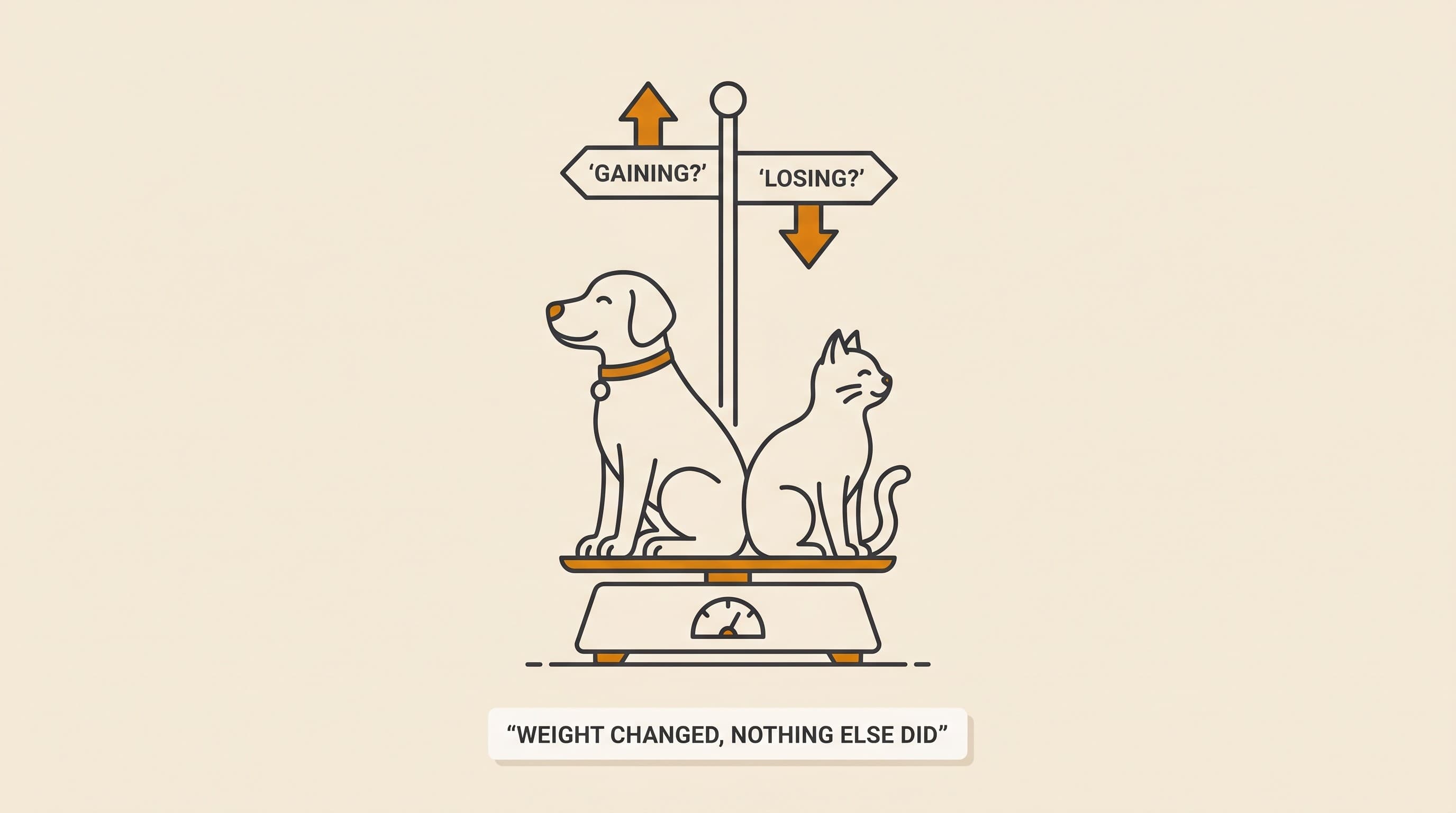
Weight changed but nothing else did: when it's a hormone
Alastair Greenway
BVM&S MRCVS
You haven't changed the food. The walks are the same. Nobody's sneaking extra treats that you know of. And yet the scales, or the way your pet feels under your hands, say something has shifted. A trouser-button of a belly that wasn't there last year. Ribs you can suddenly count. That quiet "I haven't done anything differently" is exactly the line that should make a vet reach for a blood test rather than a new diet plan.
Weight is one of the body's most telling signals, and several hormone conditions move it in a characteristic direction. The 2023 AAHA guidelines on the common hormone diseases of dogs and cats, the under-active thyroid, Cushing's and Addison's in dogs, and the over-active thyroid in cats, treat unexplained weight change as a recognised reason to investigate, each with its own step-by-step set of tests (AAHA 2023). So the trick isn't to panic. It's to notice which way the weight has gone, because the direction is a genuine clue to which gland is misbehaving.
A quick note before we start. Weight rarely changes completely on its own. The same diseases usually bring other quiet clues too, a bit more thirst, a bigger or smaller appetite, a coat going wrong, less get-up-and-go. If you've spotted those alongside the weight, our companion pieces on the classic signs and on measuring thirst will help you join the dots. This piece is about the weight itself, and where its direction points.
Losing weight while eating well
This is the one owners most often wave away, and the one that most deserves a blood test. A pet that's eating normally, or even more than usual, and still dropping condition is doing something its body shouldn't be able to do. That picture has a short, important list of causes, and two of them are hormonal (VCA Animal Hospitals).
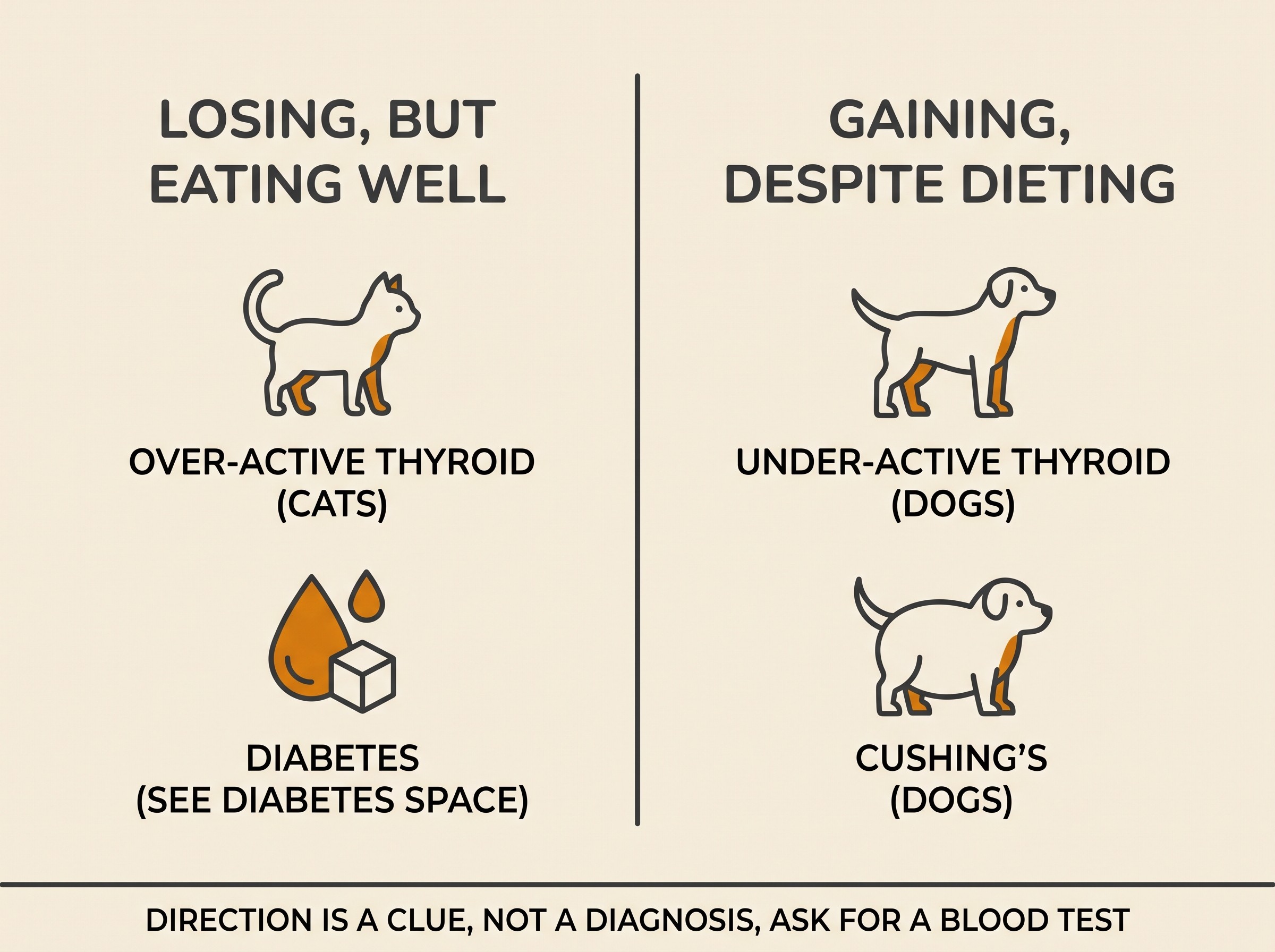
In cats, the headline suspect is an over-active thyroid. The classic signs of feline hyperthyroidism are weight loss with a big appetite, more drinking and weeing, more vocalising (often the 3am yowl), restlessness, a fast heart and breathing, sometimes vomiting or loose stools, and an unkempt coat (Carney et al. 2016). In other words, the cat is eating heartily and wasting away at the same time. It's worth taking seriously because it's common, hyperthyroidism is the most common hormone disorder of middle-aged and older cats (Carney et al. 2016), and because it's very treatable. It's usually picked up on a single blood thyroid level, a total T4, alongside the matching signs (Carney et al. 2016). There's a fuller explainer in our hyperthyroid section.
In both cats and dogs, the other hormonal cause of eating-yet-shrinking is diabetes. Diabetic dogs and cats classically show the same quartet, more drinking, more weeing, a big appetite and weight loss (AAHA 2018/2022). Diabetes has its own dedicated home on PetsLikeMine, the Diabetes space, so if the picture fits we'll hand you straight over to it rather than half-cover it here.
The reassurance, and the gentle push: please don't file "my older cat is eating fine but getting bony" under "just getting old" or "a bit fussy". Weight loss with a good appetite is the textbook flag for both hyperthyroidism and diabetes, both common, both treatable, and both far easier to manage caught early. It earns a vet visit and a blood test, not a wait-and-see.
Gaining weight, or holding it, despite dieting
Now the mirror image. Your dog is doing everything right, modest meals, decent exercise, no obvious cheating, and the waistline is winning anyway. Weight that creeps up, or simply won't shift on a sensible diet, points a different way.
The classic culprit here is an under-active thyroid in dogs. When the thyroid under-produces, the whole metabolism idles too slow, so the textbook picture is weight gain, low energy, mental dullness, a reluctance to exercise and a tendency to seek out warm spots (Merck Veterinary Manual). It's the opposite engine setting to the hyperthyroid cat. Weight gain is common in hypothyroid dogs, present in very roughly four in ten of them, but it's worth being clear that it's neither universal nor proof on its own (Merck Veterinary Manual).
That last point matters enough to slow down on, because it's where a lot of dogs get mislabelled. A low thyroid blood result is not a diagnosis by itself. Plenty of things lower a dog's thyroid hormone reading without any thyroid disease at all, being unwell for some other reason (vets call it euthyroid sick syndrome) and some common medicines among them. In fact, around 20 to 40% of genuinely hypothyroid dogs show a low total T4 and free T4 with a normal TSH, which is also the pattern you see in a dog that's simply ill with something else (AAHA 2023; Behrend). So "my overweight dog must have a thyroid problem" needs confirming on the fuller panel, read alongside the whole clinical picture, before anyone commits a dog to a tablet for life. The good news on the other side of that caution: when it truly is hypothyroidism, it's one of the most rewarding diagnoses in the book, a cheap daily tablet usually turns the dog right around. Our under-active thyroid section walks through getting the diagnosis right.
The other dog to mention here is the Cushing's dog, but with a twist that's easy to misread. Dogs with Cushing's are usually ravenous, and excess cortisol can add weight, but the famous pot-bellied, sagging-tummy look is usually not true weight gain. It comes from an enlarged liver and a weakening of the tummy-wall muscles under the catabolic pull of all that cortisol (Merck Veterinary Manual). So the belly grows while the dog may actually be losing muscle over the back and legs. If your older dog is drinking a lot, hungry all the time, panting and going pot-bellied, that combination is worth a vet's eye, and our Cushing's section covers it properly.
Why one direction isn't a diagnosis
Here's the catch that keeps weight a clue rather than a verdict. Sometimes two things are going on at once and the weight moves the "wrong" way. A Cushing's dog that also develops diabetes, which happens in roughly 5 to 10% of Cushing's dogs, may lose weight instead of gaining it (Iowa Veterinary Specialties). That's not a flaw in the logic, it's the whole reason vets run a sequence of tests rather than reading a single number. The hormone guidelines are deliberately step-by-step precisely because one finding rarely settles it (AAHA 2023). Our piece on the hormone blood tests explains what each one actually rules in or out.
So treat the direction as a signpost, not a destination. Losing while eating well, think over-active thyroid (cats) or diabetes. Gaining or stuck despite dieting, think under-active thyroid or Cushing's (dogs). Either way, the next step is the same: a vet, and a blood test, not a guess.
What to do this week
If the weight has genuinely shifted and you honestly haven't changed the feeding or the exercise, book a check-up and ask for the relevant bloods. It's a small, low-drama step that either reassures you or catches something common and treatable early.
Two practical things help your vet before you go. First, if there's any extra thirst in the mix, measure it rather than guess, our piece on drinking and weeing more shows you how, and you can log it in the Thirst and Wee tracker. As a rough flag, more than about 100 ml of water per kilogram of bodyweight per day is on the high side, though some pets drink a bit more than usual while still under that line, so measure over a few days (Today's Veterinary Practice; Cornell Riney). Second, if you can, weigh your pet at home now and again so a trend is visible rather than a one-off.
One safety line to keep in your back pocket: this piece is about a slow, "nothing else changed" drift. A sudden, dramatic loss, a fast-ballooning belly, or any collapse or real listlessness is not a wait-for-the-blood-test situation, it's a same-day vet call. For the gradual stuff, though, you've got time to do this properly, and a single blood test is often all it takes to turn "I don't understand it" into a plan.
References
- Gilor C, Niessen SJM, et al. 2023 AAHA Selected Endocrinopathies of Dogs and Cats Guidelines. J Am Anim Hosp Assoc 2023;59(3):113-135. DOI: 10.5326/JAAHA-MS-7368.
- VCA Animal Hospitals — Testing for Increased Appetite.
- Carney HC, Ward CR, Bailey SJ, et al. 2016 AAFP Guidelines for the Management of Feline Hyperthyroidism. J Feline Med Surg 2016;18(5):400-416. DOI: 10.1177/1098612X16643252.
- 2018 AAHA Diabetes Management Guidelines for Dogs and Cats (2022 update) — Diagnosis and assessment.
- Merck Veterinary Manual — Hypothyroidism in Animals.
- Merck Veterinary Manual — Cushing Syndrome (Hyperadrenocorticism) in Animals.
- Behrend EN — Diagnosis of Canine Hypothyroidism (ACVIM/Society for Comparative Endocrinology consensus background), Auburn College of Veterinary Medicine.
- Iowa Veterinary Specialties — Canine Hyperadrenocorticism.
- Today's Veterinary Practice — A Stepwise Diagnostic Approach to Polyuria and Polydipsia.
- Cornell University College of Veterinary Medicine, Riney Canine Health Center — Canine Polyuria and Polydipsia (PU/PD), April 2024.
Keep track of how your pet is doing
The owners who cope best are the ones who notice changes early. A simple health log shows you what is working, and what is not, before the next vet visit.
Start tracking, freeYou're not doing this alone
Compare treatment journeys and talk to owners managing hormone health. Free to join.
Join PetsLikeMine