

Treating Cushing's with trilostane: when to, when not to, and the monitoring
Alastair Greenway
BVM&S MRCVS
If your dog has just been diagnosed with Cushing's, the next conversation is usually about a tablet called trilostane. It's a well-understood drug that genuinely helps, and most dogs do well on it. But there are two things the single-product manufacturer pages tend to skip. The first is that not every dog needs treating, at least not straight away. The second is that trilostane is never "set and forget", and there's one specific situation where you'll need to act fast. This piece walks through both, plainly.
One quick orientation. If you're still working out whether it really is Cushing's, that belongs with the diagnosis (our piece on the testing maze covers it). If your dog's Cushing's was caused by long-term steroid medication rather than its own overactive adrenals, that's the iatrogenic, or steroid-caused, kind, and it's covered separately. This article is about treating the spontaneous disease, and trilostane is the drug it almost always starts with.
The "when not to" most owners never hear
Here's the part that surprises people. A diagnosis of Cushing's does not automatically mean a prescription. The decision to treat is driven by your dog's day-to-day signs and quality of life, not by the lab number on its own. According to the 2023 AAHA endocrinopathies guidelines, "not every dog requires treatment", and a dog's owner-observed clinical signs are "the most important factor" in deciding whether to start and whether to change the dose (AAHA 2023).
So a mild, comfortable dog, one drinking a bit more with a slightly scruffier coat but otherwise happy and well, can reasonably be monitored rather than medicated. Cushing's is usually slow-moving, so you genuinely have time to decide. It's a manageable condition, not an emergency.
What tips the balance towards treating is how much the signs bother your dog and you: the heavy thirst, the accidents in the house, the ravenous appetite, the thinning coat, the relentless panting. Those are what trilostane targets. The other side of the scale is real too: trilostane is lifelong, with regular blood tests built in, so the tablets plus repeat monitoring really do add up, and for a mildly affected dog that ongoing cost is a fair part of the decision. We've left actual pound figures out, because they vary too much by practice and dog size to quote usefully, but ask your vet for a realistic running cost before you commit.
There's a medical "when not to" as well. Trilostane shouldn't be used in dogs with primary liver disease or kidney insufficiency, or in pregnant or nursing bitches, which is why your vet checks liver and kidney bloods before starting (Trilocur SPC; FDA Vetoryl label). It also needs caution with certain heart and blood-pressure drugs, the ACE inhibitors and potassium-sparing diuretics like spironolactone, which together can push potassium dangerously high, with a few reports of sudden death on trilostane and an ACE inhibitor together (Trilocur SPC). Many Cushing's dogs are elderly and already on other medicines, so make sure your vet has the full list.
What trilostane actually does
Trilostane is the first-choice medical treatment for canine Cushing's. It works by reversibly blocking an enzyme (3-beta-hydroxysteroid dehydrogenase) in the adrenal glands, which dials down the production of cortisol, the stress hormone that's in excess in Cushing's (Trilocur SPC; Today's Veterinary Practice). The important word is "dials down". It controls the disease, it doesn't cure it. The underlying cause, usually a tiny benign growth on the pituitary gland, is untouched, so the dose often needs nudging over time and the treatment carries on for life (Today's Veterinary Practice). The other established drug is mitotane (Lysodren), older and now usually a second choice (Gallagher 2018); the third option for a genuinely mild case is the active monitoring already described.
If "doesn't cure" sounds deflating, it shouldn't, because controlling Cushing's clearly beats not controlling it. In one primary-care study, untreated dogs with pituitary-dependent Cushing's had a median survival of around 506 days, while roughly half the trilostane-treated dogs were still alive at two years, against under one in ten of the untreated ones (Nagata et al. 2017). Reported survival on treatment varies between studies, so there's no single number to quote (Barker et al. 2005; Garcia San Jose et al. 2022), but the contrast is the point: many well-managed dogs live well for years. And controlling it matters, because long-standing untreated Cushing's quietly raises the risk of recognised complications, high blood pressure, recurrent urine infections, protein in the urine, abnormal blood clots and a higher risk of pancreatitis (Trilocur SPC; Merck Veterinary Manual). These accrue slowly, which is exactly why the aim is calm control, not panic.
Getting the dose right
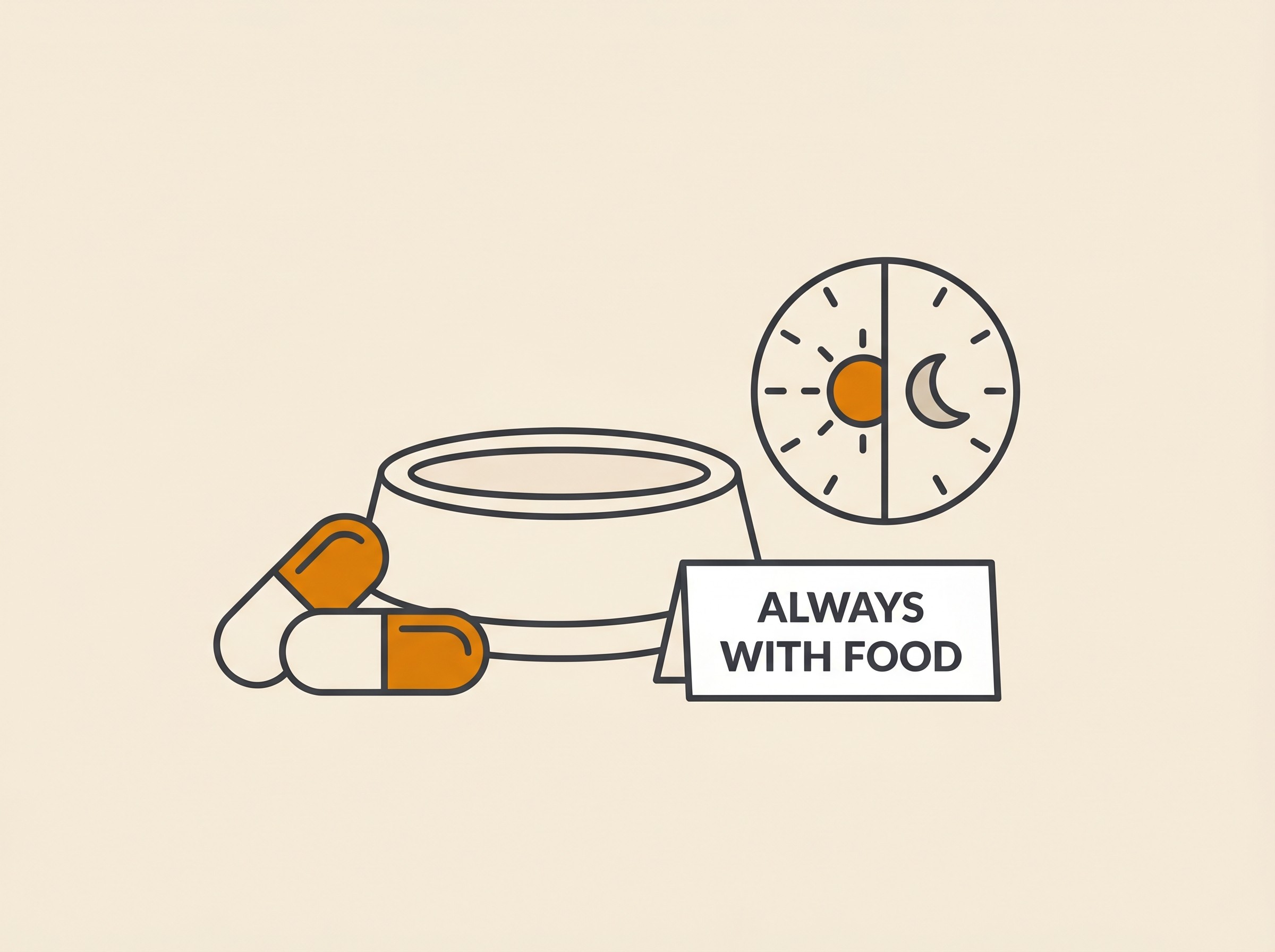
Your vet manages the dose, not you, but it helps to know the shape of it. Trilostane is given by mouth, once or twice a day, always with food (a meal genuinely helps the dog absorb it). It's started low and then titrated, meaning your vet finds the lowest dose that keeps the signs under control rather than the highest the dog will tolerate (Trilocur SPC; FDA Vetoryl label). One wrinkle: the official label dose is once daily, but trilostane's effect doesn't last a full 24 hours, so many specialists now prefer a lower dose split into a morning and an evening one (Today's Veterinary Practice; MSPCA-Angell). If your vet uses twice-daily dosing, that's a deliberate, well-supported choice. The practical message is simple: give it with food, give it when your vet says, and don't change the dose yourself.
Why the blood tests never stop
Why do we keep going back for blood tests? This is the heart of treating Cushing's safely. Trilostane is monitored at set intervals, never set-and-forget, and the rechecks exist to keep your dog in a safe window and catch any problem early.
The standard pattern is a blood test, including electrolytes, plus a cortisol check at roughly 10 to 14 days after starting, then about 30 days, then about 90 days, and every three months after that, with another after any dose change (Trilocur SPC; FDA Vetoryl label; AAHA 2023). The cortisol test most often used is an ACTH stimulation test, timed a few hours after the morning dose, when cortisol is at its lowest. The whole point of that first recheck is to make sure the cortisol hasn't dropped too low (AAHA 2023). Too little cortisol is as much a problem as too much, which is why the dose is adjusted carefully.
You may hear that vets use one of two cortisol tests, the ACTH stimulation test or a simpler pre-pill (pre-trilostane) cortisol, and that which is best is still genuinely debated (Macfarlane et al. 2016; Today's Veterinary Practice). Don't get tangled in that. The consistent message across the guidelines is that how your dog is doing at home matters most: clinical signs lead the dosing decision, above any single cortisol number (AAHA 2023).
That's the bit owners can actively help with. Your running notes on the thirst, appetite, accidents and energy aren't an afterthought, they're a real part of the monitoring, so bring them to every recheck. Measuring the water is the most useful single thing to track (marked thirst is roughly more than 100 ml per kg per day, and watching that number fall is one of the clearest signs treatment is working). Our Thirst and Wee tracker is built for exactly this, and there's more on it in our piece on measuring the drinking. Watching the thirst settle, the accidents stop and the coat come back is how you'll know it's helping, often before the bloods catch up.
The one situation to act on fast
Now the sharper part, and the reason all that monitoring exists. Trilostane lowers cortisol, and occasionally it lowers it too far. Too much trilostane, or an ordinary illness on top of a normal dose, can suppress cortisol so far that the dog tips into the opposite problem, an acquired form of Addison's disease, up to and including a collapse (Trilocur SPC; FDA Vetoryl label). The crucial nuance is that this can happen at any dose, not only an overdose, which is precisely why it's monitored for (FDA Vetoryl label).
Know these signs, and act on them. If a dog on trilostane goes off its food, becomes lethargic, vomits, has diarrhoea, seems weak, or collapses, stop the trilostane and ring your vet straight away, and treat a collapse as an emergency, vet now (Trilocur SPC; Today's Veterinary Practice). Lethargy and going off food are the commonest early signs (Lamoureux et al. 2023). Ask your vet in advance whether you should keep an emergency steroid at home for this exact situation, and exactly when to use it, so you're not working it out in a panic.
Treatment of a crisis, once you're at the vet, is stopping the drug, giving steroids and fluids, and correcting the salt imbalance (Trilocur SPC). It's the same emergency we cover under the Addisonian crisis, just arrived at from a different direction, so that piece is worth reading too if your dog is on trilostane.
Now the calibration, because this should make you vigilant, not frightened. Serious, symptomatic over-suppression is uncommon. In one referral case series, 8 of 127 dogs treated over more than a decade developed it, mostly lethargy and loss of appetite, and most recovered once the drug was stopped (Lamoureux et al. 2023). In a small minority the effect is prolonged or, rarely, permanent, because trilostane can in rare cases damage the adrenal glands (FDA Vetoryl label; Trilocur SPC). So it's a real risk, but an uncommon one, with recognisable warning signs and a monitoring routine built to catch it early. That's the whole bargain, and it's a reasonable one.
One last caution. If your dog's Cushing's is the steroid-caused kind, the same danger sits at the other end: never stop long-term steroids abruptly, because withdrawing them suddenly can trigger the very same crash. Always taper under your vet (our piece on steroid-caused Cushing's, and the Allergies and Skin guidance on long-term steroids, cover the safe taper).
Most dogs on trilostane settle into an unremarkable routine: a tablet with breakfast, the odd blood test, and a dog that's drinking normally and feeling like itself again. The decision to start is unhurried, so take it properly. The one set of warning signs is the part to plan for in advance, so have the conversation with your vet about an emergency steroid at the start, and you've covered the one thing this drug really asks of you.
References
- 2023 AAHA Selected Endocrinopathies of Dogs and Cats Guidelines. Gilor C, et al. J Am Anim Hosp Assoc 2023;59(3):113-135.
- Trilocur (trilostane) Summary of Product Characteristics, EU-authorised veterinary medicine, EMA product no. EMEA/V/C/006128.
- FDA VETORYL (trilostane) Capsules prescribing label, DailyMed (NIH).
- Today's Veterinary Practice. Trilostane for Dogs With Hyperadrenocorticism.
- MSPCA-Angell. Trilostane Dosing and Monitoring in Dogs.
- Macfarlane L, Parkin T, Ramsey I. Pre-trilostane and three-hour post-trilostane cortisol to monitor trilostane therapy in dogs. Vet Rec 2016;179(23):597.
- Nagata N, Kojima K, Yuki M. Comparison of Survival Times for Dogs with Pituitary-Dependent Hyperadrenocorticism in a Primary-Care Hospital: Treated with Trilostane versus Untreated. J Vet Intern Med 2017;31(1):22-28.
- Barker EN, et al. A comparison of the survival times of dogs treated with mitotane or trilostane for pituitary-dependent hyperadrenocorticism. J Vet Intern Med 2005;19(6):810-815.
- Garcia San Jose P, et al. Survival of dogs with pituitary-dependent hyperadrenocorticism treated twice daily with low doses of trilostane. Vet Rec 2022.
- Gallagher A / WSAVA 2018. Tips on Diagnosis and Management of Canine Hyperadrenocorticism. VIN.
- Merck Veterinary Manual. Cushing Disease (Pituitary-Dependent Hyperadrenocorticism) in Animals.
- Lamoureux A, Cadore JL, Hugonnard M, Chabanne L, Krafft E. Iatrogenic symptomatic hypoadrenocorticism after treatment with trilostane for hyperadrenocorticism in dogs: eight cases (2008-2019). J Small Anim Pract 2023;64(6):409-414.
Keep track of how your pet is doing
The owners who cope best are the ones who notice changes early. A simple health log shows you what is working, and what is not, before the next vet visit.
Start tracking, freeYou're not doing this alone
Compare treatment journeys and talk to owners managing hormone health. Free to join.
Join PetsLikeMine