

Treating Incontinence: The Medicines That Work, and What to Try When They Don't
Alastair Greenway
BVM&S MRCVS
So the leaking now has a name (urethral sphincter mechanism incompetence, USMI, the weak bladder-neck muscle we explain in my spayed dog is leaking urine), and there's a tablet or a small bottle of syrup waiting on the kitchen worktop. The fact worth leading with, because it's true: this is one of the most treatable problems in the whole of canine medicine, and most leaking dogs go back to dry beds on a single medicine.
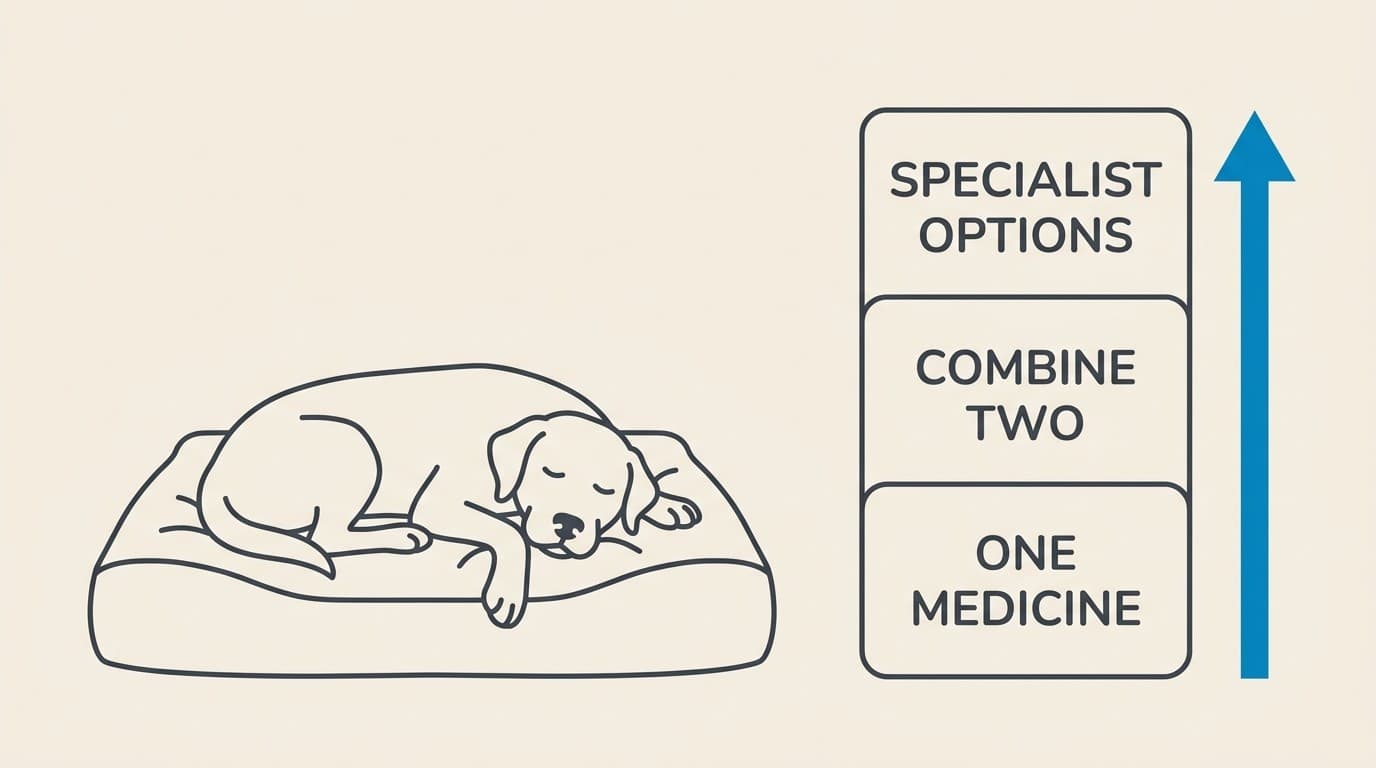
But "most" isn't "all", and if the first thing you tried didn't quite work, this page is for you too. There's a clear ladder to climb, from the first medicine through combining two, on up to the procedures a specialist can offer. It's worth knowing it exists so you don't give up on the bottom rung.
Rule this out before any tablet
Before we talk medicines, one quick but genuinely important check. The drugs below work by tightening the muscle around the bladder neck, so they only help if a weak muscle is actually the problem. If your dog is leaking because of a urine infection, bladder stones, an anatomical quirk she's had since she was a pup, or because she's suddenly drinking far more than usual, then a sphincter-tightening drug won't fix it and may simply mask what's really going on. That's why your vet will want a urine sample before settling on USMI as the answer. The 2024 ACVIM consensus statement on canine incontinence is explicit that a urinalysis, and ideally a urine culture, should come before treatment, precisely because an undetected infection can cause or worsen leaking (Kendall et al., 2024, Journal of Veterinary Internal Medicine). We cover the full sorting-out in is it incontinence or something else?
The same logic explains a pattern that catches a lot of owners out. A dog who's been dry on her medicine for months or years and then suddenly starts leaking again deserves a fresh urine test, not just a bigger dose, because a new infection is one of the commonest reasons a well-controlled dog appears to "stop responding".
Medicine one: phenylpropanolamine
This is the workhorse, and for most dogs it's where treatment starts. Phenylpropanolamine, mercifully shortened to PPA, is sold in the UK mainly as Propalin syrup. It's an alpha-adrenergic drug, which is a roundabout way of saying it tells the smooth muscle around the bladder neck to tighten up, so the exit stays shut between wees (Kendall et al., 2024).
It works, and it works well. Reported response rates sit broadly between 75% and 90%, and it tends to act fast (Today's Veterinary Practice; Kendall et al., 2024). In the placebo-controlled trial vets lean on most, around 86% of treated bitches had no episodes of involuntary leaking by four weeks, against about a third of dogs given a dummy syrup, a clear and real difference (Scott et al., 2002, Journal of Small Animal Practice). Many dogs are dry within a few days, some within 24 to 72 hours. The syrup is usually given two or three times a day, dosed to your dog's weight, and your vet will start sensibly and may nudge the dose up to find the smallest amount that keeps her dry.
Most dogs take it without any trouble. The side effects worth knowing about are restlessness, a bit of agitation, a change in sleep or appetite, and, less often, a faster heart rate or a rise in blood pressure (Kendall et al., 2024). Because of that blood-pressure point, PPA is used more cautiously in dogs with heart disease, kidney disease or Cushing's, and some vets check blood pressure before starting and again a couple of weeks in, though in an otherwise healthy dog at the normal dose a meaningful rise is uncommon (Today's Veterinary Practice; Kendall et al., 2024). One note on the long term: in some dogs the effect fades over months as the body adapts, although plenty stay well-controlled on the same dose for years. If that fading happens, it's a cue to climb the ladder, not to give up.
Medicine two: oestriol
The other first-line option, and sometimes the better starting point, is oestriol, sold here as Incurin (a 1mg tablet licensed specifically for spayed bitches). Since the link between spaying and leaking is partly the drop in oestrogen, it makes intuitive sense that topping it up helps. Oestriol works by a different route from PPA: it improves the quality and tone of the urethral lining and, neatly, increases the number and the sensitivity of the very alpha-receptors that PPA acts on (Kendall et al., 2024; Today's Veterinary Practice).
The numbers are strong here too. In the original study behind the UK licence, 83% of bitches either became continent or clearly improved on oestriol, with the owners reporting much the same (Mandigers and Nell, 2001, Veterinary Record). It's a slower burn than PPA, so it's worth giving it a few weeks before judging it, and the dose is then trimmed to the smallest schedule that keeps her dry, often dropping from daily to every other day. Side effects are usually mild and dose-related, a little swelling of the vulva or occasional signs of being in season, and they settle when the dose comes down (Kendall et al., 2024).
So which first? There's no single right answer. It comes down to your particular dog (her heart, her kidneys, her other medicines), your vet's preference, and whether a daily tablet or a measured syrup suits your routine. In practice PPA is the more popular first choice, picked first by roughly three-quarters to four-fifths of vets in one international survey, but a good number of dogs do beautifully on oestriol (Noël et al., 2024, Frontiers in Veterinary Science).
When one medicine isn't enough: the step-up
If a single drug at a sensible dose isn't getting your dog dry, you have not run out of road, not even close. The two commonest next moves, and the ones most vets reach for first, are to increase the dose or frequency, or to switch to the other first-line drug. In that international survey, changing the drug and increasing the dose were far and away the two commonest responses to a poor result, well ahead of any thought of surgery (Noël et al., 2024). Plenty of dogs who underwhelmed on one are dry on the other.
The next lever is to use both together. Because PPA and oestriol tighten the seal by different mechanisms, combining them can help a dog who responded only partly to either alone. The formal evidence for true "synergy" is mixed, and the consensus calls it controversial, but the practical experience that two together can beat one is real and widely used for stubborn cases (Kendall et al., 2024; Today's Veterinary Practice).
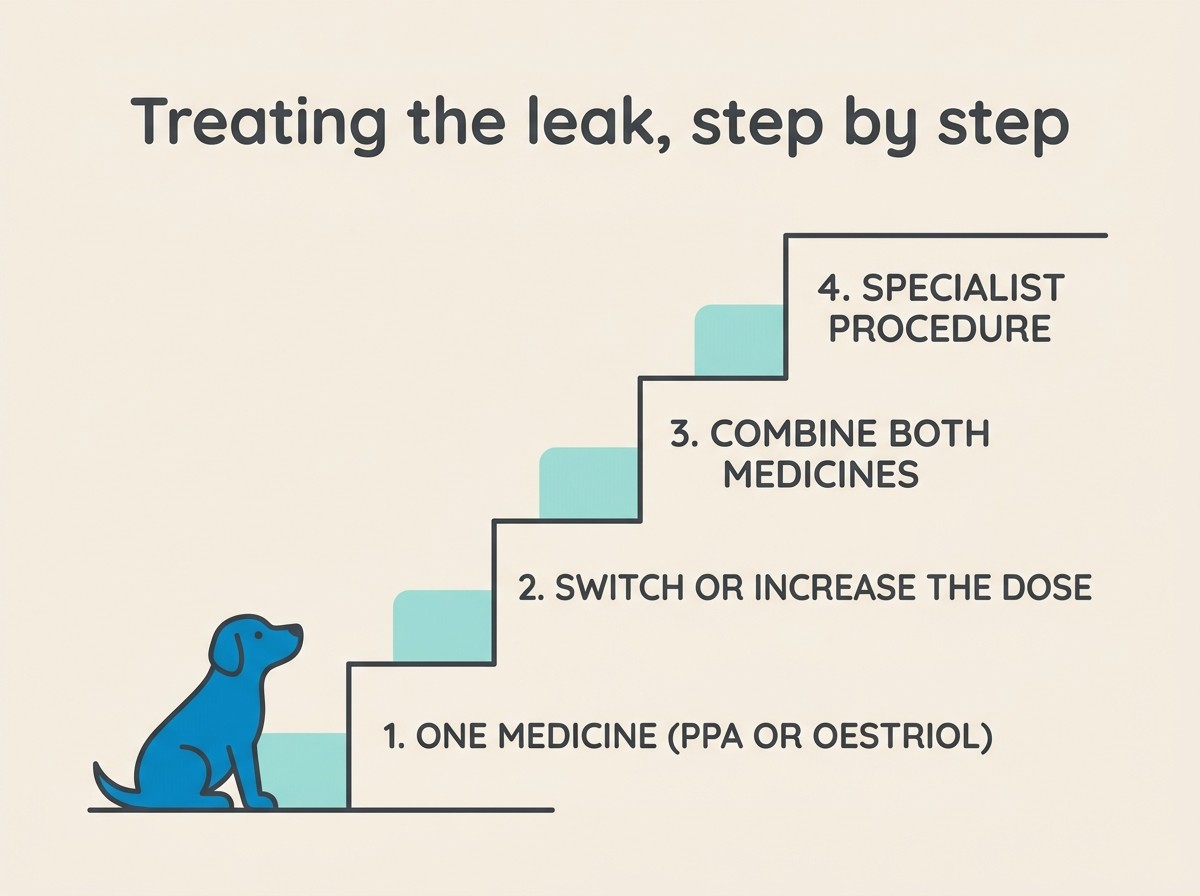
There's a third medical option your vet may raise for difficult cases: deslorelin, a hormone implant that sits under the skin. On its own it helps a little over half of dogs (around 54%), but combined with PPA the reported response climbs to about 92%, so it earns its place as a useful addition rather than a standalone fix (Today's Veterinary Practice). It isn't licensed for incontinence in the UK, so it's an extra option used at your vet's discretion when the standard ones fall short. The headline either way: a dog whose leaking isn't controlled on the first tablet is a dog with several more things still to try, and the great majority get there.
When medicines genuinely aren't enough: the specialist options
A small minority of dogs leak on despite the full medical effort, and for them there are procedures, almost always at a referral centre, that can give back a dry bed when tablets can't. It's worth knowing these exist, because too many owners hear "the medicine didn't work" and assume that's the end of the story.
- Urethral bulking. A specialist passes a fine camera into the urethra and injects a small amount of bulking material (usually collagen) just under the lining, plumping it up so the seal closes more effectively. On its own it makes around 66% to 68% of bitches continent, and adding medication back on top lifts that further (Kendall et al., 2024; Today's Veterinary Practice). The effect isn't always permanent, lasting on average from about eight months to a couple of years, so it sometimes needs repeating (Today's Veterinary Practice).
- An artificial urethral sphincter. An adjustable silicone cuff placed around the urethra, with a tiny port left under the skin that a vet can tighten over time. The results are impressive, and it's become a particularly good answer for the male dogs who tend to respond poorly to tablets; in one reported series, all 27 dogs had significantly better continence after placement (Today's Veterinary Practice).
- Surgery to reposition the bladder neck (colposuspension and related operations). Older approaches with more variable results, helping around half of dogs on their own, with newer combined techniques reaching about 70% (Today's Veterinary Practice). They're less often the first surgical choice now that bulking and the artificial sphincter exist, but they remain part of the picture.
These are referral-level procedures, and your own vet would talk through whether a trip to a specialist is the right call for your particular dog.
So where does that leave you?
Almost certainly on step one, with a dry dog. The overwhelming majority of leaking bitches are controlled on a single daily medicine, and the rest have a clear ladder of options above that, all the way up to procedures that work when nothing else has. So the right frame for tonight isn't "will this be fixable", it's "which rung gets her dry", and you and your vet work up the ladder together until you find it.
Two practical things to take with you. Keep a simple note of dry nights versus wet ones once she starts a medicine, so you can both see clearly whether it's working and at what dose (the dog incontinence management and medication chart download is built for this, and you can keep a running log on the FIC & Water-Intake tracker). And the everyday business of keeping her comfortable and her skin healthy matters just as much as the prescription, which is all in living with a leaky dog. If a fresh bout of leaking ever has you wondering whether it's the old USMI or something new, the answer is nearly always a quick urine test, so back to is it incontinence or something else? you go.
References
- Kendall, A., Byron, J. K., Westropp, J. L., et al. (2024). ACVIM consensus statement on diagnosis and management of urinary incontinence in dogs. *Journal of Veterinary Internal Medicine*, 38(2), 878–903. (open summary: https://www.rcvsknowledge.org/resource/acvim-consensus-statement-on-diagnosis-and-management-of-urinary-incontinence-in-dogs/)
- Scott, L., Leddy, M., Bernay, F., & Davot, J. L. (2002). Evaluation of phenylpropanolamine in the treatment of urethral sphincter mechanism incompetence in the bitch. *Journal of Small Animal Practice*, 43(11), 493–496. (PubMed: https://pubmed.ncbi.nlm.nih.gov/12463265/)
- Mandigers, P. J. J., & Nell, T. (2001). Treatment of bitches with acquired urinary incontinence with oestriol. *Veterinary Record*, 149(25), 764–767.
- Noël, S., et al. (2024). An international survey on canine urinary incontinence: case frequency, diagnosis, treatment and follow-up. *Frontiers in Veterinary Science*, 11, 1360288. (PMC: https://pmc.ncbi.nlm.nih.gov/articles/PMC11288968/)
- Byron, J. K. (Today's Veterinary Practice). Urethral Incompetence in Dogs: Updates in Management. (source for the 54%/92% deslorelin, 66–68% urethral-bulking and 53%/70% colposuspension figures and the 8-month-to-2-year bulking duration)
- Reeves, L., Adin, C., McLoughlin, M., Ham, K., & Chew, D. (2013). Outcome after placement of an artificial urethral sphincter in 27 dogs. *Veterinary Surgery*, 42(1), 12–18. (the 27-dog artificial-sphincter series)
- NOAH Compendium. Propalin Syrup, 40 mg/ml for Dogs (phenylpropanolamine) datasheet. (UK licence, dosing and cardiovascular cautions)
- Incurin (estriol) 1 mg Tablets, product information (licensed for hormone-dependent USMI in ovariohysterectomised bitches; one tablet daily, reducible to alternate days).
Free downloads
Companion worksheets to put what you've read into practice. Free PDFs, print at home.
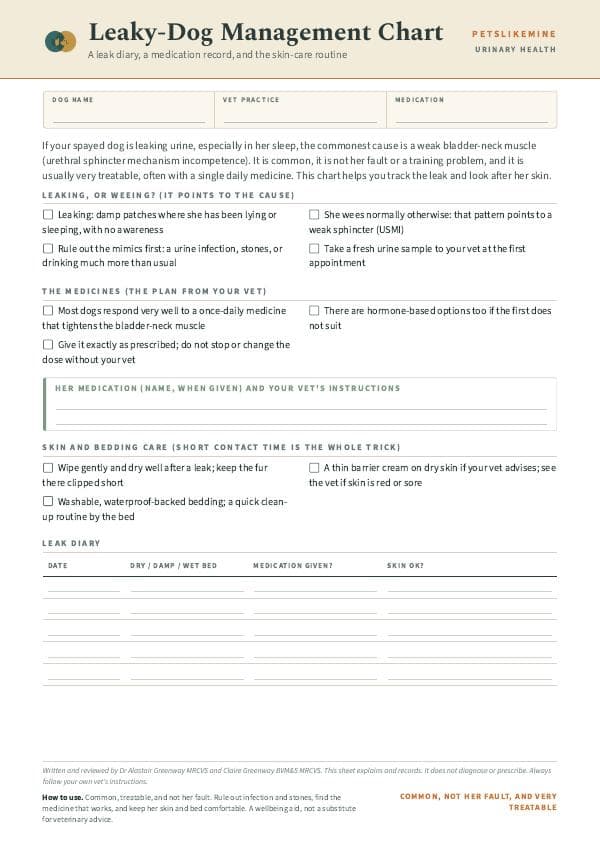
Keep track of how your pet is doing
The owners who cope best are the ones who notice changes early. A simple health log shows you what is working, and what is not, before the next vet visit.
Start tracking, freeYou're not doing this alone
Compare treatment journeys and talk to owners managing urinary health. Free to join.
Join PetsLikeMine