

Tracking that works: weigh-ins, photos and what to expect
Alastair Greenway
BVM&S MRCVS
Why bother tracking at all (the reassurance, not the surveillance)
Tracking has a reputation it doesn't deserve. Owners often picture homework, or the dread of a school report they already know is bad. It's neither of those, and it isn't surveillance or a telling-off. It's the thing that proves the plan is working, and it's the thing that gives you permission to hold the line when the begging face turns up at six o'clock.
That second part is the one most owners need. When you've measured the food and you can see, in black and white, that your pet is slowly getting lighter, the begging stops being a guilt trip. The number on the scale is how you know you're slimming them, not starving them. It's evidence, on your side, for the moment you most want to give in.
This matters because diets don't usually fail on day one. They fail three weeks in, when the novelty has worn off and the bowl looks so small and the eyes look so sad. A trend line that's gently heading the right way is what carries you through that dip. So the point here isn't to add a chore. It's to set up the one habit that keeps everything else going, and to tell you plainly what to expect.
Weigh-ins: how often, and how to get a number you can trust
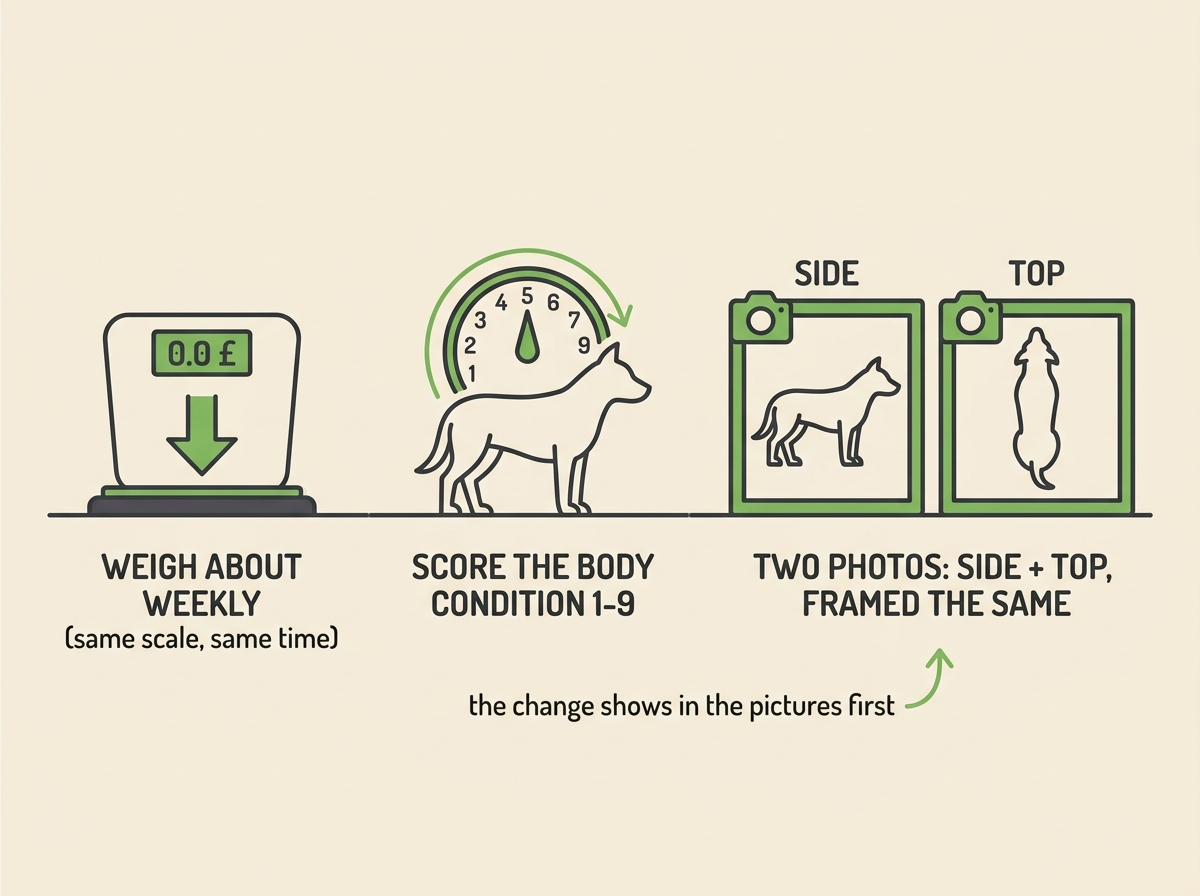
For most owners, a weigh-in at home about once a week is plenty. Your vet will usually want to recheck every two to four weeks during active weight loss, and for cats that's often closer to monthly (AAHA, 2021; APOP, n.d.). Think of the home weigh-in as your week-to-week feel for the trend, and the vet's scales as the gold-standard cross-check on top.
Consistency matters more than frequency, so this is the bit to get right. Same scale, same time of day, ideally before a meal (VCA, n.d.). A pet weighed after a big dinner and a long drink can read a few hundred grams heavier than the same pet weighed first thing, and that's enough to make a real loss vanish or a steady week look like a gain. You're trying to measure the pet, not yesterday's dinner. Pick a slot, a Sunday morning before breakfast works well for a lot of people, and keep to it.
Getting an actual number off a wriggly animal is the other hurdle. For a small dog or a cat, the trick is to weigh yourself holding them, then weigh yourself alone, and take the difference. Bathroom scales aren't perfect, but used the same way each time they track a trend just fine. Baby scales are even better for cats and small dogs, because they read in small steps and the pet sits in a tray. A bigger dog can often be coaxed to stand on the scales, and many vet practices are happy for you to pop in and use their walk-on scales, which are the most accurate of all. Whatever you use, write the number down straight away. If you want the scales-and-tricks detail in full, we go through it in weighing your pet at home.
Don't forget the body condition score and the two photos
Weight on its own can mislead you. A heavy-boned, muscular dog and a soft, overweight one can read the same on the scales. A fluffy cat can hide a lot. And as your pet loses fat and, with gentle exercise, holds onto muscle, the scale can move slowly even while the shape is changing nicely. So weight is one measure, not the whole story.
This is why two other things belong in your tracking, beside the number.
The first is the body condition score, the 1-to-9 scale your vet uses, where 4 to 5 is ideal (WSAVA, 2013). Re-score it every few weeks rather than every week, because real change in body shape is slow. We've written a full how-to in body condition score: how to score your dog or cat at home, so this article won't repeat the method, but the habit is simple: feel the ribs, look for the waist, check the tummy tuck, and note where they land.
The second is photos. Take two, a side-on shot and a top-down shot looking straight down on your pet, in the same spot and the same light each time, framed roughly the same way (VCA, n.d.). This sounds fussy and it's the single most motivating thing you'll do, because the change shows up in the pictures long before it's obvious in the mirror and long before it's convincing on the scale. You live with your pet, so you acclimatise to how they look. A photo from a month ago doesn't. When the weekly number is being stubborn, two photos side by side will often show you the waist that's quietly appeared.
The weight, the body condition score and the two photos stored together, in one place, over time, is the thing almost nobody keeps. That's exactly what the Healthy Weight Tracker is for: it holds the score and the photos right beside the weight, so you're watching all three trend together rather than guessing.
What good progress actually looks like (read the trend, not the daily wobble)
Let's set expectations plainly, because this is where a lot of owners lose heart.
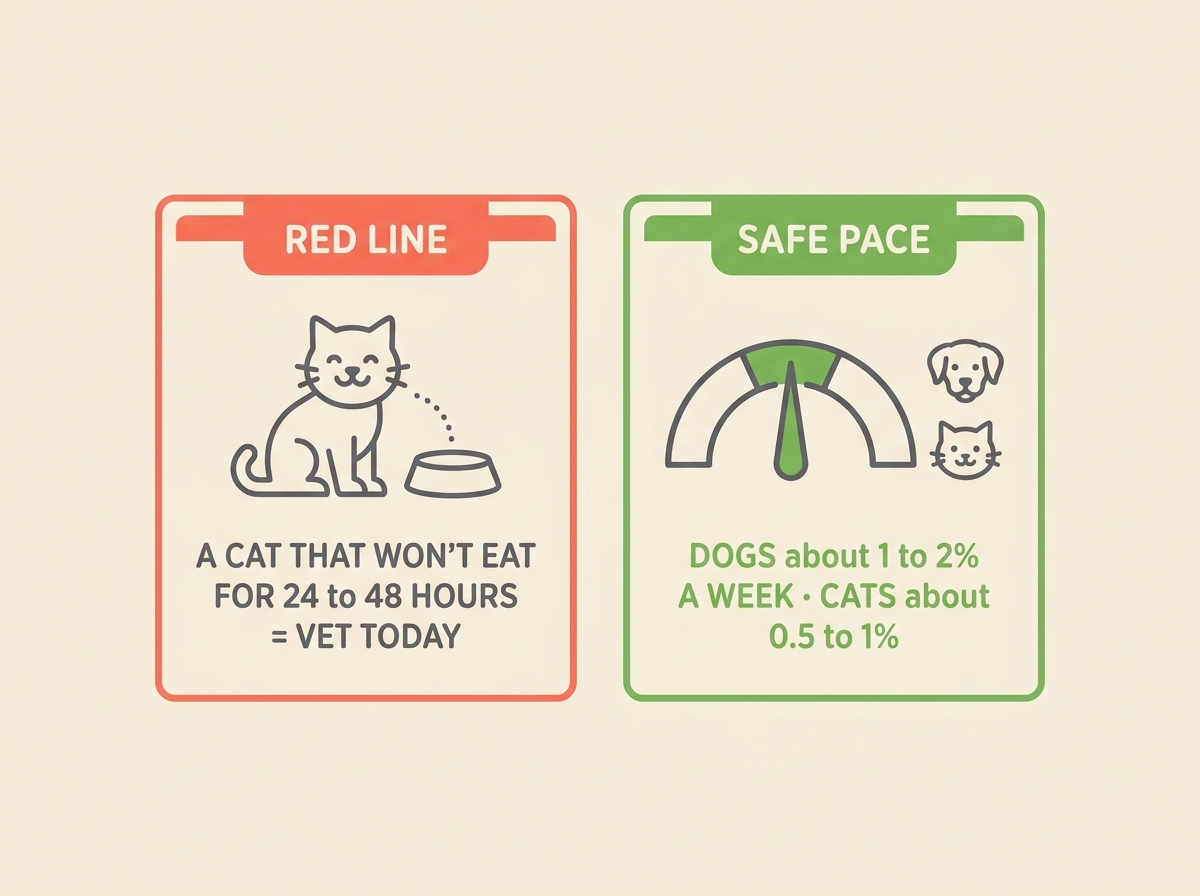
Safe, sticky weight loss is slow on purpose. For dogs it's about 1 to 2% of body weight a week, and for cats it's gentler still, about 0.5 to 1% (AAHA, 2021; APOP, n.d.). On a 30kg dog that's roughly 300 to 600g a week. On a 5kg cat it's a rough half-pound a month. Written down like that it can look disappointingly small, and that slowness is the point. Weight that comes off slowly is safer, it protects muscle, and it's far more likely to stay off than a crash.
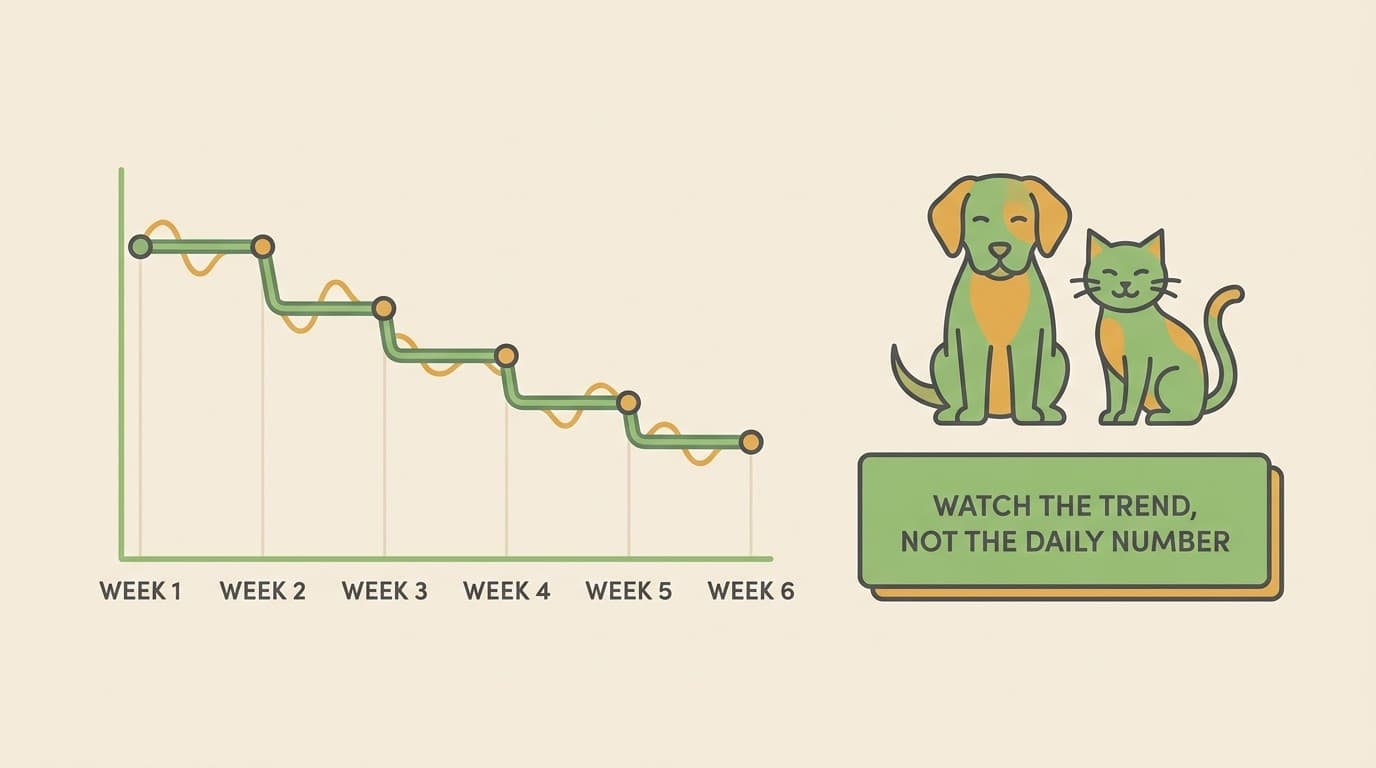
The number you read each week will not move in a tidy straight line, and you should expect that. Day to day, and even week to week, it bounces around: a full bladder, a big drink, a damp or freshly washed coat, the time you happened to weigh. Those wobbles are noise. What you're actually watching is the line over a month or so, and whether it's gently heading down. Using the same scale at the same time of day is what cuts that noise down enough to see the real trend (VCA, n.d.). One heavier week inside a month that's trending down is not a failure, it's just a Tuesday.
Plateaus happen too, where the scale flattens out for a while. That's normal and expected, not a sign you've done something wrong, so don't panic when you hit one. We've got a whole guide to busting a plateau when it happens, so flag it and read that rather than crash-cutting the food in frustration. And reading the trend instead of the daily number is itself a skill worth getting good at, which we go into properly in is it working? reading the trend, not the daily number.
One more note for genuine dieters: too fast is also a flag, not a triumph. That's true for any pet and it matters most for cats, which brings us to the one line that means stop.
The one number that means stop (cat safety)
For cats, faster is not better, and this is the one place in the whole programme where you must not push.
A cat that loses weight too quickly, or a cat that goes off its food, is at risk of hepatic lipidosis, or fatty liver. When a cat takes in far too little, the body mobilises fat to the liver faster than the liver can cope, and it can become life-threatening within days (VCA, n.d.; APOP, n.d.). This is why you never crash-diet a cat, and why slow really is the safe pace, not just the recommended one.
So here's the red line, and it's worth knowing before you ever need it. A dieting cat that won't eat for 24 to 48 hours is a vet visit today, not a successful diet (APOP, n.d.). A cat going off its food is not the diet finally working, it's the warning sign that the diet has gone wrong. If your cat stops eating, you stop the diet and you call the vet.
This is built into the tracker on purpose. The Healthy Weight Tracker flags a weigh-in that shows a cat losing too fast, for exactly this reason, so the warning reaches you before it becomes an emergency. For the full safe-cat method, the meal pattern, the protein, the slow transition, read never crash-diet a cat: the hepatic lipidosis rule.
Make tracking a habit you'll actually keep
The tracking that works is the tracking you keep up, so make it small and make it routine. Pick a day and stick to it. A Sunday-morning weigh-in before breakfast, photos on the first of the month, a quick note of the body condition score every few weeks. Set a reminder on your phone so it isn't a decision you have to make each time, and then let the trend line do the motivating. You're not chasing a perfect week, you're building a line you can look back along.
And know what each turn in that line is asking of you. When the scale stalls, that's a problem to solve, not a reason to quit, and the plateau guide is where you start. When your pet is genuinely lighter, the daily ration needs redoing, because a smaller pet needs less food, which we cover in recalculating as they shrink. And when they finally hit their target, you don't stop, you switch to keeping it there, which is switching safely to maintenance.
That's the whole job: weigh, score, photograph, and watch the line. The Healthy Weight Tracker keeps the weigh-ins, the body condition score, the side and top photos and the plateau flag in one place, so the proof that you're slimming your pet, not starving them, is always right there when the begging face needs answering.
References
- American Animal Hospital Association (AAHA) (2021). 2021 AAHA Nutrition and Weight Management Guidelines for Dogs and Cats: Weight Reduction in the Obese Pet. J Am Anim Hosp Assoc 2021;57:153-178.
- Association for Pet Obesity Prevention (APOP) (n.d.). Cat Weight Loss Information.
- VCA Animal Hospitals (VCA) (n.d.). Tips for Successful Weight Loss in Dogs and Cats.
- World Small Animal Veterinary Association (WSAVA) (2013). Body Condition Score charts (9-point scale, ideal 4-5).
Free downloads
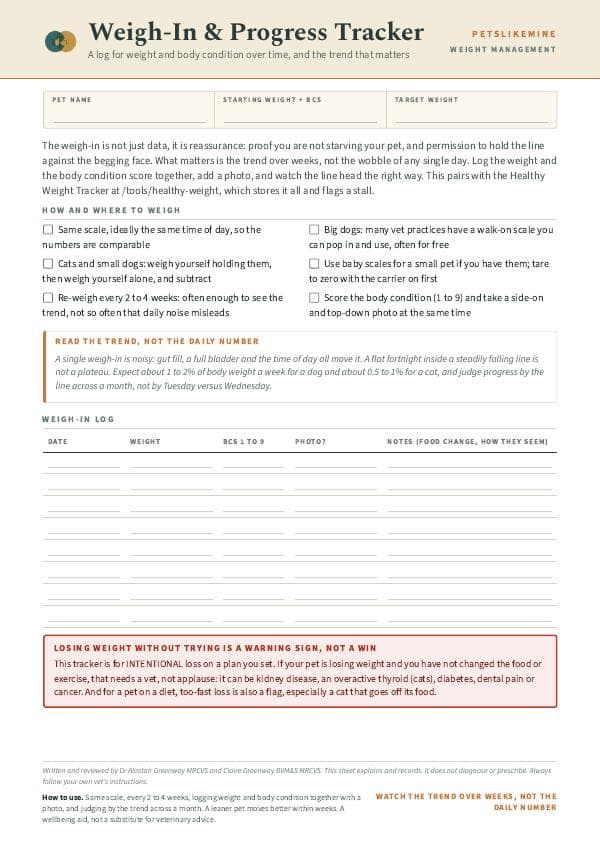
Companion worksheets to put what you've read into practice. Free PDFs, print at home.
Keep track of how your pet is doing
The owners who cope best are the ones who notice changes early. A simple health log shows you what is working, and what is not, before the next vet visit.
Start tracking, freeYou're not doing this alone
Compare treatment journeys and talk to owners managing weight management. Free to join.
Join PetsLikeMine