

The Lump You've Found: When to Worry, and Why "Wait and See" Is the Wrong Move
Alastair Greenway
BVM&S MRCVS
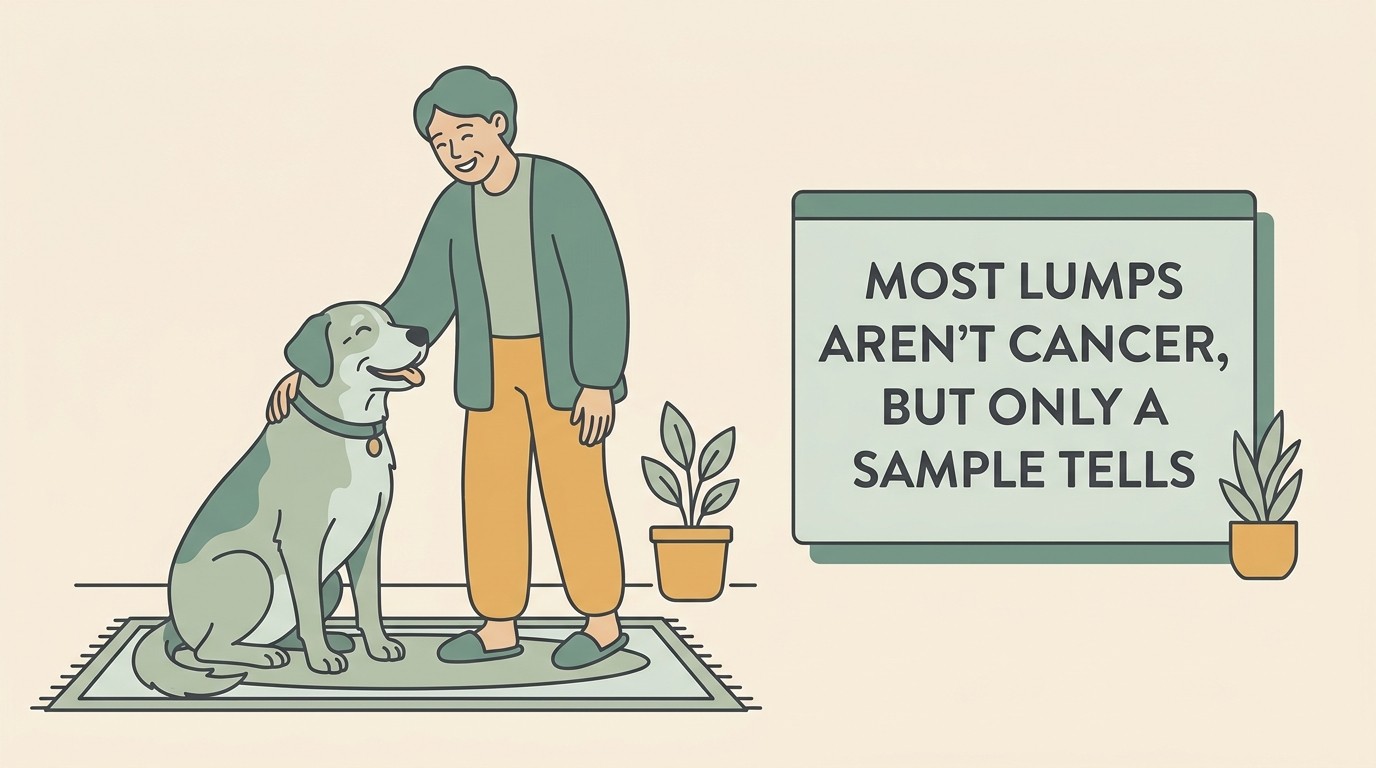
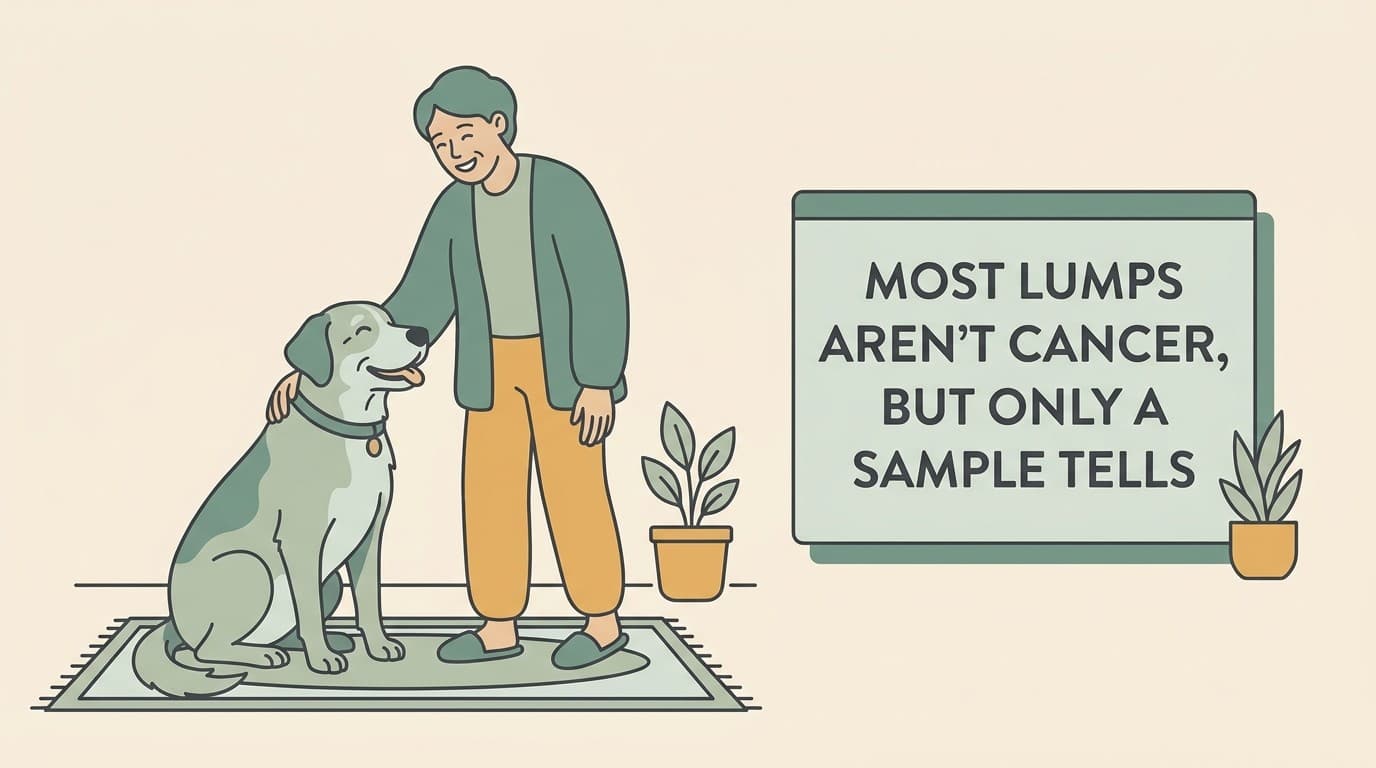
You've found a lump, and the question in your head is how worried to be. Most of the time, the answer is: less than you fear. Lumps are one of the commonest reasons owners bring a dog or cat in to us, and the large majority turn out to be harmless.
But there's one thing this page won't soften. You can't tell whether a lump is harmless by looking at it or feeling it, and neither can your vet. So the answer isn't to panic, and it isn't to keep an eye on it and hope. It's to get it sampled. Here's why, and what to do this week.
Most lumps are not cancer
Lumps and bumps get more common as dogs and cats age, and most skin lumps are benign: fatty lumps, cysts, warts and swellings that never cause a moment's trouble. The numbers bear that out. In the WSAVA "lumps and bumps" guidance, only about 20 to 40% of submitted skin masses turn out to be malignant, so most are benign (Ettinger, WSAVA 2017). A large Danish registry put a firmer figure on it: of 1,768 canine skin growths, around two thirds (66%) were benign and only about a fifth were malignant (Brønden et al., 2010). And neither figure counts the many lumps that aren't tumours at all, like cysts and abscesses.
So finding a lump isn't a reason to assume the worst or to lie awake fearing the end. It's common, it's usually benign, and even when it isn't, it's very often something that can be sorted. What it is, is a reason to get the thing checked properly rather than guessed at.
Why you can't tell by feel, and nor can your vet
There's a strong pull to read a lump like a fortune teller: soft is fine, hard is bad, loose is nothing, fixed is sinister. It feels like common sense, and it doesn't hold up. None of those features reliably separates a benign lump from a cancerous one. As the veterinary oncologist Dr Sue Ettinger puts it in the widely used "See Something, Do Something" guidance, "even the most experienced veterinarian or oncologist cannot look at or palpate a mass and know whether it is malignant or not" (Ettinger, WSAVA 2017). A soft, squishy, mobile lump that feels just like a harmless fatty lump can occasionally turn out to be the one that needed removing, and that is precisely the trap.
The only way to know what a lump actually is, is to look at its cells. Usually that means a quick, simple test called a fine needle aspirate: your vet draws a few cells out with a small needle and examines them under the microscope. There's more on what that involves in our guide to having a lump sampled. The short version: a sample tells you what a lump is, and feeling it tells you almost nothing.
When a lump should be sampled, not watched
This is why "wait and see" is the wrong instinct, even though it's the most natural one in the world. The longer a worrying lump is left, the bigger it gets, and a bigger lump is harder to remove cleanly. With many cancers the first surgery is the best chance of a cure, so a small lump caught early is far easier to deal with than the same lump three months later.
For that reason, cancer specialists use a simple, memorable threshold for when a lump should be sampled rather than watched. If it's bigger than about a centimetre, roughly the size of a pea, or it's been there for a month or more, it should be aspirated or biopsied rather than monitored (Ettinger, WSAVA 2017). You don't wait to see what it does. You find out what it is.
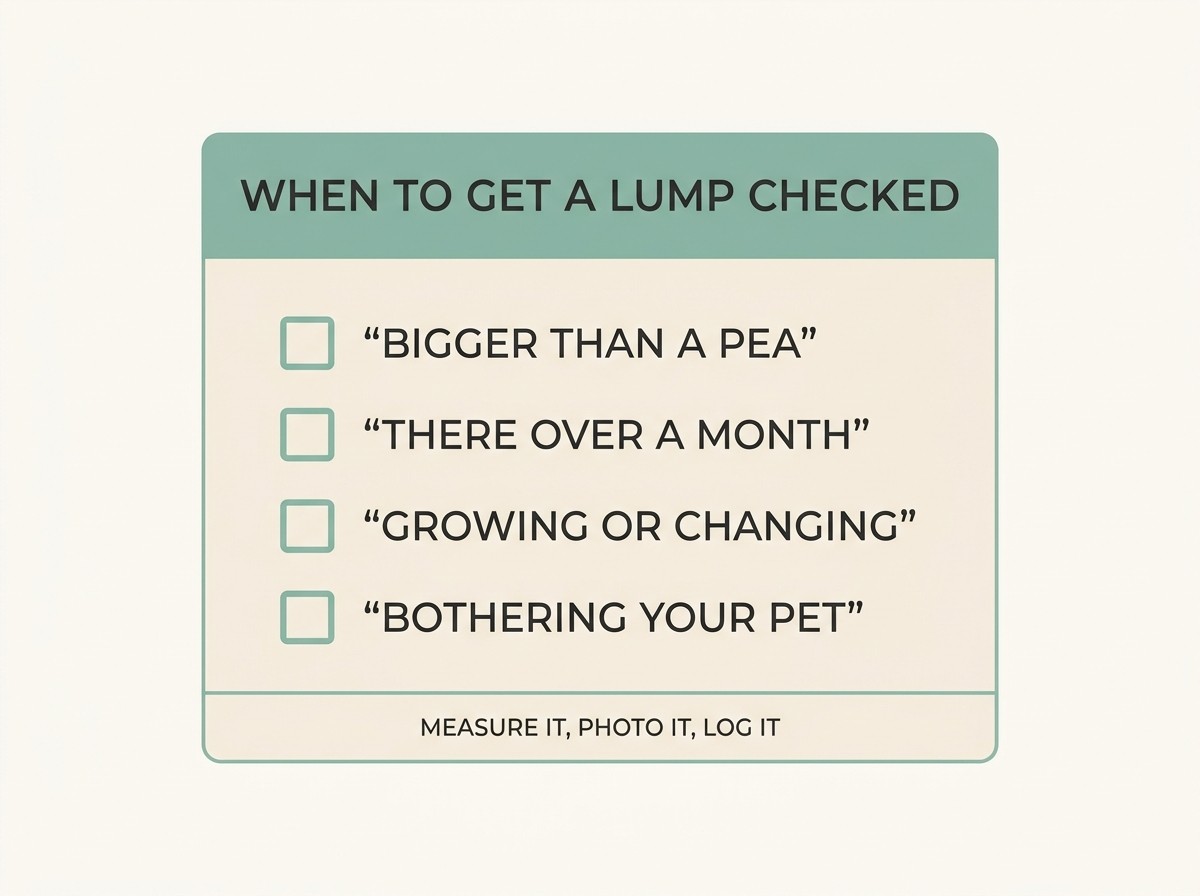
The same goes for any lump that's growing, changing, or clearly bothering your pet. Asking for it to be looked at doesn't make you a nuisance; it's exactly the right thing to do.
What to do while you wait
Waiting for an appointment doesn't have to mean sitting and worrying. A few practical things genuinely help, both you and your vet.
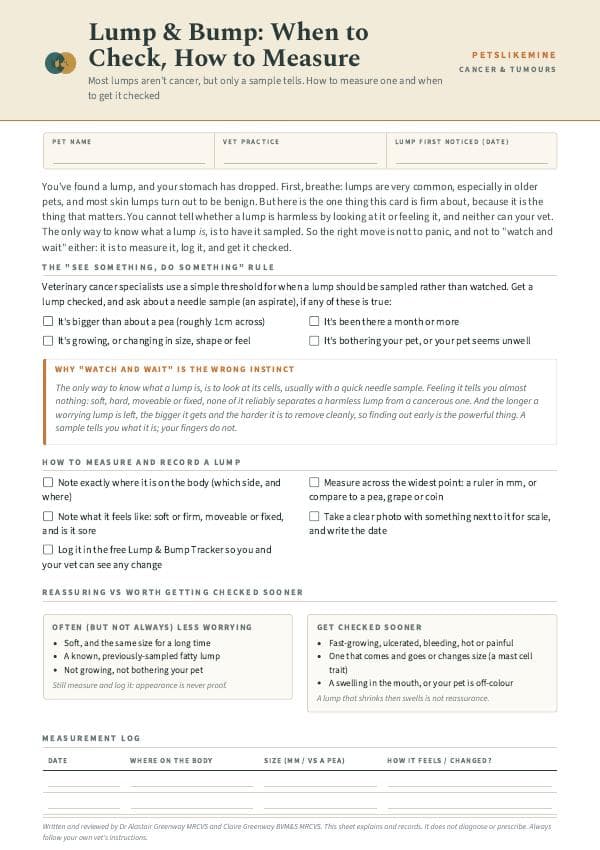
Have a proper look and a gentle feel, and note three things: where the lump is, roughly how big it is, and what it feels like. Measure it if you can, even against something familiar like a pea, a grape or a coin. Take a clear photo with something beside it for scale. Then write down the date, because the most useful thing your vet can know is whether the lump is changing, and you can only show that if you've recorded where it started.
Our free Lump & Bump Tracker is built for exactly this. You log where the lump is, measure it, add photos over time, and it keeps the history in one place, so you and your vet can see at a glance whether anything is shifting. It also flags, against the same thresholds used above, whether a lump is one to keep watching or one worth getting checked soon. It isn't a diagnosis and it never replaces a sample, but it stops you guessing in the dark while you get an appointment booked.
The lumps that shouldn't wait
Most lumps can wait the few days it takes to get a routine appointment. A handful shouldn't, so it's worth knowing which.
Get a quicker appointment if a lump is growing fast, or it's ulcerated, bleeding, hot or painful, or it comes and goes and changes size from one day to the next. That last one matters more than it sounds. A lump that swells and shrinks is classic behaviour for a mast cell tumour, sometimes called "the great pretender" because it can mimic an insect bite, a wart or a harmless fatty lump, and can swell and shrink for months (VCA; Whole Dog Journal). Owners often read the shrinking as reassurance, when it's really a reason to get it sampled. There's more in our guide to mast cell tumours.
A swelling inside the mouth needs seeing sooner too, as does any lump that's making your pet generally unwell, off their food or low in energy, or any mass that's enlarging quickly.
At the appointment
Your vet will examine the lump and, in most cases, take that quick needle sample there and then. It's usually well tolerated and rarely needs sedation. Sometimes the cells give a clear answer on the spot; sometimes the sample goes off to a lab; sometimes a small lump that's obviously benign is simply left alone with a note to watch it. If the result isn't clear, the next step may be a larger biopsy. None of that is a disaster, and all of it beats not knowing.
Whatever the lump turns out to be, the thing that actually changes the outcome is getting it checked rather than watching and hoping. Most lumps are nothing. The ones that aren't are almost always easier to deal with today than they'll be in three months. So book the appointment, log the lump so you're on top of it, and let the sample do the worrying for you.
From here you might want to read what a sample actually involves, which everyday lumps usually turn out to be harmless, or, if yours is the waxing-and-waning kind, the guide to mast cell tumours.
References
- Ettinger SN. A Practical Approach to Lumps and Bumps. WSAVA World Congress Proceedings, 2017. (Via Veterinary Information Network.) "If >1 cm (or size of large pea) and present for a month, the mass should be aspirated or biopsied"; "Even the most experienced veterinarian or oncologist cannot look at or palpate a mass and know whether it is malignant or not"; "the first surgery is the best chance for a cure."
- Ettinger SN. See Something, Do Something. Why Wait? Aspirate. dvm360, 2014. origin of the 1 cm / 1 month aspirate guideline for superficial masses in dogs and cats.
- Brønden LB, Eriksen T, Kristensen AT. Mast cell tumours and other skin neoplasia in Danish dogs - data from the Danish Veterinary Cancer Registry. Acta Veterinaria Scandinavica. 2010;52(1):6. DOI: 10.1186/1751-0147-52-6. of 1,768 canine skin/subcutaneous neoplasms, the majority (66%) were benign and 21% malignant.
- VCA Animal Hospitals. Mast Cell Tumors in Dogs. mast cell tumours as "the great pretender", variable appearance, and waxing/waning behaviour.
- Whole Dog Journal. Mast Cell Tumors in Dogs: Is It Always Cancer? mast cell tumours can wax and wane in size for months and mimic benign lumps.
- Today's Veterinary Practice. Small Animal Skin "Lumps and Bumps" Cytology. fine needle aspiration cytology as the standard first-line test to distinguish neoplastic from non-neoplastic skin lesions.
Free downloads
Companion worksheets to put what you've read into practice. Free PDFs, print at home.
Sister tool · Sightline
Track quality of life over time
Sightline, a separate ConciergeVet tool, runs a short adaptive weekly assessment with a quality-of-life focus mode built around exactly these frameworks, tracks a single composite score over time so you can see the trend rather than judge a single bad day, and produces a Sightline Report PDF you can bring to your vet.
A written log, or our printable quality-of-life sheet, does much the same job.
See how Sightline tracks quality of lifeFound a lump? Track it, and know when to act
A lump cannot be told apart by look or feel; only your vet sampling it can. The Lump & Bump Tracker records its size and how it changes, flags when it has crossed a line worth a vet visit, and builds a clean history to take in.
Open the Lump & Bump TrackerYou're not doing this alone
Compare treatment journeys and talk to owners managing cancer. Free to join.
Join PetsLikeMine