

When a Stone Causes a Blockage: The Bridge to the Emergency
Alastair Greenway
BVM&S MRCVS
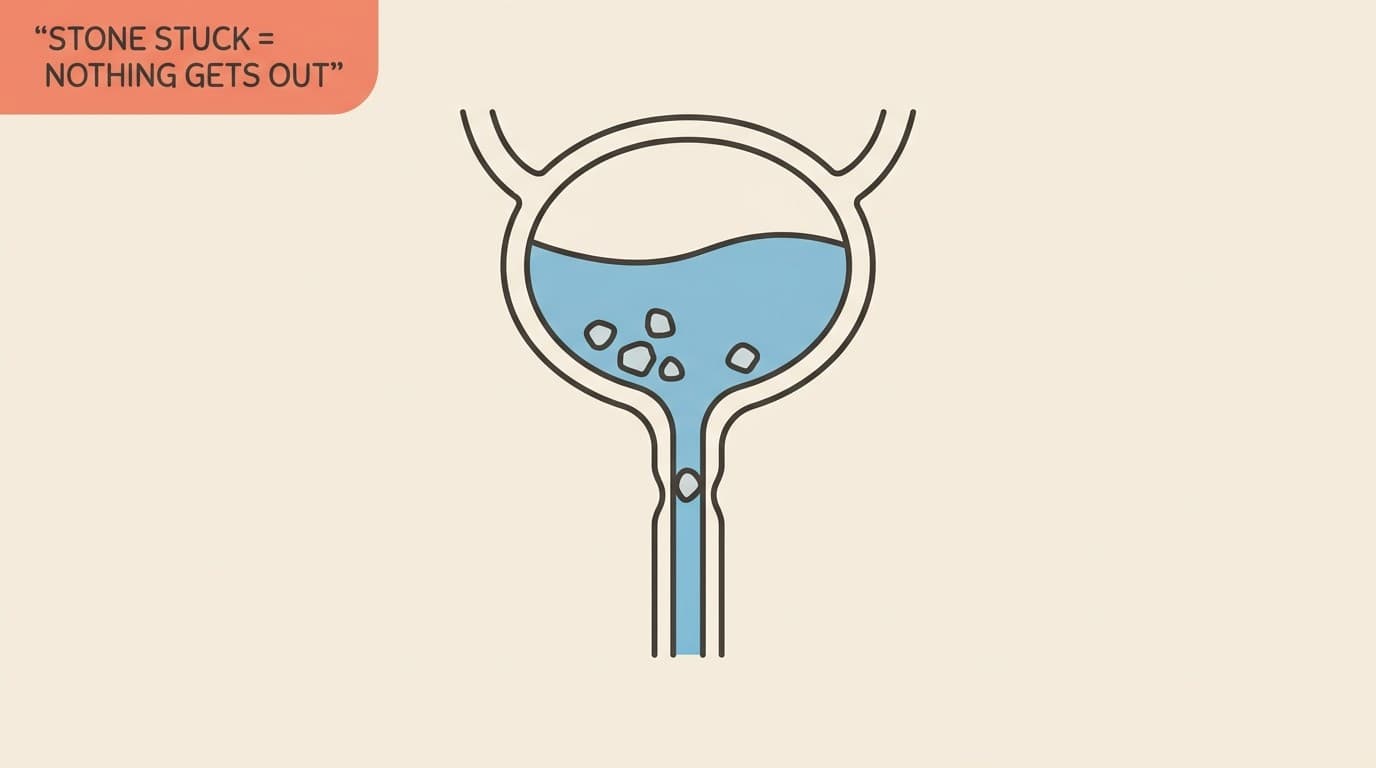
Most bladder stones sit in the bladder and cause grumbling, annoying signs: blood in the urine, frequent squatting, a bit of straining. Uncomfortable, worth treating, but not an emergency. One situation changes that completely, and it's the one every owner of a stone-forming pet needs to understand before it happens. It's when a stone leaves the bladder, travels into the urethra (the narrow tube that carries urine out of the body) and gets stuck. When that happens, urine can't get out at all, and a blockage in the urethra is a genuine, life-threatening emergency.
Once you know how a stone causes a block, you'll know which signs mean "ring the vet today" and which mean "go now, even at 3am".
How a stone in the bladder becomes a block in the urethra
A stone forms when minerals come out of solution in the urine and clump together, first into gritty crystals, then into a solid stone (we cover why this happens, and the all-important question of stone type, in the bladder-stones section anchor). While a stone stays in the wide, stretchy bladder, there's plenty of room and urine flows past it. The trouble starts when a stone, or a shower of crystals, is small enough to be swept along with the urine into the urethra. As VCA Animal Hospitals puts it, "small stones may flow with the urine into the narrow urethra, where they become lodged and cause an obstruction" (VCA Animal Hospitals).
The urethra is much narrower than the bladder, and it has natural pinch-points where even a tiny stone can jam. Once one lodges, it acts like a plug in a drain. Urine keeps being made by the kidneys, the bladder fills behind the blockage, and there's nowhere for it to go. That's the moment a stone problem becomes an emergency.
Why it's mostly males, in both species
This is the bit of plumbing that decides almost everything. In both cats and dogs, the female urethra is shorter and wider, so stones tend to pass straight out in the urine. The male urethra is longer, narrower and more curved, so a stone that would have flushed harmlessly out of a female gets trapped.
In male dogs, there's an extra trap: a small bone called the os penis sits inside the penis, and the urethra runs through a groove in it where it can't stretch. As the American College of Veterinary Surgeons describes it, within the penis "the urethra lies within a trough of bone, the os penis, and becomes narrower", so stones "will often become stuck within the urethra behind this bone, blocking the urethra" (American College of Veterinary Surgeons). Urinary stones are the most common cause of urethral obstruction in dogs, and it's the narrowing at the os penis that makes a male dog so much more likely to block than a female (ACVS).
In male cats, the urethra narrows to a very fine point near its tip, and urethral obstruction "occurs almost exclusively in male cats" (2025 iCatCare consensus guidelines). In cats, an actual stone is only part of the story. The commonest plug is a soft, toothpaste-like mix of crystals and protein-rich material that leaks from an inflamed bladder wall, often on the back of feline idiopathic cystitis rather than a true stone. As the MSD Veterinary Manual puts it, these "matrix-crystalline plugs are most commonly found within the urethra near the urethral orifice, and they are primarily responsible for urethral obstruction", and struvite is the commonest mineral within them (MSD Veterinary Manual). So a blocked cat may have a stone, a gritty plug, or just spasm and swelling. We cover the full picture of the blocked cat in the urethral-obstruction section; here, the point is simply that a stone is one of the ways it starts.
Why a blockage is an emergency, not a "tomorrow" problem
A blocked bladder doesn't just hurt. It poisons the body. With no way out, urine backs up under pressure all the way to the kidneys, the kidneys can't clear the body's waste, and the blood chemistry turns dangerous within hours. The waste-product picture (uraemia) develops "within 24 to 48 hours when UO is complete and acute" (iCatCare consensus), and the MSD Veterinary Manual puts the same window at 36 to 48 hours, leading to "coma, and death within approximately 72 hours" if nothing is done (MSD Veterinary Manual). The most dangerous change is a rising blood potassium. Hyperkalaemia "is the most common life-threatening complication and can lead to bradycardia and cardiac arrhythmias" (iCatCare consensus). Potassium, normally removed through the urine, can climb high enough to cause heart problems (ACVS). Left long enough, the bladder can even rupture.
Hold on to the timeline. A fully blocked cat can die within a day or two, and dogs "with total urethral obstruction will die within days if the obstruction is not relieved" (ACVS). This is measured in hours, not days, which is exactly why you don't wait to see if it sorts itself out.
Caught in time, though, the outlook is good. More than 90% of blocked cats that reach the vet survive to go home (Today's Veterinary Practice), with reported survival to discharge of 91 to 94% on standard catheter protocols (iCatCare consensus). The whole difference is how quickly the pet gets through the door.
Spotting a stone that has blocked
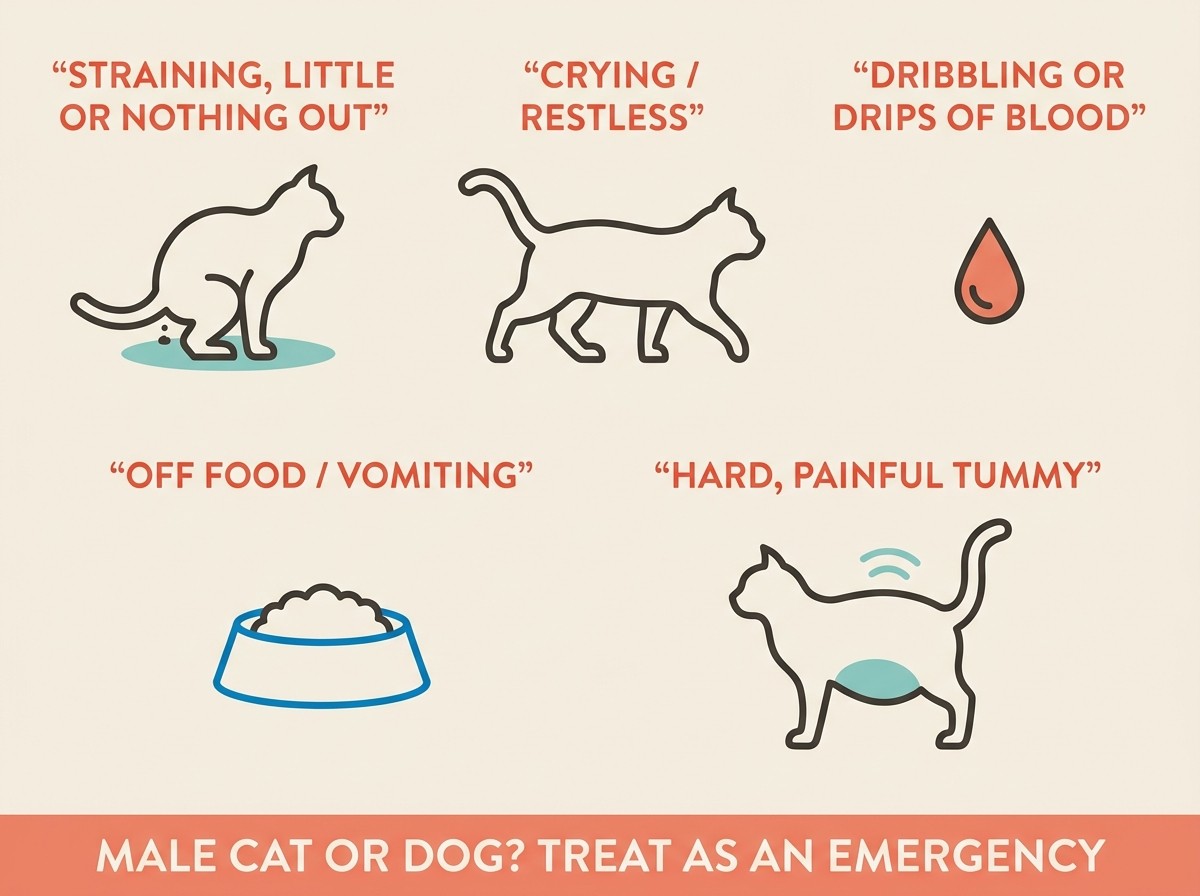
The make-or-break question is the same in cats and dogs: is your pet actually passing urine, or just trying to? A pet producing normal amounts has some time. A pet straining over and over and producing little or nothing may be blocked.
Watch for:
- Straining with little or no urine. Repeated trips to the tray or repeated squatting outdoors, with nothing or only a few drops coming out.
- Crying, restlessness or obvious pain, sometimes licking at the back end.
- A dog dribbling urine in drips instead of a stream, or drips of blood from the penis.
- Off food, vomiting, hiding or lethargy as the body chemistry turns toxic.
- A hard, painful, swollen tummy (the over-full bladder), and later, collapse.
Any of these in a male cat or male dog should be treated as a possible blockage. Don't assume it's constipation, and don't assume it's a simple urine infection, the two things owners most often mistake it for. If your pet is straining and passing little or nothing, ring your vet or the out-of-hours emergency service now, tonight if it's night. On the way in, keep your pet calm and warm, and never give human painkillers (ibuprofen and paracetamol are poisonous to pets, and dangerous to a pet whose kidneys are already struggling).
What the vet does, briefly, and why prevention matters
At the vet, a blockage is relieved under sedation or anaesthetic, usually by passing a catheter and, where possible, flushing the stone back into the bladder so urine can flow again. Most pets then need a few days on a drip to flush the kidneys and bring the blood potassium back to safe. The stone itself is dealt with afterwards: if it's struvite it may be dissolved on a special diet, but if it's calcium oxalate it can't be dissolved and has to be removed, because the type of stone decides the whole plan (see the bladder-stones section anchor, and the articles on dissolving struvite and on preventing calcium oxalate).
One caution is worth knowing. Trying to dissolve a stone in a male pet carries a small risk that a shrinking stone slips into the urethra and blocks it on the way out, which is why dietary dissolution is favoured mainly when the risk of obstruction is already low, and why your vet weighs dissolution against removal carefully in males (VCA Animal Hospitals). It's not a reason to avoid treatment, just a reason to follow the monitoring plan and watch for the signs above.
The same lever that prevents stones forming also prevents blocks: getting more water through the bladder. Dilute urine means fewer crystals and stones, and a stone that never forms can never block. So the prevention plan (more water, the right diet for the stone type, and for cats, managing the cystitis underneath it) isn't optional housekeeping. It's how you keep a future stone from ever becoming the emergency this article describes. We set out the lifelong plan in the diet-and-water article for stone-forming pets, and you can log your pet's water intake and any urinary signs in the FIC & Water tracker so you, and your vet, can see the pattern.
If you ever find yourself unsure in the moment, the Blocked-Cat / Straining-Cat triage will sort your pet's signs into "go now", "today" or "watch" in under a minute, and the blocked-cat red-flags fridge card is worth printing and sticking up where you'll see it.
References
- Taylor S, Boysen S, Buffington T, et al. 2025 iCatCare consensus guidelines on the diagnosis and management of lower urinary tract diseases in cats. *Journal of Feline Medicine and Surgery* 2025;27(2):1098612X241309176.
- MSD / Merck Veterinary Manual. Urolithiasis in Cats.
- MSD / Merck Veterinary Manual. Urethral Obstruction in Small Animals.
- American College of Veterinary Surgeons (ACVS). Urinary Obstruction in Dogs.
- VCA Animal Hospitals. Bladder Stones in Dogs.
- VCA Animal Hospitals. Struvite Bladder Stones in Dogs.
- George CM, Grauer GF. Feline Urethral Obstruction: Diagnosis and Management. *Today's Veterinary Practice*, July/August 2016.
Keep track of how your pet is doing
The owners who cope best are the ones who notice changes early. A simple health log shows you what is working, and what is not, before the next vet visit.
Start tracking, freeYou're not doing this alone
Compare treatment journeys and talk to owners managing urinary health. Free to join.
Join PetsLikeMine