

Diet and Water for a Stone-Forming Pet: The Prevention Plan for Life
Alastair Greenway
BVM&S MRCVS
Once your pet has formed a bladder stone, your vet will almost certainly have said something that lands with a small thud: this isn't really a one-off. Whether the stone was dissolved away on a diet or lifted out at surgery, the tendency that made it is still there, and the job from here is to stop the next one forming. That can feel deflating after the worry, the cost and the recovery. The genuinely good news is that prevention is mostly about two cheap, everyday things you control at home, water and food, and that getting them right tips the odds firmly back in your pet's favour.
This is the long-game article. The struvite-versus-oxalate decision and the immediate treatment are covered elsewhere in this section (see "Bladder stones in cats and dogs: the two main types" and "Dissolving struvite stones with diet"). Here is the plan you settle into for the rest of your pet's life, so the stone you've just dealt with stays the last one.
Why prevention has to be for life
A bladder stone isn't bad luck that strikes once. It forms because that pet's urine, for reasons of body chemistry, diet and how concentrated it runs, keeps tipping minerals out of solution. Remove the stone and you've cleared today's problem, but you haven't changed the chemistry, so without a plan the minerals simply start clumping again.
How likely a comeback is depends, as ever, on the stone type. Calcium oxalate is the frustrating one: in dogs, one study found new stones in around half of cases within two years of the first, which is why oxalate is managed as a lifelong condition rather than a cured event [1][2]. Cats fare somewhat better, with a large urolith-database study finding a first recurrence in well under one in ten over five years [3], but "better odds" is not "no odds". Struvite is more forgiving, because if you remove the conditions that made it (over-concentrated urine in cats, a urinary infection in most dogs) it largely stays away, but that still means a permanent routine [1][4]. So the framing that helps most is this: you're not waiting for a recurrence, you're running a quiet daily plan that makes one unlikely [5].
Water is the master lever, for every stone type
If you do one thing well, make it this. More water through the bladder is the single most important and most effective thing you can do to prevent any kind of stone, and it works for a simple physical reason: the more dilute the urine, the lower the concentration of the minerals that form crystals, and the less time they spend sitting still long enough to clump [5][6]. It costs almost nothing, and it pulls the same weight whatever the stone is made of, which is rare in stone prevention [6].
Vets put a number on "dilute enough". Urine concentration is measured as specific gravity, and the target for a stone-forming pet is to bring it down below roughly 1.020 in dogs and 1.030 in cats, well below the concentrated urine many pets produce on dry food alone [6][7]. You won't measure that at home, but it's what your vet checks at rechecks, and it's reached almost entirely through water and food rather than medicine.
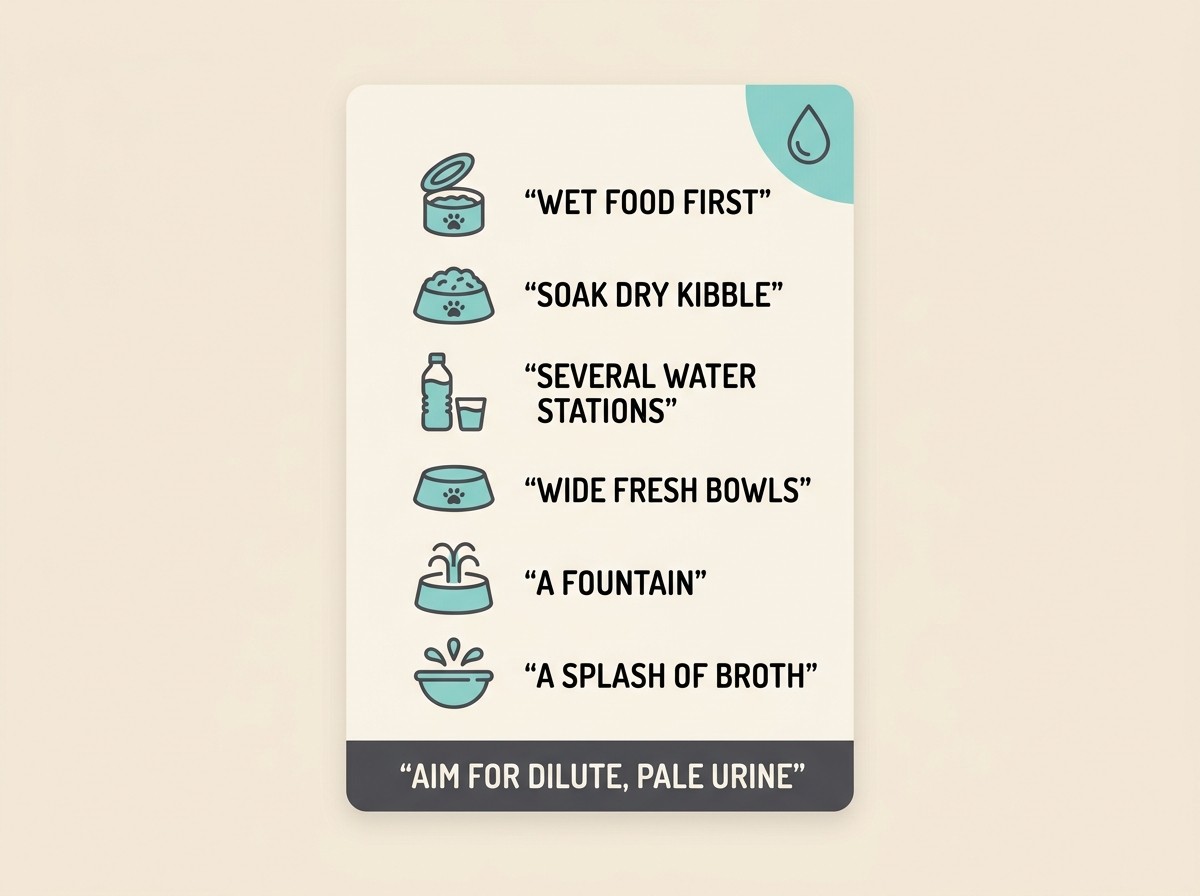
Wet food is the most powerful way to get there. Tinned and pouched food is roughly 70 to 80% water, against 9 to 12% in dry biscuits, so shifting some or all of the diet to wet pours water in through the food bowl where your pet isn't paying attention [6][7]. If your pet won't give up dry food, you can soak it: the Minnesota Urolith Center suggests soaking kibble until it floats, around one cup of water to one cup of food [7]. On top of that, the tactics are the same ones that help any fussy drinker:
- Several water stations, in quiet spots away from the food and the litter tray, topped up with fresh water daily.
- Wide, brim-full bowls, ceramic or glass rather than plastic, which many pets prefer.
- A fountain, if yours likes moving water, treated as a nice extra rather than the whole answer.
- Flavoured water, a teaspoon of salt-free, onion-free meat or vegetable broth (or a little tuna water) stirred into a bowl, which tempts a reluctant drinker without adding anything harmful [7].
There's much more, including the cat-specific tricks, in "Why getting more water in is the best thing you can do for your pet's bladder" and the water-intake boosting guide download.
Diet: the right one depends on the stone, so don't guess
The "a urinary diet for stones" shorthand falls apart right about here, which is why this part is a decision to make with your vet rather than a tub to grab off the shelf. The diet that prevents one stone can actively encourage another, so the type your pet formed sets the whole approach.
For calcium oxalate, the diet aims to keep urine dilute and not too acidic. This is the point owners most often get wrong, because the same acidifying foods that dissolve struvite are exactly wrong here, calcium oxalate crystals are less soluble in acidic urine, so a struvite diet can quietly make oxalate worse [1][2]. The right oxalate-prevention foods hold urine pH in a gentle middle range (your vet is aiming for roughly 6.5 to 7.5) and avoid loading the urine with calcium [2]. Where the urine stays stubbornly acidic, your vet may add potassium citrate to nudge it back [1][2]. Dietary salt is a nuanced point: a little extra sodium makes a pet drink and dilute, which sounds helpful, but too much pushes more calcium into the urine, so the consensus guidance is to avoid high-salt diets in oxalate formers rather than load salt in [1][2].
For struvite, prevention turns on the cause. In most dogs it's driven by a urinary infection with urease-producing bacteria, so the real prevention is catching and treating infections promptly, and your vet may want a urine culture rather than relying on a dipstick, because a culture is the only reliable way to confirm or rule out infection [9][10]. In cats, where struvite is usually sterile, prevention is a low-magnesium, mildly acidifying diet plus dilute urine [1][5]. Many pets stay on a preventive diet long-term, and if your vet recommends one, ask whether it comes as a wet food, because the wet version of the same diet produces more dilute urine and so does more work [5].
The other stones, urate and cystine, follow their own rules and are covered in "The other stones: urate, cystine and the breed and liver links". The thread through all of them is the same: dilution helps every type, but the diet is type-specific, and that's a vet decision.
What to leave on the shelf
A couple of well-meant purchases work against an oxalate-forming pet in particular. Cranberry products are the big one: marketed for urinary health, they've been shown to increase the oxalate in urine, so they're the wrong call for a calcium oxalate former [2]. Vitamin C supplements are the other: the body turns surplus vitamin C into oxalate, which is exactly the building block you're trying to keep out of the urine, so dogs and cats with an oxalate history shouldn't be given high doses [2][11]. Cats and dogs make their own vitamin C anyway, so they rarely need a supplement at all. In general, resist the urge to stack supplements: more isn't better, and some quietly shift the urine chemistry the wrong way for your particular pet, so run any supplement past your vet first if your pet has formed a stone.
Keep checking, because small stones are easy stones
Prevention isn't only what you feed; it's also catching trouble early, while it's still tiny. Your vet will want to recheck the urine and periodically image the bladder, because a stone spotted at the gritty-crystal stage can often be managed on diet and water, whereas one left to grow may mean another procedure.
A typical schedule is a urine test roughly every three to six months and imaging (an X-ray or ultrasound scan) every six to twelve months, often more frequently in the first year or for an oxalate former, where rechecks every two to three months are commonly advised at first [2][8]. It sounds like a lot, but it's how you stay ahead of the stone rather than chase it. Logging your pet's water intake and any urinary signs at home turns these visits into a real conversation: the FIC & Water tracker lets you and your vet watch the pattern over months, and the stone-prevention diet-and-water worksheet gives you the daily checklist on paper. If you ever spot blood, straining or going little and often again, get a urine sample to your vet sooner rather than wait for the next routine check (see "How to describe urinary signs to your vet, and how to collect a urine sample").
One thing must never wait, and it's why this whole section is wired to the emergency one. If your pet, and above all a male cat, is straining repeatedly and passing little or nothing, crying, off their food, vomiting or hiding, treat it as the life-threatening emergency it is and ring your vet or the out-of-hours service now [12]. A stone or a plug of grit lodged in the urethra blocks the way out, and a complete blockage can poison a cat and become fatal within about a day, so a stone-forming pet's prevention plan always includes knowing those red flags cold [12]. Male dogs can block on a urethral stone too, far less often than male cats but just as urgently. Keep the warning signs to hand (see "When a stone causes a blockage: the bridge to the emergency", "Is this an emergency? The blocked-cat signs you must not wait on", and the Blocked-Cat triage tool, and keep the blocked-cat red-flags fridge card somewhere obvious).
The plan, in one breath
Prevention for a stone-forming pet really does come down to a short, repeatable routine: keep the urine dilute with plenty of water and wet food, feed the right diet for the stone type your pet actually formed, skip the supplements that work against them, and keep the rechecks so any comeback is caught small. None of it is dramatic, and that's rather the point. The dramatic part is behind you, and the quiet daily plan is what keeps it there. If you're not sure which stone your pet formed or what their diet should be, that's the one question to settle with your vet, because everything else follows from it.
References
- Lulich JP, Berent AC, Adams LG, Westropp JL, Bartges JW, Osborne CA. ACVIM Small Animal Consensus Recommendations on the Treatment and Prevention of Uroliths in Dogs and Cats. *J Vet Intern Med.* 2016;30(5):1564-1574. (DOI: 10.1111/jvim.14559)
- Understanding and Addressing Canine Calcium Oxalate Urolithiasis. *Today's Veterinary Practice.* 2022.
- Albasan H, Osborne CA, Lulich JP, Lekcharoensuk C. Rate and frequency of recurrence of uroliths after an initial ammonium urate, calcium oxalate, or struvite urolith in cats. *J Am Vet Med Assoc.* 2009;235(12):1450-1455. (DOI: 10.2460/javma.235.12.1450)
- Hindar C, et al. 2025 ISFM/iCatCare consensus guidelines on the diagnosis and management of lower urinary tract diseases in cats. *J Feline Med Surg.* 2025.
- Queau Y. Nutritional Management of Urolithiasis. *Vet Clin North Am Small Anim Pract.* 2019;49(2):175-186. (DOI: 10.1016/j.cvsm.2018.10.004)
- Bartges JW, Kirk CA. Nutrition and Urolithiasis. *J Feline Med Surg.* 2007 (PMC).
- How to increase water intake in pets. Minnesota Urolith Center, University of Minnesota College of Veterinary Medicine.
- Canine Calcium Oxalate (prevention and monitoring recommendations). Minnesota Urolith Center.
- Struvite bladder stones in dogs. Cornell University College of Veterinary Medicine, Riney Canine Health Center.
- Weese JS, Blondeau J, Boothe D, et al. International Society for Companion Animal Infectious Diseases (ISCAID) guidelines for the diagnosis and management of bacterial urinary tract infections in dogs and cats. *Vet J.* 2019;247:8-25. (DOI: 10.1016/j.tvjl.2019.02.008)
- Tudor K. Vitamin C and Calcium Oxalate Stones. PetMD (veterinarian-authored).
- Hindar C, et al. 2025 ISFM/iCatCare consensus guidelines on lower urinary tract diseases in cats (urethral obstruction as a life-threatening emergency, near-exclusively male cats, uraemia within 24 to 48 hours).
Free downloads
Companion worksheets to put what you've read into practice. Free PDFs, print at home.
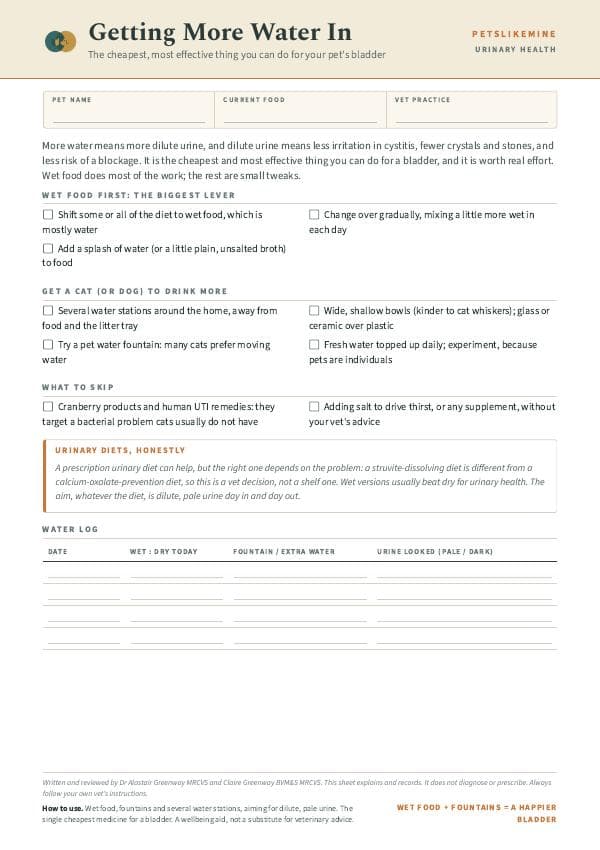
Getting More Water In
PDF · 180 KBThe cheapest, most effective thing you can do for a bladder: wet food first, fountains and water stations, what to skip, the honest take on urinary diets, and a simple water log.
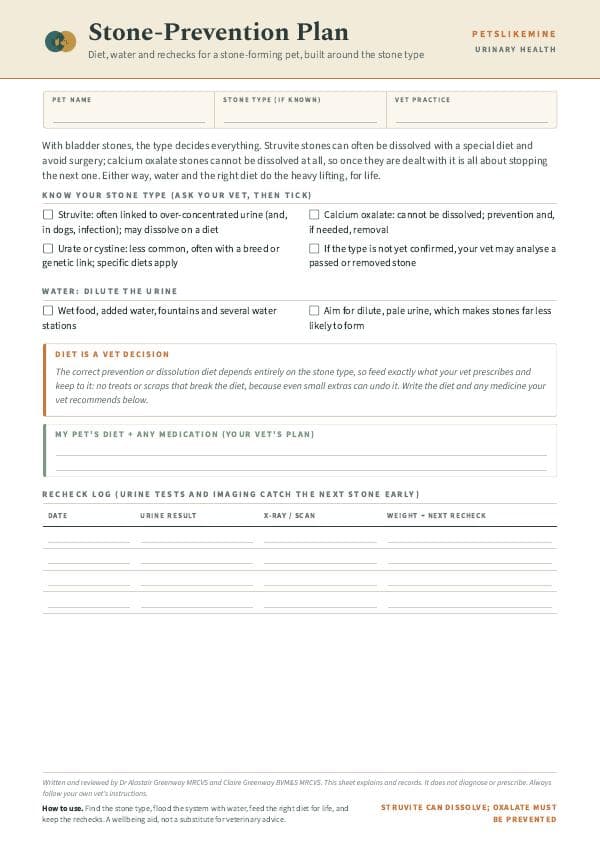
Stone-Prevention Plan
PDF · 184 KBDiet, water and rechecks for a stone-forming pet, built around the stone type: struvite can often be dissolved, calcium oxalate must be prevented. Includes a recheck log for urine tests and imaging.
Keep track of how your pet is doing
The owners who cope best are the ones who notice changes early. A simple health log shows you what is working, and what is not, before the next vet visit.
Start tracking, freeYou're not doing this alone
Compare treatment journeys and talk to owners managing urinary health. Free to join.
Join PetsLikeMine