

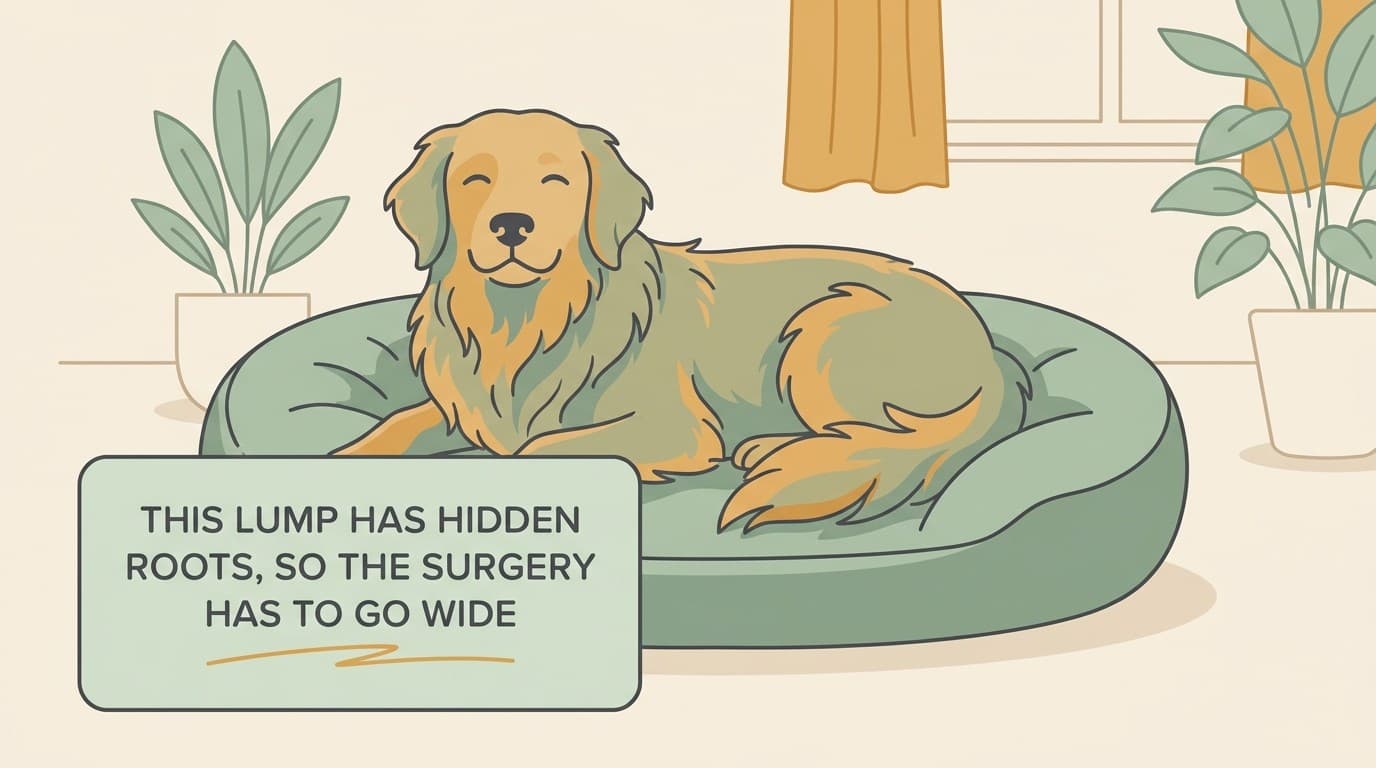
Soft Tissue Sarcoma: The Lump That Needs More Than a Simple "Lumpectomy"
Alastair Greenway
BVM&S MRCVS
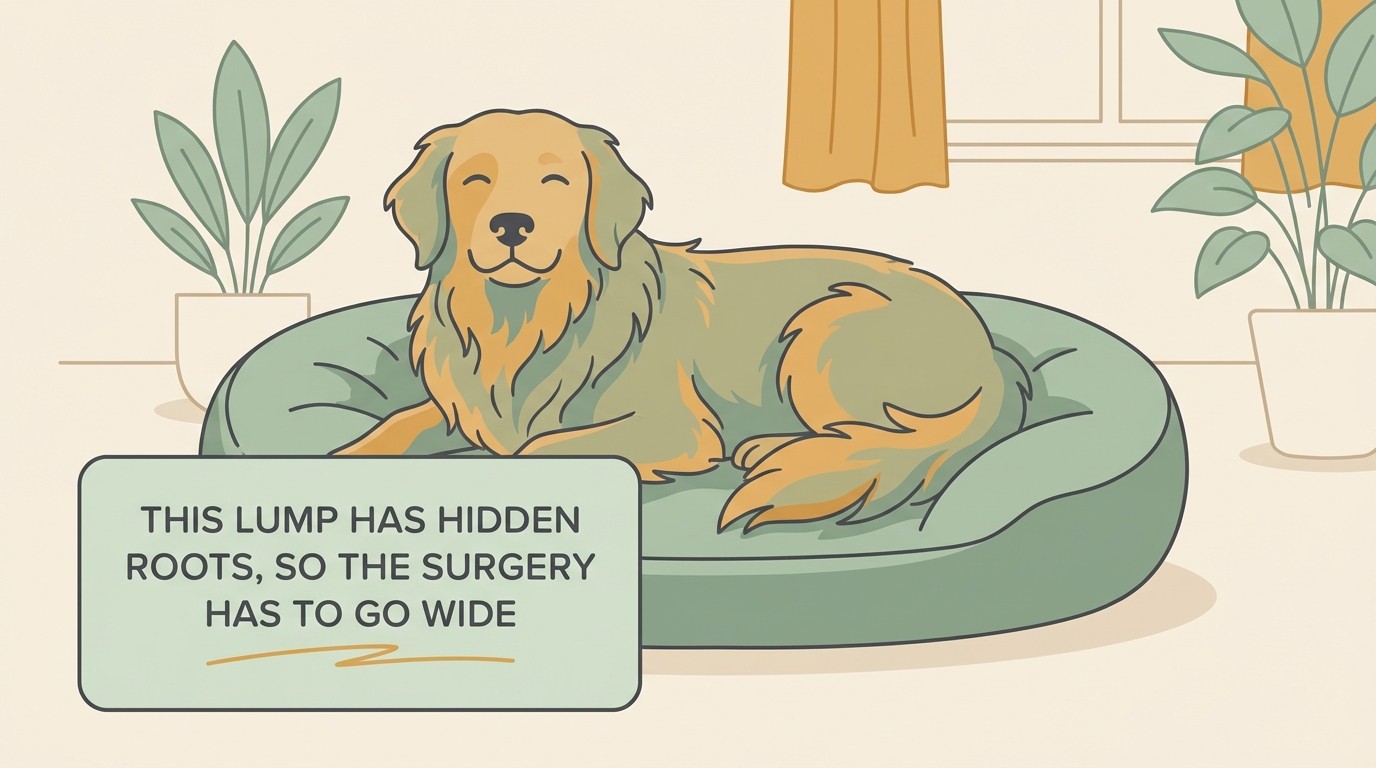
A soft tissue sarcoma usually turns up as a firm lump on a leg, a shoulder or the chest wall, sitting just under the skin and feeling neatly self-contained. It can be there a good while before anyone worries about it. Then the diagnosis comes back, and the conversation isn't the one most owners expect. Instead of "we'll pop it off", it's wide surgery, margins, and sometimes a referral. For a lump that feels so tidy, that can land as a surprise.
The headline is genuinely reassuring, though. These tumours are usually slow to spread, so for most pets the real danger isn't the cancer racing round the body. It's the lump coming back in the same spot if it isn't taken out properly the first time. Get the surgery right and the outlook for many of these is good. Below I'll explain what a soft tissue sarcoma actually is, why simply shelling it out tends to fail, what "wide margins" means, and what the grade tells you about the smaller risk of spread.
A family of tumours under one name
"Soft tissue sarcoma" isn't a single cancer. It's an umbrella term for a group of tumours that arise from the body's connective tissues: fibrous tissue, fat, muscle, blood-vessel walls and the coverings of nerves (VCA Animal Hospitals). They behave alike and they're treated alike, so vets tend to lump them together and manage them as one, even though under the microscope they carry different names: fibrosarcoma, peripheral nerve sheath tumour (you may hear the older name "schwannoma"), perivascular wall tumour (once called haemangiopericytoma), liposarcoma, myxosarcoma and others (VCA Animal Hospitals).
They're not rare. Soft tissue sarcomas make up roughly 15% of skin and under-skin cancers in dogs, and about 7% in cats (VCA Animal Hospitals). They usually appear as a firm mass on or just beneath the skin, often on a limb or the trunk, and they're typically not painful, which is one reason they get left.
Where a simple "lumpectomy" comes unstuck
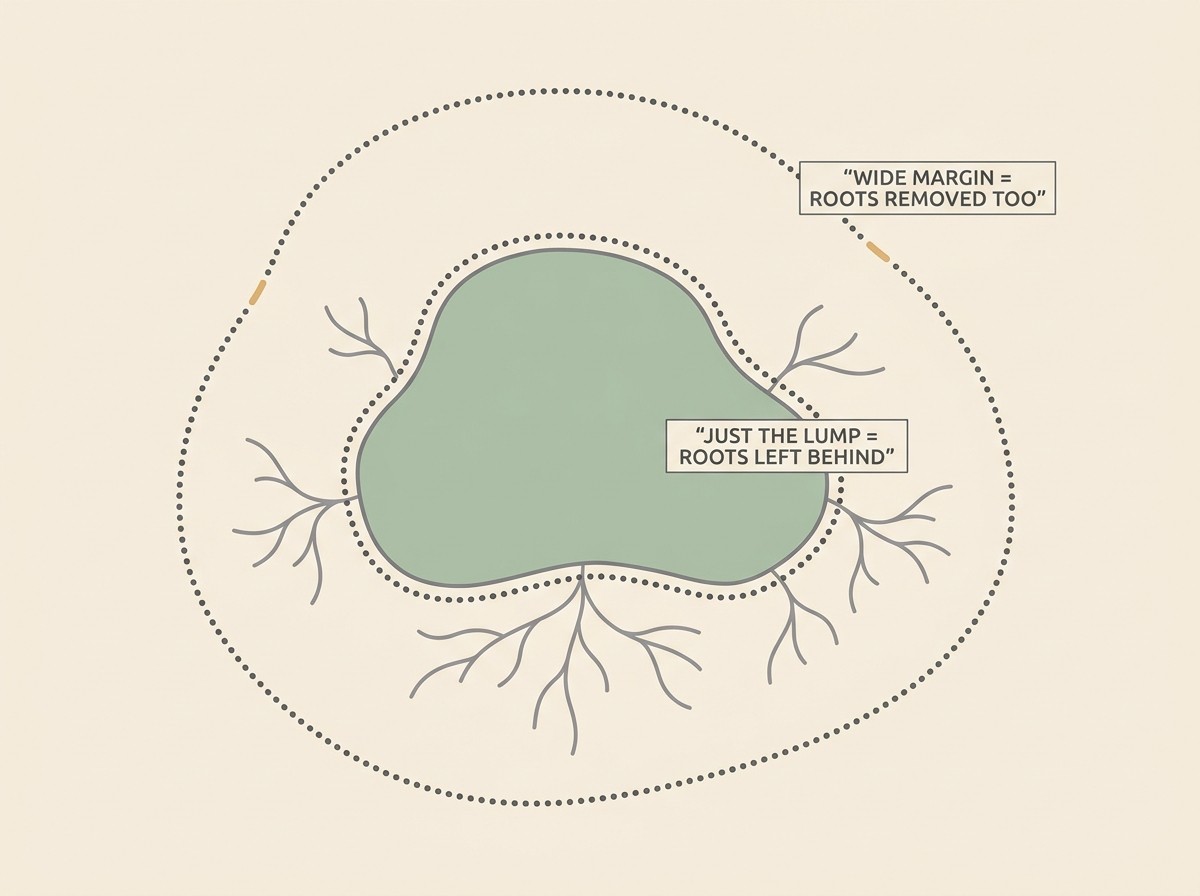
This is precisely where a routine "just take the lump off" approach goes wrong, and the figures make the case plainly. Local recurrence is around eleven times more likely after an incomplete (marginal) removal than after a complete one, and when these tumours do come back after a shell-out they come back fast: one set of figures puts the median time to first recurrence at about 79 days after a marginal removal, against roughly 325 to 419 days after a proper wide or radical operation (dvm360, Multimodality proceedings).
A study that tracked recurrence by how clean the edges were fills in the larger picture. Three years on, the cancer had returned locally in about 41% of dogs whose margins were "infiltrated" (cancer reaching the cut edge), in about 23% where the margins were clean but close, and in just 7% where the margins were properly tumour-free (Chiti et al., 2021). The operation goes by the same name in each case. The outcomes differ enormously, settled by how much normal tissue came out with the lump.
The aim, then, isn't to remove the lump. It's to remove the lump plus a cuff of normal-looking tissue all around and beneath it, working on the assumption that the invisible roots are hiding in there. That cuff is the "margin", which is why your vet keeps coming back to the word. We cover what clean and dirty margins mean, and why the first surgery is the best chance, in our guide to cancer surgery.
"Wide margins", in practice
A wide excision for a soft tissue sarcoma means taking a cuff of normal tissue to the sides of the lump, scaled to how aggressive the tumour is (commonly around 2 to 3cm for a low- or intermediate-grade tumour, wider for a high-grade one), and going one full layer of fascia or muscle deep rather than stopping at the fat just beneath it, since fat is a poor barrier to the spreading cells (Cannon & Ryan, 2018). On a leg that's a meaningful amount of tissue, which is why these operations run bigger than owners expect and why awkwardly placed tumours are sometimes sent on to a surgical specialist.
One cat tumour is worth flagging on its own. A feline injection-site sarcoma is a soft tissue sarcoma that behaves far more aggressively than most, so it needs much wider, radical surgery, often with margins of around 5cm, and the first operation counts for even more (Cannon & Ryan, 2018). We cover that one separately, because its message runs differently. For most other soft tissue sarcomas in cats, the approach matches dogs (Cannon & Ryan, 2018).
Grade: the small print on spread
If recurrence is the local worry, whether the cancer travels to the rest of the body comes down to grade. After surgery the lump goes to a pathologist, who grades it from 1 to 3 (low, intermediate, high) on how aggressive the cells look (VCA Animal Hospitals).
Here's the encouraging part. Most soft tissue sarcomas are low or intermediate grade, and for those the risk of spread is genuinely low, generally under about 15 to 20% (Cannon & Ryan, 2018). High-grade (grade 3) tumours are the minority, somewhere around 7 to 17% of cases, and they're the ones that behave badly, spreading in roughly 40 to 50% of dogs, usually to the lungs (PetMD; Cannon & Ryan, 2018). The lesson is the familiar one in cancer care: the grade, rather than the word "sarcoma", tells you which animal you're actually dealing with.
Treatment, and the genuinely good news
For a low- or intermediate-grade soft tissue sarcoma that's fully removed with clean margins, often nothing more is needed. The cancer in that spot is gone, and recurrence is uncommon. That's the outcome we're aiming for, and for many pets it's exactly what happens.
When surgery can't get a clean margin, because of where the tumour sits, the next step is usually one of two things: a second, wider operation, or a course of radiation therapy to mop up the microscopic cells left behind (VCA Animal Hospitals). Radiation works well here. In one study of dogs whose sarcomas were incompletely removed and then irradiated, the five-year survival rate was 76%, with most dogs free of regrowth for years (McKnight et al., 2000), so an imperfect surgery is a long way from the end of the road.
Chemotherapy plays a smaller part and is generally held back for high-grade tumours, where the risk of spread is real, rather than used as a first-line treatment for the lump itself (VCA Animal Hospitals; PetMD).
What to do now
Ask the two questions that decide everything: what grade is it, and were the margins clean. Those two answers carry almost the whole story, the chance it comes back locally and the small chance it spreads, far better than the size or feel of the lump ever could.
The other thing is to resist the urge to "just have it whipped off" at the first opportunity. With a soft tissue sarcoma the first operation is the one most likely to get it all, so it's worth a sample beforehand and a proper plan, even if that means a short wait or a referral. That patience is what turns this from a lump that keeps coming back into one that's dealt with once. If you've found a new lump, our piece on the lump you've found is the place to start, and for the bigger picture, our guide to what grade and stage really mean puts all of this in context.
References
- VCA Animal Hospitals. Soft Tissue Sarcomas. Soft tissue sarcomas arising from connective, muscle and nervous tissues; making up "about 15% of cancers of the skin affecting dogs and about 7% of those affecting cats"; the "octopus" description of the bulk of the tumour as the head and the invading microscopic cells as the tentacles; surgery as the main treatment with wide margins because recurrence is "much more likely" if microscopic cells are left; second surgery or radiation for incomplete margins; grading I to III with higher grade meaning spread is more likely; chemotherapy not usually a primary treatment.
- Cannon C, Ryan S. Soft Tissue Sarcomas in Dogs and Cats. WSAVA World Congress Proceedings, 2018 (VIN). STSs having "microscopic projections at their periphery invading surrounding normal tissues" and the most active cells sitting at the pseudocapsule margin; deep margin of fascia or muscle rather than adipose tissue; metastatic potential <15-20% for grade 1 and 2 and up to 40-50% for grade 3; recurrence with narrow margins approximately <10% (grade 1), one third (grade 2) and three quarters (grade 3); feline injection-site sarcoma being more aggressive and requiring radical ~5cm margins, while other feline STS are managed as in dogs.
- Chiti LE, Ferrari R, Roccabianca P, Boracchi P, Godizzi F, Busca GA, Stefanello D. Surgical Margins in Canine Cutaneous Soft-Tissue Sarcomas: A Dichotomous Classification System Does Not Accurately Predict the Risk of Local Recurrence. Animals (Basel), 2021;11(8):2367. Three-year cumulative incidence of local recurrence of 41.2% (infiltrated margins), 22.5% (clean but close margins) and 7.1% (tumour-free margins); cites pooled literature local-recurrence rates of about 9.8% with tumour-free margins versus 33.3% with infiltrated margins.
- McKnight JA, Mauldin GN, McEntee MC, Meleo KA, Patnaik AK. Radiation treatment for incompletely resected soft-tissue sarcomas in dogs. Journal of the American Veterinary Medical Association, 2000;217(2):205-210. (PMID 10909459). Five-year survival rate of 76% in 48 dogs with incompletely resected soft-tissue sarcomas treated with postoperative radiation; tumour recurrence after radiation in 8 dogs (17%).
- PetMD. Soft Tissue Sarcoma in Dogs. STS having "arm-like structures that extend outward" making complete removal challenging; grade 3 spreading in "40 to 50% of cases" with grade 3 only 7-17% of cases; recurrence after surgery in 7-30% of grade 1-2 cases; chemotherapy "most often suggested for dogs with Grade III soft tissue sarcoma".
- dvm360. Multimodality approach to soft tissue sarcomas in dogs and cats (Proceedings). Local recurrence approximately 11 times more likely after incomplete versus complete excision; median time to first recurrence approximately 79 days after marginal resection versus 325-419 days after wide or radical resection.
Sister tool · Sightline
Track quality of life over time
Sightline, a separate ConciergeVet tool, runs a short adaptive weekly assessment with a quality-of-life focus mode built around exactly these frameworks, tracks a single composite score over time so you can see the trend rather than judge a single bad day, and produces a Sightline Report PDF you can bring to your vet.
A written log, or our printable quality-of-life sheet, does much the same job.
See how Sightline tracks quality of lifeFound a lump? Track it, and know when to act
A lump cannot be told apart by look or feel; only your vet sampling it can. The Lump & Bump Tracker records its size and how it changes, flags when it has crossed a line worth a vet visit, and builds a clean history to take in.
Open the Lump & Bump TrackerYou're not doing this alone
Compare treatment journeys and talk to owners managing cancer. Free to join.
Join PetsLikeMine