

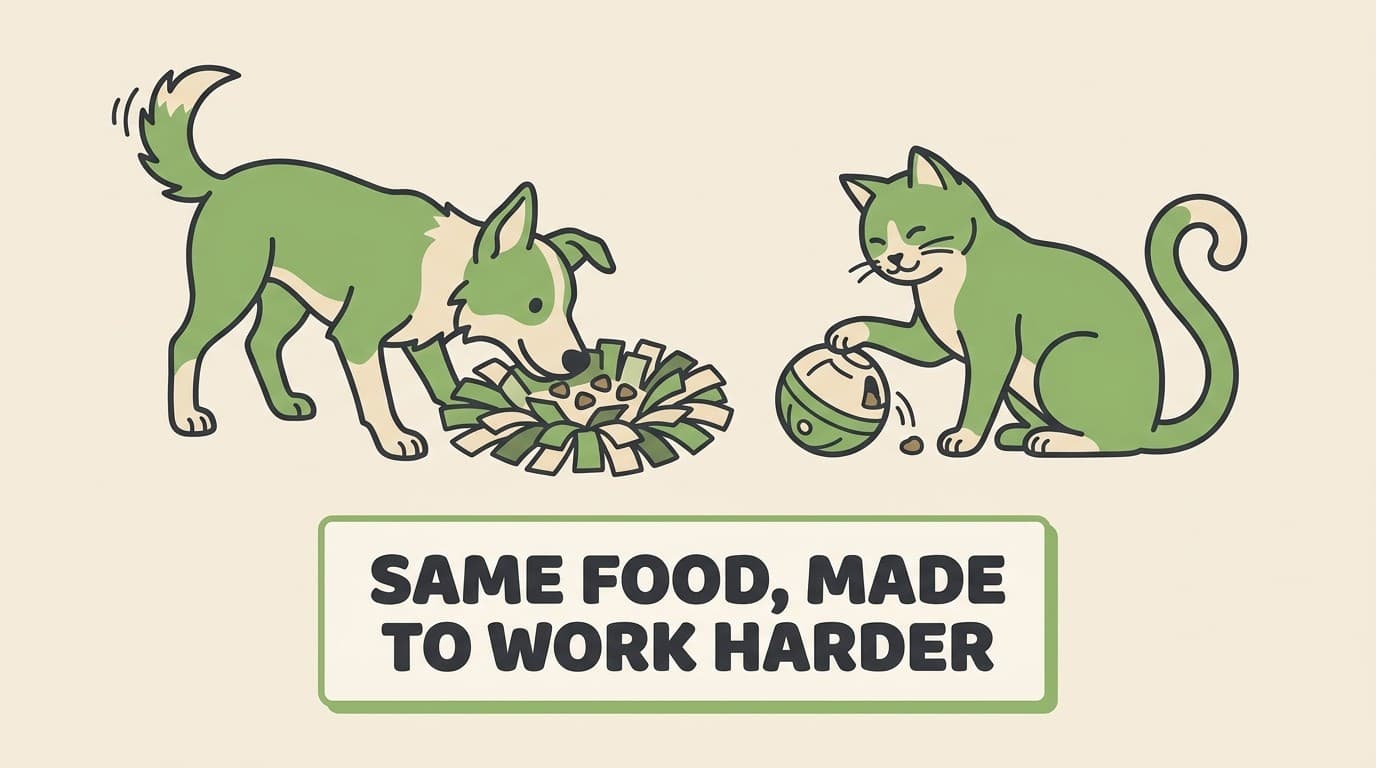
Slow feeding and foraging: making food work harder
Alastair Greenway
BVM&S MRCVS
Make the same food go further (it's not extra food)
A smaller bowl goes down in ten seconds, and then come the staring, the pawing and the sad little sit by the cupboard. It's easy to feel like you've short-changed your pet. You haven't, and the fix isn't more food. It's making the food they already get harder to get.
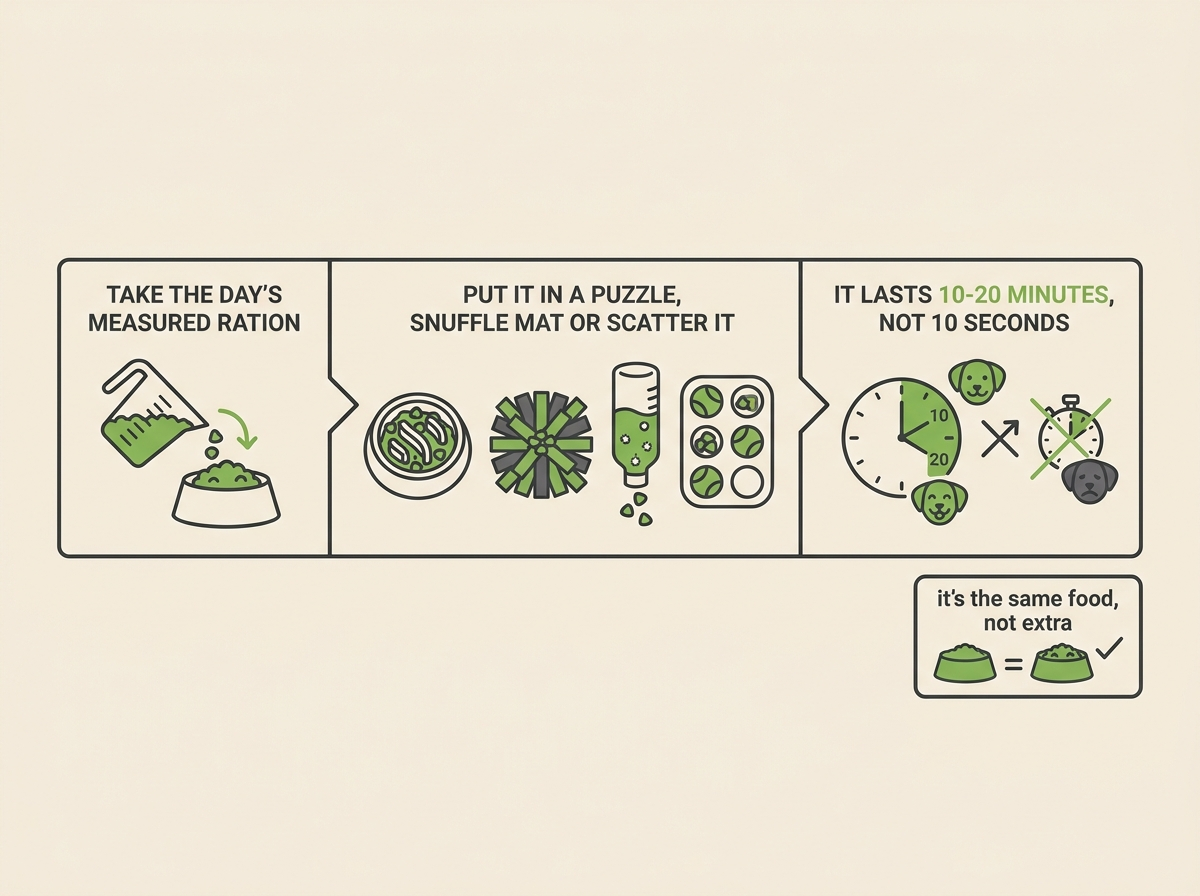
Take the day's measured ration, the exact amount you worked out, and instead of tipping it into a bowl, spread it into a puzzle, a snuffle mat, a scattered "treasure hunt" or a slow feeder. A ten-second gulp becomes ten or twenty minutes of sniffing, pawing, nudging and working. The same grams. A completely different experience.
That does four useful things at once. It slows the bolting. It burns a bit of mental and physical energy. It eases the begging and the boredom that a cut ration brings. And it makes a smaller portion feel like more, because the eating takes real time and effort.
This is the same food, from the same daily allowance, just portioned out differently. It is never a top-up and never extra. The puzzles are filled from the ration you already measured, not in addition to it. If you're not sure what that ration is, that's the Feeding Calculator and the article on how much to actually feed. Anything tasty you tuck inside a toy still counts inside the day's treat budget. Get that rule right and everything below is one of the easiest wins in the whole programme.
Why working for food helps a dieting pet
It's worth knowing why this works, because it's not magic and it's not really about burning calories. There are three mechanisms.
First, it slows the gulp. A fast eater inhales a bowl and feels cheated the moment it's empty. Spread the same food thin and make it fiddly, and those grams take genuine minutes to win. That feels far more satisfying, and in dogs it eases the wind and discomfort that come with bolting a meal. Fast eating is also one of the recognised risk factors for bloat, or gastric dilatation-volvulus, in large and deep-chested dogs (Glickman et al., 2000). Slowing the gulp may reduce that one factor. To be straight with you, though, a slow feeder does not prevent bloat, so treat this as a helpful side benefit, not a safety guarantee.
Second, it spends energy and eases boredom and begging. An under-occupied pet that feels under-fed has nothing to do but pester. Foraging and problem-solving give it a job. In kennelled dogs, a food-stuffed toy increased active, appetitive behaviour and reduced barking compared with a plain bowl (Schipper et al., 2008). An occupied pet bothers the bowl, and you, a good deal less. That ties straight into handling begging and food obsession, which is really about spending that energy rather than caving to it.
Third, it brings out natural behaviour, which is good for mood as well as waistline. Food puzzles weren't invented for diets at all. They were originally created to enrich captive zoo and laboratory animals (Dantas et al., 2016). Dogs and cats are built to work for food, to hunt and forage, and giving that back is a welfare win in its own right. The same review notes that providing food puzzles has been shown to increase activity and reduce problem behaviour in dogs, and documents real cats losing weight on them, one older cat shedding 6.4% of its body weight in three and a half months with improved mobility, alongside less meowing for food (Dantas et al., 2016).
There's a genuine species split worth flagging, and it's the one the veterinary guidelines themselves draw. Feeding toys can positively affect activity level in dogs, while in cats the benefit is more about enrichment and behaviour modification than calorie-burning (Cline et al., 2021). So for a dog, you're adding a little movement and a job. For a cat, you're mostly adding interest and easing the frustration of a smaller ration. Either way, the value is making portion control liveable, not melting fat. The bowl does the slimming. This makes the bowl bearable.
What to use: dogs, cats and the free DIY versions
None of this needs a shopping trip. The ideas that cost nothing are worth starting with, because they work just as well as anything on a shelf.
Scatter feeding is the simplest. Toss the measured ration across a clean floor, a towel or, on a dry day, the lawn, and let your pet nose it out like a treasure hunt. A folded towel with kibble rolled inside it makes an instant snuffle mat. A plastic bottle with a few holes punched in the sides, lid off, becomes a rolling dispenser that drops kibble as it's nudged. A muffin tin with a piece of kibble in each cup and a tennis ball sitting on top makes your pet lift each ball to get the food. An egg box, or a cardboard box loosely stuffed with scrunched-up paper and the day's biscuits, turns a meal into a rummage. All free, all using food you already own.
If you'd rather buy something, the useful categories are slow or maze bowls, which turn a gulp into a graze around raised ridges; snuffle mats, which hide kibble in fabric to nose out; and food-dispensing or puzzle toys, from wobblers and rolling balls to stuffable rubber toys. The type matters far more than the brand.
For dogs, rolling and wobbler toys and snuffle mats tend to suit them well. A particularly good trick for making a meal last is to pack a stuffable rubber toy with their measured wet food and freeze it. Frozen solid, it can keep a dog happily busy for a long stretch, which is brilliant for the gap when the rest of the family is eating. Think of this as the indoor partner to the walks in exercising an overweight dog, the mealtime job that ticks over on the days a long walk isn't on.
For cats, match the puzzle to the food. Mobile puzzles shaped like balls, eggs or tubes are designed for dry food or treats, while stationary puzzles with sturdy bases and wells can hold wet food (Dantas et al., 2016). Cats also love to climb and search, so scatter small measured portions up high, on a cat tree or a shelf, so she has to seek them out. There's much more on indoor-cat enrichment and play in getting an indoor cat moving, which hands the foraging detail over to this article. And if your pet can't do much physical exercise because of sore joints, age or a heart condition, foraging is ideal, because it spends mental energy without the impact, which is exactly the angle in slimming when exercise is limited.
Whatever you pick, match the difficulty to the individual pet, and start easy. Which brings us to the catch.
Start easy, then make it harder (the catch)
There's one thing the gadget marketing skips, and it matters.
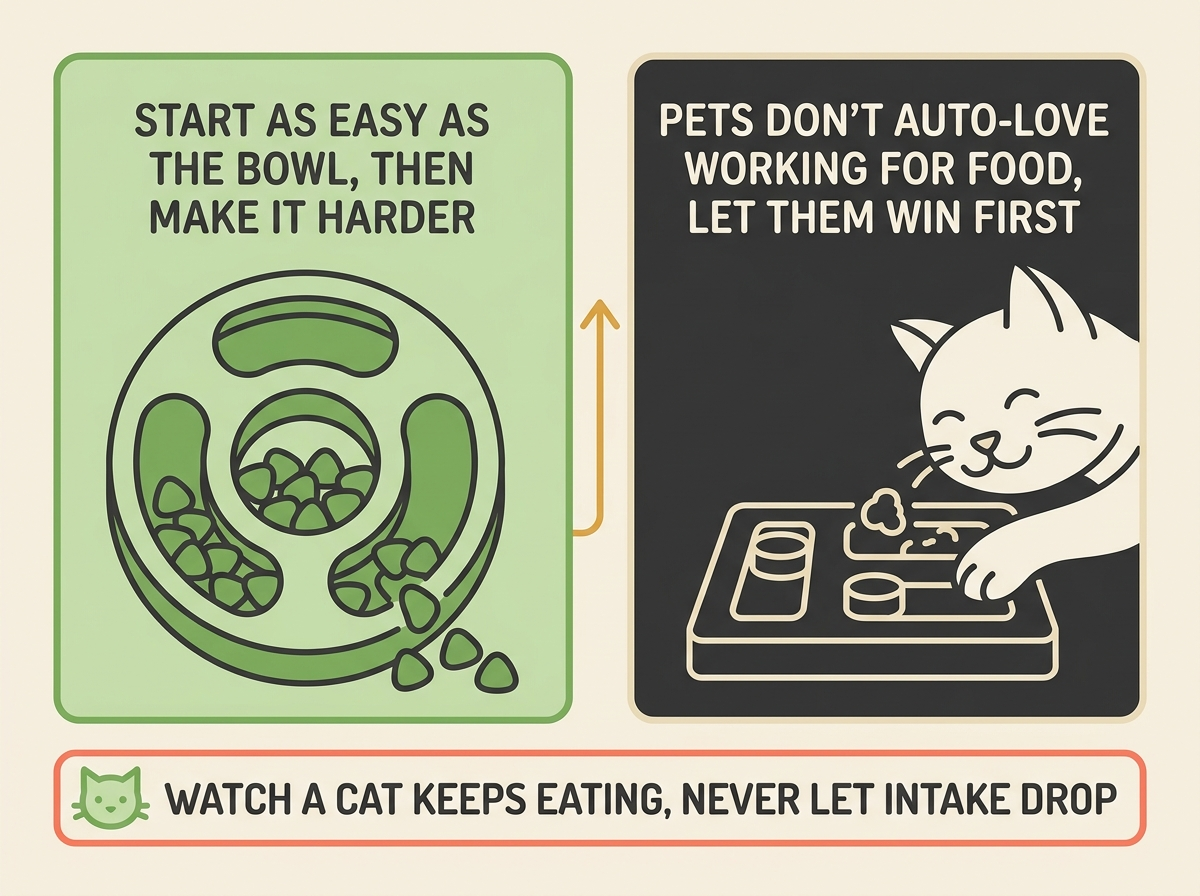
Pets do not automatically prefer to work for their food. Offered a puzzle and a free bowl of the same food side by side, cats reliably choose the free bowl (Delgado et al., 2022), and dogs show no preference to contrafreeload either, although they're perfectly willing to do it (Rothkoff et al., 2024). So a puzzle thrown in cold, set too hard from day one, can mean a frustrated pet, a walked-away meal, or, in a cat, a worrying skipped meal.
The answer is to introduce it as easy as the bowl. On day one, fill the puzzle generously and use big openings so food falls out almost for free (Dantas et al., 2016). Let your pet win, immediately and easily, so the thing becomes rewarding rather than annoying. Once they've got the hang of it over a few days, you gradually make it harder, smaller holes, more of the food held back, a trickier toy. You're building a skill, not setting an exam.
A few safety notes, kept proportionate. Supervise chews and any DIY items, because a swallowed bottle cap, a chewed-off chunk of plastic or a mouthful of fabric is a real hazard. Wash puzzles and bowls regularly, since wet food and saliva in crevices go off. And there's one cat-specific watch point that genuinely matters.
With a cat, keep an eye on whether she's actually eating the ration, not just whether the bowl looks emptier. The danger with cats is the one that quietly opts out. A cat that finds a puzzle too much like hard work, gets fed up and simply eats less is not on a successful diet, she's at risk. Intake must never drop. An overweight cat that goes off her food and won't eat for 24 to 48 hours is a hepatic lipidosis emergency, a vet-today situation, not a fast diet. There's the full safe-feeding picture in never crash-diet a cat, and it's worth reading before you puzzle-feed a cat. If your cat isn't taking to a puzzle, go easier or go back to the bowl. Never let foraging become a reason she eats less than she should.
Fit it into the plan
Enrichment feeding is portion control made bearable. It is not a licence to feed more, and it is not a calorie-burner that lets you skip the maths. The slimming comes from the measured ration. This just makes that ration easier to live with for both of you.
Work out the day's allowance with the Feeding Calculator, then portion that allowance into the puzzles, mats and scatter feeds instead of the bowl. Hold your treat budget while you're at it, kibble puzzled from the ration is free, but anything tasty you stuff into a toy counts inside the 10%. When the begging starts, spend that energy here, on a puzzle, rather than caving to the begging. And let the Healthy Weight Tracker show you that the smaller, harder-won ration really is working, week by week. If you want ready-made ideas for the fridge, the foraging and food-puzzle download lays out the free DIY versions, the plastic bottle, the muffin tin, the egg box and the towel snuffle mat.
The reassurance to leave you with is this. You don't have to feed more to stop the staring. The same food, made to work harder, slows the gulp, fills the time, eases the begging and gives your dog or cat a job they're built to enjoy. It's quietly one of the easiest wins in the whole programme.
References
- Glickman LT, Glickman NW, Schellenberg DB, et al. (2000). Non-dietary risk factors for gastric dilatation-volvulus in large- and giant-breed dogs. J Am Vet Med Assoc 217(10):1492-1499.
- Schipper LL, Vinke CM, Schilder MBH, Spruijt BM. (2008). The effect of feeding enrichment toys on the behaviour of kennelled dogs (Canis familiaris). Appl Anim Behav Sci 114(1-2):182-195.
- Dantas LM, Delgado MM, Johnson I, Buffington CAT. (2016). Food puzzles for cats: feeding for physical and emotional wellbeing. J Feline Med Surg 18(9):723-732.
- Cline MG, Burns KM, Coe JB, et al. (2021). 2021 AAHA Nutrition and Weight Management Guidelines for Dogs and Cats. J Am Anim Hosp Assoc 57(4):153-178.
- Delgado MM, Han BSG, Bain MJ. (2022). Domestic cats (Felis catus) prefer freely available food over food that requires effort. Anim Cogn 25(1):95-102.
- Rothkoff L, Feng L, Byosiere S-E. (2024). Domestic pet dogs (Canis lupus familiaris) do not show a preference to contrafreeload, but are willing to. Sci Rep 14:1314.
Keep track of how your pet is doing
The owners who cope best are the ones who notice changes early. A simple health log shows you what is working, and what is not, before the next vet visit.
Start tracking, freeYou're not doing this alone
Compare treatment journeys and talk to owners managing weight management. Free to join.
Join PetsLikeMine