

Slimming when exercise is limited: arthritis, heart or age
Alastair Greenway
BVM&S MRCVS
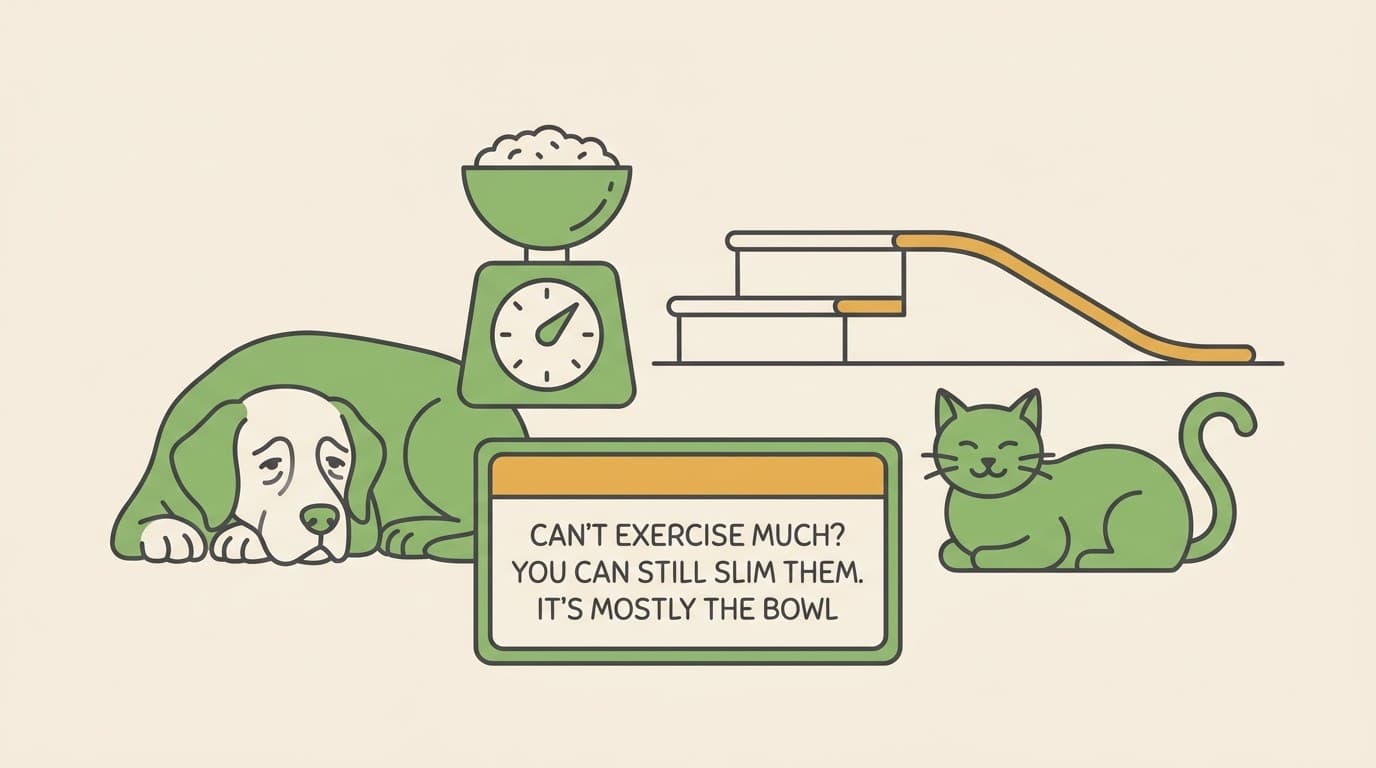
There's a particular kind of stuck a lot of owners land in. Your pet needs to lose weight, but they can't really exercise, and every bit of advice you read says "walk them more, play with them more". That's the one thing your dog or cat can't do. Maybe the arthritis means a lap of the garden is enough. Maybe it's a heart condition, recovery from a knee operation, simply great age, or that they've got so heavy that moving itself has become hard work. Whatever the reason, here's the good news: you can still slim them down, and it's more straightforward than you'd think.
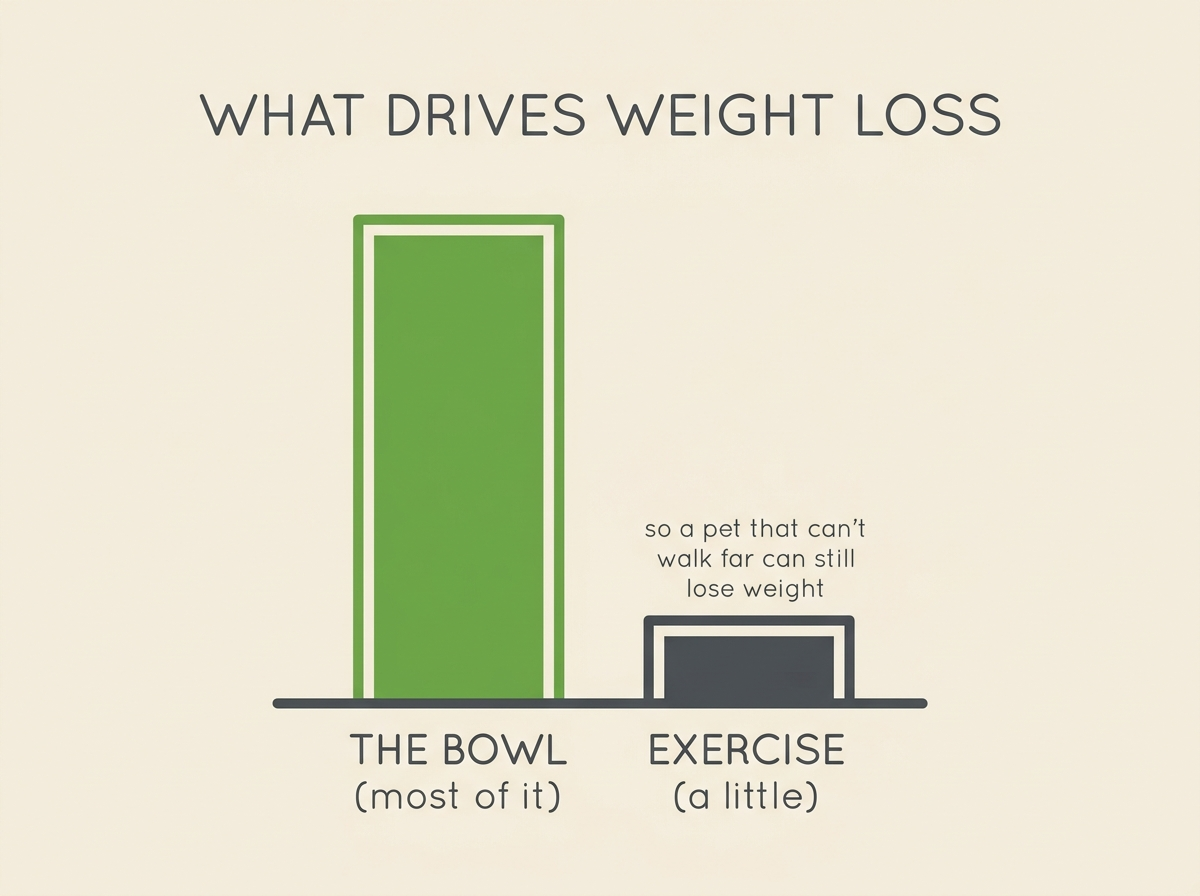
Weight loss is mostly done in the bowl, not on the lead. Movement helps, but it does a surprisingly small share of the work. The one lever that actually shifts weight is the one you control completely, which is how much food goes in. So a pet who can barely walk can still get lighter, and as the weight comes off, moving tends to get easier on its own. The prize isn't some distant payoff. It's a pet who's more comfortable, who finds the stairs less of a mountain, who wants to potter about again, often within a few weeks.
Stuck between rest and slimming? You're not
Start with the relief, because most owners in this spot feel boxed in. You've been told your pet needs to lose weight, and also that they need to rest the joint, take it easy on the heart, or stay crate-confined while the knee heals. Those two instructions feel like they cancel each other out. They don't.
The reason comes down to the numbers. The energy a pet burns pounding the pavement is far smaller than most people imagine, and far smaller than the energy you can simply not put in their bowl in the first place. A gentle calorie reduction, fed steadily, does far more than any amount of trotting around ever could. So your pet being unable to exercise doesn't really hold the weight loss back. It changes which tool you reach for, not whether the job can be done. And the order of events works in your favour: you take a little weight off through the food, the joints or chest or recovering leg cope a bit better, your pet moves a fraction more comfortably, and that small bit of movement nudges things along. Diet leads, movement follows. Nobody's asking a sore or breathless pet to exercise their way slim. We're going to do the opposite.
Why the bowl does the heavy lifting (and that's lucky here)
This isn't wishful thinking, it's what the research shows. In a clinical trial that split overweight pet dogs into a calorie-cut group and an extra-activity group, the dieting dogs lost a median of around 10% of their starting body weight, while the dogs given more exercise alone lost only about 2%, which wasn't even a statistically meaningful drop. The researchers concluded plainly that exercise on its own is unlikely to drive weight loss without cutting calories too (Chapman et al., 2019).
For most pets that's a slightly inconvenient truth, because we'd all love a long walk to undo a few too many treats. But for your pet, the one who can't do the long walk, it's the lucky break. The single lever that genuinely works is the one that doesn't need legs, lungs or a healed joint. It needs a measuring scale and a plan: you feed a deliberate, gentle deficit, aimed at the weight you want your pet to reach rather than the weight they are today, and the weight comes off.
What that deficit is, in grams of the food already in your cupboard, is a sum we don't need to do by hand here. Our Feeding Calculator works it out in about ten seconds from your pet's target weight, and how much should I actually feed? walks through the thinking behind it. The point to hold onto: you very often don't need a special product or a clever gadget. You can usually just measure and cut back the food you're already buying.
For these pets the weight matters more, not less
It would be comforting to tell you the weight is less of an issue if your pet can't move much. The truth is the opposite. For an arthritic, cardiac, airway-struggling, knee-recovering or very heavy pet, the extra weight isn't a cosmetic afterthought. It's doing active harm, and it's very often the thing keeping them from moving in the first place.
Take sore joints. Every extra pound is more load going through hips, knees and elbows that are already worn. But weight harms joints a second way most owners never hear about. Body fat isn't an inert cushion. It's an active tissue that pumps out inflammatory signals of its own, and weight loss measurably lowers those inflammatory markers in dogs (German et al., 2012). So an overweight pet runs a low, constant background of inflammation that adds to the inflammation already grinding in an arthritic joint. Lose the weight and you turn down both the load and the inflammation, which is why it helps more than any supplement. The figure worth pinning to the fridge: losing as little as about 6% of body weight produces a measurable improvement in arthritis lameness (Marshall et al., 2010). For a 30kg dog that's under 2kg, a target most owners can genuinely reach.
That same logic runs through the other conditions. Carrying extra weight makes the heart work harder, and studies of obese dogs show changes in the heart's structure, some of which ease once the weight comes off, though not all of it reverses (Partington et al., 2022). For flat-faced breeds who already struggle to breathe, excess weight crowds an airway that's tight to begin with, and weight loss is recommended before airway surgery because obesity independently worsens flat-faced breathing (University of Cambridge, n.d.). And a dog recovering from cruciate surgery who's carrying extra weight is loading the very joint that's trying to heal, so slimming is part of getting a knee right, not separate from it.
So if anything, being unable to exercise makes the weight message more urgent, not less. We just frame it around comfort and function now: a pet who hurts less, breathes easier, recovers better and moves more freely. To go deeper, we own the ground upstream: the Arthritis hub and its 2-Minute Mobility Check, the Heart Health hub, the Breathing hub for flat-faced airways, and weight and the cruciate for recovering knees.
Gentle, joint-kind movement once it's easier
None of this means movement is off the table. It means movement follows the loss rather than driving it, and that what we choose has to be kind to whatever's limiting your pet. As the weight comes off and your pet grows more comfortable, you can layer in small amounts of the right activity, and it does one genuinely important job: it helps protect muscle while the fat comes off, which matters most in exactly these older, arthritic and recovering pets.
For a stiff dog, think short and flat rather than long and hilly. A couple of brief, gentle lead walks on the level beat one long march, and breaking the day's movement into small bouts is far kinder to sore joints than one big outing that leaves them seized up the next morning. Choose slopes over stairs where you can, let them warm up slowly, and stop while they're still comfortable rather than waiting for the limp.
Water is your friend for sore joints especially. Swimming or, better still, a session on an underwater treadmill under professional guidance (hydrotherapy) lets a pet move and build muscle with their weight supported, taking the load off the joint while they work, and it helps preserve muscle during weight loss. It's one of the few ways a genuinely sore pet can get meaningful, safe movement.
And for the pet who simply can't walk far, dog or cat, you can make their own food do the moving. Scattering a measured meal for a dog to snuffle out, or putting a cat's portion in a food puzzle or a few hidey-spots around the room, turns eating into gentle foraging that burns a few calories and busies the mind without a single painful step. It's perfect for cats, who can't be walked anyway and slim best when you give the hunting instinct back through play and foraging instead, and for dogs whose legs aren't up to much, and there's a whole approach to it in slow feeding and foraging. The thread through all of it: we add movement because the weight is coming off, not to exercise the weight off.
The safety lines, and where to go next
A few firm lines for this particular reader, because slimming a fragile pet has rules that slimming a healthy young one doesn't.
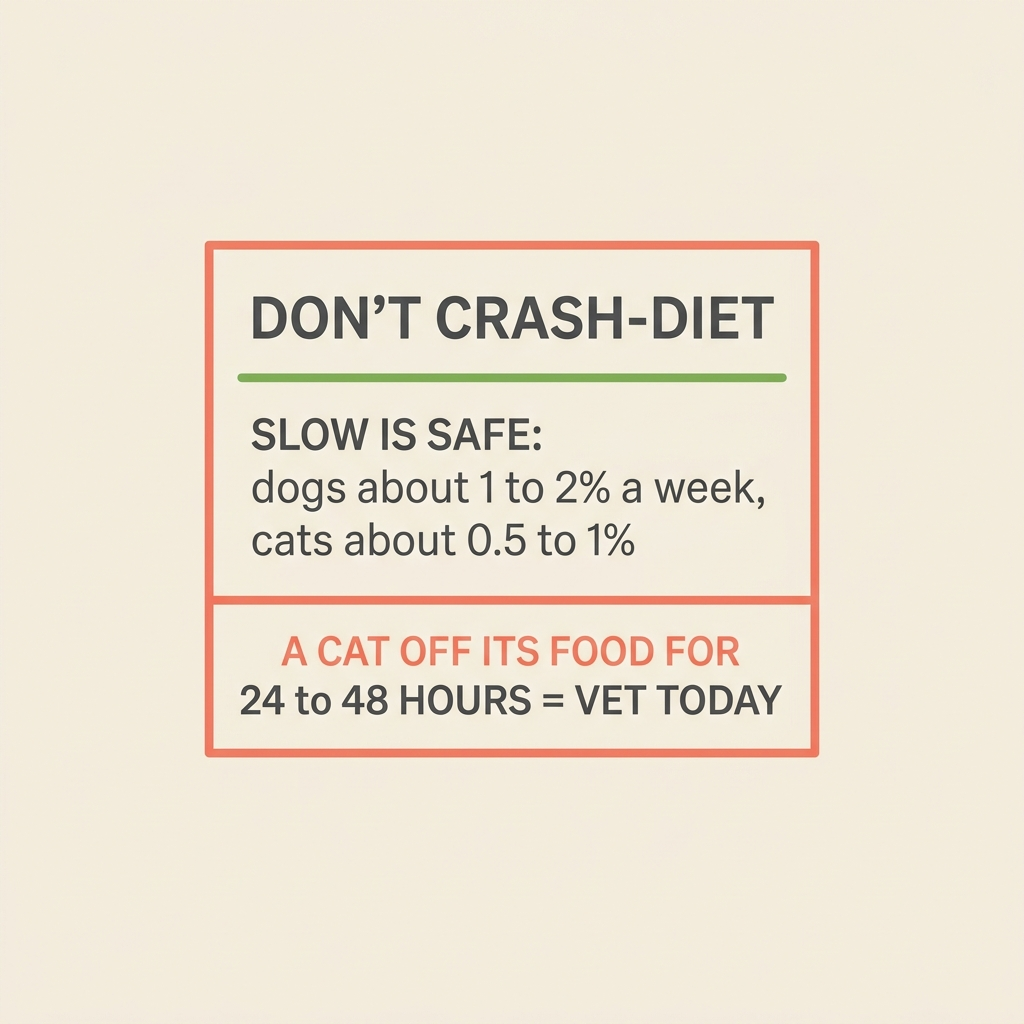
Never crash-diet, and this matters most of all for cats. Slimming has to be slow, around 1 to 2% of body weight a week for dogs and a gentler 0.5 to 1% a week for cats, and a cat's food must never be withdrawn. Cutting a cat's food too hard, or a cat simply going off its food, can trigger a dangerous liver condition that comes on within days. Treat an overweight cat who won't eat for 24 to 48 hours as a same-day emergency, not a diet that's finally working. The safe feline method is covered in full in never crash-diet a cat.
Rule out the wrong kind of weight loss first. Some pets who can't exercise are losing weight for a bad reason rather than a good one, and a pet shedding weight without a deliberate diet behind it needs a vet, not applause. If your pet is getting thinner and you haven't changed anything, read losing weight without trying and get them checked before you assume the diet is "working". The same goes for any pet recovering from surgery or managing a new diagnosis: clear the plan with your vet first.
Protect the muscle. It's easy to hear "it's mostly diet" as "let them waste away on next to nothing", and that's not it at all. Slow loss, a ration with enough good-quality protein, and that little bit of gentle movement together protect lean muscle, the very thing an older, arthritic or post-op pet can least afford to lose. That's why we feed a proper amount of the right food, not a starvation portion.
Recalculate as they shrink. A lighter pet needs less food, so the ration that was a deficit last month becomes "just enough" as the weight comes off, and the loss stalls if you don't keep up. Redo the sum against their new, lower weight every few weeks, and recalculating as they shrink explains the rhythm of it.
When you're ready to act, the Feeding Calculator turns the plan into real grams of your own food, and the Healthy Weight Tracker lets you set the target and watch the trend, so you can see them get lighter and move more easily with every weigh-in. If you've landed here from the arthritis side, weight and arthritis is the companion piece, and exercising an overweight dog safely is there for the day your dog's ready for a bit more.
References
- Chapman M, Woods GRT, Ladha C, Westgarth C, German AJ. (2019). An open-label randomised clinical trial to compare the efficacy of dietary caloric restriction and physical activity for weight loss in overweight pet dogs. The Veterinary Journal, 243, 65-73.
- German AJ, et al. (2012). Weight loss reduces inflammatory biomarkers in obese dogs. The Veterinary Journal.
- Marshall WG, Hazewinkel HAW, Mullen D, De Meyer G, Baert K, Carmichael S. (2010). The effect of weight loss on lameness in obese dogs with osteoarthritis. Veterinary Research Communications, 34(3), 241-253.
- Partington C, Hodgkiss-Geere H, Woods GRT, Dukes-McEwan J, Flanagan J, Biourge V, German AJ. (2022). The effect of obesity and subsequent weight reduction on cardiac structure and function in dogs. BMC Veterinary Research, 18, 351.
- University of Cambridge (n.d.). Management & Treatment of BOAS. Cambridge BOAS Research Group.
Keep track of how your pet is doing
The owners who cope best are the ones who notice changes early. A simple health log shows you what is working, and what is not, before the next vet visit.
Start tracking, freeYou're not doing this alone
Compare treatment journeys and talk to owners managing weight management. Free to join.
Join PetsLikeMine