

The Warning Signs of Cancer in Dogs and Cats (and the Quieter Feline Ones)
Alastair Greenway
BVM&S MRCVS
Something has caught your eye. Your dog's a bit slower on walks, or your cat's gone off her food. Maybe there's a lump you weren't expecting, or a smell, or a sore that won't quite heal. And sitting behind it is the word nobody likes to think about.
Let's be calm and clear about this from the start. Knowing the warning signs of cancer is worth doing, because catching things early genuinely changes outcomes. But almost every sign on this page is also caused by dozens of far more ordinary things, from a dodgy tummy to a sore tooth to simply getting older. Knowing the signs isn't there to help you diagnose your pet at midnight. It's there so you can tell when something is worth a vet's eyes on it, rather than left to wait and hope.
This page is about the general signs to watch for. If what you've actually found is a lump, the guide on [the lump you've found] is the one you want. If your vet has already suggested a sample, the guide to [aspirates and biopsies] will help.
The classic warning signs, in plain terms
Veterinary cancer specialists have worked from much the same list for decades, and most cancer charities and university cancer centres publish a version of it. Colorado State University's cancer centre, one of the best known in the world, lists ten (CSU, 2021). They're worth knowing not because each one means cancer, but because each one means "this is a body change worth checking".
- A lump or swelling that lasts or keeps growing. Stroking your pet is the best way to find these. A swelling that persists, grows, or changes is one to have looked at.
- A sore that won't heal. Most scrapes and scabs heal in a week or two. One that lingers, or keeps coming back in the same spot, deserves a closer look.
- Weight loss you didn't plan. A pet losing weight without a diet change is giving you a signal, not a bonus.
- Going off their food. A lasting drop in appetite isn't normal, and can point to pain, nausea or a mass somewhere, including in the mouth.
- Bleeding or any unusual discharge. Blood, pus or odd fluid from anywhere, including persistent vomiting or diarrhoea, should be checked.
- A bad smell that wasn't there before. A new, offensive odour from the mouth, ears, or rear end can sometimes point to a tumour in those areas.
- Trouble eating or swallowing. Dropping food, drooling, or struggling to swallow can flag a problem in the mouth or throat.
- A cough or laboured breathing. A persistent dry cough in an older pet is worth chest X-rays; difficulty breathing always warrants prompt attention.
- Limping with no obvious cause. Unexplained lameness is a recognised warning sign, and CSU notes it can point to cancer, especially of the bone (CSU, 2021). Take it seriously in a large or giant-breed dog, the body type in which bone cancer is most common.
- Tiring easily, or trouble going to the toilet. Losing stamina, or straining to wee or poo, can be early hints that something isn't right.
Noticing one of these doesn't mean you've found a diagnosis. It means you've found a reason to book an appointment.
Why cats are the quiet ones
This is the part that matters most, and the dog-shaped version of the list tends to skip it. Cats are far harder to read than dogs, and it isn't because they feel less. It's instinct.
A cat is a small predator who is also potential prey, and in the wild any obvious sign of weakness marks an animal out as an easy target. So cats have evolved to hide illness and pain, and that instinct doesn't switch off just because your cat lives indoors on a heated bed. As VCA Animal Hospitals puts it, "cats have evolved to hide signs of illness and pain" (VCA). They'll often carry on looking more or less normal until they're really quite unwell.
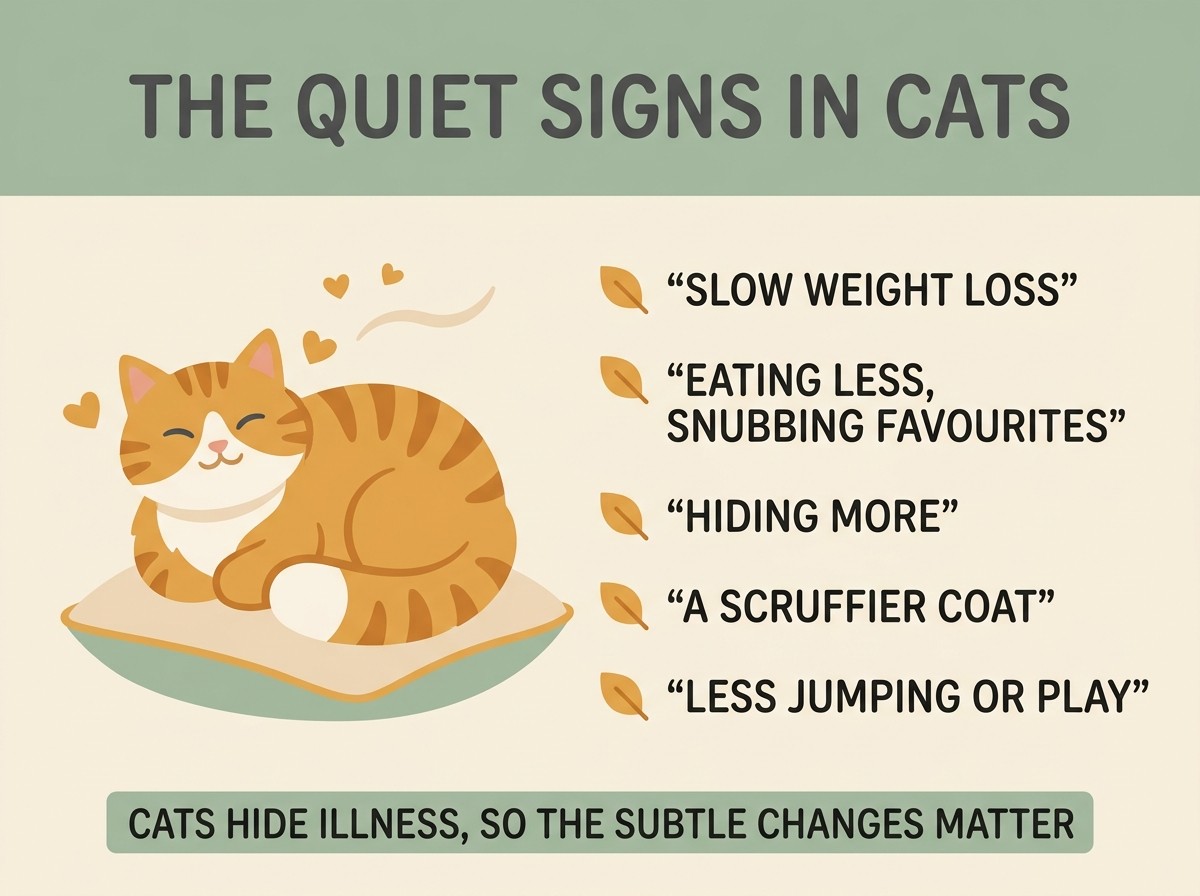
So the dramatic, easy-to-spot signs frequently don't show up in cats. The clues are quieter instead, and they're easy to explain away as your cat "just slowing down" or "getting older". The ones worth taking seriously are:
- Slow, subtle weight loss. In cats this is often the one that matters most, and it's sneaky. A cat can lose a worrying amount of weight so gradually that you only feel it when you run your hands down their ribs and spine and realise they're sharper than they were (VCA). Weighing your cat now and again catches what your eyes miss.
- Eating a bit less, or snubbing favourites. A cat who picks at food, leaves meals, or turns her nose up at a previously loved treat may be feeling nauseous or sore, not fussy (PetMD).
- Hiding more, and joining in less. A cat who's started retreating under the bed, sleeping in odd quiet spots, or no longer coming to greet you is telling you something. Withdrawal is one of the commonest ways a cat shows she feels unwell (VCA).
- A scruffier coat. Cats who feel rough often stop grooming properly, so a coat that's gone greasy, matted or unkempt, especially in a cat who was always immaculate, is a real sign rather than laziness (VCA).
- Less jumping, less play, more sleep. Not leaping onto the windowsill any more, or sleeping even more than a cat's already-impressive baseline, can be quiet markers of pain or illness.
None of these is dramatic, and that's exactly why they get missed in a cat, and exactly why they're worth taking seriously. Because cats hide illness so well, regular weigh-ins and a yearly check-up earn their keep, and they matter even more as your cat gets into the senior years. The [senior pet hub] goes into screening in more depth.
None of this is specific to cancer
Hold on to this bit, because it's easy to read a list like this and talk yourself into the worst. Not one of these signs means cancer on its own. Every one of them has common, far less frightening explanations.
Weight loss can be an overactive thyroid, kidney disease or diabetes. A cough can be a chest infection or heart disease. Going off food can be a sore tooth, an upset stomach, or simply a hot day. Lumps are usually benign, and the majority of skin lumps turn out to be harmless (Lap of Love). Vomiting and diarrhoea are among the most common things vets see, and the overwhelming majority have nothing to do with cancer.
So the message of this page is to get it checked, not to panic. A change that's new, that's lasting more than a week or two, or that's slowly getting worse is worth a vet's opinion, whatever turns out to be behind it. Most of the time you'll get reassurance, or a simple problem with a simple fix. And on the rarer occasions when it is something serious, you'll have caught it at the point where you have the most options.
When to go sooner rather than later
Most of these signs can wait the few days it takes to get a routine appointment. A handful shouldn't.
Get seen promptly, the same day if you can, for difficulty breathing, a swollen or painful belly, collapse or sudden weakness, pale gums, ongoing bleeding, or a pet who's stopped eating and drinking altogether. These aren't necessarily cancer either, but they point to a pet who needs help now, not at the weekend.
At the appointment
There's no mystery to it, and it helps to know what's coming. Your vet will start with a thorough hands-on examination, feeling for lumps and enlarged glands, listening to the chest, checking the mouth, and weighing your pet so there's a number to compare against next time. Where things go from there depends on what they find. It might be a quick needle sample of a lump, a blood test, or imaging like X-rays or an ultrasound scan to look inside. Often the first visit ends with reassurance or a straightforward diagnosis that has nothing to do with cancer at all.
What you can do beforehand is be the eyes and ears that count. Jot down what you've noticed and when it started, weigh your cat or dog if you've a way to, and photograph anything visible like a lump or a sore. The history you bring is frequently the most useful thing in the room.
If it's a lump you've found, read [what to do about a lump] next. If you want to understand what a sample involves, the guide to [aspirates and biopsies] walks through it. And if a diagnosis has already been made, the guide to [what grade, stage and prognosis really mean] is the calm next step.
References
- Mingus L. Top 10 Warning Signs of Cancer in Pets. Colorado State University College of Veterinary Medicine and Biomedical Sciences, 2 November 2021. the canonical ten warning signs (abnormal swellings; non-healing sores; weight loss; loss of appetite; bleeding or discharge; offensive odour; difficulty eating or swallowing; loss of stamina; persistent lameness; difficulty breathing, urinating or defecating), and lameness in large/giant-breed dogs as a sign of bone cancer.
- American Animal Hospital Association (AAHA). Signs of Cancer in Dogs and Cats: When to See Your Veterinarian. common warning signs (lumps, odours, discharges, non-healing wounds, weight loss, appetite change, coughing/breathing difficulty, lethargy, changes in toileting, evidence of pain) and the note that many signs overlap with non-cancer conditions.
- Christensen J, Johnson K, Ettinger S, et al. AAHA Oncology Guidelines for Dogs and Cats. Journal of the American Animal Hospital Association. 2026;62(1):1-37. DOI: 10.5326/JAAHA-MS-7549. current professional guidance on diagnosing, staging and treating common cancers in dogs and cats, including the role of early detection and monitoring in primary care.
- FETCH a Cure (citing the Veterinary Cancer Society). Quick Pet Cancer Facts. "cancer is the leading cause of death in 47% of dogs, especially dogs over age ten, and 32% of cats." The widely cited one-in-four-dogs lifetime incidence figure is attributed to the Veterinary Cancer Society (1 in 4 dogs, 1 in 5 cats).
- VCA Animal Hospitals. Recognizing the Signs of Illness in Cats. "Cats have evolved to hide signs of illness and pain"; gradual weight loss apparent only on feeling the ribs and spine; withdrawal/hiding; reduced grooming and a messy or greasy coat as signs of illness.
- PetMD. Hidden Health Issues in Cats and How To Spot Them. cats as masters at hiding illness; decreased appetite, refusing favourite foods, reduced activity and changed behaviour as early clues.
- Lap of Love Veterinary Hospice. 10 Common Cancer Signs in Pets. the warning-signs list framed for owners, the note that many lumps are benign, and that vomiting and diarrhoea are among the commonest non-specific signs vets see.
Sister tool · Sightline
Track quality of life over time
Sightline, a separate ConciergeVet tool, runs a short adaptive weekly assessment with a quality-of-life focus mode built around exactly these frameworks, tracks a single composite score over time so you can see the trend rather than judge a single bad day, and produces a Sightline Report PDF you can bring to your vet.
A written log, or our printable quality-of-life sheet, does much the same job.
See how Sightline tracks quality of lifeFound a lump? Track it, and know when to act
A lump cannot be told apart by look or feel; only your vet sampling it can. The Lump & Bump Tracker records its size and how it changes, flags when it has crossed a line worth a vet visit, and builds a clean history to take in.
Open the Lump & Bump TrackerYou're not doing this alone
Compare treatment journeys and talk to owners managing cancer. Free to join.
Join PetsLikeMine