Signs the Cancer Is Winning: Recognising Decline
Alastair Greenway
BVM&S MRCVS
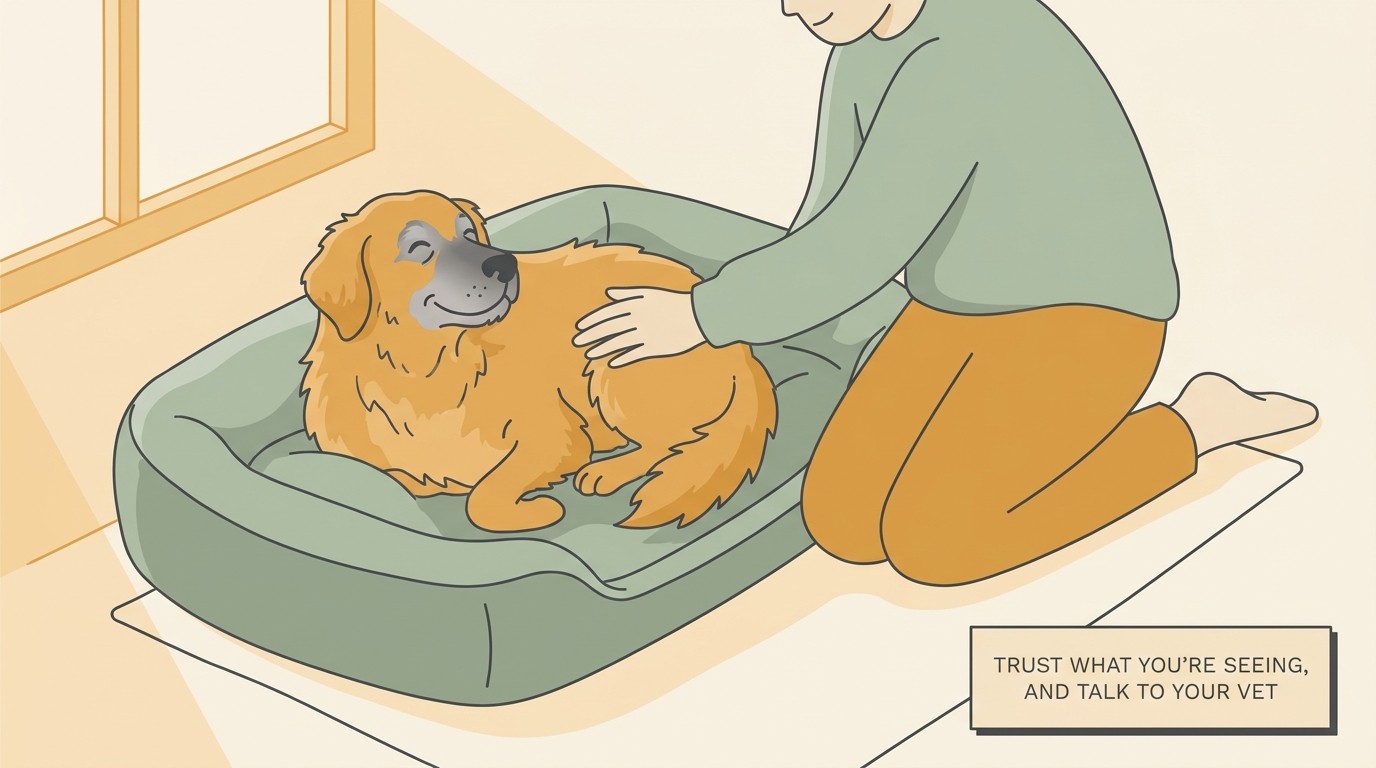
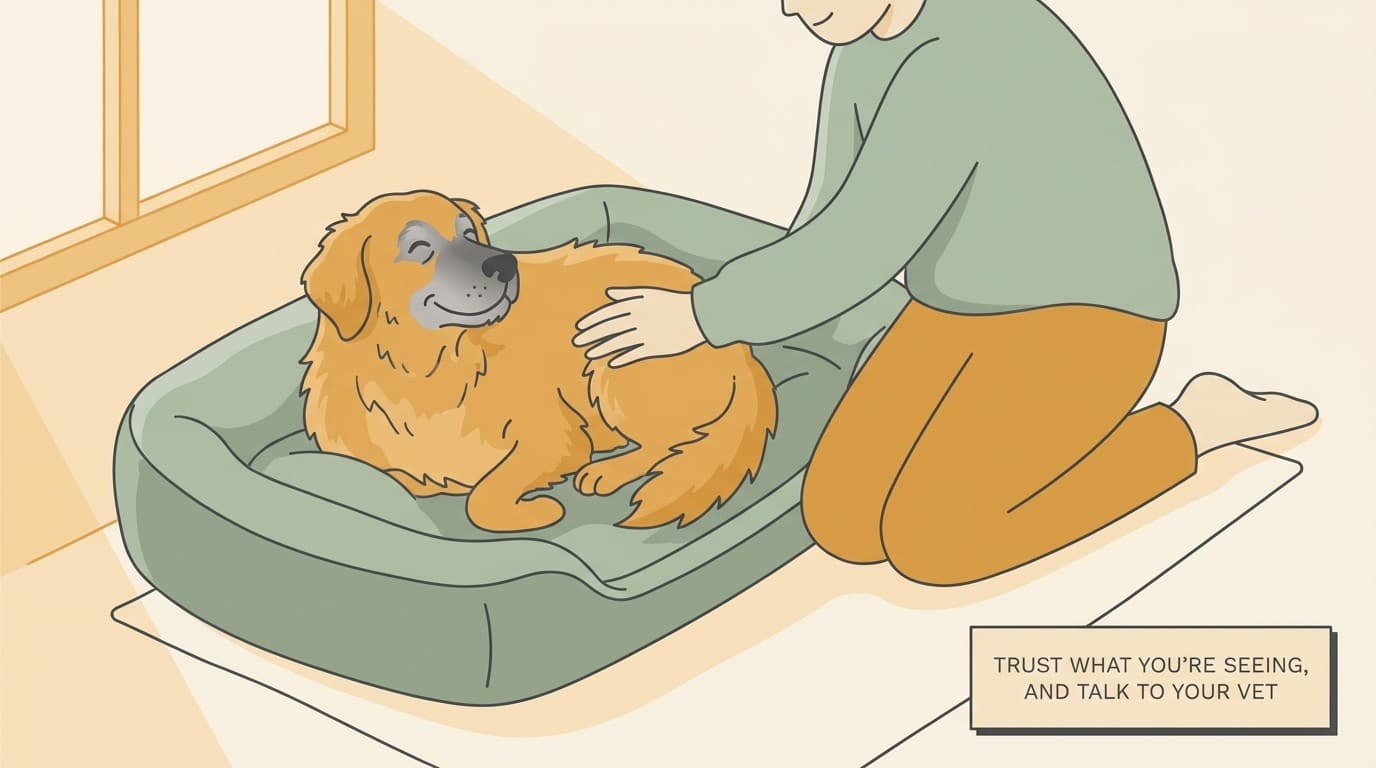
There's a question owners often arrive at without quite saying it out loud: how do I tell when my pet is genuinely going downhill, rather than just having an off day? It's a fair thing to want to understand, and wanting to understand it doesn't mean you've given up hope. You know this animal better than anyone, and when some part of you senses that the bounce has gone or the greeting at the door has slowed, that sense is usually telling you something real.
This piece is here to help you put words to what you're seeing and to know what's worth a call to your vet. It isn't here to frighten you, and it isn't pushing you toward any decision today. The aim is simply to help you read the signs calmly and trust your own close attention, because that attention is usually right.
What decline actually looks like
Cancer rarely turns with one dramatic moment. More often it shows up as a handful of small changes that, taken together, tell you your pet's quality of life is starting to slip. These are the ones vets and hospice teams watch for (Lap of Love, 2024):
- Eating and drinking less. Turning away from meals they'd normally hoover up, or needing to be hand-fed and coaxed. A fading appetite is one of the clearest and commonest signs, and it often comes from pain, nausea, or the cancer itself rather than fussiness.
- Losing weight and muscle. A spine or hips that feel more prominent under your hand, a topline gone bony. This can creep in slowly, which is exactly why it's easy to miss from inside the day-to-day.
- Moving less, and more stiffly. Struggling to get up, going off walks, no longer jumping onto the sofa or managing the stairs, or simply sleeping far more than usual.
- Laboured breathing. Breathing that looks like hard work even at rest, or a cough that won't settle, can mean the cancer has reached the chest. Genuine difficulty breathing is never something to watch and wait on. It's a same-day call to your vet.
- Pain you can't get on top of. When pain relief that was working no longer seems to be holding, that matters, and it's often something your vet can still adjust (more on that below).
- Accidents and trouble staying clean. Soiling indoors, or no longer being able to keep themselves groomed and comfortable, especially in a cat who's always been fastidious.
- Withdrawing. Hiding away, not greeting you, losing interest in the people, toys and routines that used to light them up. A pet who seems quietly switched off from their own life is showing one of the signs that weighs most heavily (VCA, 2024).
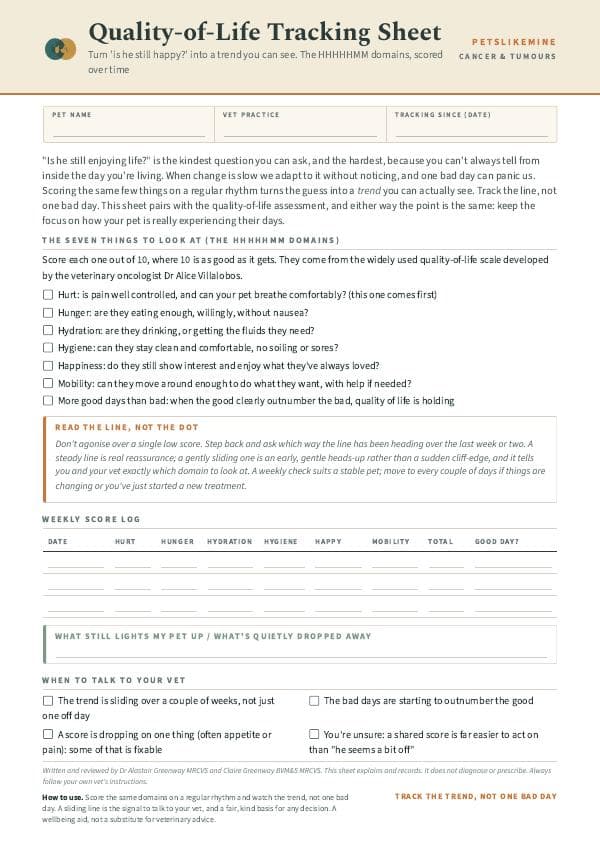
You may notice these are the same areas a quality-of-life score keeps an eye on: the comfort, the eating, the mobility, the interest in life. That overlap is no accident. If you've been keeping a [quality-of-life score], this is the moment it earns its keep, and if you haven't, [measuring quality of life] walks through how. Either way the goal is the same, to see the whole picture clearly rather than being swept along by a single good or bad afternoon.
When a cat hides the very thing you need to see
Cats are harder to read here, because hiding weakness is wired deep into them. A dog in trouble often tells you plainly. A cat will tuck themselves away and carry on looking almost normal until things are quite advanced. So the signals come softer and are easier to dismiss: more time spent hidden in odd, quiet corners, a coat gone unkempt because grooming has stopped, sitting hunched, or just not coming out for the things they've always come out for, dinner included (PetMD, 2025). With a cat, take the small changes seriously. They tend to mean more than they look like they do.
The one that can't wait: a sudden bleed
Most decline is gradual, and you'll have time to think. One cancer emergency isn't, and it's worth knowing about so it never catches you completely off guard.
Haemangiosarcoma, a cancer of the blood vessels that often sits silently on the spleen, can grow unnoticed and then rupture and bleed internally without warning. When that happens, a dog who seemed more or less fine can collapse within minutes. The signs are sudden weakness or collapse, very pale or white gums, a swollen or painful belly, and fast or laboured breathing (Cornell University, 2024). This isn't a see-how-they-are-in-the-morning situation. It's an emergency right now, this minute: a phone call to your vet or the out-of-hours service on your way out of the door.
If your pet has been diagnosed with haemangiosarcoma, [the silent splenic cancer] explains what's happening, and [the treatment emergencies article] sets out the call-now signs in full. Knowing this one in advance won't make it less frightening if it comes, but it can spare you those awful minutes of wondering whether it's serious. It is.
Read the trend, not the single day
If there's one thing worth holding onto, it's this: a single bad day is not a verdict.
Pets with cancer have wobbles. There'll be a day they won't eat and sleep flat out, and you'll feel the bottom drop out of everything, and then the next morning they're at the back door asking to go out. One day, good or bad, is a poor narrator. What tells the truth is the run of days. As the hospice teams put it, it's the overall trend that matters far more than any single event (Lap of Love, 2024).
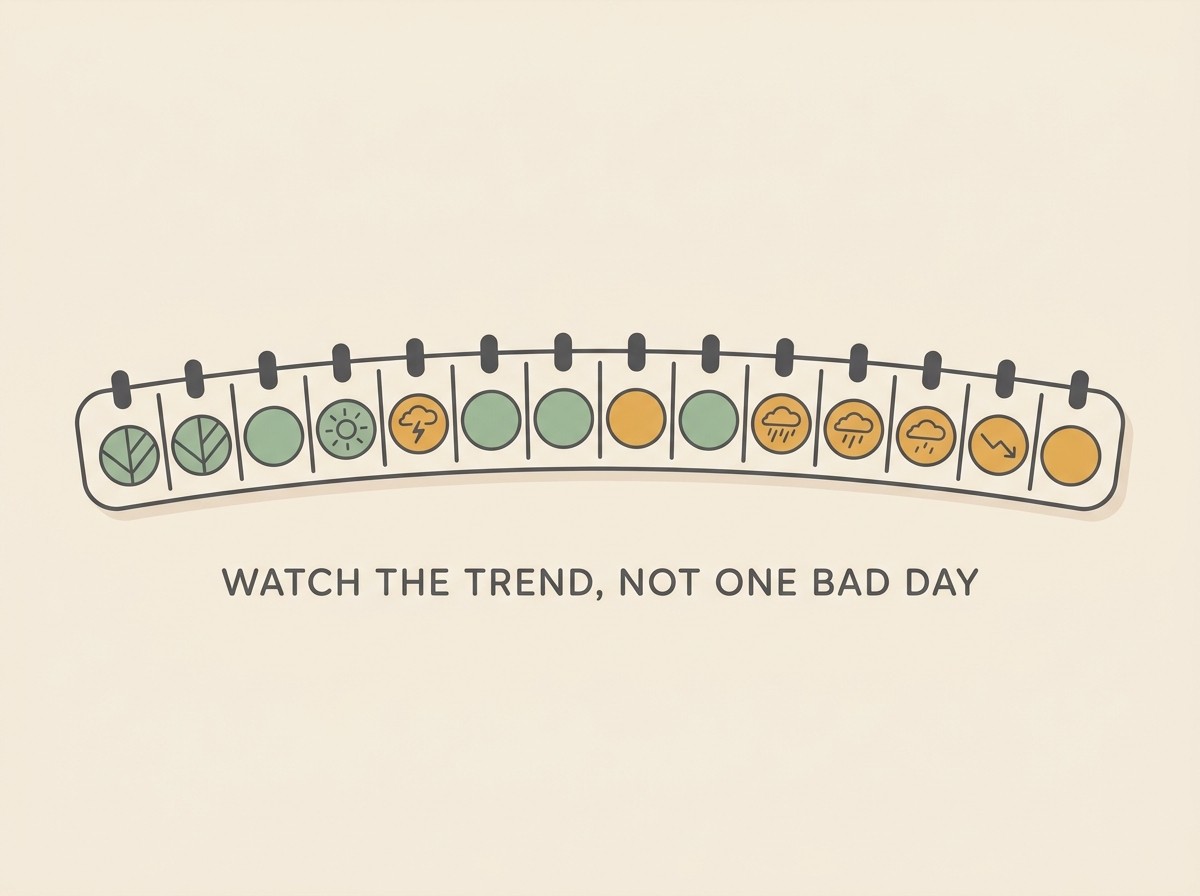
It's why the well-known quality-of-life scales keep coming back to one plain test: is your pet still having more good days than bad? (VCA, 2024) While the good days clearly outnumber the bad, there's still good life being lived. When that balance starts to tip the other way, and stays tipped, that's the signal worth listening to. Not a single hard night, but the slow change in the shape of the weeks.
Talk to your vet sooner rather than later
If you're recognising your pet in any of this, the kindest next step is a frank conversation with your vet, earlier rather than later. Not because the moment has arrived, but because there's room to help while there's still time to plan.
Some of what looks like the cancer winning is genuinely fixable. A dip driven by pain or nausea isn't always the end. It can be a dose that needs adjusting or some better symptom control, and your vet can often restore comfort and buy back good days. And where things really are progressing, your vet can tell you plainly what's likely ahead and how comfortable your pet is likely to stay, so nothing blindsides you. Most vets would far rather you came to them while there's still room to think than waited for a crisis to force the moment.
Recognising decline isn't the same as deciding anything. It's just looking clearly, which is the necessary first step, and a loving one. When you're ready to think about what comes next, we walk through that gently in [the quality-of-life decision], and there's a whole [End-of-Life space] ready for the road ahead: hospice and comfort planning, the timing, and the grief that's part of loving them this much.
For now, you don't have to do anything except keep paying the kind, close attention you're already paying. Noticing is not giving up. It's staying with them, which is the thing that matters most.
References
- Lap of Love Veterinary Hospice. "Navigating End-of-Life Decisions for Dogs with Cancer." 2024. (The signs of declining quality of life in cancer: appetite loss, weight and muscle loss, mobility difficulty, laboured breathing, unmanageable pain, trouble toileting and maintaining hygiene, withdrawal from family and activities; monitoring overall trends rather than single events; talking to your vet about progression and expected comfort.)
- VCA Animal Hospitals. "Quality of Life at the End of Life for Your Dog." 2024. (The HHHHHMM quality-of-life scale by Dr Alice Villalobos; "more good days than bad" as the practical test; a pet seeming "turned off" to life as a sign that quality of life is slipping.)
- Cornell University College of Veterinary Medicine, Riney Canine Health Center. "Hemangiosarcoma in Dogs." Updated October 2024. (Splenic haemangiosarcoma's silent course and sudden rupture; presentation "as an emergency after a sudden episode of collapse"; emergency signs of collapse or severe weakness, pale gums, rapid or difficult breathing, and the risk of sudden death; bleeding into the abdomen, hemoabdomen.)
- PetMD. Tarantino M. "Signs a Dog Is Dying of Cancer." Updated 31 January 2024. (Owner-facing description of end-stage cancer signs in dogs: appetite loss, laboured breathing as an emergency, signs of pain, and quality-of-life assessment using the HHHHHMM scale.)
- PetMD. Vogelsang J. "How To Tell If a Cat Is in Pain." Updated 12 November 2025. (Cats are renowned for masking pain and discomfort; subtle signs include a normally social cat suddenly hiding, stopping grooming and looking unkempt, a hunched posture, and a sudden drop in appetite.)
Free downloads
Companion worksheets to put what you've read into practice. Free PDFs, print at home.