


Should I Treat? Treating, Comfort Care, and Why There's No Wrong Answer
Alastair Greenway
BVM&S MRCVS
There is no wrong answer here, and that is the thing most owners reach this decision without ever being told plainly. Whether you choose to treat your pet's cancer or to keep them comfortable and happy without treatment, you can be making the right, loving choice. Both paths are real veterinary medicine, chosen by good owners every day. Neither one is giving up, and neither one is playing God.
That can be hard to believe right now, because the world pushes you in two directions at once. One voice says that if you don't throw everything at the cancer, you didn't love your pet enough. Another says that putting them through treatment is selfish, that you're prolonging things for yourself. Both of those guilts cannot be true, and in fact neither is. So before we get to how you actually decide, let's take both of them off the table.

What treating actually means in practice
Say the words "treat the cancer" and most people picture a fight to the death against the disease, a cure or nothing at all. That's the human-medicine reflex, and it's the wrong frame for your pet.
In veterinary oncology, treatment is almost never aiming for a cure. It's aiming for good extra time. The 2026 AAHA Oncology Guidelines, written for everyday vet teams, describe the goal of much cancer treatment as "improvement or extension of quality of life," typically over the short to medium term (AAHA, 2026). That's the real target: a stretch of good months in which your pet still feels like themselves. For some cancers that stretch is long and the quality is excellent. For a few it's genuinely short. The type, grade and stage decide which, so understanding your specific diagnosis matters far more than the word "cancer" on its own (it's worth reading [what grade, stage and prognosis actually mean] before you decide anything).
A cancer review puts the underlying point simply: each patient can be helped, whatever stage the disease is at, with the aim of maintaining their quality of life (Repetti et al., 2023). Treating can mean a full course of chemotherapy, a single operation to remove a lump, a short course of medication to shrink something that's bothering them, or pain relief that lets them enjoy their dinner and their walk again. There's a whole range to choose from, and you are allowed to choose any point on it. You don't have to pick "everything" to count as having treated your pet, and you needn't fear that treatment automatically means months of misery, because for most pets it doesn't (the reality of [pet chemotherapy] surprises almost everyone).
Comfort care is active care
Here is the half of this that gets unfairly painted as doing nothing, when in truth it's one of the most attentive forms of care there is.
Comfort-focused care, what vets call palliative care, doesn't mean you've stopped caring for the cancer. It means you've changed the goal from controlling the disease to keeping your pet feeling well for as long as that's genuinely possible. As one veterinary reference puts it, in palliative care "we stop trying to cure disease and shift our focus to managing symptoms," and it "employs multiple techniques to maximize comfort and quality of life" (VCA Animal Hospitals, n.d.). That is a plan, not an abandonment.
In practice, comfort care is a real and busy job. You stay ahead of pain with proper medication, keep the appetite up, and protect the things your pet loves most: the soft bed, the sunny spot, the gentle pootle round the garden, the lap. It can run instead of treatment or alongside it, and plenty of pets have an operation to take the pressure off, then live the rest of their time on comfort care. The Colorado State University veterinary team frame palliative care as preventing suffering, managing pain and sustaining comfort while keeping the bond between you and your pet intact for as long as possible (Colorado State University, n.d.). Choosing it can be the kindest, most clear-eyed decision an owner ever makes, and if that's the direction you're leaning, you can read about what [comfort-focused care] looks like day to day.
So please don't let anyone, including the voice in your own head, tell you that choosing comfort means you loved your pet less. Often it means you loved them clearly enough to put their experience first.
What really belongs in the decision
Once both choices sit on the table as equals, deciding gets easier, because now it's a real question with real inputs rather than a test of how good an owner you are. Here is what actually goes into it.
The specific cancer. Not "cancer", but your pet's type, grade and stage, and the realistic outlook that comes with them. A low-grade skin mast cell tumour caught early and a splenic haemangiosarcoma share almost nothing but the word. Ask your vet for the realistic picture for this one: what treatment could offer, in good-quality time rather than just time, and what comfort care would look like instead.
Your pet, as an individual. Their age, their other health problems, and their temperament. A bouncy, people-loving dog who takes the vet's in their stride is a different proposition from a cat who is terrified by the carrier and the car. How your particular animal would actually experience a course of treatment is a fair and important part of the sum, not a detail.
What the treatment involves, week to week. The number of visits, the schedule, the monitoring, and how it fits your life and theirs. A plan that means a long drive to a referral centre twice a week is a heavier ask than one your own practice can run, and it's reasonable to weigh that.
The cost, and how you'd manage it. As a rough UK guide, a full course of chemotherapy commonly runs to somewhere around £2,500 to £5,000, and surgery or radiation can be substantial too, with an involved course of specialist treatment realistically reaching the £5,000 to £10,000 region (PetCoverHQ, 2025; ManyPets, 2026). Read those as ranges, not prices, and ask for a written estimate for your own pet, because plenty are managed for far less. Whether you're insured, and what your policy covers, matters a great deal. Money is allowed to be part of this. Choosing not to spend money you don't have, or not to take on debt, does not make you a bad owner, and a good vet will help you find the option that fits what you can actually do (for more on [what cancer treatment costs] and how people pay for it, there's a separate guide).
You, and your circumstances. Your own health, your work, the other people and animals depending on you, what you can carry emotionally. These count too. You are part of your pet's world, and a plan that quietly wrecks you isn't good for either of you.
There's something reassuring in the research here. When Cornell vets studied how owners decide between surgery, palliative care and euthanasia for dogs with a sudden internal bleed (often a haemangiosarcoma), they expected money to dominate. It didn't. "We thought that cost-benefit, such as finances and potential for a cancer diagnosis, would be the most important factors, but we found that quality of life was the primary driver," said one of the researchers, and finances actually ranked among the least important (Cornell University, 2023). Owners, faced with the hardest version of this decision, mostly weren't asking what they could afford. They were asking what was right for their dog. That instinct, your pet's quality of life first, is exactly the right one to follow.
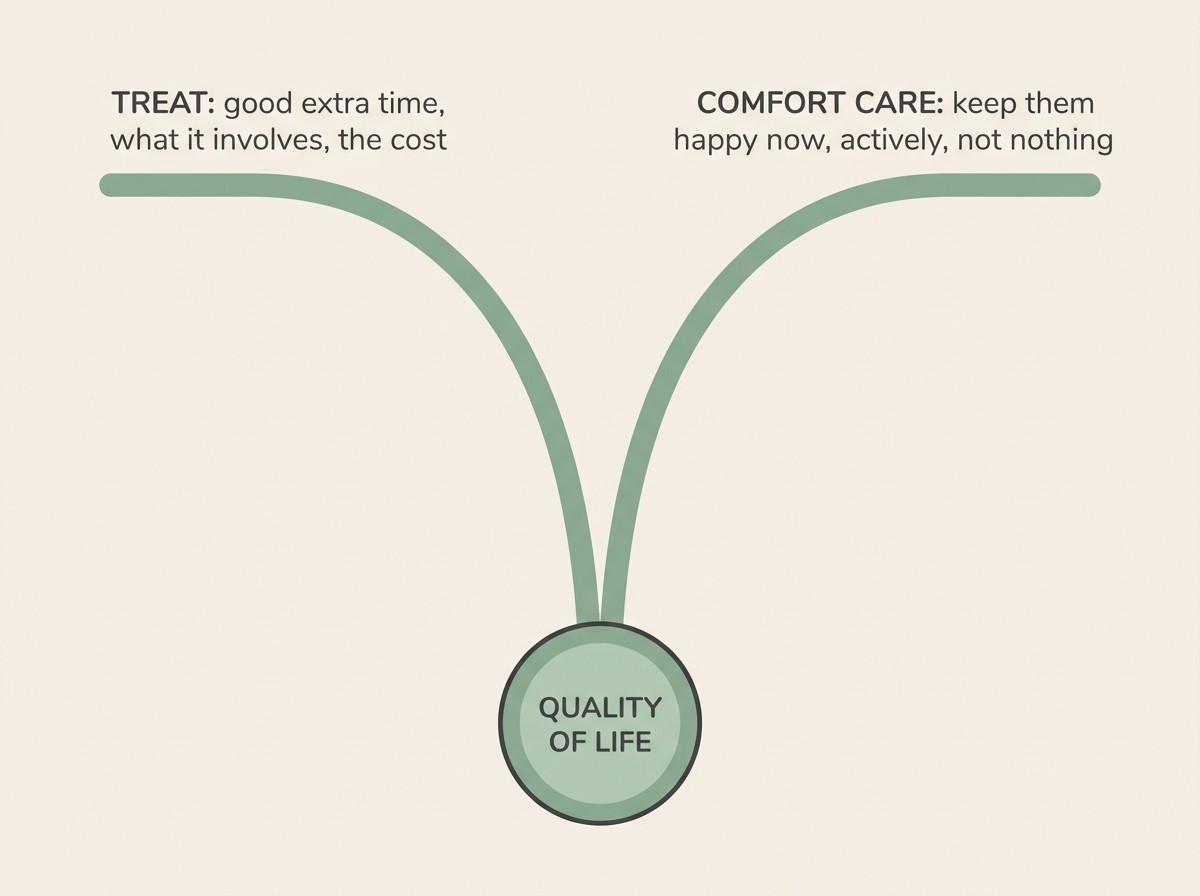
A way to think it through
If you're stuck, it often helps to ask the questions out loud, some to your vet and some to yourself.
For your vet: what's the realistic gain from treatment, in good time, not just time? What does the schedule look like? How will my pet most likely feel during it? What are the warning signs I'd need to watch for? What does comfort care look like instead, and could we do that just as well? Roughly what will each cost? Write these down before the appointment, because almost nobody remembers their questions in the room (a [questions for your oncologist] sheet can help you keep track).
For yourself: what matters most to my pet? What would a good day look like for them through this? What can I genuinely manage, with money, time and my own heart? There are no model answers. Your own answers are the right ones.
One frame takes a lot of the pressure off: you don't have to decide the whole future today. With many cancers you can choose a trial with a review point. Start treatment, then sit down at an agreed moment a few weeks in and look clearly at how it's going, using your pet's quality of life as the measure rather than hope or fear. Tracking that quality of life, rather than guessing at it day to day, is one of the kindest tools you have, and you can read about [measuring quality of life] and use a simple [quality-of-life assessment] to see the trend clearly. If treatment is buying good time, you carry on. If it isn't, you can change course, and it was never a failure. You tried, you watched, and you listened to your pet. That is exactly how this is meant to work.
You are not failing your pet
It's worth carrying this back out the door with you: there is no version of this where loving your pet and making a careful, considered decision counts as the wrong one.
If you treat, you're not being cruel or selfish, you're reaching for good time you've real reason to hope for. If you choose comfort, you're not giving up, you're putting your pet's experience of their last chapter above the fight against the disease. If you start treatment and then stop, you didn't fail, you watched closely and you put them first. In my experience, the owners who agonise most over this are almost always the ones doing it right, because the agonising is just love trying to work out the kindest thing.
Take the decision a step at a time. Get a clear picture of the specific cancer, talk it through with your vet, and let your pet's quality of life lead. Whichever road you take, you'll be walking it for the right reasons.
References
- American Animal Hospital Association (AAHA). 2026 AAHA Oncology Guidelines for Dogs and Cats. AAHA, published 2 January 2026.
- Williams, J., Phillips, C., & Byrd, H. M. (2017). Factors Which Influence Owners When Deciding to Use Chemotherapy in Terminally Ill Pets. Animals, 7(3), 18.
- Repetti, C. S. F., et al. (2023). Palliative care for cancer patients in veterinary medicine. Veterinary Medicine (Praha), 68(1), 2-10. (PMC10878255: https://pmc.ncbi.nlm.nih.gov/articles/PMC10878255/)
- VCA Animal Hospitals. Palliative Care and Hospice for Pets: Overview (Weir, M., Hunter, T., & Downing, R.). VCA Know Your Pet.
- Colorado State University, College of Veterinary Medicine and Biomedical Sciences. Palliative care for pets: Providing comfort and pain relief during illness. CSU Source.
- Cornell University College of Veterinary Medicine. Pet's quality of life drives owner decision-making in emergency situations (reporting Menard, J., Sylvester, S., Lopez, D., et al., Journal of the American Veterinary Medical Association). Cornell News, 17 November 2023.
- International Association for Animal Hospice and Palliative Care (IAAHPC). Animal Hospice and Palliative Care Guidelines.
- PetCoverHQ (2025). Dog Cancer Treatment Costs in the UK: What Pet Owners Need to Know (UK £ ranges: IV chemotherapy £2,500–£5,000 over a full course; surgical removal £1,500–£4,000; radiation up to ~£9,000).
- ManyPets. How much is a vet visit in the UK? (updated 26 January 2026; advanced oncology realistically £5,000–£10,000).
Free downloads
Companion worksheets to put what you've read into practice. Free PDFs, print at home.
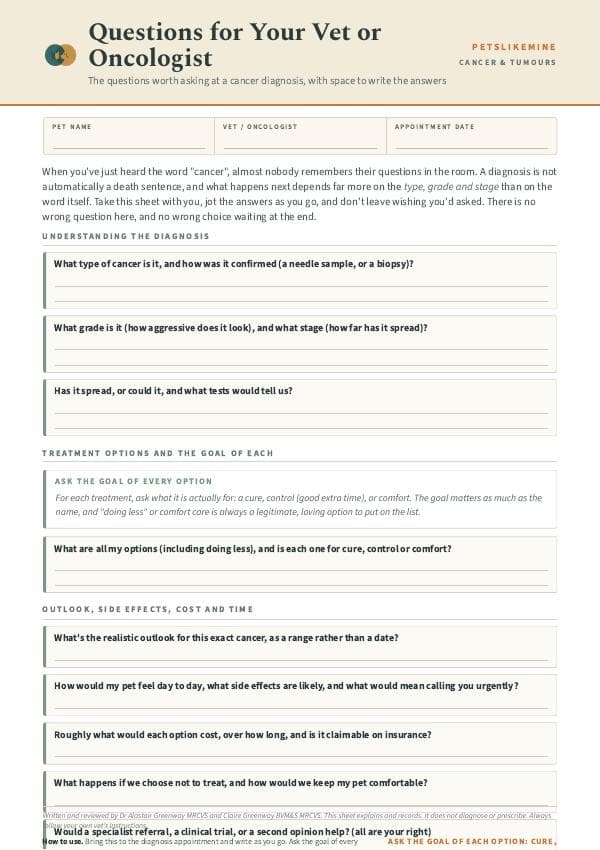
Questions for Your Vet or Oncologist
PDF · 173 KBThe questions to ask at a cancer diagnosis (type, grade, stage, spread, options and the goal of each, outlook, side effects, cost, doing nothing) with write-on answer space.
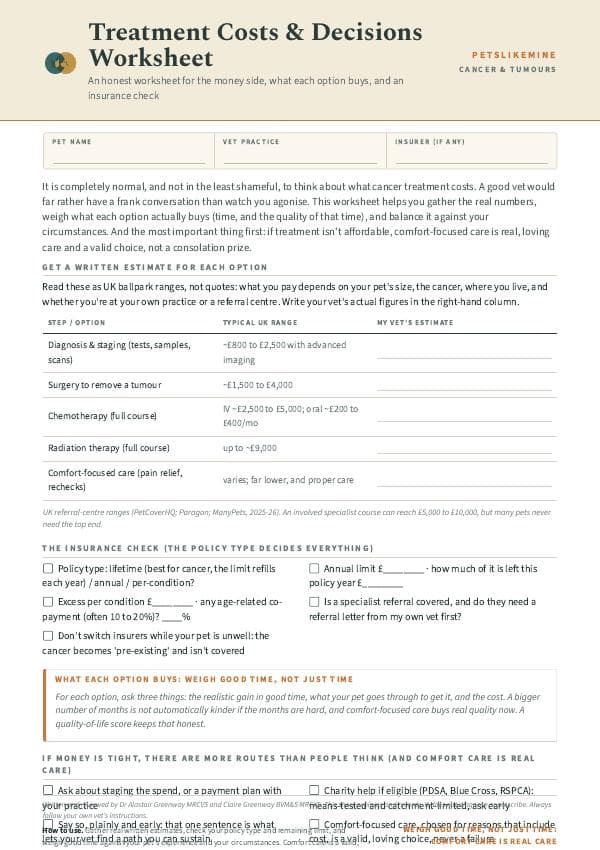
Treatment Costs & Decisions Worksheet
PDF · 234 KBA frank worksheet: UK cost ranges with write-on for your vet's quotes, an insurance check, what each option buys (time vs quality), and that comfort/do-nothing is a valid, loving choice.
Sister tool · Sightline
Track quality of life over time
Sightline, a separate ConciergeVet tool, runs a short adaptive weekly assessment with a quality-of-life focus mode built around exactly these frameworks, tracks a single composite score over time so you can see the trend rather than judge a single bad day, and produces a Sightline Report PDF you can bring to your vet.
A written log, or our printable quality-of-life sheet, does much the same job.
See how Sightline tracks quality of lifeFound a lump? Track it, and know when to act
A lump cannot be told apart by look or feel; only your vet sampling it can. The Lump & Bump Tracker records its size and how it changes, flags when it has crossed a line worth a vet visit, and builds a clean history to take in.
Open the Lump & Bump TrackerYou're not doing this alone
Compare treatment journeys and talk to owners managing cancer. Free to join.
Join PetsLikeMine