

"How Long Has My Pet Got?" Reading a Prognosis Honestly
Alastair Greenway
BVM&S MRCVS
How long has my pet got? It's the question almost every owner asks the moment the room goes quiet, and a lot of people are too frightened to say it out loud. You want a number, something solid to hold on to. Often you'll be given one: "the median survival time is about six months", or "without treatment, weeks". Then you take it home and it sits in the middle of the kitchen table like a countdown clock.
What nobody tends to explain properly at the appointment is what that number actually is. It's real, and it's useful, and it almost certainly doesn't mean what you've taken it to mean. Reading it properly is worth doing, because a prognosis read wrongly will either flatten you for no good reason or lull you into missing the time you've actually got.
Why the question is so hard to answer
When you ask your vet how long, you're asking for a prediction about one specific animal: the one asleep on the sofa. Cancer doesn't behave like a clock wound to a set time, though. It behaves like a range. Two dogs with the same diagnosis, the same grade and the same treatment can have very different outcomes, and there's often no way to know in advance which one yours will be.
So what a good vet gives you isn't really a prediction. It's a statistic, drawn from groups of pets with a similar cancer, and the honest ones say as much. As one veterinary oncology service puts it, these times "can be used to predict your pet's likelihood of survival, however, it is impossible to give a specific prognosis for an individual animal as there is often a wide possible range around the median" (Pieper Veterinary, 2024). That isn't a vet hedging or softening bad news. It's the truth about how the disease works.
Median survival time, in plain terms
The figure you're most likely to be handed is the median survival time, and this is where the misunderstanding usually starts. People hear it as "this is how long my pet has". It isn't that.
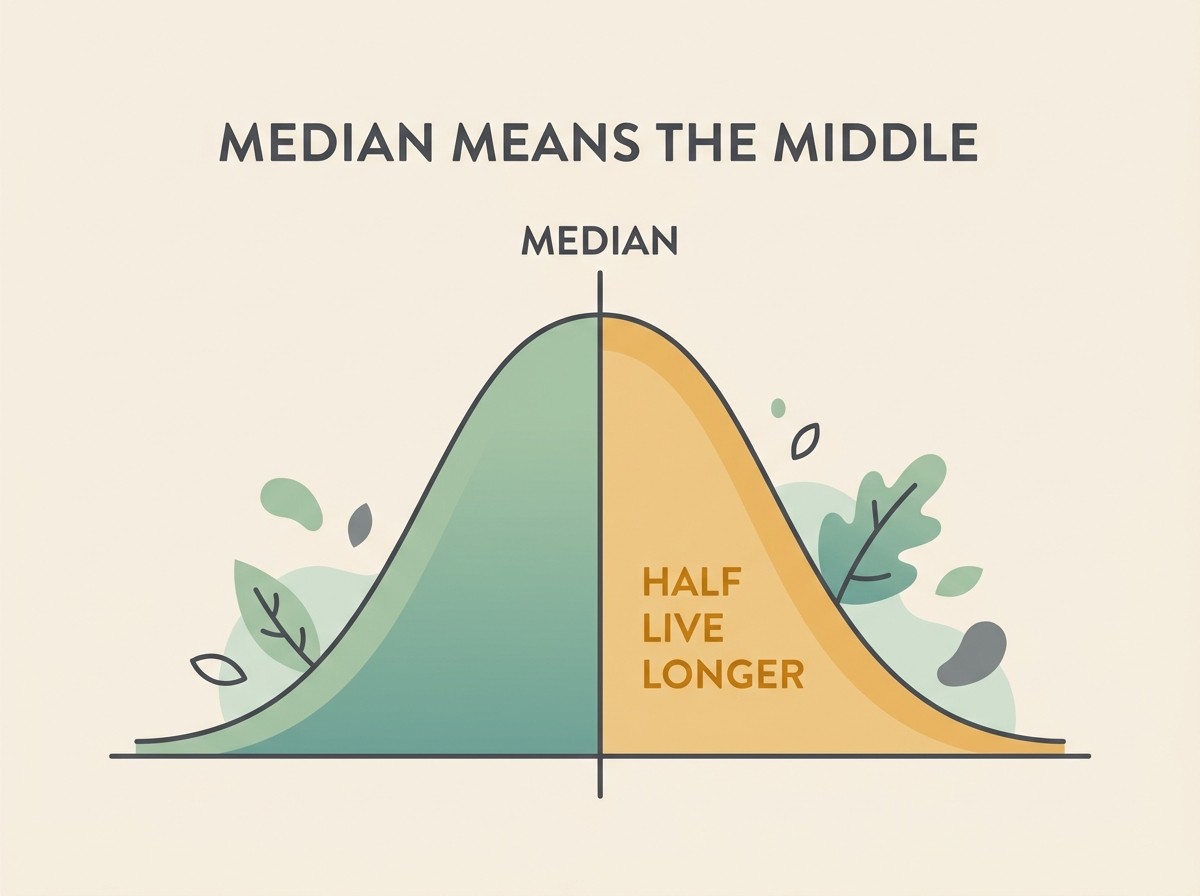
The median is simply the midpoint. If the median survival time for a particular cancer is one year, that means half of the pets in that group lived less than a year and half lived longer, often well beyond it (Pieper Veterinary, 2024). It's a use-by date for nobody. To borrow the plainest phrasing I've seen, "50% of dogs are expected to live less than the MST, and 50% of dogs are expected to live longer" (DogCancer.com, 2023). And some of that second half live a good deal longer than the figure suggests.
Picture it for a moment. Line up all the pets with this diagnosis by how long they lived, shortest on the left, longest on the right. The median is the one standing in the middle of the line. Your pet could be anywhere along it. The figure tells you where the middle is; it tells you nothing about which place in the queue is yours.
Time and good time aren't the same thing
There's a quieter point under all of this, and it matters more than the raw number. The figure that should guide you isn't really length of life. It's length of good life.
A prognosis tells you something about quantity. It says nothing about quality: whether the days ahead are comfortable, bright, your pet still themselves. Those are the days that actually count, and you don't have to guess at them. You can measure them. Tracking your pet's quality of life over time, the appetite, the comfort, the interest in things, shows you the trend in a way a single anxious evening never can. As one veterinary oncology resource puts it, "the quantity of life is meaningless without quality" (OncoLink, n.d.). A pet who has fewer weeks but spends them happy and pain-free may be far better served than one whose time was stretched at the cost of how they felt.
Letting a prognosis guide you, not govern you
So what do you actually do with the number once you've got it? Use it the way your vet does: as a planning tool rather than a sentence.
A realistic prognosis helps you make good decisions. It shapes whether an intensive treatment is worth it, what to budget, whether to book the trip you'd been putting off, when to gather the family. It turns "I don't know what's coming" into a rough shape you can plan around. That's the number doing its job.
It also gives you a fair way to decide without committing to everything at once. You don't have to choose today between throwing everything at the cancer and doing nothing. Many owners and vets agree a trial of treatment with a planned review point: give it a set number of weeks, then sit down together and look at how your pet is genuinely doing, using the quality-of-life trend rather than hope or fear. If things are good, you carry on. If they aren't, you've learned something real, and stopping is a kind decision rather than a failure. A prognosis turns that review from a gut feeling into an informed one.
What it can't do is tell you the date, so try not to let it become one. Pets don't read the textbook, and plenty quietly outlive their figure. Held loosely, as a guide rather than a deadline, it lets you stay present for the time you have instead of watching a clock.
There's a hard caveat this piece owes you, because false comfort would be its own kind of cruelty. Some cancers really are short and fast, and no amount of gentle framing changes that. Splenic haemangiosarcoma is the hardest of these. Even with surgery to remove the spleen, the median survival is only around 1.6 months, and without treatment many dogs are lost within days to weeks (Wendelburg et al., 2015). If that's the diagnosis in front of you, the kindest thing the number can do is tell you the time is short and precious, so you spend it well instead of chasing odds that aren't there.
The number is a guide. Your pet is an individual, not a statistic, and the goal was never to win a race against a figure on a clock. It's the quality of the days you've got. If you want a fuller view of those days, the quality-of-life tools are there to help you see them clearly, and to lean on when the harder decisions come.
References
- Pieper Veterinary. Oncology FAQs.
- DogCancer.com. Median Survival Time Meaning.
- NC State Veterinary Hospital. Canine Multicentric Lymphoma.
- Wendelburg, K.M., Price, L.L., Burgess, K.E., et al. (2015). Survival time of dogs with splenic hemangiosarcoma treated by splenectomy with or without adjuvant chemotherapy: 208 cases (2001-2012). Journal of the American Veterinary Medical Association, 247(4), 393-403.
- OncoLink (Bach, C.). Quality of Life Issues: Cancer Treatment in the Companion Animal.
Sister tool · Sightline
Track quality of life over time
Sightline, a separate ConciergeVet tool, runs a short adaptive weekly assessment with a quality-of-life focus mode built around exactly these frameworks, tracks a single composite score over time so you can see the trend rather than judge a single bad day, and produces a Sightline Report PDF you can bring to your vet.
A written log, or our printable quality-of-life sheet, does much the same job.
See how Sightline tracks quality of lifeFound a lump? Track it, and know when to act
A lump cannot be told apart by look or feel; only your vet sampling it can. The Lump & Bump Tracker records its size and how it changes, flags when it has crossed a line worth a vet visit, and builds a clean history to take in.
Open the Lump & Bump TrackerYou're not doing this alone
Compare treatment journeys and talk to owners managing cancer. Free to join.
Join PetsLikeMine