

Radiation Therapy for Pets: When It's Used and What It's Like
Alastair Greenway
BVM&S MRCVS
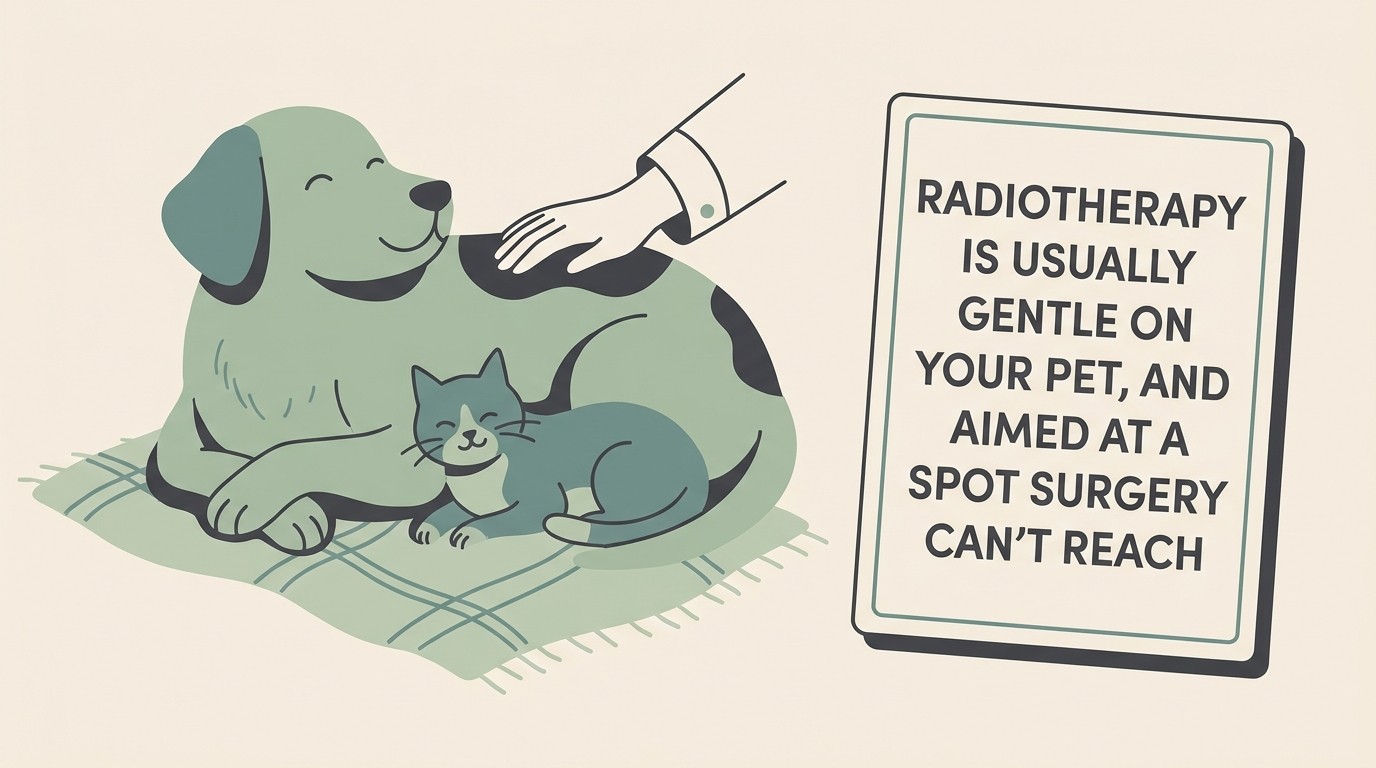
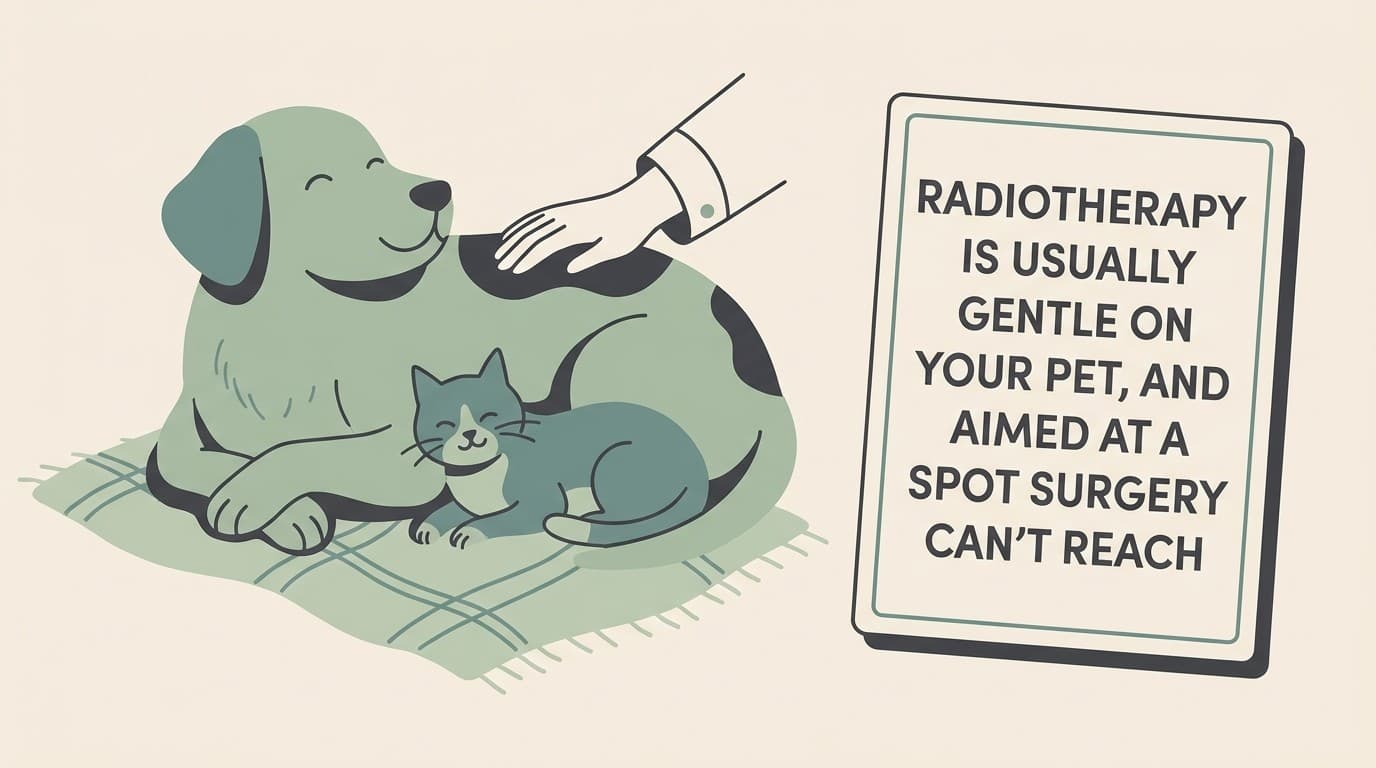
Radiotherapy is one of the three main ways we treat cancer, alongside surgery and chemotherapy, and it does a job the other two often can't: it treats one specific spot very precisely, including spots a surgeon can't safely cut. The word tends to carry a lot of human baggage, though, because in people radiotherapy can mean weeks of feeling dreadful, burns and exhaustion. For pets the experience is usually milder than that. There are some genuine practical hurdles to weigh up, mind you, since pets need an anaesthetic for each session and only a handful of UK centres offer the treatment at all.
So it's worth knowing what radiotherapy actually involves before you decide. Most pets tolerate it far better than people expect. Here is the full picture, including the parts that are harder in the UK.
How the treatment works
Radiotherapy uses carefully aimed, high-energy beams to damage the DNA inside cancer cells so they can't keep dividing. The beam is shaped and pointed at the tumour, with the dose worked out by a specialist team so it hits the cancer hard while sparing as much of the healthy tissue around it as possible (Merck Veterinary Manual, 2023). It is a local treatment, like surgery: it works on the area it's aimed at, not on cancer that has spread elsewhere, which is the job chemotherapy does.
That precision is the whole point of it, and it's why radiotherapy gets offered when surgery alone can't finish the job.
When it's used
A few situations make your vet or oncologist likely to raise it:
- When surgery couldn't get it all. Some lumps, especially soft tissue sarcomas and some mast cell tumours, sit in places where the surgeon can't take a wide enough cuff of normal tissue around them, so a few cancer cells are left behind at the edges (what's called an incomplete or "dirty" margin). Radiotherapy to that area can mop up those cells and greatly lower the chance of it growing back.
- When the tumour can't be operated on at all. This is the big one. Tumours in the nose, the brain, and parts of the mouth often can't be removed without unacceptable damage, so radiotherapy becomes the main treatment rather than a back-up. Nasal tumours in dogs are the classic example.
- For oral melanoma in dogs, which often responds well to radiotherapy as part of the plan.
- To relieve pain and other signs (palliation). Even when a cure isn't on the table, a shorter course can shrink a painful tumour, ease bleeding or breathing trouble, and buy comfortable time. Bone tumours are a common reason for this.
Two very different goals: definitive and palliative
The distinction between these two aims matters more than almost anything else here, because they feel completely different for you and your pet.
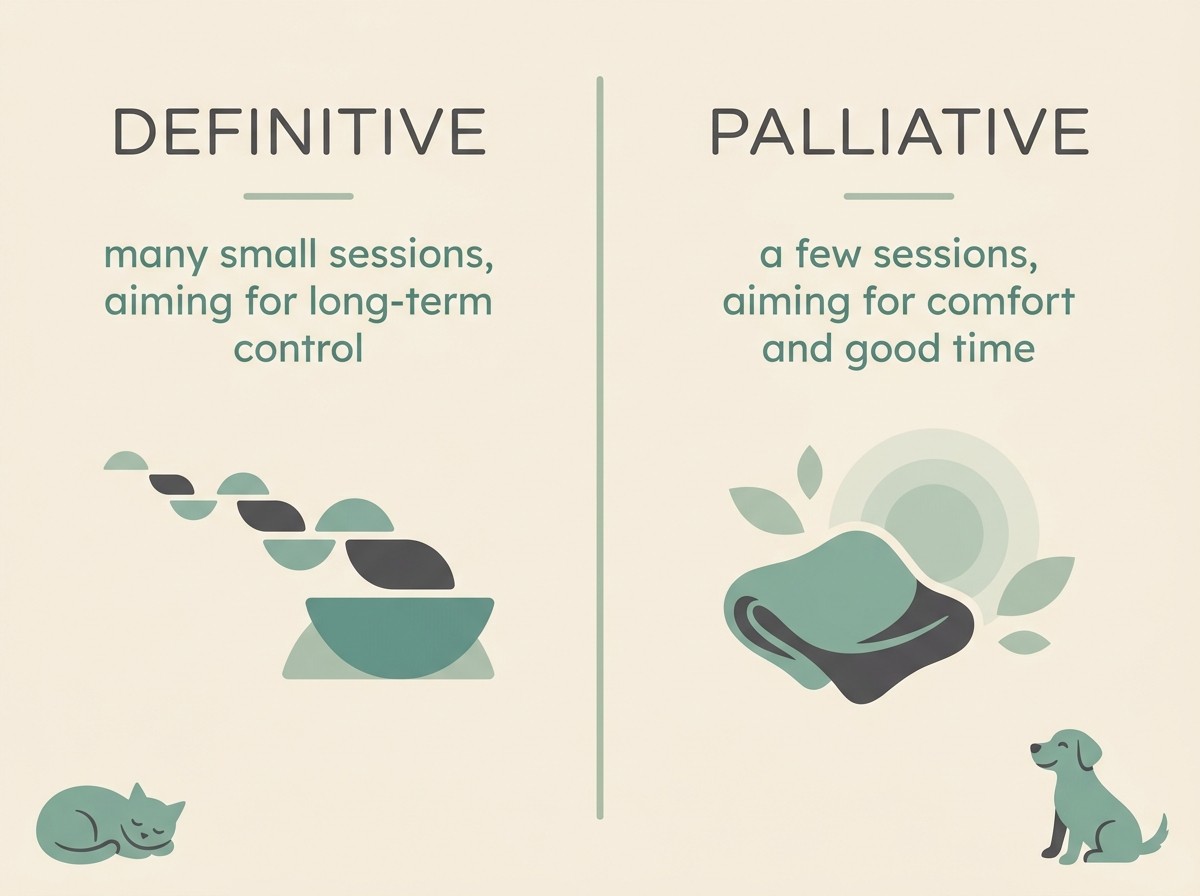
Definitive (or curative-intent) radiotherapy aims for long-term control. To do that safely, the total dose is split into many small daily doses, called fractions. A typical definitive course is somewhere around 10 to 20 sessions, given on weekdays over roughly two to four weeks (Merck Veterinary Manual, 2023; Southfields Veterinary Specialists, 2024). Splitting it up like this lets the cancer take a heavy hit while healthy tissue gets a chance to recover between doses.
Palliative radiotherapy has a gentler aim: comfort rather than cure, usually when the outlook is already limited. It uses fewer, larger doses, often around four to six sessions, given over anything from a single week to a few weeks (Today's Veterinary Practice, 2021). The goal is to take the edge off pain and other signs quickly, with the fewest visits and anaesthetics, so the time it buys is good time.
A newer, more precise option called stereotactic radiotherapy (SRT or SRS) is also worth knowing about. It delivers a much higher dose with sub-millimetre accuracy, so the whole treatment can often be done in just one to five sessions rather than fifteen or twenty (Today's Veterinary Practice, 2021). Far fewer anaesthetics is a real advantage, and for some tumours, such as canine nasal tumours, the results are encouraging, with reported median survival times of well over a year in larger recent series (Yoshikawa et al., 2023). It isn't right for every tumour, and it's offered at fewer centres, but it's worth asking about.
An anaesthetic every time
This is the part owners worry about most, and it's the part that's genuinely different from human radiotherapy. The beam has to be aimed at exactly the same spot to within a millimetre or two, every single session, and a pet won't lie perfectly still to order. So your pet has a short general anaesthetic for each treatment (Merck Veterinary Manual, 2023). With a long definitive course, that can mean a dozen or more anaesthetics over a few weeks.
It sounds alarming, and it's a fair thing to ask about. In practice each anaesthetic is brief, usually only the few minutes it takes to position your pet and deliver the dose, and oncology teams give these light anaesthetics day in, day out (VCA Animal Hospitals, 2024). For most pets it's the daily anaesthetic, the travel and the disruption that add up, rather than the radiation itself. It's still a real consideration, especially for an older pet or one with heart or other health problems, so it's exactly the sort of thing to talk through openly with the team. It's also one of the reasons the shorter stereotactic and palliative courses appeal to a lot of owners.
What the side effects are really like
Here again the human picture oversells the misery. Because radiotherapy is a local treatment, the side effects are mostly limited to the small patch of skin and tissue in the beam's path, rather than the whole-body sickness people associate with cancer treatment.
The common ones are acute effects, which show up part way through the course and settle afterwards. They appear in the fast-renewing tissues being treated, the skin and the lining of the mouth or nose, and look a bit like sunburn: redness, soreness, sometimes a moist or peeling patch, or a sore mouth if that's the area treated (Today's Veterinary Practice, 2021). These tend to start around two to three weeks in, can peak near the end of the course, and usually settle within a few weeks once treatment finishes, occasionally taking up to about six (Today's Veterinary Practice, 2021; Merck Veterinary Manual, 2023). The team will give you what you need to keep your pet comfortable and stop them licking or scratching the spot.
Late effects are much less common but more serious, because they don't reverse. Months or more after treatment, slow-renewing tissues such as bone, nerve and muscle can be affected, and depending on the area you might see permanent hair loss or a colour change over the treated patch, a cataract if an eye was near the field, or rarely damage to bone (Today's Veterinary Practice, 2021). Splitting a definitive course into all those small doses is exactly how the team keeps this risk low. Your oncologist can tell you which, if any, are a realistic concern for your pet's particular tumour, because it depends heavily on where it is.
What you very rarely see, and what surprises people most, is a pet made systemically ill by radiotherapy. Most carry on eating, playing and being themselves throughout, with a sore patch as the main sign anything's going on.
Getting it in the UK
Here I want to be straight with you. Radiotherapy for pets is a referral-only, specialist treatment, and only a small number of UK centres have the linear accelerator (the machine) to provide it. Southfields Veterinary Specialists describe themselves as "one of only six centres in the UK to have a LINAC system for treating cancer in small animals" (Southfields Veterinary Specialists, 2024). Others include the university hospitals at Cambridge and Glasgow, and referral centres such as Bristol Vet Specialists and Willows.
That has three practical consequences. You'll need a referral from your own vet to one of these centres (we cover how that works, and second opinions, separately). You may face a journey, since the nearest centre could be a long way away, which matters a lot when you're attending daily for weeks. And it isn't cheap: radiotherapy is one of the more expensive cancer treatments, often running to several thousand pounds depending on the tumour, the protocol and the centre, so it's worth getting a written estimate up front and checking what your insurance covers, which we go into in the cost piece.
None of that is meant to put you off. It's so you can plan realistically. If the travel or the cost makes a long definitive course impractical, a shorter palliative course or a focus on comfort care is a perfectly valid and loving path, not a failure.
Daily life during a course
For a definitive course, the rhythm is usually an outpatient one. You bring your pet in on weekday mornings, they have their short anaesthetic and treatment, they recover, and they come home with you, often the same day. Some families who live far from the centre arrange to board their pet nearby for the few weeks instead. Pets generally settle into the routine quickly, and because they don't feel unwell from the treatment itself, many are their normal selves at home in the evenings.
If you're weighing radiotherapy up, the useful questions are the practical ones: is this for control or for comfort, how many sessions and over how long, how far is the travel, how many anaesthetics, what side effects should I expect for this tumour in this spot, and what will it cost. Bring that list to the referral appointment. Whatever you decide, knowing what radiotherapy genuinely involves means you're choosing for real reasons, not for the frightening version it isn't.
References
- Merck Veterinary Manual (2023). Radiation Therapy in Animals (Therapeutics).
- Rancilio, N. (2021). Conventional Versus Stereotactic Radiotherapy. Today's Veterinary Practice (Nov/Dec 2021; peer-reviewed clinical article; definitive 10 to 20 fractions, palliative 4 to 5 large fractions, SRT 1 to 5 fractions with submillimetre accuracy, acute effects from 2 to 3 weeks).
- Southfields Veterinary Specialists (2024). Radiotherapy (referral service page; "one of only six centres in the UK to have a LINAC system").
- VCA Animal Hospitals (2024). Radiation Therapy (client education).
- Yoshikawa, H., Lafferty, M.H., Griffin, L.R., & LaRue, S.M. (2023). A retrospective study of sinonasal tumors in 182 dogs treated with stereotactic radiotherapy (3 x 10 Gy) (2010 to 2015). Journal of Veterinary Internal Medicine, 37(6), 2356 to 2367. (large recent series; median overall survival 441 days for canine sinonasal tumours treated with SRT).
Sister tool · Sightline
Track quality of life over time
Sightline, a separate ConciergeVet tool, runs a short adaptive weekly assessment with a quality-of-life focus mode built around exactly these frameworks, tracks a single composite score over time so you can see the trend rather than judge a single bad day, and produces a Sightline Report PDF you can bring to your vet.
A written log, or our printable quality-of-life sheet, does much the same job.
See how Sightline tracks quality of lifeFound a lump? Track it, and know when to act
A lump cannot be told apart by look or feel; only your vet sampling it can. The Lump & Bump Tracker records its size and how it changes, flags when it has crossed a line worth a vet visit, and builds a clean history to take in.
Open the Lump & Bump TrackerYou're not doing this alone
Compare treatment journeys and talk to owners managing cancer. Free to join.
Join PetsLikeMine