

PU Surgery (Perineal Urethrostomy): When It's the Right Call, and Life After
Alastair Greenway
BVM&S MRCVS
If you're reading this, you're probably exhausted. Your cat has blocked more than once, you've done the late-night dash to the emergency vet more times than feels fair, and somewhere in the last conversation your vet said the words "perineal urethrostomy", or "PU surgery", and your stomach dropped. It can sound drastic, even like a last resort you've somehow failed your way into. It isn't. For a cat who keeps blocking, PU surgery is often the single kindest, most protective decision you can make, and the cats who have it generally go on to live full, comfortable lives.
This page is the straight version of that decision: what the operation does, when it's the right call, the real outlook, and what life looks like afterwards. It picks up where the re-block prevention plan leaves off, so if you haven't read [will it happen again? preventing a re-block after your cat comes home] yet, that's the article on stacking the odds without surgery. This one is for when the odds aren't enough.
What the operation actually does
Male cats block because of their plumbing. The male urethra, the tube that carries urine out of the bladder, is long and gets steadily narrower towards the tip of the penis, and that narrow end is where a gritty plug of crystals, mucus and inflammatory debris wedges and stops urine getting out (VCA Animal Hospitals). It's the same reason a block is almost always a male-cat problem and rarely a female one.
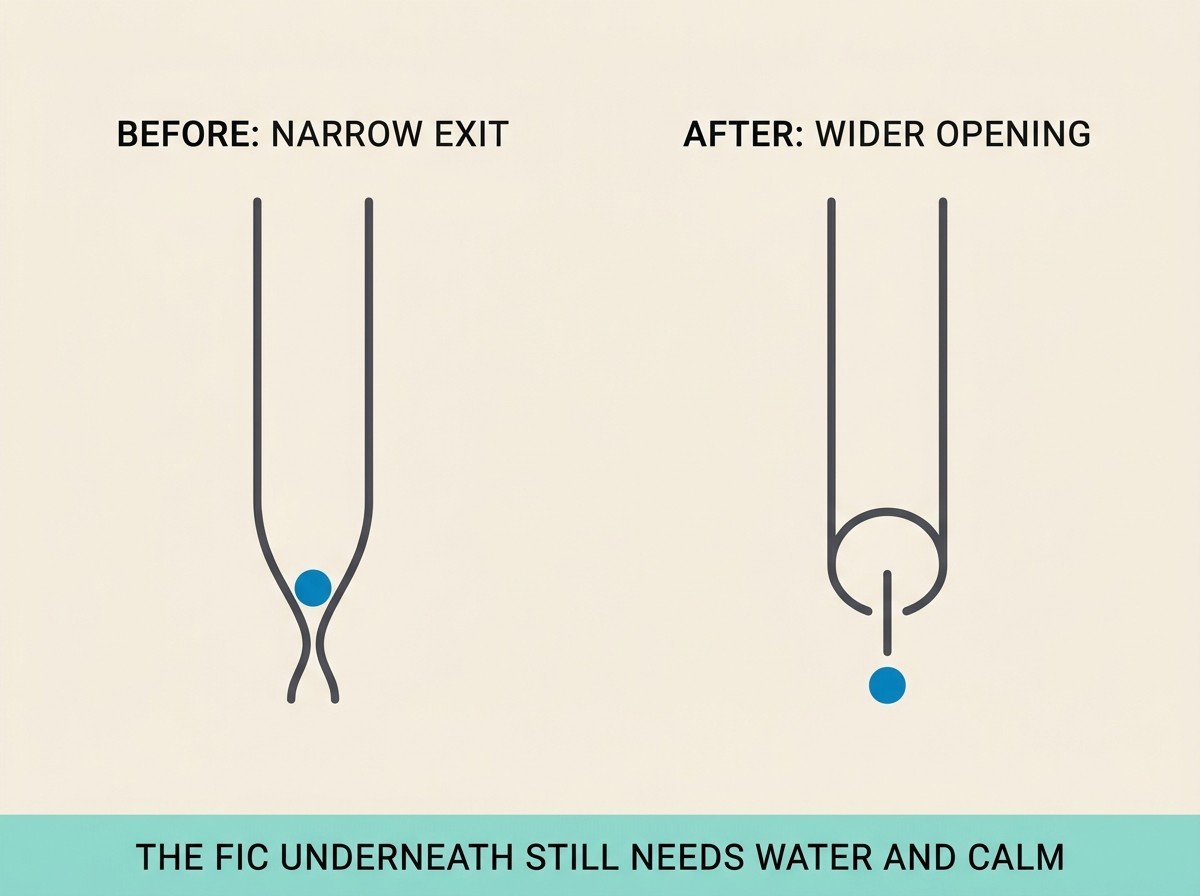
A perineal urethrostomy fixes the bottleneck rather than the plug. Under a general anaesthetic, the surgeon removes the narrow end of the urethra and the penis, then stitches the wider part of the tube, the part that sits further back near the pelvis, to a new opening in the skin under the tail (Tobias, Clinician's Brief). In plain terms, your cat is given a shorter, wider exit, so a plug that would have jammed the old narrow tip now simply washes straight out. After healing, he squats rather than aims, but the act of weeing itself is normal and comfortable. It's a well-established, routine procedure with very good modern results, not a desperate measure, usually with a day or two in hospital.
When it's the right call (and when it isn't)
PU surgery is a salvage procedure, which is a clinical way of saying it's held back for the cats who genuinely need it rather than offered to every blocked cat. The first block is almost never an automatic reason to operate. Most cats who block once are managed medically, by unblocking them and then working hard on water, diet and stress to prevent a repeat ([the full prevention plan is here]). Surgery comes into the conversation when that isn't holding the line.
Your vet is likely to raise it in a handful of situations:
- Repeat blocks. This is the commonest reason by far. A cat who blocks again and again, despite a genuine prevention effort, is telling you his anatomy is working against him, and widening the exit changes that (2025 iCatCare consensus guidelines). As a rough guide, many vets start the discussion after a second or third obstruction.
- A block that can't be cleared the usual way. Occasionally a plug or a small stone is jammed so firmly in the narrow urethra that it can't be flushed back into the bladder. Removing that narrow segment solves the immediate problem and the future one at once (Tobias, Clinician's Brief).
- Permanent narrowing (a stricture). Repeated blocks, or a difficult catheter, can leave scar tissue that narrows the urethra for good. Once the tube is permanently narrowed, no amount of water or diet will widen it again, and surgery is the only way to give a reliable opening (Tobias, Clinician's Brief).
The decision is rarely just clinical, and a good vet will say so. The toll of repeated emergencies, the cost of each one, and the stress on your cat and on you all sit in the balance, and the 2025 iCatCare guidelines explicitly recognise recurrence and cost pressures as legitimate reasons to choose surgery (2025 iCatCare consensus guidelines). If you've been white-knuckling through flare after flare, surgery can be the thing that finally lets you both stop bracing.
What surgery does and doesn't fix
The relief of "we've fixed it" can make this easy to miss. A PU widens the exit, but it does not cure the disease underneath. Most cats who block have feline idiopathic cystitis (FIC), the stress-linked, sterile bladder inflammation that makes the bladder sore and sheds the debris that forms plugs ([feline idiopathic cystitis explained]), and in one large series of 314 cats having a PU, FIC was the cause in 93% of them (Hankins and Zacher-Coy, 2025). Surgery does nothing to the FIC. The bladder can still get inflamed and sore, your cat can still have flares with straining and blood, and the 2025 iCatCare guidelines are blunt that the underlying disease must still be managed after the operation (2025 iCatCare consensus guidelines).
What surgery does change is the danger. After a PU, a flare is far less likely to tip into a life-threatening blockage, because the plug has a wide door to leave by instead of a narrow one to jam in. So the right way to think about it is this: the operation buys safety, and your water, diet and stress-reduction work still buys comfort and fewer flares ([water, diet and your cat's bladder] and [managing FIC with MEMO]). You keep doing all of it. The difference is that a bad day is no longer an emergency.
The outcomes: what the evidence really says
On quality of life, the news is genuinely good. In a study of 74 cats followed for up to roughly two and a half years after their PU, every single owner rated their cat's quality of life as at least as good as it had been before the urinary problems ever started, and 48% said it was actually better than before (Slater and colleagues, 2020). Asked to score their cat's life out of ten, three-quarters of owners gave a perfect ten. These are cats who, before surgery, were having repeated frightening emergencies, so "back to normal or better" is a high bar cleared.
The operation also does its main job. The whole point of a PU is to stop the blocking, and it largely does: in a recent series of 314 cats, only about 1 in 75 blocked again afterwards (1.3%), and serious complications of any kind affected just 2.2% (Hankins and Zacher-Coy, 2025). Most cats go home and stay home.
It isn't risk-free, and you deserve the trade-offs in plain sight:
- A new infection risk for life. This is the main long-term trade-off. The wider, shorter exit that stops plugs jamming also lets bacteria reach the bladder more easily, so these cats are more prone to genuine bacterial urine infections, with figures commonly quoted around one in four cats over time (Tobias, Clinician's Brief). The flip side is that a true infection is treatable with antibiotics, which a block and FIC usually are not, so it's a much more manageable problem to have.
- Scarring of the new opening (a stricture). If the new stoma heals down too tight, it can narrow and need a small revision, reported in roughly 2 to 12% of cats across studies depending on the surgeon and technique (Tobias, Clinician's Brief; Hankins and Zacher-Coy, 2025). It's one of the reasons careful aftercare in the first few weeks matters.
- The usual surgical risks, including a wound that's slow to heal, some bruising, and short-lived dysuria (uncomfortable weeing) while everything settles (Watson and colleagues, 2020). Most of these are minor and pass.
Outcomes are generally better in experienced hands, so it's entirely reasonable to ask your vet how often they do this operation, or whether referral to a surgeon is an option in your area.
Life after surgery: the recovery and the one thing that changes for good
The first few weeks need care, and then most cats simply get on with being cats.
The recovery weeks. Your cat comes home with a buster collar (the cone), and it has to stay on day and night for at least two to three weeks, because a single determined lick at the healing stoma can undo the surgery and is the commonest cause of a problem (Tobias, Clinician's Brief). A soft recovery collar or a body suit can be gentler than a hard cone if your cat hates it, but something has to be on. Expect him to be a bit subdued, to visit the tray often, and to look a little sore at first, all of which is normal. Keep him calm and indoors, give every medicine exactly as prescribed, and call the practice if the wound looks angry, if he strains and passes nothing, or if he stops eating.
The litter change. This is the practical thing nobody warns you about, and it's easy once you know. For the first few weeks after surgery, ordinary clumping or clay litter is out, because the fine granules stick to the fresh wound and cause irritation (Dogwood Veterinary Surgical Care). Switch to shredded paper or a non-clumping pelleted paper litter such as the recycled-newspaper types for the healing period, and keep the tray scrupulously clean. If a bit of litter does stick to the site, you can wipe it off with a damp cloth rather than picking at it. Many owners stay on a paper-based or larger-pellet litter long-term simply because it's kinder to the new opening, though once fully healed most cats tolerate a return to a softer one. Your vet will tell you when.
Beyond that, life looks much as it did, minus the dread. The new opening becomes unremarkable, and the emergency you'd been living in fear of is largely off the table.
What stays the same: the bladder still needs you
Because the FIC underneath doesn't go away, the calm, cheap habits you've built don't stop at the hospital door. They carry on doing the real day-to-day work.
- Water, still the biggest lever. Dilute urine means a less irritated bladder and fewer flares, so keep going with wet food, fountains and water stations spread around the house ([water, diet and your cat's bladder]).
- A calm home, still the best FIC medicine. The litter-tray rules, the hiding spots, the routine and the reduced multi-cat tension that settle FIC are exactly as worth doing after surgery as before ([managing FIC with MEMO], and the [FIC home-care and MEMO checklist] download).
- The emergency rule, with one update. A blocked PU cat is much rarer, but it isn't impossible, so straining and passing little or nothing, crying, vomiting or going flat still means see a vet today, the same as ever ([is this an emergency? the blocked-cat signs you must not wait on], and the [Blocked-Cat triage] tool). The reassuring part is that for most PU cats, the worry shifts from "is he blocked and dying" to "has he got a treatable infection".
Keeping a simple log of his tray visits, water and any flares on the [FIC & Water tracker] is just as useful after surgery, because it lets you and your vet catch a urine infection early and watch the flares stay mild and spaced out.
For a cat who keeps blocking, a PU takes the life-threatening emergency off the table, the cats who have it overwhelmingly do well, and the trade-offs are real but manageable. Choosing it isn't giving up on your cat. For one who keeps ending up on the emergency table, it's one of the most protective things you can do.
References
- Slater MR, Pailler S, Gayle JM, Cohen I, Galloway EL, Frank KA, DeClementi C. *Welfare of cats 5-29 months after perineal urethrostomy: 74 cases (2015-2017).* Journal of Feline Medicine and Surgery. 2020;22(6):582-588. doi:10.1177/1098612X19867777. (Owner-reported quality of life after PU: 100% of owners rated their cat's quality of life at least the same as before urinary problems began, 48% reported it better; on a 1-10 scale 100% rated at least 7 and 75% rated 10.)
- Hankins K, Zacher-Coy L. *The use of 6-0 glycomer 631 for perineal urethrostomy in male cats: 314 cases (2013-2023).* Frontiers in Veterinary Science. 2025;12:1515477. doi:10.3389/fvets.2025.1515477. (Large recent PU series: indication was FIC in 292/314 (93.0%) and urethral calculi in 22/314 (7.0%); minor complications 18/314 (5.7%), major complications 7/314 (2.2%), stricture requiring revision 6/314 (1.9%), re-obstruction needing catheterisation 4/314 (1.3%); 44/146 (30.1%) presumptively treated for a UTI.)
- Tobias KM (updated by Peterson-Levitt J). *Perineal Urethrostomy in Cats.* Clinician's Brief. (PU as a salvage procedure for recurrent idiopathic urethral obstruction, caudal urethral stricture, or obstructive uroliths that cannot be retropulsed; surgical principle of anastomosing the wider postprostatic urethra to skin to make a wider stoma; E-collar for at least 3 weeks; stricture 5-12% and bacterial UTI ~23% as the commonest postoperative complications; dehiscence, urine extravasation, dermatitis and dysuria as further complications.)
- Taylor S, Boysen S, Buffington T, Chalhoub S, Defauw P, Delgado MM, Gunn-Moore D, Korman R, et al. *2025 iCatCare consensus guidelines on the diagnosis and management of lower urinary tract diseases in cats.* Journal of Feline Medicine and Surgery. 2025;27(2). doi:10.1177/1098612X241309176. (PU as a salvage option that can be considered in recurrent cases, including where caregiver cost limitations apply; explicit statement that the underlying disease such as FIC must still be addressed after surgery; risk of UTI is increased after PU.)
- Watson MT, Roca RY, Breiteneicher AH, Kalis RH. *Evaluation of postoperative complication rates in cats undergoing perineal urethrostomy performed in dorsal recumbency.* Journal of Feline Medicine and Surgery. 2020;22(4):399-403. doi:10.1177/1098612X19838286. (Short-term complication limited to transient dysuria in 2/12 (16.7%) cats; most common long-term complication a single recurrent UTI in 3/9 (33.3%) cats, resolved with a short antibiotic course; no urethral stricture, re-obstruction or chronic UTI reported.)
- Seneviratne M, Stamenova P, Lee K. *Comparison of surgical indications and short- and long-term complications in 56 cats undergoing perineal, transpelvic or prepubic urethrostomy.* Journal of Feline Medicine and Surgery. 2021;23(6):477-486. doi:10.1177/1098612X20959032. (Among 37 perineal urethrostomy cats: indication FIC 21/37 (56.7%), urolithiasis 12/37 (32.4%); short-term complications affected 23/37 (62.2%); long-term complications 2/14 (14.3%), all UTI; no long-term stricture.)
- VCA Animal Hospitals. *Perineal Urethrostomy Surgery in Cats* (owner information; the male feline urethra is long and narrows towards the penis, predisposing to obstruction; PU removes the narrowest part of the urethra and creates a new, shorter, wider opening; recurrence after surgery uncommon; E-collar and restricted activity during recovery).
- PetMD. *PU Surgery in Cats: Perineal Urethrostomy and Recovery.* (E-collar or bodysuit worn for ~14-21 days during healing; higher long-term UTI risk because the wider, shorter urethra admits bacteria into the bladder more easily.)
- Dogwood Veterinary Surgical Care. *After Care Instructions: Perineal Urethrostomy.* (Postoperative litter management: use non-clumping paper litter such as shredded paper or pelleted recycled-newspaper products for the 2 to 3 week recovery, and avoid regular clumping/granular litter whose granules stick to and irritate the healing stoma; keep the incision untouched to minimise stricture; E-collar required throughout recovery.)
Keep track of how your pet is doing
The owners who cope best are the ones who notice changes early. A simple health log shows you what is working, and what is not, before the next vet visit.
Start tracking, freeYou're not doing this alone
Compare treatment journeys and talk to owners managing urinary health. Free to join.
Join PetsLikeMine