

Will It Happen Again? Preventing a Re-block After Your Cat Comes Home
Alastair Greenway
BVM&S MRCVS
You've brought him home. He's a bit subdued, maybe shaved on one front leg from the drip, and you're watching the litter tray like it owes you money. That fear in your chest, the one that says "what if it happens again tonight", is completely reasonable. It might happen again, and you're right to take it seriously. The reassuring news is that you can genuinely lower the odds, and most of what lowers them costs very little.
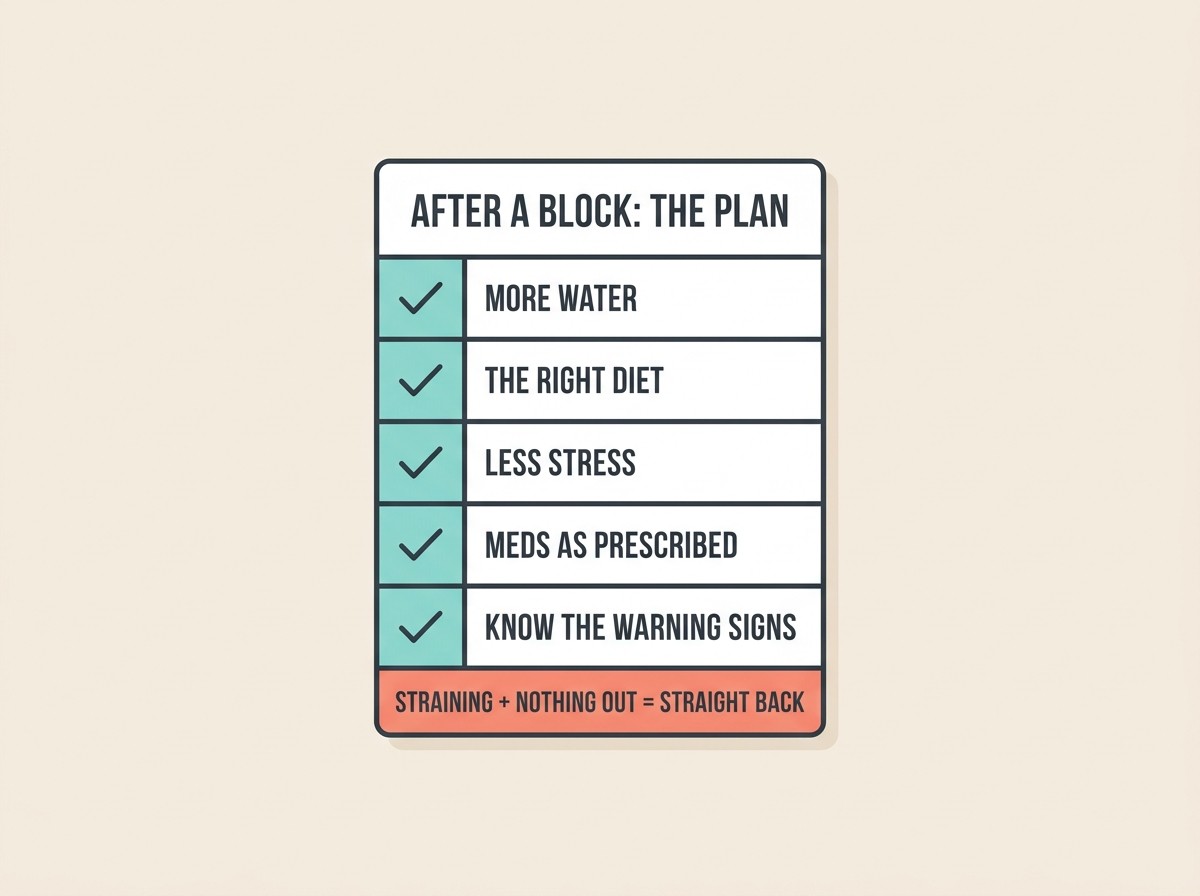
This article is the plan: the recurrence rate and the high-risk first few weeks, then the five things that actually move the needle. Water, the right diet, stress and the home, the medicines your vet may have sent home, and the warning signs that mean you go straight back.
The setup: how likely is a re-block?
Let's not sugar-coat it, because you'd see through that. Blocking again is common. Across the studies, somewhere around 30 to 40% of cats with lower urinary signs get them again within a year, and one long-term follow-up found 43% had recurrent signs inside the first year and well over half over the years that followed (Kaul and colleagues, Journal of Feline Medicine and Surgery, 2020). Most re-blocks happen early, in the first days to weeks after coming home, while the urethra is still inflamed and swollen from the catheter and the original episode. That's why the anxious first fortnight you're in right now is the one that matters most.
That same study found recurrence didn't really depend on which exact problem caused the first episode, the rates were much the same whether the cause was idiopathic cystitis, stones or a genuine infection, so this is about managing the whole cat, not chasing one tidy cause. And the changes that lower the risk are the same calm, cheap, home-based ones that settle feline idiopathic cystitis (FIC), the stress-linked bladder inflammation that sits underneath a large share of blocks in the first place [link to C1, Feline idiopathic cystitis]. You're not learning five separate skills. You're learning one approach to a sensitive cat.
A re-block is not a failure on your part. It's a feature of the condition, and your job over the coming weeks is simply to tilt the odds.
Water first, because it's the biggest lever you have
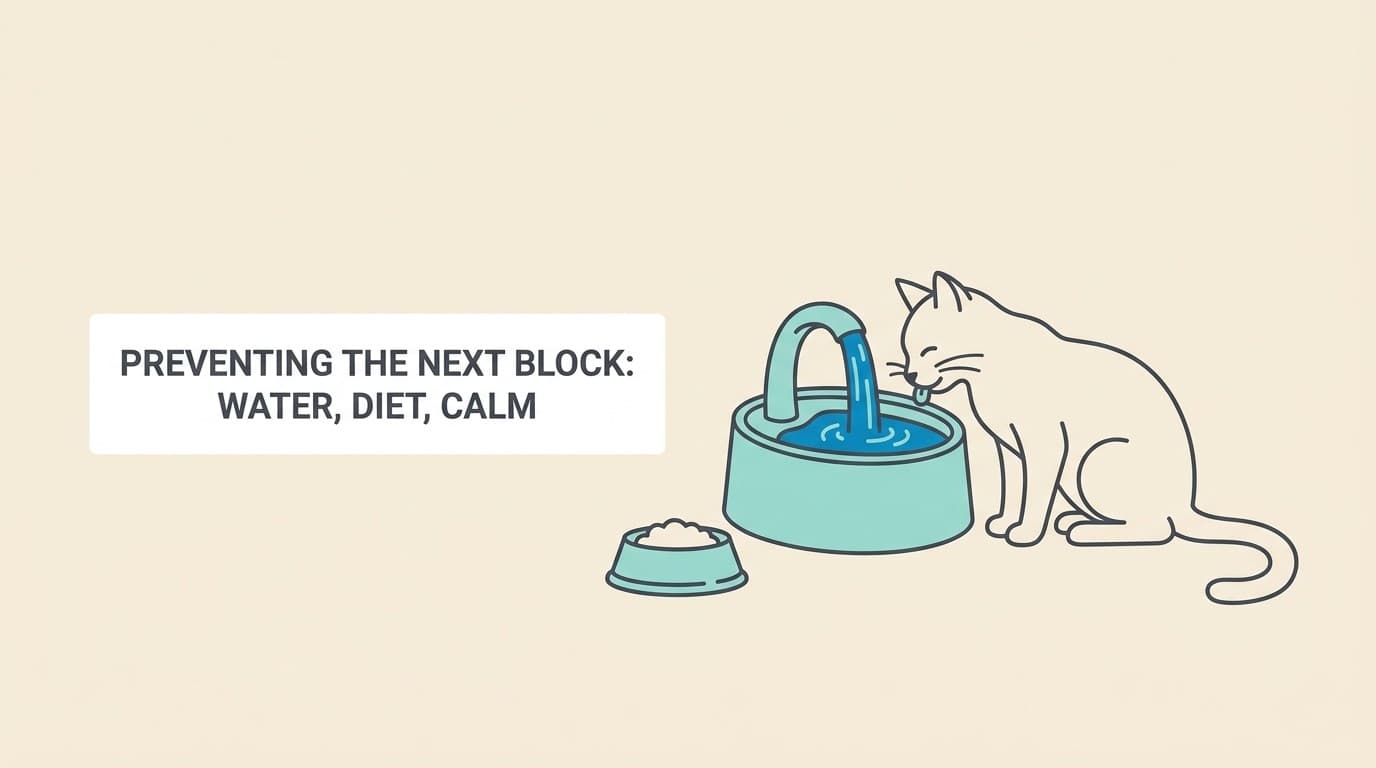
More water through the bladder means more dilute urine, and dilute urine is far less likely to form the gritty plug of crystals, mucus and inflammatory debris that blocks the urethra in the first place. This isn't a wellness tip dressed up as advice. In cats with idiopathic lower urinary signs, recurrence rates may be more than halved when cats are kept on a high-moisture diet rather than a dry one, with one study reporting recurrence within a year of around 11% on a canned diet versus 39% on the dry version (Markwell and colleagues, Journal of the American Veterinary Medical Association, 1999). That is a bigger effect than most medicines manage.
The single most powerful move is wet food. Tinned or pouched food is roughly 70 to 80% water, so shifting your cat's diet towards wet is the easiest way to flood the system without him having to choose to drink. If he's been a dry-food cat his whole life, go slowly, mixing in a little more wet over a week or two so you don't trigger a hunger strike (cats can be infuriatingly principled about this). A splash of warm water in the wet food helps too.
Then make drinking easy and tempting:
- Several water stations around the house, not one, and away from food and away from the litter tray (cats instinctively avoid drinking next to where they eat or toilet).
- Wide, shallow bowls so his whiskers aren't squashed against the sides, in glass or ceramic rather than plastic.
- A pet fountain if he likes moving water, as plenty of cats drink more from running water than a still bowl.
- Fresh water, topped up daily.
You won't know which trick lands until you try, because cats are individuals. There's a fuller look at all of this in our water-and-diet article [link to C4, Water, diet and your cat's bladder] and the funnel piece on why water is the best thing you can do for a bladder [link to F6]. The principle is simple: dilute him out.
The diet: the right one depends on what they found
Your vet may have sent you home with a specific urinary diet, and you may have left the consult slightly fuzzy on why. The logic is simple. A urinary diet does two useful things: it pushes water intake (the wet versions especially), and it adjusts the mineral content and urine pH to discourage crystals from forming.
The important nuance, and the thing the diet marketing tends to flatten, is that the right diet depends on what was actually causing the trouble. If crystals or a stone were involved, the type matters enormously, because a diet designed to dissolve struvite is a different diet from one designed to prevent calcium oxalate, and they are not interchangeable [link to S1, Bladder stones]. If the block sat on top of FIC with no stone at all, the diet's main job is dilution. This is a vet decision rather than a shelf decision, so if you're unsure which camp your cat is in, ask the practice what they found and why they chose that food. And wherever you can, lean towards the wet version of whatever diet you're given.
Stress and the home, because FIC is usually underneath
This is the part that sounds soft and turns out to be central. Many blocks form because an inflamed, irritable bladder, the FIC bladder, leaks proteins and sheds debris that clump with crystals into a plug. Calm the inflammation and you reduce the raw material for the next block. And the best-evidenced way to calm FIC is not a pill, it's the environment.
The approach has an ugly name, multimodal environmental modification (MEMO), and a lovely effect. In the foundational study, adding environmental changes to usual care produced a marked, statistically significant drop in recurrent lower urinary signs over the following months, alongside calmer, less fearful cats (Buffington and colleagues, Journal of Feline Medicine and Surgery, 2006). The headline changes:
- Litter trays: the n+1 rule (one tray per cat, plus one spare), spread around the home rather than lined up in one corner, large, uncovered, with unscented clumping litter, scooped daily.
- Resources, multiplied and separated: food, water, beds, scratching posts and hiding spots dotted around so he never has to queue, compete or run a gauntlet to reach them. This matters most in multi-cat homes, where tension is often silent [link to C6, Breaking the cycle].
- Up and away: shelves, a cat tree, a quiet box to retreat to. A cat that can get high and hide feels safe, and safe cats flare less.
- Predictability: steady feeding and play routines, and any change introduced slowly. Daily play that lets him stalk and pounce burns off the stress that feeds the cycle.
You don't have to do all of it this week. Pick two or three changes and build from there. The full practical checklist lives in our MEMO article [link to C3, Managing FIC with MEMO] and the printable MEMO home-care checklist [link to the FIC home-care and MEMO checklist download].
The medicines from the discharge sheet (and a straight word on prazosin)
Most cats go home with a short course of pain relief, and sometimes an anti-inflammatory, to settle the bruised, inflamed urethra and bladder. Give these exactly as prescribed, and never add human painkillers, as several of them are toxic to cats and can be fatal.
Many cats also go home on prazosin, a muscle relaxant meant to ease the smooth muscle of the urethra and, in theory, prevent another spasm-driven block. Here you deserve the real picture rather than reassurance. The best current evidence does not support prazosin for preventing a re-block. A randomised, placebo-controlled, double-blind trial found no benefit, with reobstruction actually a little more common in the prazosin group than the placebo group (Hanson and colleagues, Journal of Feline Medicine and Surgery, 2021), and a large 388-cat study found cats given prazosin reobstructed more often in the first two weeks, not less (24% versus 13%; Conway and colleagues, Journal of the American Veterinary Medical Association, 2022). The likely reason is anatomical: most of the cat's urethra is striated muscle that prazosin simply doesn't act on.
What does this mean for you? It does not mean stop a medicine without asking, as your vet may have good case-specific reasons and stopping abruptly has its own issues. It does mean that if you were leaning on the prazosin as your main safety net, the net is weaker than it looks, and your water, diet and stress changes are doing the heavy lifting. It's a fair thing to raise at the recheck: "given the recent evidence, is the prazosin still earning its place for my cat?" A good vet will welcome the question.
The warning signs: when to go straight back
This rule overrides everything else. In a cat that has only just been unblocked, the urethra is swollen and the risk of it closing over again is at its highest. So you do not wait and see. Go straight back to your vet, or to the emergency vet out of hours, if you notice any of these:
- Repeated trips to the tray, squatting and straining, with little or nothing coming out.
- Crying or obvious pain when he tries to wee.
- Restlessness, pacing, or hiding away.
- Licking persistently at his back end.
- Being sick, going off his food, or seeming flat and weak.
- A hard or tense tummy.
In the days after a block, treat any of these as an emergency and act tonight, not tomorrow. A blocked bladder can become life-threatening within about a day, so minutes of hesitation are the enemy [link to F2, Is this an emergency, and the Blocked-Cat triage tool]. If you're ever unsure, the triage tool will sort it for you in under a minute, and it's worth sticking the emergency red-flags fridge card up with your clinic and out-of-hours numbers on it [link to the blocked-cat emergency red-flags fridge card download]. There is no prize for waiting.
When prevention isn't enough: surgery as a sensible next step
Some cats keep blocking despite everything, with an owner doing everything right. If that's your cat, your vet may raise perineal urethrostomy (PU surgery), an operation that widens the narrow exit of the urethra so a plug can no longer wedge there. For a repeat blocker it's often the right call and largely removes the day-to-day blocking risk. Most cats do well long-term, though it isn't free of trade-offs, as these cats are a little more prone to urine infections and need certain litter changes for life (Slater and colleagues, Journal of Feline Medicine and Surgery, 2020) [link to B4, PU surgery]. Choosing it is not giving up on your cat. For one who keeps ending up on the emergency table, it's often the kindest, most protective decision you can make.
Track it, and let yourself breathe
The last thing, and a quietly powerful one: write it down. Log his litter trips, roughly how much he's drinking, any straining or blood, and any flare, using the FIC Flare and Water-Intake tracker [link to the FIC & Water tracker]. Patterns you'd never spot in the moment become obvious on a chart, so you'll catch trouble earlier, and it's genuinely reassuring to watch the flares space out and the water creep up over the weeks, because that's the proof your changes are working. Bring it to the recheck and your vet will love you for it.
The first few weeks are the worst of it. You'll relax a little once they're behind you and the new routines, the wet food, the spread-out trays, the fountain humming in the corner, just become how your house runs. You can't promise yourself it'll never happen again. But you can stack things heavily in his favour, and you already have, just by reading this and watching that tray.
References
- Kaul E, Hartmann K, Reese S, Dorsch R. Recurrence rate and long-term course of cats with feline lower urinary tract disease. *Journal of Feline Medicine and Surgery*. 2020;22(6):544-556.
- Markwell PJ, Buffington CA, Chew DJ, Kendall MS, Harte JG, DiBartola SP. Clinical evaluation of commercially available urinary acidification diets in the management of idiopathic cystitis in cats. *Journal of the American Veterinary Medical Association*. 1999;214(3):361-365.
- Buffington CAT, Westropp JL, Chew DJ, Bolus RR. Clinical evaluation of multimodal environmental modification (MEMO) in the management of cats with idiopathic cystitis. *Journal of Feline Medicine and Surgery*. 2006;8(4):261-268.
- Hanson KR, Rudloff E, Yuan L, Mochel JP, Linklater AKJ. Effect of prazosin on feline recurrent urethral obstruction. *Journal of Feline Medicine and Surgery*. 2021.
- Conway DS, Rozanski EA, Wayne AS. Prazosin administration increases the rate of recurrent urethral obstruction in cats: 388 cases. *Journal of the American Veterinary Medical Association*. 2022;260(S2):S7-S12. doi:10.2460/javma.21.10.0469.
- Slater MR, Pailler S, Gayle JM, et al. Welfare of cats 5-29 months after perineal urethrostomy: 74 cases (2015-2017). *Journal of Feline Medicine and Surgery*. 2020.
- Markwell PJ, Buffington CT, Smith BH. The effect of diet on lower urinary tract diseases in cats. *Journal of Nutrition*. 1998;128(12 Suppl):2753S-2757S.
- Taylor S, Boysen S, Buffington T, et al. 2025 iCatCare consensus guidelines on the diagnosis and management of lower urinary tract diseases in cats. *Journal of Feline Medicine and Surgery*. 2025;27(2).
Free downloads
Companion worksheets to put what you've read into practice. Free PDFs, print at home.
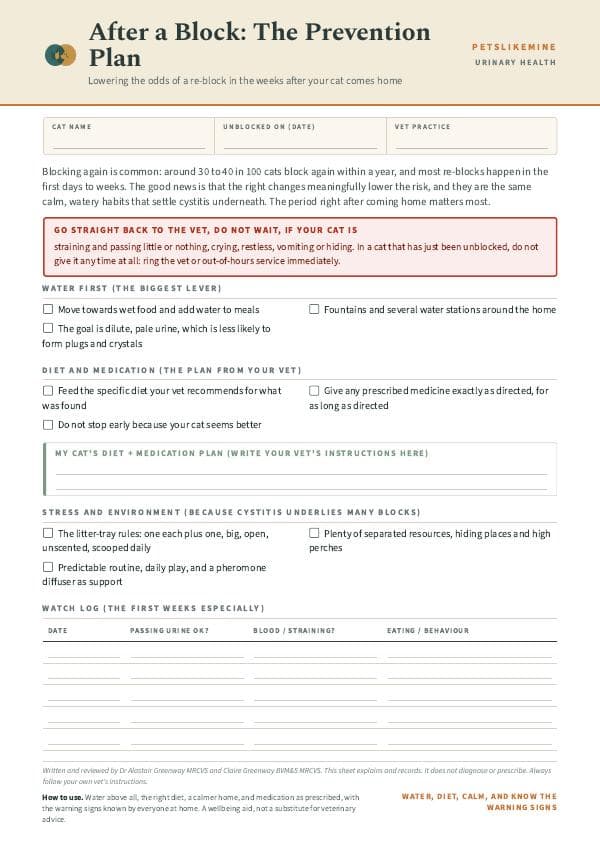
Keep track of how your pet is doing
The owners who cope best are the ones who notice changes early. A simple health log shows you what is working, and what is not, before the next vet visit.
Start tracking, freeYou're not doing this alone
Compare treatment journeys and talk to owners managing urinary health. Free to join.
Join PetsLikeMine