

Pet Chemotherapy Is Not Human Chemotherapy: What to Really Expect
Alastair Greenway
BVM&S MRCVS
Say the word "chemotherapy" to most owners and one picture arrives: a person they loved, exhausted and sick, hair gone, counting down hard months. It is one of the most frightening images any of us carry. So when a vet uses that same word about a beloved dog or cat, plenty of owners say no before they have heard the next sentence.
For pets, though, that picture is mostly wrong. Veterinary chemotherapy differs from the human version in what it's trying to achieve, in the doses used, and in how it tends to feel for the patient. That gap is worth closing before you decide anything, because a great many owners turn chemo down out of a fear that doesn't match what their pet would actually experience. Nothing here is a push towards treatment. It is the honest comparison, so that whatever you choose, you choose it for the right reasons.
Why so many owners say no, and why the picture misleads them
If your first instinct is "I couldn't put them through that", you have a lot of company. In one study of pet owners, 58% said they would not choose chemotherapy for a pet, mostly because of the side effects they expected (Williams et al., 2017). Those expectations leaned heavily on human experience. Owners imagined a pet that was less active, slept more and played less, with a quality of life worth shielding from treatment rather than improving with it.
The same study turned up something just as revealing at the other end. 72% of owners overestimated how long a pet would live after chemotherapy, many assuming it would lead to a cure (Williams et al., 2017). The common picture, then, gets it wrong in both directions at once: it expects far more misery than chemo usually causes, and far more cure than it usually offers. Setting both straight is what turns a frightened reflex into a genuine decision.
A different goal, and a different bargain
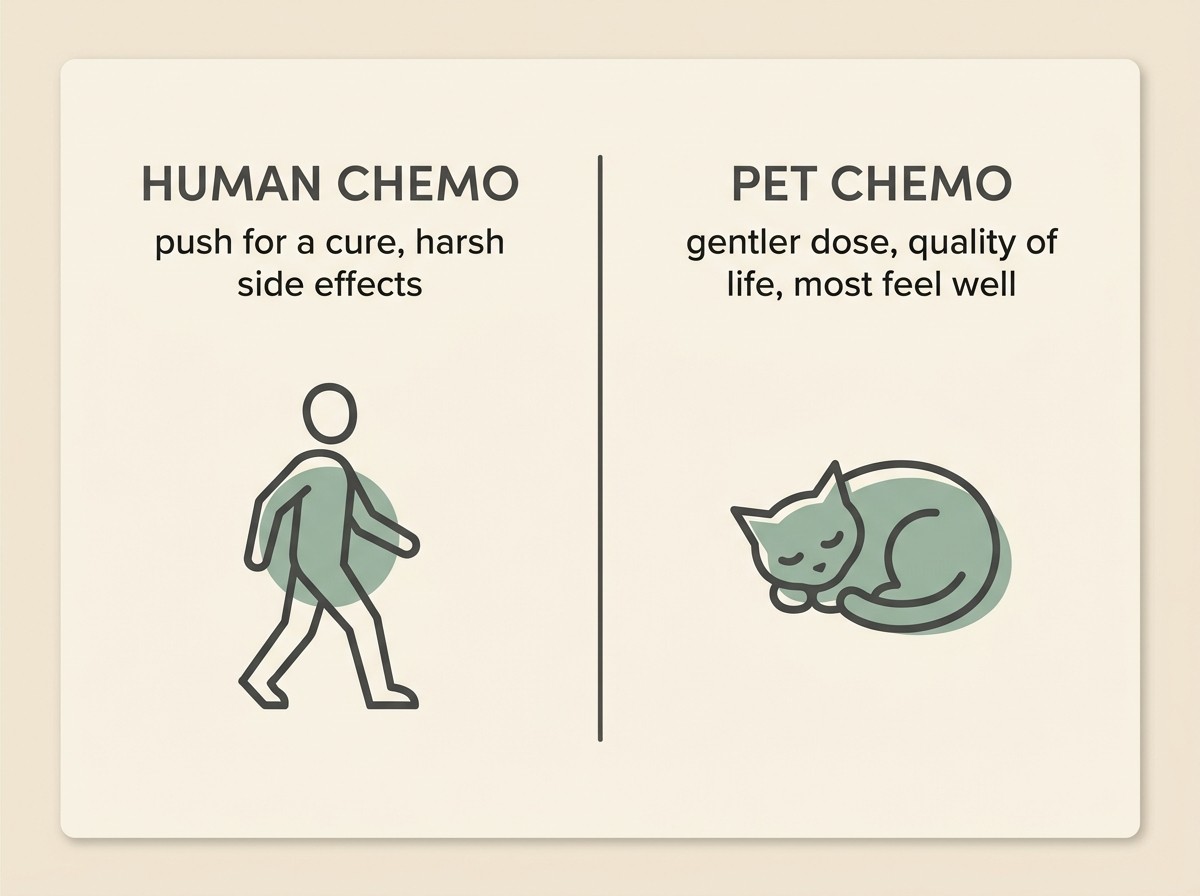
This is the heart of it. Human cancer treatment often pushes for a cure and accepts harsh, sustained side effects as the price of trying to get there. For a person who understands why they feel dreadful and can keep the bigger goal in view, that bargain can be well worth it.
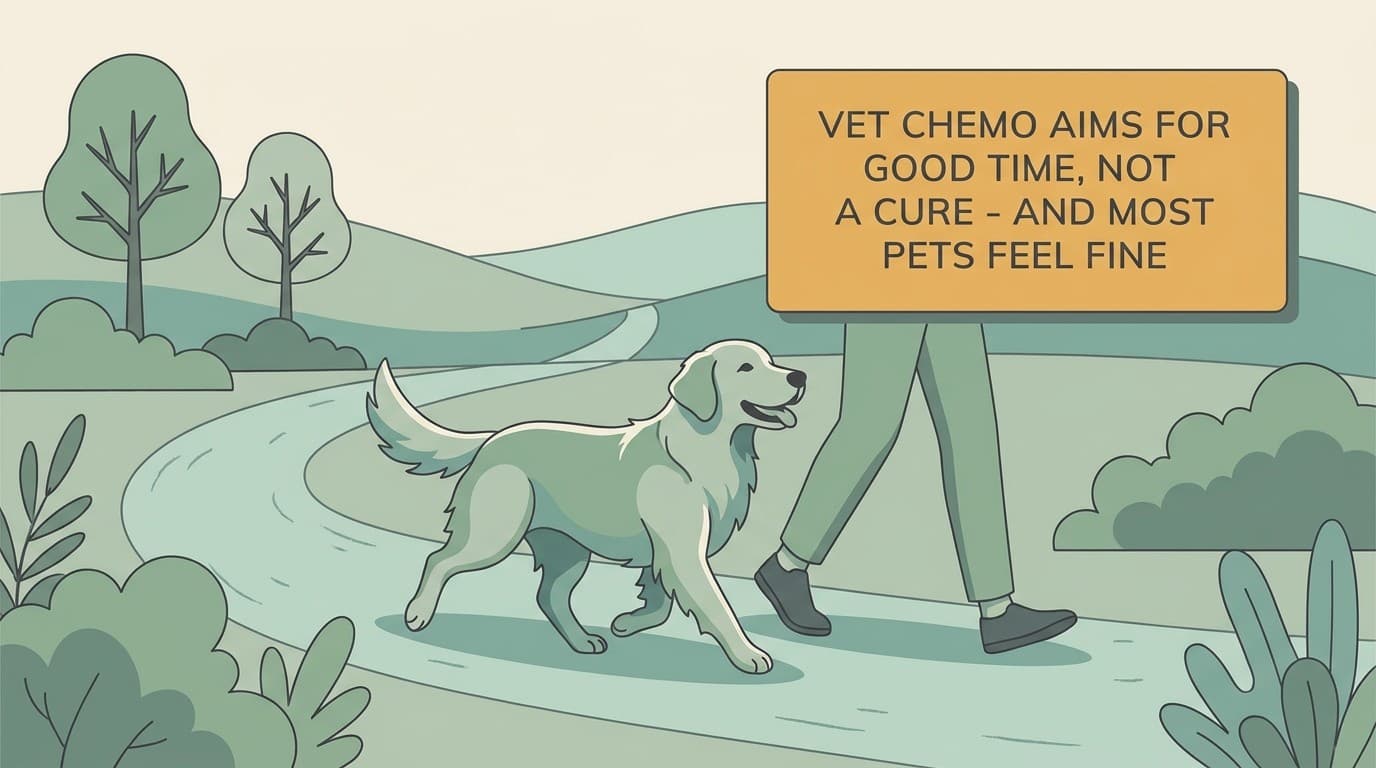
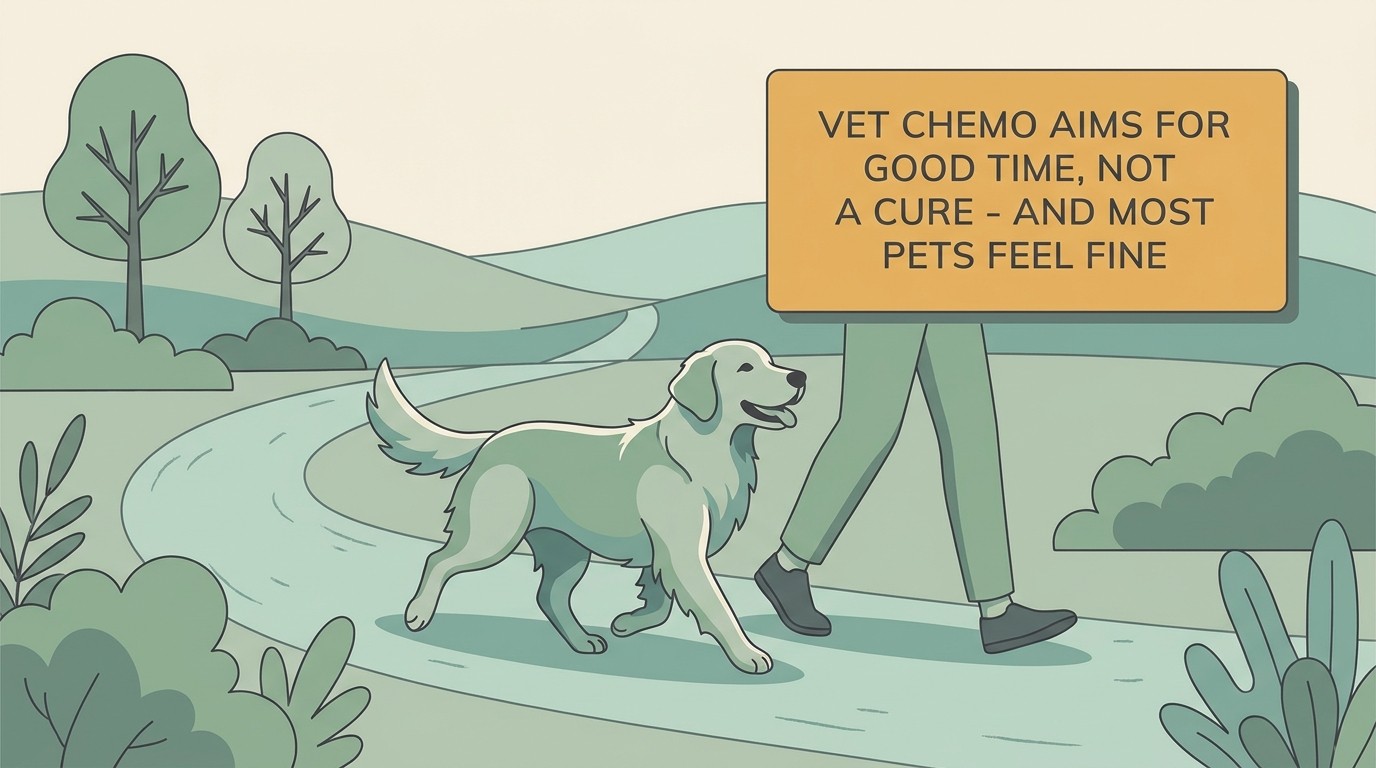
Veterinary chemotherapy runs on a different bargain. Your pet cannot grasp why they feel unwell, and they cannot weigh a few rough months now against years later. So vets deliberately use lower, gentler doses, aimed at giving good, comfortable extra time rather than chasing a cure at any cost (AKC, 2024). The American Kennel Club's veterinary guidance puts it plainly: chemo for dogs "isn't likely to cure your pet", but it can help them "enjoy many more months (or even years) of comfortable life without suffering from severe side effects" (AKC, 2024).
That changes the whole frame. You are not signing your pet up to be made ill in the hope of a cure. Most of the time you are buying good time, and the protocol is built to keep that time good. If the treatment ever started draining the quality from your pet's days, that would be a reason to stop rather than push on, and any decent oncology team will say so.
It also clears up a difference owners often miss when they read survival numbers. A pet who goes into remission usually feels well, eats, plays and behaves much as before, which is the entire point of dosing this way. The aim is to hand your pet back their ordinary good days for as long as the cancer allows, not to spend those days in pursuit of a longer life lived feeling rough.
What side effects are actually like
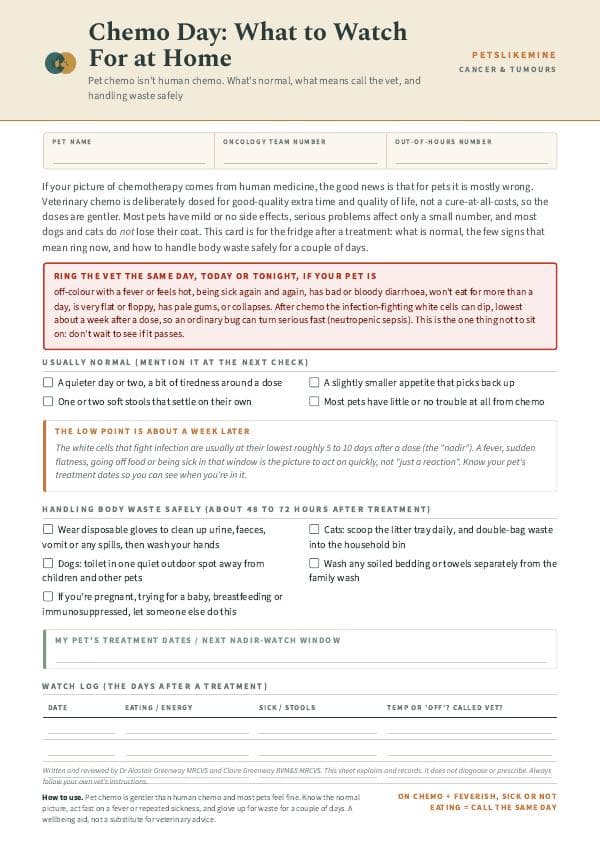
Most pets come through chemotherapy far better than people expect. The numbers say so plainly: in the AKC's veterinary-reviewed guidance, adverse effects "typically only affect 20 to 25% of patients", and where they do appear they are "usually mild and manageable at home" (AKC, 2024).
Turn that around and roughly three in four pets have little or no trouble at all. Among the minority who do react, most have a quiet few days: a softer appetite, looser stools, or some tiredness in the day or two after a dose, the kind of thing that settles on its own or with simple medication your vet sends home.
A small number have something more serious, and the one that matters most is a temporary drop in the white blood cells that fight infection. That dip tends to reach its lowest around five to ten days after a dose (AAHA, 2026). During that window, an ordinary bug your pet would normally shrug off can turn serious quickly. The monitoring blood tests and the safety-netting exist precisely for this, which is why a pet on chemo who suddenly goes off-colour, runs a fever or stops eating needs a vet the same day, not in the morning. The call-now signs have their own piece, because they are the part you genuinely do need at your fingertips.
None of this means side effects never matter, or that your worry is misplaced. It means the realistic picture reads "most pets feel fine, a few have a rough patch, a small number need prompt care", a long way from the wall-to-wall sickness the human version brings to mind.
The coat myth: most pets keep their fur
Here is the one that catches owners most off guard, and it deserves saying clearly. Most dogs and cats do not lose their coat on chemotherapy. It runs opposite to the human picture, and it comes down to how their hair grows.
Most pet hair grows to a set length and then sits in a long resting phase, and resting follicles are largely left alone by drugs that target rapidly dividing cells (Tufts University, 2017). Human hair, by contrast, is in near-constant active growth, which is why people lose it. The exceptions are breeds whose coats behave more like ours, the ones with continuously growing, curly or wiry hair such as poodles, some terriers and the Maltese; they can thin or go patchy, though it usually grows back once treatment ends (Tufts University, 2017; AKC, 2024). Whiskers and the longer guard hairs are the most likely to be affected in any pet, and hair can be slow to regrow over a clipped patch.
So the image of a bald, frail "chemo pet" isn't how it tends to look. With most dogs and cats, you would struggle to tell from the outside that they were on treatment at all.
What a course actually looks like
In practice, chemotherapy is a run of outpatient visits rather than one big ordeal. Depending on the cancer and the protocol, your pet comes in for a check and bloods, has the drug given (often as an injection or short drip, sometimes as a tablet at home), and goes home with you the same day. Many pets soon trot in happily once they realise the vet visit means fuss and treats, not pain.
A typical course runs over a few months, treatments spaced out, with blood tests along the way to confirm the white cells and organs are coping before the next dose. The exact shape depends entirely on the type of cancer, which is why the type-specific articles matter; lymphoma in dogs is the classic example where chemo works best.
Cost is a real part of the picture and you deserve a straight answer. As a rough UK guide, a full course of intravenous chemotherapy commonly comes to somewhere around £2,500 to £5,000, and more for the longer multi-drug protocols (PetCoverHQ, 2025; Paragon Veterinary Referrals, 2025). There's a separate piece on what treatment costs and how families manage it, because money is a legitimate part of this decision and not something to feel ashamed of weighing.
How to decide well
Once you have the real picture, the hard questions become answerable ones. Worth putting to your vet, and to yourself:
- What is the realistic gain here, in good time, not just time? A few extra comfortable months mean something quite different from a few extra weeks of being unwell.
- What does the schedule involve, how many visits, over how long, and how far is the travel?
- What is my pet's temperament? A dog who finds the vet stressful at every single visit is a real consideration, not a small one.
- What will it cost, and can we manage that without it hurting the rest of the family?
And then the permission that matters most: saying no is also a valid, loving answer. Choosing comfort-focused care instead of treatment is not giving up on your pet, and there's a whole piece on that choice and why no version of it is the wrong one. Understanding what chemo really is isn't meant to talk you into it. It's so that if you decline, you do it knowing the true picture, and if you go ahead, you do it without the dread of a version of treatment your pet was never going to face.
References
- Williams, J., Phillips, C., & Byrd, H.M. (2017). Factors Which Influence Owners When Deciding to Use Chemotherapy in Terminally Ill Pets. Animals (Basel), 7(3), 18. (open access via https://pmc.ncbi.nlm.nih.gov/articles/PMC5366837/)
- American Kennel Club (2024). Chemotherapy for Dogs With Cancer: What to Expect (Gemma Johnstone, updated 5 July 2024; with veterinary input from Dr Diane Brown DVM PhD DACVP, AKC Canine Health Foundation).
- American Animal Hospital Association (2026). 2026 AAHA Oncology Guidelines for Dogs and Cats / From the guidelines: chemotherapy nadir appointment considerations (neutrophil nadir 5 to 10 days after most agents). and https://www.aaha.org/trends-magazine/publications/from-the-guidelines-chemotherapy-nadir-appointment-considerations/
- Tufts University, Cummings School of Veterinary Medicine (2017). Chemo and Furry Coats (Falk et al., study of hair loss in 150 dogs on chemotherapy, originally published in Veterinary Dermatology, 2016).
- Vail, D.M., Thamm, D.H., & Liptak, J.M. (eds.) (2019). Withrow and MacEwen's Small Animal Clinical Oncology (6th ed.), Elsevier (Saunders). (Standard reference for canine multicentric lymphoma: CHOP-type multi-agent protocols achieve remission in roughly 80 to 90% of dogs with overall median survival of around 10 to 12 months; B-cell disease typically does better than T-cell.) ISBN 9780323594967.
- PetCoverHQ (2025). Dog Cancer Treatment Costs in the UK: What Pet Owners Need to Know (UK £ ranges for staging, surgery, chemotherapy and radiation).
- Paragon Veterinary Referrals, Wakefield (2025). General Cancer Q&A (UK referral-centre cost guidance: injectable chemotherapy £300 to £500 per treatment over a roughly 3-month course; oral metronomic £200 to £400 a month).
Free downloads
Companion worksheets to put what you've read into practice. Free PDFs, print at home.
Sister tool · Sightline
Track quality of life over time
Sightline, a separate ConciergeVet tool, runs a short adaptive weekly assessment with a quality-of-life focus mode built around exactly these frameworks, tracks a single composite score over time so you can see the trend rather than judge a single bad day, and produces a Sightline Report PDF you can bring to your vet.
A written log, or our printable quality-of-life sheet, does much the same job.
See how Sightline tracks quality of lifeFound a lump? Track it, and know when to act
A lump cannot be told apart by look or feel; only your vet sampling it can. The Lump & Bump Tracker records its size and how it changes, flags when it has crossed a line worth a vet visit, and builds a clean history to take in.
Open the Lump & Bump TrackerYou're not doing this alone
Compare treatment journeys and talk to owners managing cancer. Free to join.
Join PetsLikeMine