

Cancer and Your Pet: Start Here
Alastair Greenway
BVM&S MRCVS
People reach this page from a few different places. Some have just found a lump that wasn't there last month. Some sat in a consulting room an hour ago and stopped hearing properly after the word "cancer". Some have lived with a diagnosis for a while and are weighing up what to do next, or quietly counting the time that might be left. You don't have to read everything at once, and you don't have to start at the top.
This page has one job. It sets out the few things that hold true for almost every owner facing a cancer diagnosis, then it sends you to the part of this space that matches where you actually are today. Treat it as the front door, with a map pinned just inside.
How common this really is
It helps to know how common cancer is, because a diagnosis can feel terribly isolating, and you are nowhere near the only person sitting where you're sitting tonight.
Around one in four dogs develops cancer at some point, and that climbs to nearly half of dogs over the age of ten (Veterinary Cancer Society figures, via AAHA, 2024; AVMA). In cats it's roughly one in five, and cancer is among the leading causes of death in older cats (AVMA). It's largely a disease of older animals, which is why it so often seems to come from nowhere after years of a pet who was simply, dependably well.
That doesn't make your own situation any lighter. It does mean a great deal is understood about what you're facing, a great deal can frequently be done, and you're walking a path that thousands of owners and a whole field of veterinary medicine have walked ahead of you.
What "cancer" actually covers
Two ideas get knotted together the moment the word lands, and pulling them apart early changes how the whole thing feels.
The first is that "cancer" isn't a single illness. It's an umbrella word covering dozens of diseases that behave in completely different ways. A small, low-grade lump on your dog's skin, caught early and lifted out in one operation, has almost nothing in common with an aggressive cancer in the spleen except the word printed on the leaflet. That's why a late-night search for "how long does a dog with cancer live" only ever frightens you: there's no single answer, because there's no single disease. The things that count are the type, the grade (how aggressive it looks) and the stage (how far it has spread), and those are precisely what the next conversation with your vet is for.
The second is that a diagnosis doesn't automatically mean the end. It's serious, and we won't pretend otherwise. Plenty of pets live good lives, sometimes for years, after being diagnosed, and many cancers can be cured outright or held quietly in check for a long stretch. Some are genuinely hard, and we won't gloss over those. The outlook turns on the details, not the word, and you almost never have to decide everything today.
Our honest promise to you
This space is run by vets, it's free, there's no book to buy and nothing to join. We mention that because so much of what's written about pet cancer online is frightening, or vague, or quietly steering you towards a purchase. Here is what we offer instead.
We'll be straight with you. Where a cancer carries a good outlook, we'll tell you; where it's hard, we'll tell you that too, gently. No false hope, and no manufactured doom. We won't pretend there's one correct answer, because there usually isn't, and we will never let you feel that choosing comfort over treatment, or treatment over comfort, means you've let your pet down. Either can be the loving, right call. What we're here to do is help you understand what's happening and feel steady enough to choose well for your pet, your family and your circumstances. Support, with no pressure attached.
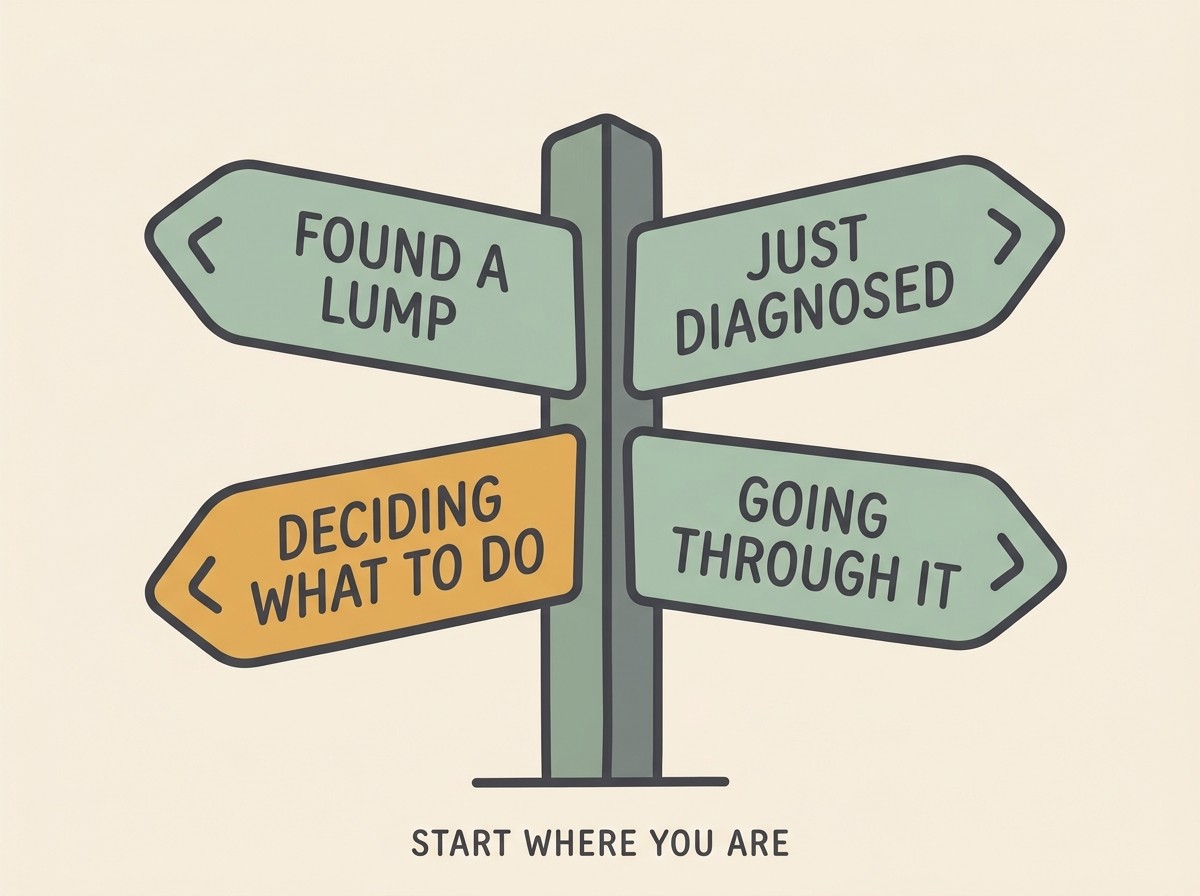
Where are you right now?
Find the line below that sounds most like your day. Each one points you to the best place to read next, and the map is always here to come back to.
"I've found a lump and I'm scared it's cancer." Start here, and take a breath, because most lumps turn out to be benign. Don't panic, but don't quietly "wait and see" either, because the only way to know what a lump is, is to have it sampled. Read The Lump You've Found: When to Worry, and Why "Wait and See" Is the Wrong Move, and use the Lump & Bump Tracker (below) to measure it, photograph it and keep track of whether it's changing while you get an appointment.
"My vet has just said the word cancer." You're in the hardest, most disorienting few days, and what helps most now is getting to grips with the diagnosis rather than dreading the word. Read You've Heard the Word "Cancer": What Grade, Stage and Prognosis Actually Mean, which walks through the terms you're about to hear, and then Should I Treat? Treating, Comfort Care, and Why There's No Wrong Answer once you're ready to start weighing up choices.
"I'm trying to decide whether to treat." This is the big one, and there's a whole part of this space built around it, with no thumb on the scale. Begin with Should I Treat? Treating, Comfort Care, and Why There's No Wrong Answer, then read Pet Chemotherapy Is Not Human Chemotherapy: What to Really Expect, because the picture most of us carry of chemo comes from human medicine and, for pets, is mostly wrong.
"My pet is going through treatment." What you need is practical, steady support, and above all the handful of signs that mean "call the vet now" rather than "wait and see". The treatment articles cover what's normal during chemo and what isn't, feeding, and pain and comfort, so you know what to expect and what to act on.
"I'm thinking about time, comfort and quality of life." Whether your pet is in remission, on comfort-focused care, or simply ageing alongside their cancer, the question shifts to "are they still enjoying life?". Read Quality of Life You Can Measure: Using the Score to See What's Really Happening, and when the road turns towards the end, The Quality-of-Life Decision, and Where to Go Next will help you recognise the moment and point you gently onward.
If none of those quite fits, that's fine. Read whatever calls to you, in any order. The map will be here when you need it.
Tools you can lean on
Alongside the articles, this space gives you two practical tools, because some of this is easier to do than it is to read about.
The Lump & Bump Tracker is for the very start. You measure a lump, note where it is, photograph it and log it over time, so you and your vet can see whether it's changing instead of relying on memory. It will never tell you what a lump is, because only a sample can do that, but it leaves you far better prepared for the appointment.
The quality-of-life assessment is for later on. It turns the agonising daily question of "is he still happy?" into a simple score you can track, so you watch the trend rather than being thrown by a single good or bad day. It's a kind thing to use, because it keeps the focus exactly where it belongs, on your pet's actual experience.
References
- American Animal Hospital Association (AAHA). How Common Is Cancer in Dogs? Risk and Early Warning Signs. (incidence figures attributed to the Veterinary Cancer Society: approximately 1 in 4 dogs develop cancer in their lifetime, rising to nearly half of dogs over the age of ten)
- American Veterinary Medical Association (AVMA). Cancer in Pets. (cancer a leading cause of death in dogs and cats; almost half of deaths in pets over age ten)
- FETCH a Cure. Quick Pet Cancer Facts and Questions. (cancer the leading cause of death in 47% of dogs and 32% of cats)
Sister tool · Sightline
Track quality of life over time
Sightline, a separate ConciergeVet tool, runs a short adaptive weekly assessment with a quality-of-life focus mode built around exactly these frameworks, tracks a single composite score over time so you can see the trend rather than judge a single bad day, and produces a Sightline Report PDF you can bring to your vet.
A written log, or our printable quality-of-life sheet, does much the same job.
See how Sightline tracks quality of lifeFound a lump? Track it, and know when to act
A lump cannot be told apart by look or feel; only your vet sampling it can. The Lump & Bump Tracker records its size and how it changes, flags when it has crossed a line worth a vet visit, and builds a clean history to take in.
Open the Lump & Bump TrackerYou're not doing this alone
Compare treatment journeys and talk to owners managing cancer. Free to join.
Join PetsLikeMine