

Osteosarcoma in Dogs: The Amputation Decision, and Life on Three Legs
Alastair Greenway
BVM&S MRCVS
Osteosarcoma is bone cancer, and the treatment your vet will raise first is amputation. That pairing is enough to make most owners want to stop the conversation right there, because the picture it puts in your head is of your dog hobbling about, diminished and struggling. It's worth knowing before you decide anything: the part you're dreading most, life on three legs, is usually the part that goes far better than you expect. Most dogs cope remarkably well, and many are visibly happier afterwards than they were before.
That doesn't make this an easy diagnosis. Osteosarcoma is aggressive and it is painful, and you deserve the truth about it rather than reassurance for its own sake. Both things are true at the same time: it's a serious cancer, and the surgery that treats it tends to give dogs more comfort, not less. Holding those two together is really the whole of this decision.
Bone cancer, and the pain behind it
Osteosarcoma is a cancer of the bone, and by a wide margin it's the commonest bone tumour in dogs. It usually turns up in a leg, most often in one of the larger long bones, and the classic story is a big or giant-breed dog who develops a limp that won't settle, sometimes with a firm swelling near a joint. Lameness, or a reluctance to walk, together with a firm localised swelling on a limb, are the two signs vets see most (Cornell Riney Canine Health Center). The breeds carrying the highest risk include the Scottish Deerhound, Leonberger, Great Dane, Rottweiler and Greyhound, along with other large and giant breeds such as Irish Wolfhounds and Saint Bernards, although it can happen in any dog (Polton et al., 2025; Cornell Riney Canine Health Center).
Osteosarcoma is intensely, relentlessly painful. The tumour eats away at the bone from the inside, and a bone that's being destroyed hurts in a way that tablets alone struggle to control. When you watch your dog fail to settle, or cry getting up, that isn't the cancer "spreading". That's the bone itself. Keeping that pain in view while you decide matters more than almost anything else here, because it changes how the whole choice looks (see the article on managing your pet's pain and comfort through cancer).
The hard truth, told kindly
Osteosarcoma spreads early, and it usually spreads to the lungs. By the time it's diagnosed, only a small proportion of dogs, fewer than one in twenty, have visible spread on a scan (Polton et al., 2025). But the cancer has very often already sent out microscopic seeds we simply can't see yet. Around 90% of dogs are thought to have this hidden micrometastatic disease at the point of diagnosis (Polton et al., 2025). That's the cruel arithmetic of this particular cancer, and it's why the conversation is usually about good time rather than cure.
It shapes the numbers, so here they are plainly. Amputation alone deals decisively with the pain but does nothing about those hidden seeds, and with surgery on its own the typical survival is around three to four months (Polton et al., 2025). Adding chemotherapy after surgery, to slow the spread to the lungs, extends that to somewhere between about eight and fourteen months depending on the study and the protocol, with carboplatin courses commonly giving a median of roughly nine to eleven months (Polton et al., 2025). "Median" means the middle, so half of dogs do better than that figure and some do considerably better, which is worth holding on to (see the article on reading a prognosis).
None of that is easy reading. But it's worth being clear about what it does and doesn't say. It says this is a serious, often shorter-course cancer. It doesn't say there's nothing worth doing, and it doesn't say your dog is in for a bad time between now and then. Usually quite the reverse.
Why amputation is about pain, not just cancer
This is the part owners almost never hear clearly, and it changes how the surgery should feel.
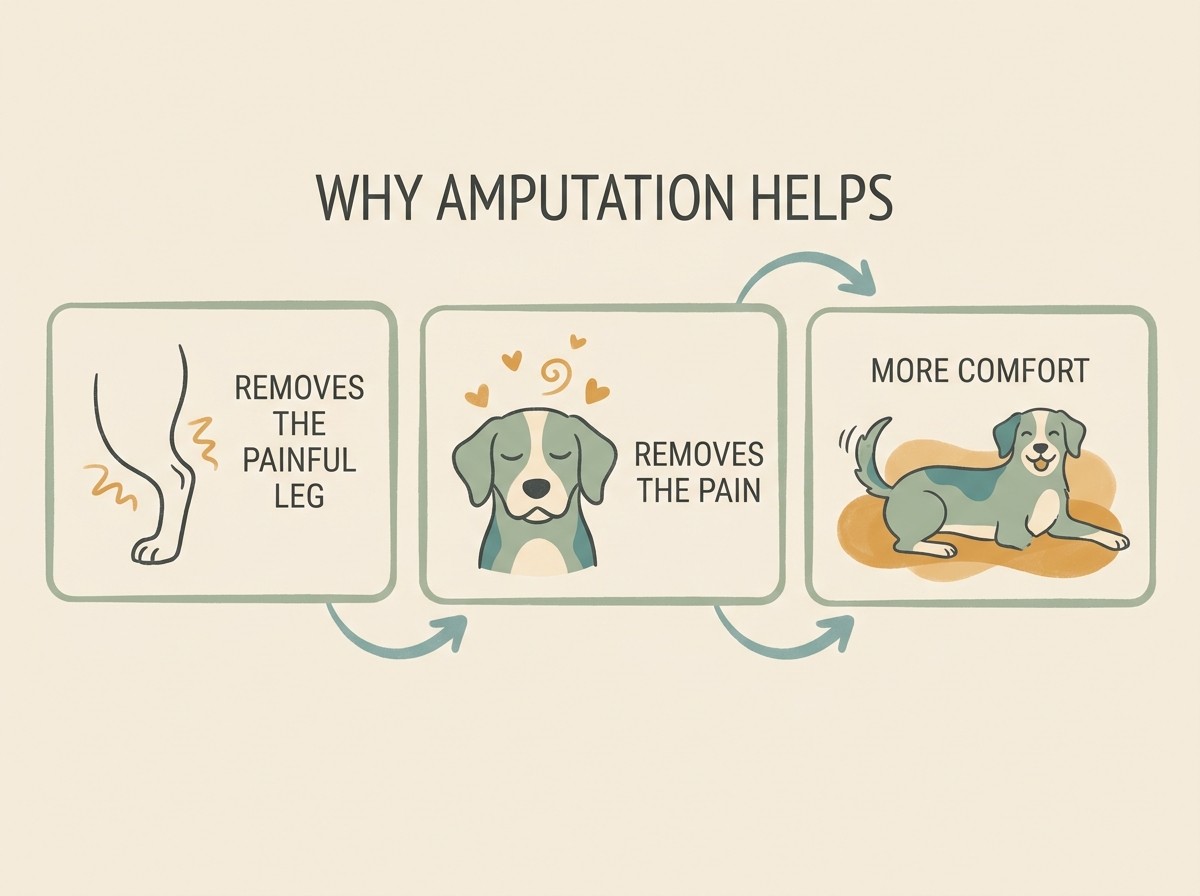
Amputation isn't really being offered as a cure for the cancer. The hidden lung seeds mean that removing the leg won't, on its own, get rid of the disease. What it does, reliably and immediately, is remove the source of the pain. Take away the diseased bone and you take away the thing that's hurting your dog every minute of every day. The current consensus guidance frames the goal as "complete resection of the tumor and alleviation of the tumor-associated bone pain" (Polton et al., 2025).
So even when cure isn't on the table, amputation is one of the most powerful pain-relief operations in veterinary medicine. Cornell's oncology team put it directly: many dogs are "much more comfortable after surgery, often returning to normal activities" (Cornell Riney Canine Health Center). You wouldn't be putting your dog through something brutal for the sake of a few extra weeks. You'd be removing a limb that has become a source of constant agony, and most dogs feel the relief almost at once. For many families that comfort is reason enough on its own, whether or not they go on to chemotherapy.
"But how will my dog cope on three legs?"
Now the fear you actually came here with, and this is where the answer is genuinely reassuring.
Dogs don't think about their bodies the way we think about ours. They don't mourn a leg, dread a mirror, or feel self-conscious in the park. They live in the moment, and the moment after recovery is one without the pain that's been grinding them down. Most dogs are back up on their feet remarkably fast, generally walking within a day of the operation (Polton et al., 2025), settling into life on three legs within a month (Kirpensteijn et al., 1999), with a good number up and moving around almost normally within the first week or two (DogCancer.com).
The fear nearly always sits with the owner rather than the dog. In one study of families whose dogs had a leg amputated, the large majority reported their dog adapted "very well" to three legs, most within a month, and not one of them regretted the decision (Kirpensteijn et al., 1999). Of the owners who'd been against the amputation when it was first advised, the great majority later felt their objections had been unfounded (Kirpensteijn et al., 1999). It's the people who need the few weeks to come round, not usually the dog.
That isn't to pretend it's nothing. A larger or older dog, or one with significant arthritis in the other legs, will have a harder time of it, since the remaining three legs have to carry the load, and that's a real factor your vet will weigh up with you. Some dogs take longer, and a small number don't return to quite the same level of activity. But the thing to carry out of the consulting room is that the part you're dreading most is usually the part your dog handles best.
This is also the moment to mention Tripawds. It's a large, warm, free support community built entirely around three-legged dogs and cats and the people who love them, founded by owners who went through this with their own dog. There are thousands of stories, a helpline, practical recovery advice, and a great many photos of very happy tripod dogs doing very normal dog things. If you want to see what life on three legs actually looks like, from people living it, that's the place to go.
The options, laid out plainly
There's rarely one right path here, so it helps to see them laid out without a thumb on the scale.
Amputation for comfort. Removing the painful leg to give your dog a comfortable life for whatever time they have, without chemotherapy. A completely valid, loving choice, and often the right one for an older dog or a tighter budget.
Amputation plus chemotherapy. The same pain relief, plus a course of chemotherapy afterwards to slow the spread to the lungs and aim for more good time. Pet chemotherapy is dosed for quality of life and most dogs tolerate it well, which surprises people who are picturing human chemo (see the article on why pet chemotherapy is not human chemotherapy).
Limb-sparing surgery. In selected cases a specialist can remove the tumour and rebuild the bone rather than taking the leg, usually where amputation isn't suitable because of the dog's other joints or the owner's wishes (Polton et al., 2025). It's a bigger undertaking with more potential complications, and it isn't right for every tumour or every dog.
Radiotherapy for pain. Where surgery isn't the right call, a short course of palliative radiotherapy can take the edge off the bone pain for a while (Polton et al., 2025), bought as comfort rather than cure (see the article on radiation therapy for pets).
Comfort-focused care. Choosing not to operate, and instead keeping your dog as comfortable as possible with strong pain relief and a focus on good days. This is a legitimate, caring decision, particularly given how hard the pain is to control with medication alone (see the article on comfort-focused care).
Making the decision
There's no formula, but there are good questions. What does treatment realistically buy in good time, not just time? How will my dog, at this age and size and with these other joints, cope with surgery and with three legs? What's the schedule, and the cost, and can we manage it? And underneath all of it, the one that actually decides things: what gives my dog the most comfortable, happiest time from here?
That last question is the one worth keeping in front of you, and you can measure it rather than guess at it day to day. Tracking your dog's quality of life, the comfort, the appetite, the interest in things, gives you and your vet a clear, shared view of how the days are really going, whichever path you take (see the article on quality of life you can measure).
Whatever you choose, hold on to this. Choosing amputation isn't cruel, and choosing comfort care without surgery isn't giving up. They're both ways of doing right by a dog you love, faced with a cancer that gave you no good options to begin with. The pain is the enemy here, not the number of legs. A dog freed from that pain, hopping happily after a ball on three good legs, is not a diminished dog. Ask anyone at Tripawds.
References
- Polton, G., et al. (2025). Osteosarcoma of the appendicular skeleton in dogs: consensus and guidelines. Frontiers in Veterinary Science, 12, 1633593.
- Cornell University College of Veterinary Medicine, Richard P. Riney Canine Health Center. Osteosarcoma in dogs.
- Nolan, M.W., et al. (2022). Intensity of perioperative analgesia but not pre-treatment pain is predictive of survival in dogs undergoing amputation plus chemotherapy for extremity osteosarcoma. Veterinary and Comparative Oncology, 20(4), 854-863.
- DogCancer.com (Dressler, D.). Canine Osteosarcoma: Amputation and Life Quality.
- Kirpensteijn, J., van den Bos, R., & Endenburg, N. (1999). Adaptation of dogs to the amputation of a limb and their owners' satisfaction with the procedure. Veterinary Record, 144(5), 115-118.
- Tripawds Three Legged Dog and Cat Support Community. About Tripawds.
Sister tool · Sightline
Track quality of life over time
Sightline, a separate ConciergeVet tool, runs a short adaptive weekly assessment with a quality-of-life focus mode built around exactly these frameworks, tracks a single composite score over time so you can see the trend rather than judge a single bad day, and produces a Sightline Report PDF you can bring to your vet.
A written log, or our printable quality-of-life sheet, does much the same job.
See how Sightline tracks quality of lifeFound a lump? Track it, and know when to act
A lump cannot be told apart by look or feel; only your vet sampling it can. The Lump & Bump Tracker records its size and how it changes, flags when it has crossed a line worth a vet visit, and builds a clean history to take in.
Open the Lump & Bump TrackerYou're not doing this alone
Compare treatment journeys and talk to owners managing cancer. Free to join.
Join PetsLikeMine