

Mucocoele: Operate Now, or Watch and Wait?
Alastair Greenway
BVM&S MRCVS
Your dog has a gallbladder mucocoele, it was found by chance, and your dog seems completely well. Now you are being asked to decide something that feels impossible: do you put a well dog through major abdominal surgery to prevent a problem that might not happen, or do you leave it alone and monitor it, knowing that if it goes wrong it can go wrong badly? This is one of the hardest decisions in the whole space, precisely because there is no risk-free option, and anyone who tells you otherwise is not being straight with you.
This piece is about how that decision is actually made. It assumes you have read the introduction to mucocoeles, so you know what one is and why older dogs get them; here we sit with the harder question of timing. The honest goal is not to make the decision for you, because it depends on your specific dog and your circumstances, but to give you the real considerations on both sides so that whatever you and your vet decide, you decide it with your eyes open.
Why this is genuinely a decision
Some medical situations decide themselves. A mucocoele in a well dog is not one of them, and it is worth understanding why the honest answer is "it depends" rather than a confident rule.
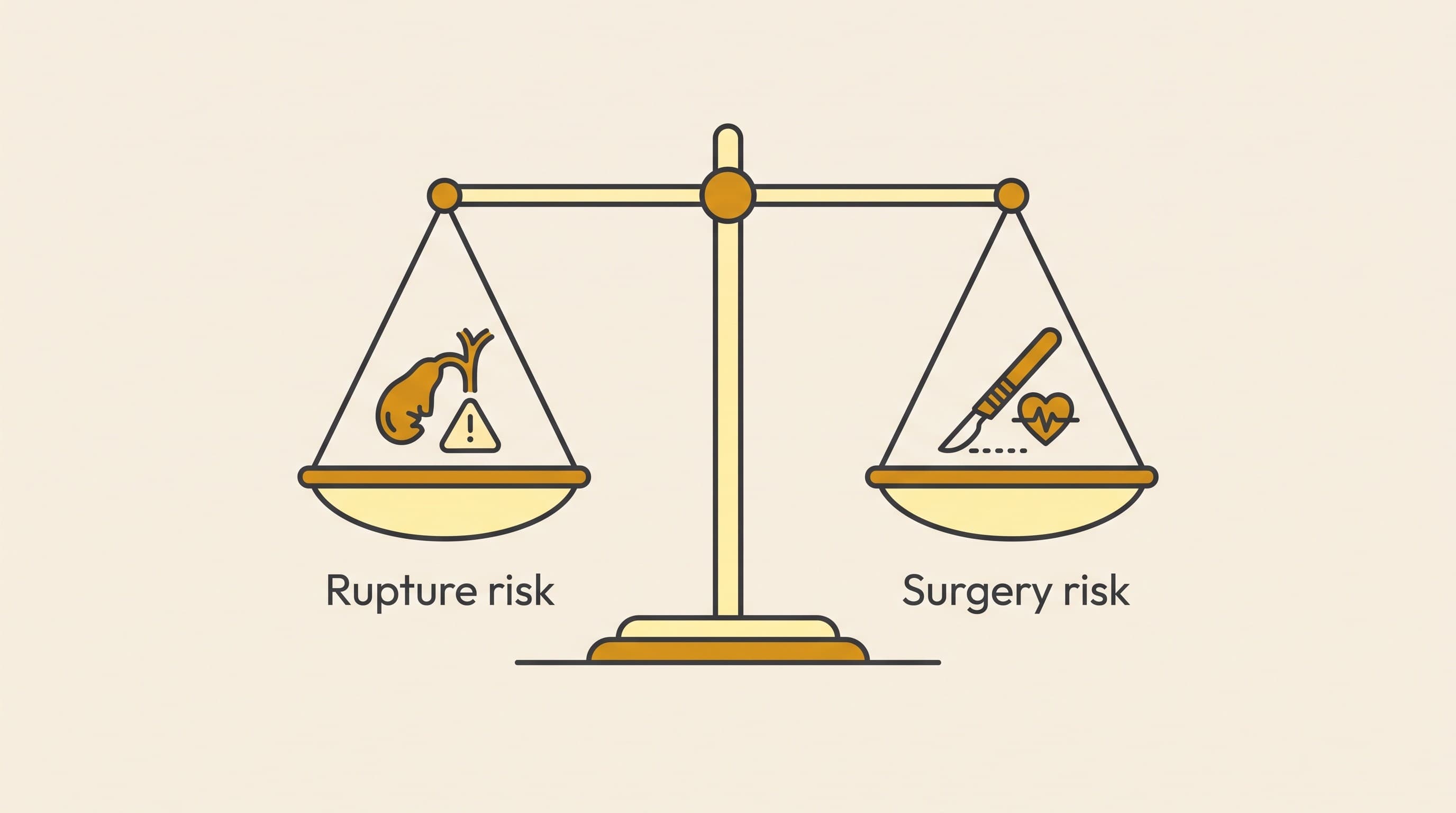
On one side is the rupture risk. A mucocoele can rupture, spilling bile into the abdomen, and a rupture turns a stable situation into a life-threatening emergency. On the other side is surgical risk. Removing the gallbladder (a cholecystectomy) is major abdominal surgery, and in an older dog, who often has other things going on, that carries its own real risk. So you are not weighing risk against safety. You are weighing one risk against another, and the whole art is in judging which is larger for your individual dog, right now.
The complicating factor is that we cannot reliably predict which particular incidental mucocoele will progress or rupture and which will sit quietly. That uncertainty is uncomfortable, but naming it is more useful than pretending a scan can tell you your dog's future. It is why monitoring exists as a real option, and also why some surgeons argue against leaving it too long.
It also helps to be honest about time horizons. This is not usually a decision that has to be made in the next hour, as long as your dog is well; you generally have room to get an opinion, to screen for underlying conditions, and to think. But it is not a decision you can safely park indefinitely and forget either, because the whole point is that a quiet mucocoele can change. The useful frame is "decide, then act on the decision", whether that action is booking surgery or committing to a monitoring schedule, rather than letting the finding drift with no plan attached to it.
The case for operating now
The strongest argument for elective surgery comes down to one stark comparison. When a gallbladder is removed electively, on a stable, well dog before anything has ruptured, the outcomes are generally good. When it is removed as an emergency, after a rupture, the dog is critically ill, there is bile contaminating the abdomen, and the risk of death is far higher.
That gap is the heart of the "operate now" argument: the surgery you plan calmly is a fundamentally safer operation than the one you are forced into during a crisis. If a mucocoele is going to need surgery eventually, the logic runs, it is better to do it while your dog is well and you can choose the timing, the surgeon, and the circumstances, rather than gambling on catching a rupture in time. Certain ultrasound features, or a mucocoele that is enlarging or changing on repeat scans, can push this argument harder. This is the thinking reflected in current management reviews, including the JAVMA 2025 review and the ACVS overview.
The case for watching and waiting
The case for monitoring is also real, and it is not simply "doing nothing". Major abdominal surgery in an older dog is not trivial, and if a mucocoele is small, stable, and causing no signs, there is a legitimate argument for not rushing a well dog to theatre, particularly if your dog has other health problems that raise the anaesthetic risk. Cost is also an honest part of the picture for many families, and it is a legitimate consideration, not something to be ashamed of.
But watch-and-wait is only a safe choice if it is done properly, and this is the crucial caveat. Monitoring means active, scheduled surveillance, not hoping for the best. In practice that means:
- Repeat ultrasound scans at intervals your vet sets, to see whether the mucocoele is stable or progressing.
- Screening for and treating the underlying conditions, Cushing's disease above all, plus hypothyroidism and high blood fats, because managing the underlying driver is part of managing the mucocoele (the piece on the Cushing's, thyroid and gallbladder link covers this).
- Knowing the emergency signs cold, so that if things change you act immediately rather than waiting.
If you cannot or will not keep up the monitoring, then watch-and-wait is not really the option you think it is, and that is worth being honest with yourself about.
There is also an argument that in some watched dogs, treating the underlying condition and the high blood fats may help stabilise the situation, and some vets will use medication aimed at improving bile flow while monitoring. This is an area where practice varies and the evidence is not settled, so it is a conversation to have with your own vet rather than a rule, and it does not replace the surveillance scans or the readiness to operate if things change.
Watch-and-wait is not risk-free: the line to hold
This is the single most important sentence in the piece: watching and waiting is a legitimate, monitored decision, but it is never a risk-free one. A quiet mucocoele today can rupture, and while monitoring aims to catch trouble early, no schedule of scans can guarantee it. Anyone who frames "we'll just keep an eye on it" as the safe, cautious, do-no-harm option has misunderstood the situation. Both roads carry risk; monitoring simply moves the risk to a different place and asks you to stay watchful.
So if you choose to monitor, you take on a job. Learn the signs that mean the situation has changed and act on them without delay. A dog with a known mucocoele who suddenly becomes unwell, vomiting repeatedly, collapsing, showing obvious abdominal pain, going off food, or turning yellow (jaundiced), may have ruptured or become obstructed and needs an emergency vet immediately, not an appointment in a few days. Save your vet's number and the nearest emergency service's number where you can find them fast. That readiness is the difference between watch-and-wait being a reasonable choice and being a gamble.
It can help to write the plan down somewhere everyone in the household can see it: the date of the next scan, the specific signs to watch for, and exactly who to call and when. In a real emergency, at night or at the weekend, you do not want to be searching for a number or second-guessing whether "off colour" counts. A dog who has ruptured deteriorates quickly, so a household that already knows the plan buys precious time. That small piece of preparation is part of what makes monitoring a responsible choice rather than a hopeful one.
How to make the decision with your vet
Because there is no universal right answer, the useful thing is to make this a proper conversation rather than a snap call. Questions worth bringing:
- For my dog specifically, how would you weigh the rupture risk against the surgical risk, given his age and any other conditions?
- Are there features on the scan that make you more or less worried?
- Has my dog been screened for Cushing's and the other underlying conditions, and would treating those change your advice?
- If we monitor, exactly how often should we scan, and what would make you change the recommendation to surgery?
- If we operate, what are the risks for my dog, and would you refer to a specialist surgeon?
There is no shame in taking a day or two to think, or in asking for a referral opinion, provided your dog is currently well. A considered decision made with good information is worth more than a fast one made in fright.
It is also fair to bring your own dog's whole life into the decision, not just the gallbladder. A fit dog with years of good living ahead sits differently from a frail dog with several other serious conditions, and neither the surgery nor the monitoring should be considered in a vacuum. Thinking about your dog's overall quality of life, likely lifespan, and how they cope with handling and hospitalisation is not being unloving; it is part of making a decision that is genuinely in their interest. A good vet will welcome that conversation rather than reducing everything to a single scan finding.
Where this leaves you
The honest summary is that this is a real fork with real risk on both sides, and the right answer is the one that fits your particular dog, weighed carefully with your vet: how large the surgical risk is for this older dog, how the mucocoele is behaving on repeat scans, whether an underlying condition can be treated, and whether reliable monitoring is genuinely possible for you. Neither choosing surgery nor choosing to monitor is the "wrong" answer in the abstract; the wrong move is deciding without understanding that both carry risk.
If you have not yet had your dog screened for the underlying hormonal conditions, that is a sensible next step whichever way you are leaning, because it can change the whole picture; the Cushing's, thyroid and gallbladder link piece explains why. And if you choose to monitor, treat the recheck-scan schedule as non-negotiable and keep the emergency signs firmly in mind, because that vigilance is exactly what makes watching and waiting a defensible choice rather than a hopeful one.
Keep track of how your pet is doing
The owners who cope best are the ones who notice changes early. A simple health log shows you what is working, and what is not, before the next vet visit.
Start tracking, freeYou're not doing this alone
Compare treatment journeys and talk to owners managing liver & gallbladder. Free to join.
Join PetsLikeMine