
Quality of Life You Can Measure: Using the Score to See What's Really Happening
Alastair Greenway
BVM&S MRCVS
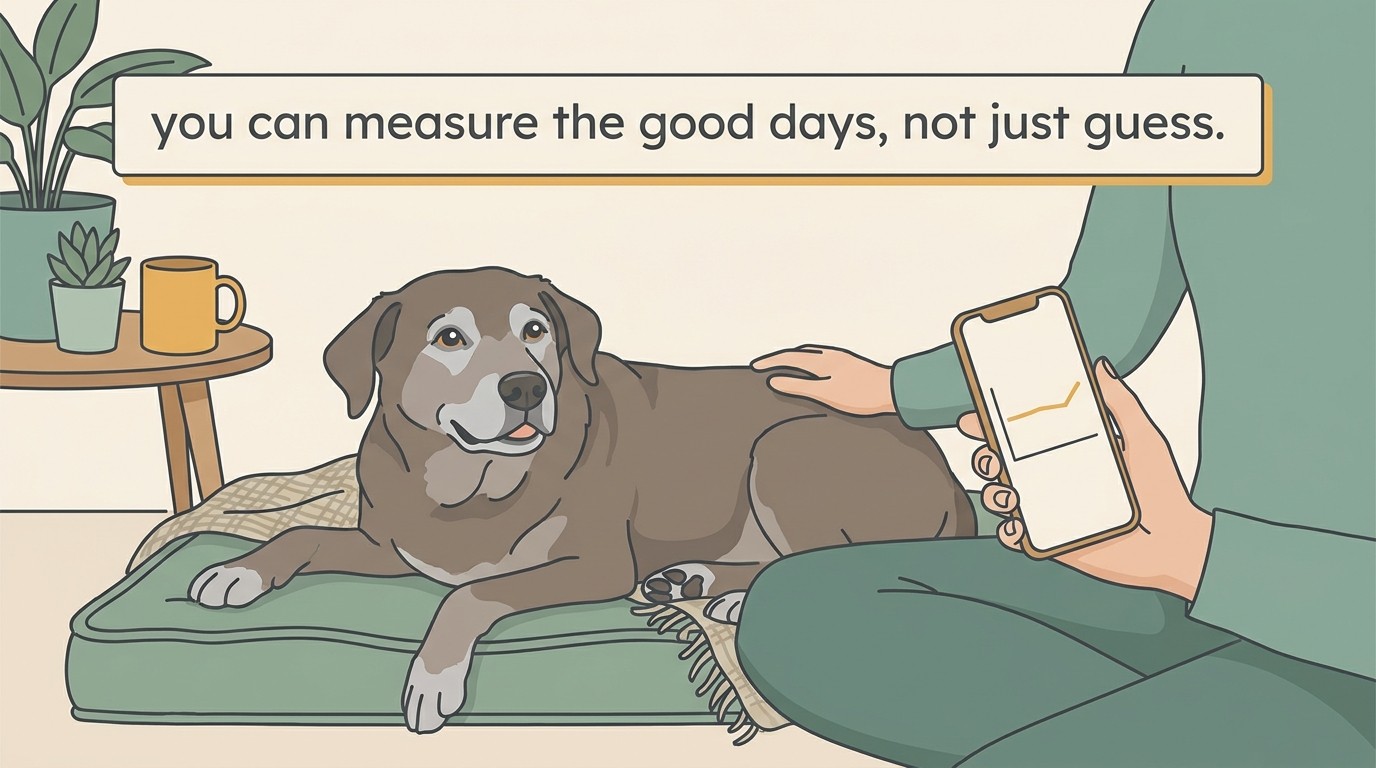
Is he still enjoying life? Is she still happy? When a pet has cancer, that question turns up in the quiet moments, last thing at night or first thing in the morning, and there's rarely a clean answer to it. It's the kindest thing an owner can ask, and one of the hardest, because from inside the day you're living, you often can't tell.
A quality-of-life score is a way of turning that daily guess into something you can actually look at. It isn't clinical or morbid to measure how a pet is doing. For an animal who can't tell you in words how they feel, paying close, regular attention is about the most loving thing you can offer.
Why the happiness question is so hard
You see your pet every day, so you'd expect to be the best judge there is. That closeness is exactly the problem.
When a change comes on slowly, we adjust to it without noticing. The dog who used to bound up the stairs now takes them one at a time, and because the shift happened over weeks, it quietly becomes the new normal. Sometimes this gets called caregiver burden, or simply the slow drift. It isn't a failing on your part; it's how human attention works when you're standing too close to see the whole shape of something.
The reverse trap is just as common. One bad day, when your pet won't eat and sleeps more than usual, can convince you the end has arrived. Then the next morning they're at the back door asking to go out, and you feel foolish for the panic. Any single day, good or bad, makes a poor narrator. The run of days is what tells you the truth.
What you gain by measuring
Veterinary hospice guidance is clear about where the value lies: a quality-of-life assessment takes something subjective and turns it into something you can record and look back on (IAAHPC, 2024). Score the same handful of things on a regular schedule, and you stop leaning on how today happens to feel. You start seeing the trend.
The trend is the whole point. A steady line, week after week, is reassurance you can genuinely lean on. A line that's gently sliding is an early signal, clear enough to let you act with thought rather than scramble at 2am. The team at Lap of Love describe it the same way: look for the weekly pattern, not any single day (Lap of Love, 2023). The numbers by themselves don't tell you much. The shape they make over time does.
A simple framework: the HHHHHMM scale
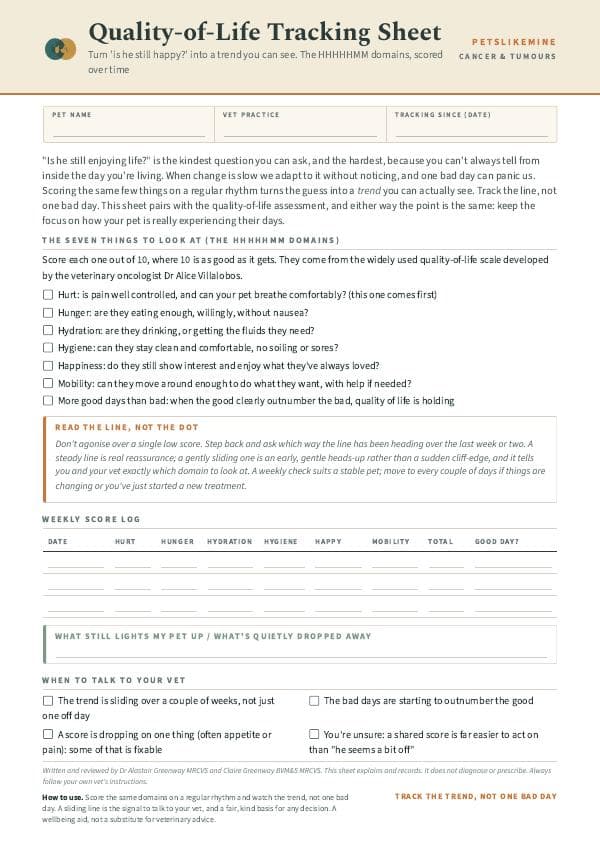
The most widely used quality-of-life scale for pets came from the veterinary oncologist Dr Alice Villalobos, first in 2004 and then in her textbook on geriatric oncology (Villalobos, 2007). It goes by the slightly unwieldy name HHHHHMM, which is really just a memory aid for seven things to keep an eye on. In plain terms:
- Hurt. Is your pet's pain well controlled? Can they breathe comfortably? Pain and breathing come first, because nothing else matters if these aren't right.
- Hunger. Are they eating enough, willingly, without nausea or a struggle?
- Hydration. Are they drinking, or getting the fluids they need?
- Hygiene. Can they stay clean and comfortable, or are they soiling themselves or developing sores?
- Happiness. Do they still show interest, respond to you, enjoy the things they've always loved?
- Mobility. Can they move around enough to do what they want to do, with help if needed?
- More good days than bad. While the good days clearly outnumber the bad ones, quality of life is holding. Once the bad start to win, that's the signal to talk things through.
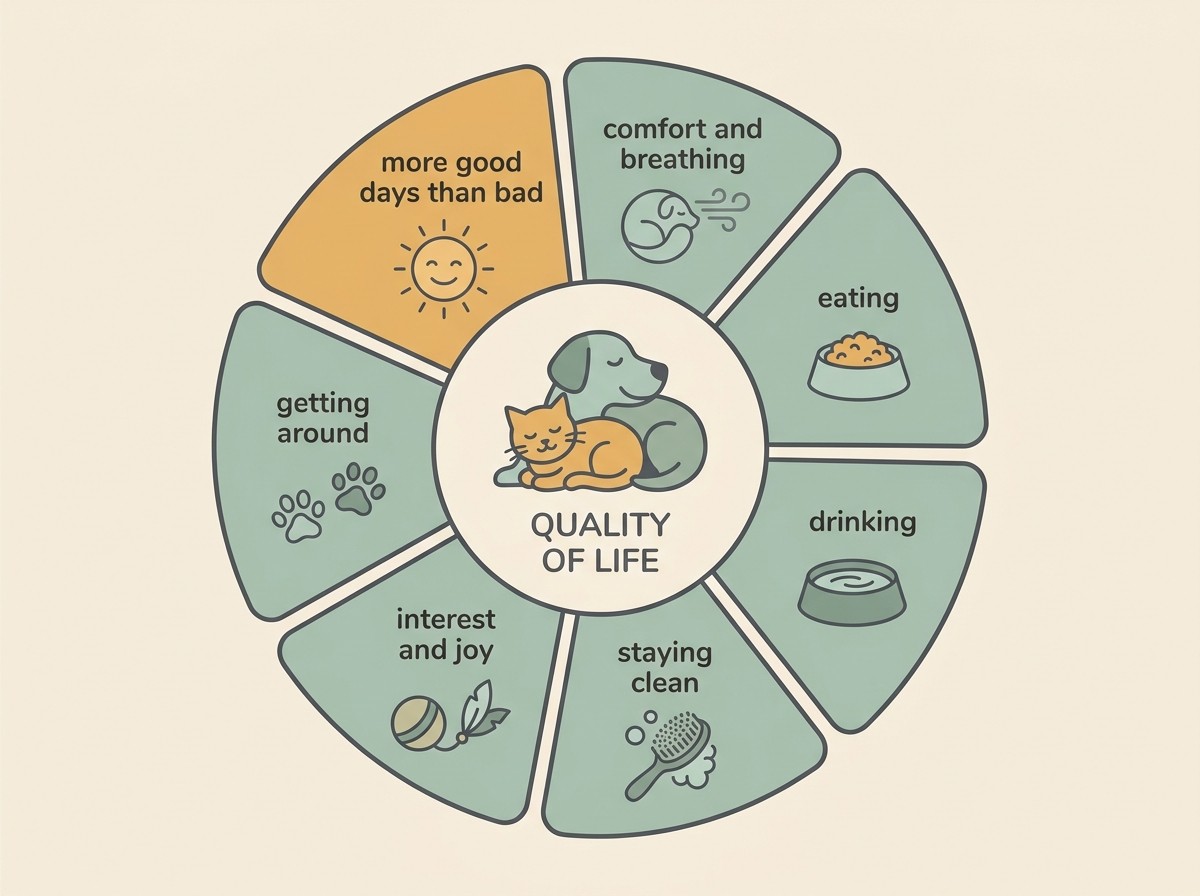
Villalobos's original version asks you to score each one out of ten and add them up, with anything above about 35 out of 70 suggesting quality of life is still acceptable, and a score of at least five in every category being the rough mark of a reasonably good day (Villalobos, 2011). You needn't follow her exact numbers. The same seven domains sit at the heart of the major veterinary end-of-life guidance, which asks about a pet's pain, their ability to eat, drink, breathe, toilet and move, and whether they're still engaging with the people and the world around them (Bishop et al., 2016).
The thing that makes it work is consistency: checking the same things, the same way, on a regular basis, so the comparison from one week to the next is a fair one.
Putting the tracker to work
Holding all of this in your head every day isn't realistic, and it isn't kind to you either. That's where writing it down earns its keep.
You can record your pet's quality-of-life score in [the quality-of-life assessment on PetsLikeMine], which walks you through the domains above and keeps each entry so you can lay them side by side over time. For a pet who's stable, a weekly check is a sensible rhythm. You might move to every couple of days, or daily, if things are shifting or you've started a new treatment and want to watch how they respond. If you'd rather keep it on paper, there's a [quality-of-life tracking sheet] you can print and stick on the fridge.
Once you've logged a few, the knack is to read the line and not the dot. Don't agonise over a single low score. Step back and ask which way the line has been heading over the last fortnight. That's the question the scale is really there to answer.
What the trend is actually for
A tracked score pays its way in a few quiet ways.
When the line holds steady, it's permission to stop second-guessing and simply enjoy your pet. Plenty of owners are surprised by how much that reassurance is worth.
When the line starts to slide, you get an early, gentle heads-up instead of a sudden cliff-edge, and that's the difference between planning with love and reacting in fear.
It also gives you and your vet a shared language. "He seems a bit off" is hard to act on. "His score has dropped from 6 to 4 over three weeks, mostly on appetite and mobility" is something you can both work with, whether that means adjusting pain relief, tweaking the treatment, or having a more candid conversation about what comes next. A record like that is exactly what the veterinary hospice guidelines have in mind when they describe a written quality-of-life account as something that should guide the discussion about care options (IAAHPC, 2024). It spares you trying to compress weeks of worry into a two-minute appointment from memory, and it keeps the things you noticed at 6am on a Tuesday from getting lost.
It can also catch the things that are fixable. A dip driven mostly by appetite or pain isn't always the cancer winning. Sometimes it's a side effect, a dose that wants adjusting, or pain relief that's no longer quite enough, all of which your vet can do something about. Seeing which domain the score is falling on points you both straight at what to try next, rather than leaving you assuming the worst.
And when the time does come to weigh up that conversation, the score gives you a fair, steady foundation for it, built up over weeks of calm observation rather than the fog of one frightening night. For the hardest decision an owner ever faces, that's a far kinder basis than gut feel alone (Bishop et al., 2016). We cover that decision gently in [the quality-of-life decision, and where to go next].
This is kindness, not bookkeeping
If keeping a score feels cold, or like you're counting down, try turning it round the other way. Every entry you make is you paying close, loving attention to how your pet is actually experiencing their days, rather than how you fear they might be. It keeps the focus exactly where it belongs, on them.
It tends to surface the good, too. When you're watching properly, you notice the morning they wolfed their breakfast, the evening they brought you a toy, the sunny spot they claimed on the rug. Those are the days worth holding onto, and [making the most of the time] is really a piece about exactly that.
You don't have to get this perfect. You just have to keep looking, kindly and regularly, and let the trend tell you what a single day never can.
References
- Villalobos AE. Canine and Feline Geriatric Oncology: Honoring the Human-Animal Bond. Ames, Iowa: Blackwell Publishing; 2007. (The HHHHHMM quality-of-life scale was first published by Dr Villalobos in Veterinary Practice News in 2004 and formalised in this textbook.)
- Villalobos AE. Quality-of-life assessment techniques for veterinarians. Veterinary Clinics of North America: Small Animal Practice. 2011;41(3):519-529.
- Bishop G, Cooney K, Cox S, Downing R, Mitchener K, Shanan A, Soares N, Stevens B, Wynn T. 2016 AAHA/IAAHPC End-of-Life Care Guidelines. Journal of the American Animal Hospital Association. 2016;52(6):341-356.
- International Association for Animal Hospice and Palliative Care (IAAHPC). Animal Hospice and Palliative Care Guidelines. 2024.
- Lap of Love. Quality of Life Assessment: A Critical Tool for Your Senior Pet. 2023.
Free downloads
Companion worksheets to put what you've read into practice. Free PDFs, print at home.
Sister tool · Sightline
Track quality of life over time
Sightline, a separate ConciergeVet tool, runs a short adaptive weekly assessment with a quality-of-life focus mode built around exactly these frameworks, tracks a single composite score over time so you can see the trend rather than judge a single bad day, and produces a Sightline Report PDF you can bring to your vet.
A written log, or our printable quality-of-life sheet, does much the same job.
See how Sightline tracks quality of lifeFound a lump? Track it, and know when to act
A lump cannot be told apart by look or feel; only your vet sampling it can. The Lump & Bump Tracker records its size and how it changes, flags when it has crossed a line worth a vet visit, and builds a clean history to take in.
Open the Lump & Bump TrackerYou're not doing this alone
Compare treatment journeys and talk to owners managing cancer. Free to join.
Join PetsLikeMine