

Drinking and weeing far more than usual: measuring it, and what it means
Alastair Greenway
BVM&S MRCVS
You've noticed the water bowl emptying faster than it used to, or you're refilling it twice a day when once was plenty. Maybe there are puddles where there never used to be, or the litter tray is heavier and you're scooping more. It's unsettling, and it's one of the most common reasons owners get in touch.
Here's the calm version first. Drinking and weeing more is real, it's measurable, and it's one of the most useful early clues your pet's body can give you. The number you can gather at home won't tell you what the cause is, but it will tell you whether this is worth a vet visit, and it gives your vet a head start. Most of the causes are common, well understood and treatable. So before you worry, the single most helpful thing you can do is measure it.
There's one important exception to "measure first, worry later", and it's worth knowing up front. If you have an unspayed female dog who is drinking more and also seems off colour, do not reach for the measuring jug. That combination can mean a womb infection, and that's an emergency. There's a clear box on that below.
What "more than usual" actually means
Vets split this into two linked words. Polyuria means passing too much urine. Polydipsia means drinking too much. They almost always travel together (the two are often shortened to "PU/PD"), and the link matters, because for most causes the urine problem comes first and the drinking is the body trying to keep up. When the kidneys lose water they shouldn't, your pet drinks more to avoid getting dehydrated (Bates 2023). That's why measuring the drinking is a genuine window onto what the kidneys and hormones are doing.
There's a firm, agreed line for "definitely too much". Drinking more than 100 ml per kilogram of body weight per day is the recognised threshold for polydipsia in both dogs and cats (Bates 2023; VetSpecialists). For context, a normal pet usually drinks somewhere in the region of 20 to 70 ml per kg per day, with a lot of individual variation (VetSpecialists). Dogs tend to sit comfortably below roughly 90 ml per kg per day, and cats normally drink less than dogs because so much of their water comes from food (dvm360). Treat those lower species figures as a soft "getting near the top end" guide rather than a hard cut-off, and treat the 100 ml per kg per day line as the clear flag.
One caveat. Your pet is an individual. Some pets show a real, meaningful rise in their drinking while still technically under that 100 ml line (VetSpecialists). So the threshold isn't the only thing that matters. A clear, sustained increase from your own pet's normal level is reason enough to ask the vet, even if the maths comes in just under the flag.
How to measure water intake at home
This is simpler than it sounds, and it's the most useful homework you can do.
- Give one water source only for the measuring period, so you can account for everything that goes in. If there are several bowls, a dripping tap or a water fountain, narrow it to one.
- Mark a line on the bowl, or measure the starting volume with a measuring jug so you know exactly how much you put in.
- Top up with a measuring jug and write down how much you add, so you're capturing every refill across the day.
- At the same time each day, work out the total drunk over those 24 hours. Remember to account for evaporation and for any water you tip away.
- Divide that total in ml by your pet's weight in kg. That gives you ml per kg per day, the number your vet will want.
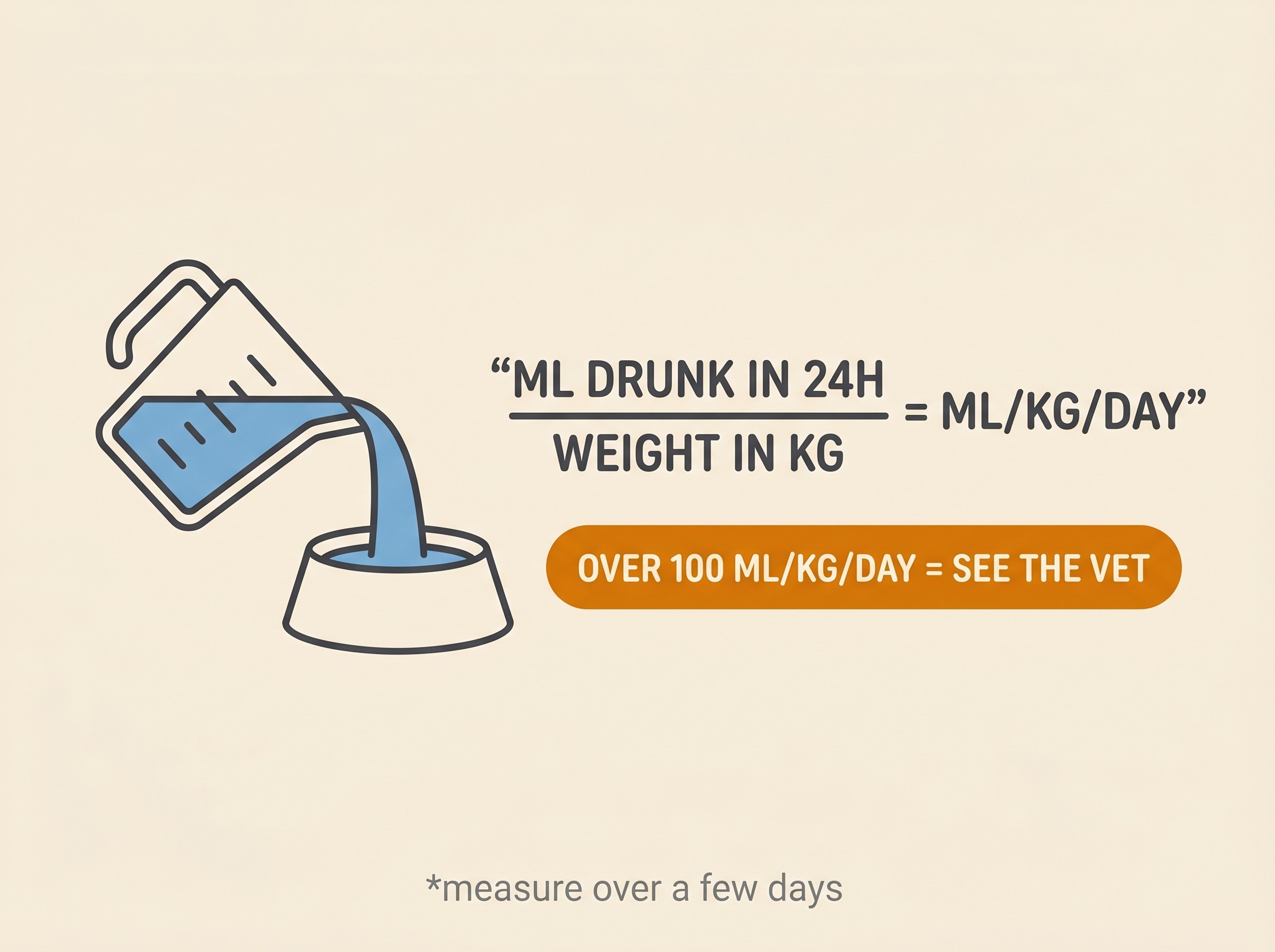
So the formula is simply: total ml drunk in 24 hours divided by body weight in kg equals ml per kg per day.
Because intake naturally varies from day to day, it's best to measure over a few days and take an average rather than reading too much into a single figure (Companion Animal Veterinary Hospital). A couple of practical limits are worth flagging. In a multi-pet household you can't easily tell who drank what, and an outdoor pet may be drinking from puddles, ponds or next door's bowl. Pets on wet food also get a lot of water from the food itself. None of that makes measuring pointless, it just means you should tell your vet the conditions, so they know how much weight to put on the number.
A word of caution that matters: do not try to fix the drinking by restricting water. If the underlying problem is that the kidneys are losing water, the drinking is keeping your pet safe from dehydration, and taking the water away can be dangerous (Merck Veterinary Manual). Any test that involves withholding water is a vet-supervised procedure only.
What the number might mean
If you've confirmed a genuine increase, the next question is "what's behind it?". The list is broad, which is exactly why the number tells you to act but not what's wrong. The common culprits differ a little by species.
In dogs, the three most frequent causes are chronic kidney disease, diabetes mellitus and Cushing's disease (Bates 2023). In cats, they're chronic kidney disease, diabetes mellitus and an overactive thyroid (Bates 2023). Beyond those, the fuller list a vet will work through includes Addison's disease, high blood calcium, diabetes insipidus (the "water diabetes" that isn't about sugar at all), liver problems, and some medications such as steroids and water tablets (Bates 2023). It's a long list, but your vet narrows it down quickly with a few standard tests.
That's the reassuring part. You don't have to work out which one it is. A typical first work-up is a urine sample (including how concentrated it is), blood tests including a count and a biochemistry panel with salts, and, especially in cats over about seven years old, a thyroid level (Bates 2023). From there your vet adds further tests only as the picture points somewhere. One blood result rarely settles it on its own, which is why several often get run together.
To see how these signs fit alongside the appetite, weight and coat changes that point to a particular gland, our piece on the classic hormone signs is the place to start, and the deeper dive on what each blood test rules in or out is in our article on the hormone blood tests, explained.
When it's not "measure and book a routine appointment"
Most of the time, measuring the drinking and ringing the practice for a sensible appointment is exactly right. A few situations need to skip that step.
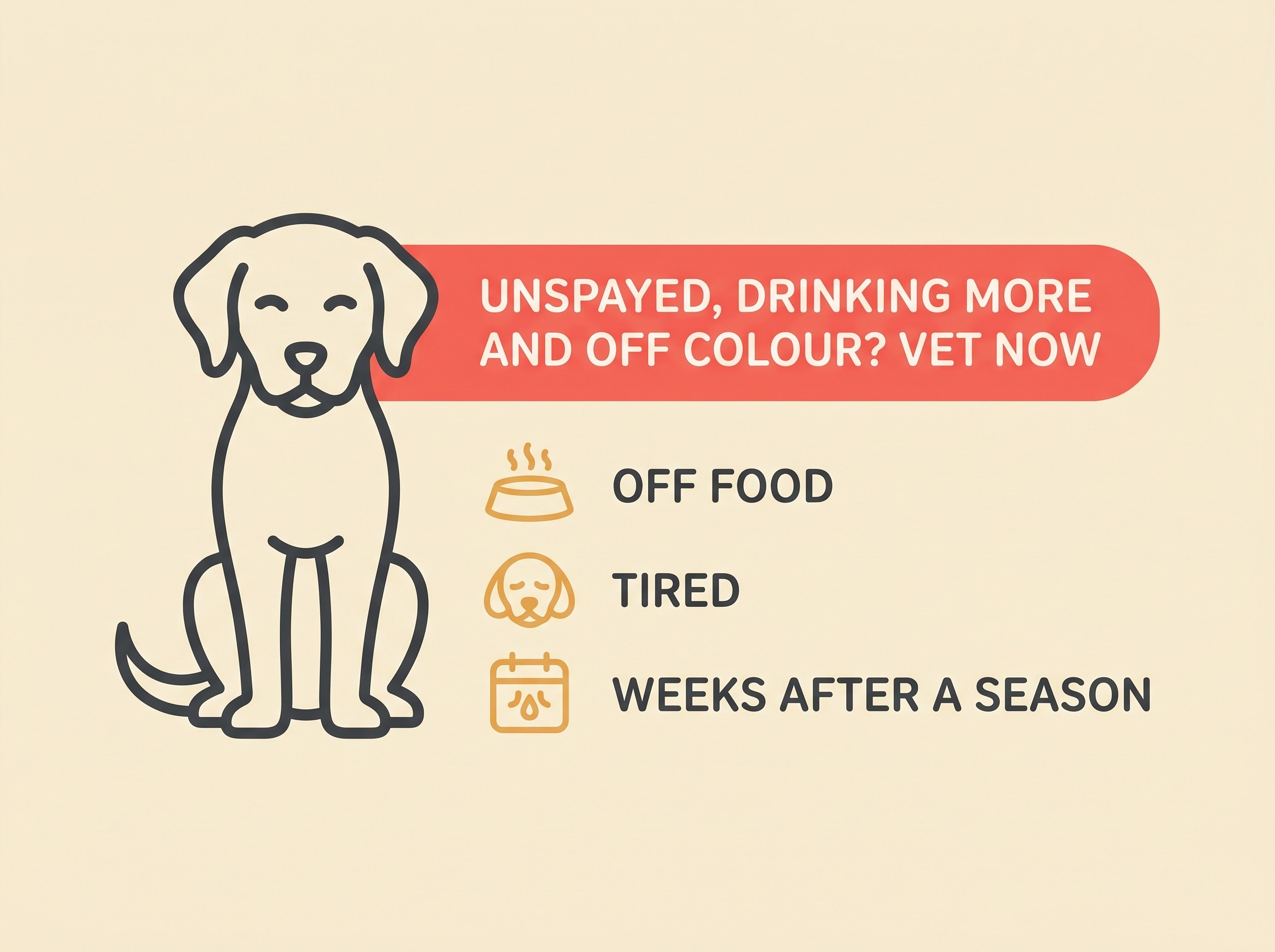
Unspayed female dog, drinking more and off colour? Ring the vet now. A womb infection (a pyometra) is a true emergency, and increased drinking and weeing is one of its signs. It classically appears within a few weeks of a season, often with tiredness, going off food, vomiting, and sometimes a discharge from the back end (dvm360; Bates 2023). The infection's toxins stop the kidneys concentrating urine, which is why the thirst goes up (dvm360). This is the one place to put the measuring jug down and call straight away.
Likewise, any collapse, sudden weakness or rapid deterioration needs an urgent vet rather than a web search (Bates 2023). And while you'd never detect it yourself, this is why a vet will check your pet's blood calcium too. A high calcium level causes drinking and weeing in its own right, and in dogs it can be an early flag for problems worth catching quickly, so the blood test that picks it up earns its place (dvm360; Bates 2023).
Your next step
If you can, spend the next two or three days measuring. Use a measuring jug, one bowl, and the simple sum above, and jot the daily figures down. Our Thirst and Wee tracker does the arithmetic for you, turns your bowl refills into ml per kg per day and plots the trend, so you can see at a glance whether your pet is over the line and bring a clear record to the appointment. If you'd rather work on paper, the "Is my pet drinking too much?" measuring card walks through the same method.
Whatever the number comes out as, you've done the genuinely useful thing. You've turned a vague worry into something measurable, and that's the fastest route to an answer. If the cause turns out to be a sugar problem, our Diabetes space picks it up from here. If it's the kidneys, our urinary health section covers chronic kidney disease. And if it points to the thyroid or the adrenal glands, the rest of Hormone Health is built for exactly that.
References
- Bates J. "A Stepwise Diagnostic Approach to Polyuria and Polydipsia." Today's Veterinary Practice, 2023.
- Davies Veterinary Specialists / VetSpecialists. "Polydipsia in Dogs and Cats (increased drinking) Fact Sheet."
- dvm360. "The ins and outs of polyuria and polydipsia in veterinary practice."
- Companion Animal Veterinary Hospital. "How to Measure Your Dog's Water Intake: A Key Indicator of Health."
- Merck Veterinary Manual. "Diabetes Insipidus in Animals."
Keep track of how your pet is doing
The owners who cope best are the ones who notice changes early. A simple health log shows you what is working, and what is not, before the next vet visit.
Start tracking, freeYou're not doing this alone
Compare treatment journeys and talk to owners managing hormone health. Free to join.
Join PetsLikeMine