

Measure, don't scoop: getting portions right in grams
Alastair Greenway
BVM&S MRCVS
So you've got the number. Maybe the vet gave it to you, maybe you read it off the bag, maybe you ran it through our Feeding Calculator. Either way, you know roughly how many grams (or calories) your pet should be getting each day. Now you have to actually deliver it, every day, with a tired hand on a Tuesday morning. And the awkward truth is this: if you're scooping or using a mug, the amount you think you're feeding and the amount you're really feeding can be miles apart. This piece is the hands-on follow-up to "how much should I actually feed?" It won't give you a new number. It'll make you confident you're hitting the one you've already got.
Why the scoop lies (and it isn't your fault)
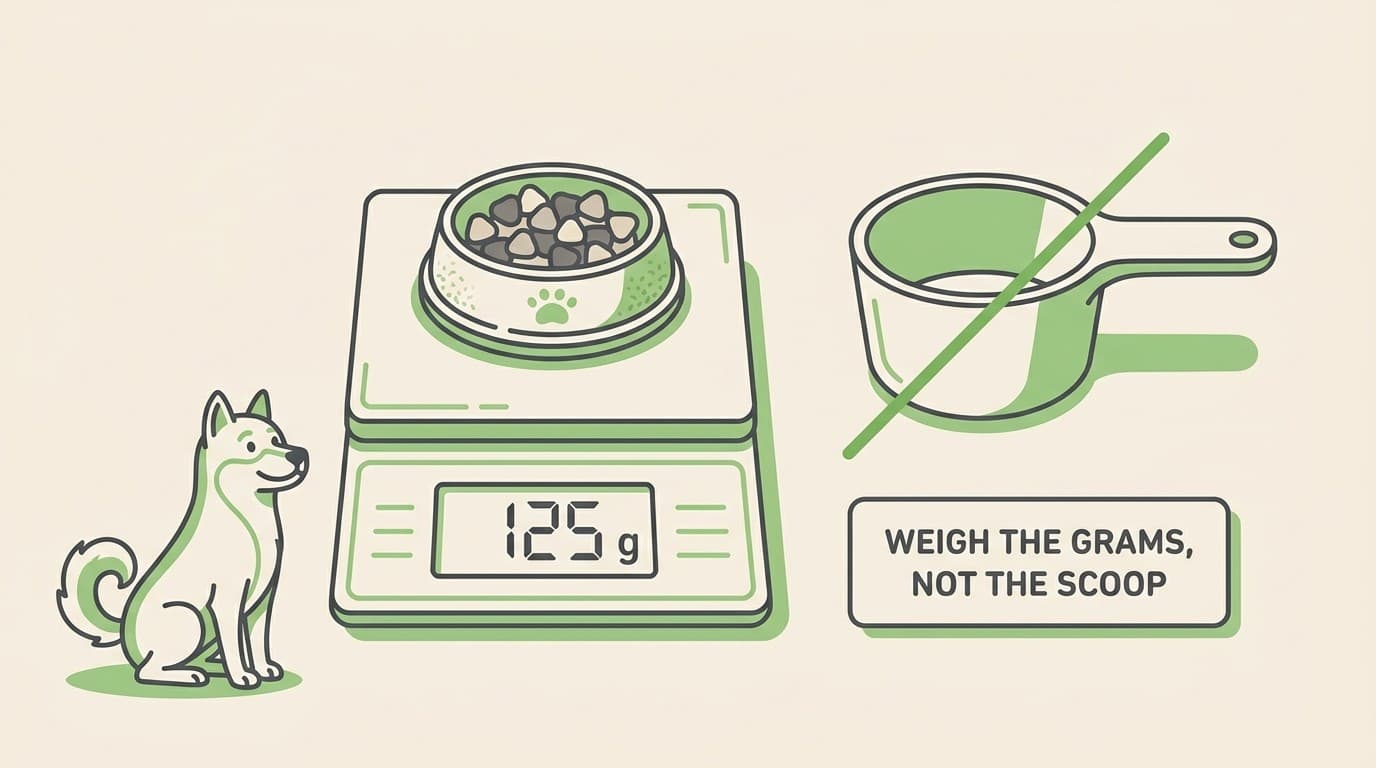
Let's start by taking you off the hook, because this is the bit owners feel guilty about and shouldn't. A standard measuring cup is genuinely bad at measuring kibble. When researchers asked people to portion out dry food with a measuring cup, the amounts ranged from an 18% under-estimate all the way to an 80% over-estimate of the intended portion (German, 2011). Eighty per cent over. That's nearly double the food, from a tool that looks like it's doing a precise job.
And a measuring cup is the careful end of the scale. Most of us aren't even using one. We're using the scoop that came in the bag, or a mug, or a yoghurt pot, or we're just eyeballing it. All of those are worse, and for a simple reason: you're not feeding "a cup", you're feeding calories, and a cup of one food is never the same number of calories as a cup of another. Kibble size and density vary enormously from brand to brand. A dense, small kibble packs far more food into the same cup than a big, airy one, so "one level cup" might be 300 calories on one bag and 450 on the next. Switch foods and your scoop quietly starts lying to you all over again, even if your hand hasn't changed at all.
If this is landing a bit close to home, you are in very normal company. An Association for Pet Obesity Prevention survey found that only about 16% of dog owners and around 3% of cat owners weigh their pet's food (APOP, 2025). So if you've been scooping, you're not the careless exception. You're the overwhelming majority, using a tool that was never built for precision.
The single best 10 pounds you'll spend
Here's the fix, and it really is this simple: a cheap digital kitchen scale that reads in grams and has a zero (or "tare") button. That's it. That one piece of kit is, genuinely, the single highest-impact change you can make in the whole programme.
I can say that plainly because we don't sell you anything: no portion-controlled bag, no smart bowl, no subscription to push. The reality is that you very often don't need to buy special food at all, you just need to weigh the food you already own, and the thing that lets you do it costs about 8 to 12 pounds (that's a rough high-street price, not a clinical figure). You can spend a great deal more on weight management than that and get a great deal less.
Why grams rather than volume? Because you're feeding calories, and a gram is a gram every day. Sixty grams this morning is exactly sixty grams next Tuesday and the same again in a month. A "cup" drifts: a slightly heaped one, a slightly settled bag, a new kibble shape, and your portion has changed without you deciding to change it. Weight cuts the drift out completely.
And on the "this sounds like faff" worry: it isn't. Tip food onto the scale, watch the number, stop. Once it's a habit it adds seconds to your morning, not minutes. This matters because owner habits, not the pet's metabolism, are what make or break a weight-loss plan in the real world. Non-adherence is the main reason these programmes fail (Cline et al., 2021), and the scale is how you quietly win on adherence without thinking about it.
Weigh the whole day first thing, then split it
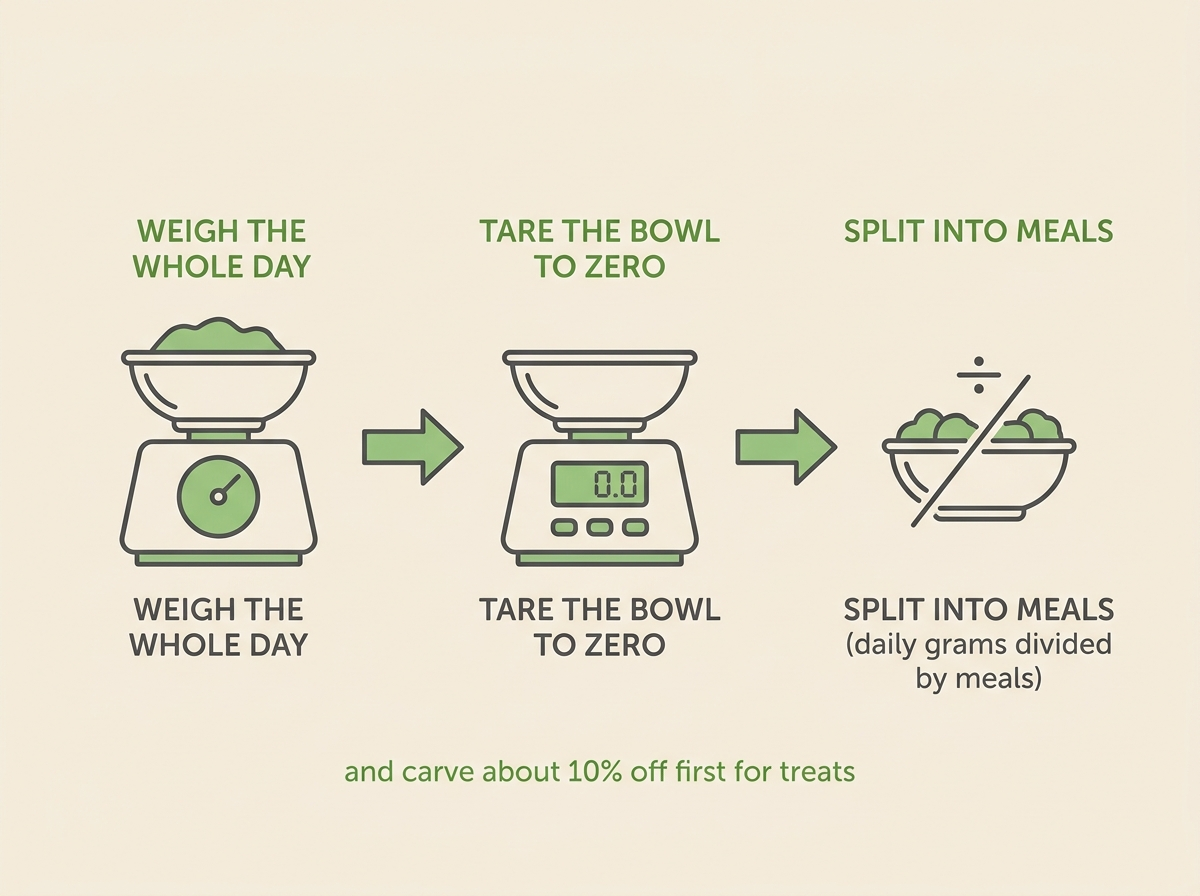
Here's the habit that makes it stick, and it's a small twist that changes everything. Don't weigh each meal as you go. In the morning, weigh out the whole day's ration in one go into a single tub or container. Then portion the meals out of that tub.
This does two quietly brilliant things. First, the day can't creep over budget, because the day is finite. When the tub's empty, that's the food gone. There's no "oh, I'll just top him up", because the topping-up has to come from tomorrow's tub and you'll see it. Second, anyone in the house can see at a glance exactly how much is left to feed. No double dinners, no "did you feed her?", because the answer is sitting right there in the tub.
Splitting it into meals is just arithmetic, and it's exactly the sum the Feeding Calculator does for you:
daily grams divided by the number of meals = grams per meal.
So a dog on 240 grams a day fed twice = 120 grams a meal. A cat on 55 grams a day fed three times is a touch over 18 grams a meal. Two meals, three meals, four little ones for a grazing cat, the maths is the same. Both species, same method.
One thing people forget, then wonder why the number's always a bit off: tare the bowl first. Put the empty bowl (or tub) on the scale, press the zero button so it reads 0, then add the food. Now you're weighing the food and only the food. If you don't zero it, the bowl's weight gets counted as dinner and you under-feed by however much the bowl weighs, which for a heavy ceramic bowl is not nothing. If you want the why behind the number you're splitting, "how much should I actually feed?" walks through where it comes from.
Wet, dry, or both: weigh them on their own terms
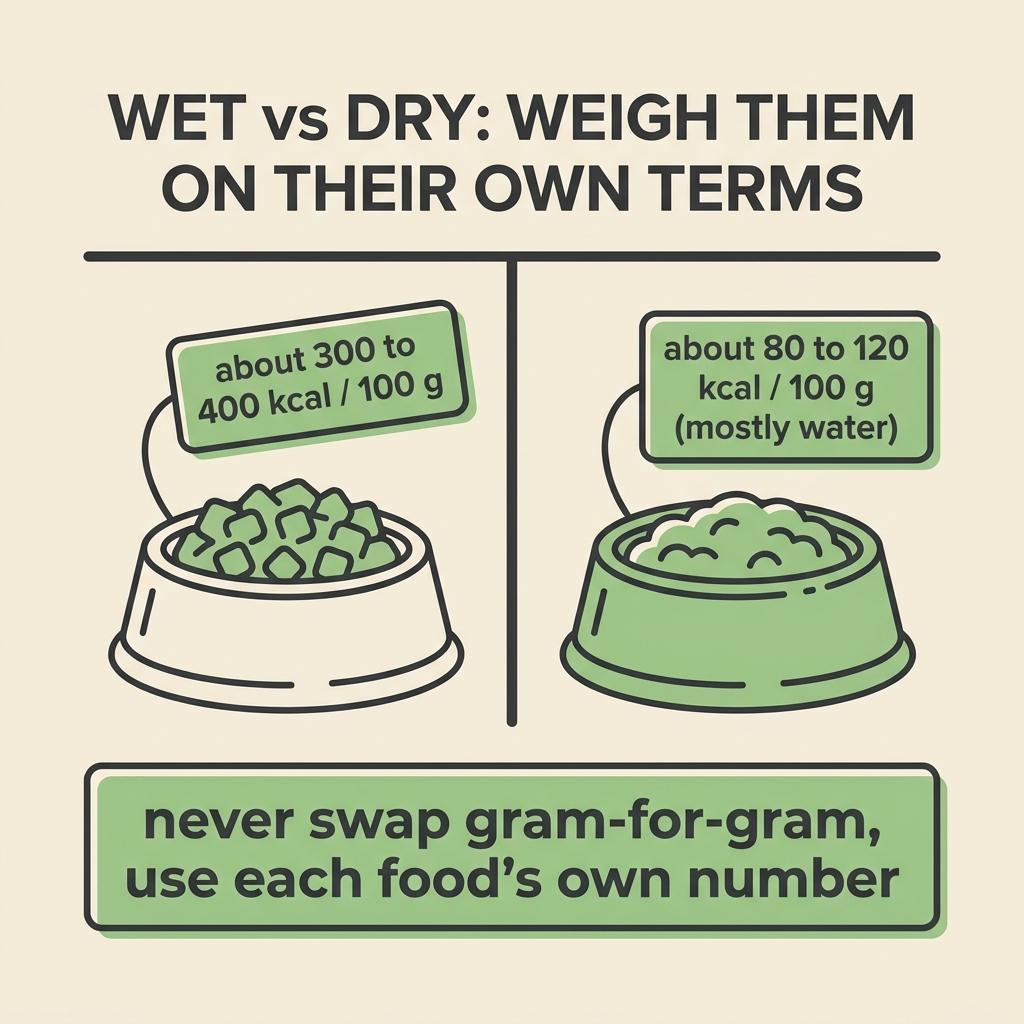
Now the bit that genuinely trips people up, because it's not obvious and it matters. You cannot swap wet food for dry food gram-for-gram. They are not interchangeable by weight, not even close.
Dry kibble is roughly 300 to 400 calories per 100 grams. Wet food is only about 80 to 120 calories per 100 grams (these are typical ranges, so treat them as approximate). The difference is almost entirely water. Kibble is around 8 to 12% moisture; wet food is about 75 to 85% moisture, so most of what you're weighing in a pouch or tin is water, and water has no calories. That's why 50 grams of kibble and 50 grams of wet food are not remotely the same meal.
So the rule is simple: weigh each food against its own number. Read the calories-per-100g off that food's own pack (it's on the label, sometimes in small print, but it's there) and weigh to that. Never assume a gram of one equals a gram of the other. If you feed both, mixed in the bowl or wet in the morning and dry at night, weigh each part separately to its own number and add the calories up.
There's a useful upside here for a dieting pet. Because wet food carries far fewer calories for the same weight, a wet or part-wet ration can feel like more food for the same calorie budget, which helps a hungry dieter feel fuller and less hard-done-by. It's a real perk. It just doesn't excuse you from the scale: you still weigh it, you just weigh it to its own number.
Make it idiot-proof for the whole house (and a quick reality-check)
Pre-portioning the day on the counter isn't just tidy, it's your single best anti-sabotage move. The dog-sitter, the kids, the partner who "only gave him a little bit", they all draw from the one measured tub, so the day can't be fed five times over. If you want the household conversation in full, "getting the whole family on board" and "feeding a dieter in a multi-pet home" cover the awkward bits.
Carve the treat budget out before you split the meals, not after. Treats should be no more than about 10% of the day's calories, so take that 10% off the top first, then divide what's left into meals. If you split first and treat second, the treats are bolted on over budget and the maths you so carefully weighed is undone by a couple of dental chews. "The treat budget" shows how to keep the treats and still make it work.
And do a reality-check now and then. Every few weeks, re-weigh a portion against the amount you think you're feeding. This catches scoop-creep, the slow drift where a portion quietly grows back over time, which is one of the commonest reasons a diet that was working suddenly stalls. If your pet's loss has flattened out, this is the first place to look, and "the scale won't budge" goes through the rest.
One gentle word for cat owners, because it's the worry that sits underneath all of this. Weighing isn't just how you trim a cat, it's how you protect one. A cat must never be crash-dieted, and weighing is exactly what stops that happening by accident. Because you're measuring, you can prove your cat is still getting her full, sensible daily ration even as you trim her down. You'll never quietly under-feed her, because the grams are right there in front of you. The scale isn't the enemy of a cat on a diet, it's the safety net. "Never crash-diet a cat" explains exactly why that line matters so much.
Next step
Don't overthink this one. Grab the cheapest digital kitchen scale you can find, the same one you'd weigh flour on. Run today's number through the Feeding Calculator if you haven't already, and tomorrow morning weigh the whole day's ration into a tub before you do anything else. Most owners are genuinely surprised by what the scale says versus the scoop, usually that they were feeding more than they thought, occasionally that they could feed a little more. Either way, you'll finally know.
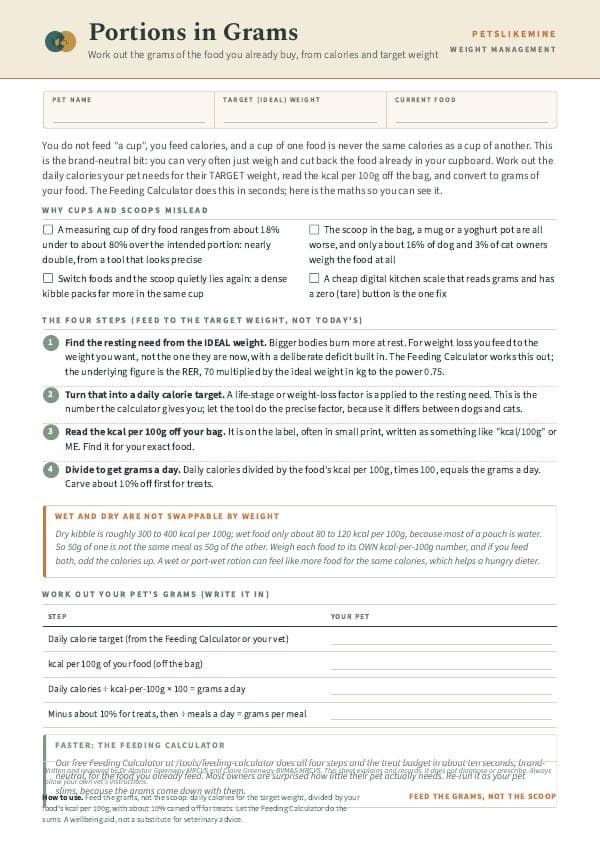
From here, "how much should I actually feed?" has the why behind the number, "the treat budget" keeps the treats without wrecking the plan, "cut back or switch to a diet food?" weighs up your food options, and the portions-in-grams guide is a print-out for the fridge so the whole house is feeding from the same page.
References
- German AJ, et al. (2011). Imprecision when using measuring cups to weigh out extruded dry kibbled food. Journal of Animal Physiology and Animal Nutrition (Berlin).
- Association for Pet Obesity Prevention (APOP) (2025). 2025 Pet Obesity and Nutrition Opinion Survey.
- Cline MG, et al. (2021). 2021 AAHA Nutrition and Weight Management Guidelines for Dogs and Cats. Journal of the American Animal Hospital Association, 57(4):153-178.
Free downloads
Companion worksheets to put what you've read into practice. Free PDFs, print at home.
Keep track of how your pet is doing
The owners who cope best are the ones who notice changes early. A simple health log shows you what is working, and what is not, before the next vet visit.
Start tracking, freeYou're not doing this alone
Compare treatment journeys and talk to owners managing weight management. Free to join.
Join PetsLikeMine