

Managing Your Pet's Pain and Comfort Through Cancer
Alastair Greenway
BVM&S MRCVS
Across all the worries a cancer diagnosis brings, the one that keeps owners awake at night usually isn't the prognosis or the cost. It's a plainer, harder question: is my pet in pain, and would I even know?
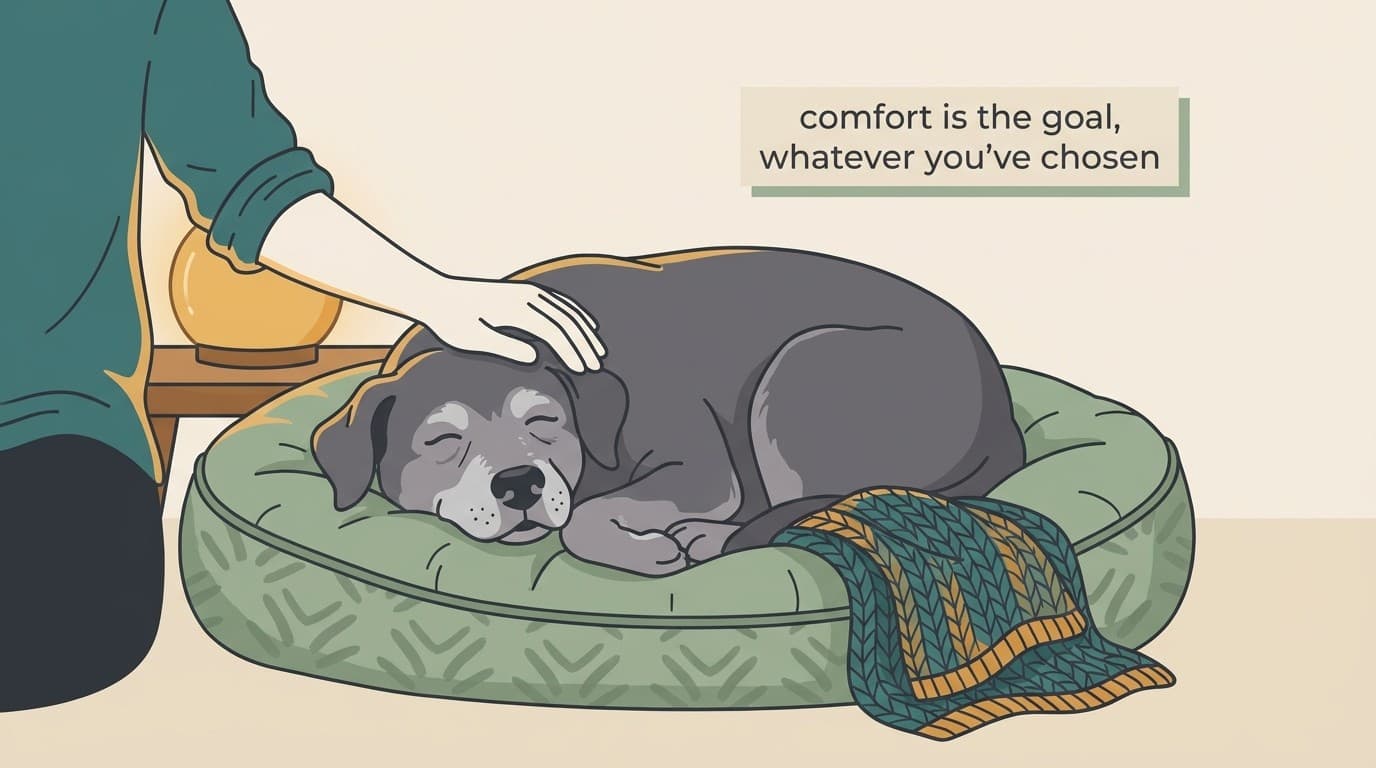
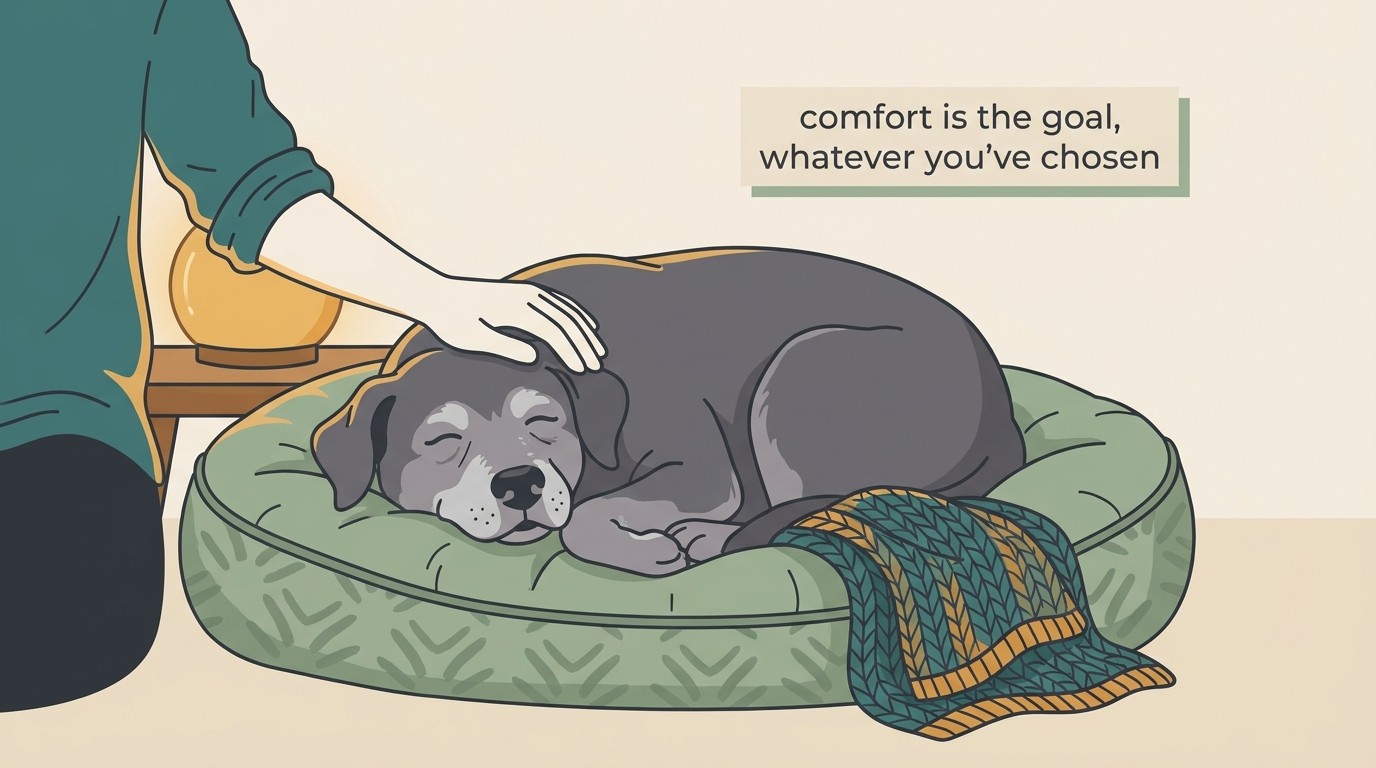
That's a fair thing to fear. Pets can't tell us in words, and cats in particular are remarkably good at hiding discomfort. The part worth holding on to is this: cancer pain can almost always be controlled, and keeping your pet comfortable is the goal that holds steady whichever path you choose. Whether you're treating the cancer hard, focusing on comfort, or somewhere between the two, good pain relief sits right at the centre. It isn't a bolt-on. It's the work itself.
Comfort is the goal, on every path
Owners sometimes picture pain relief as something that belongs at the very end. It doesn't. A comfortable pet eats better, sleeps better, moves more and stays interested in the things they love, and that is precisely what we mean by quality of life. Pain control is the foundation the good days are built on. The same holds if you've decided against treating the cancer itself. Comfort-focused care is a long way from doing nothing, and further still from giving up. It's the active, skilled job of keeping your pet feeling well, and managing pain well is the core of that job.
Learning to read your pet's pain
It all starts with spotting the pain, and pets rarely make that easy. They won't point to where it hurts. Instead it surfaces as small shifts in behaviour, and because you know your pet better than anyone, you're usually the first to sense that something is a little off.
Dogs tend to show it more openly: a reluctance to climb stairs or jump into the car, slowing down on walks, stiffness getting up, trouble settling, panting that doesn't match the weather, a hunched back, or simply a dog who seems quieter and less like themselves. Some grow clingy, others pull away, and a normally easy-going dog may grumble when you touch a sore spot.
Cats are where it gets genuinely hard. They're wired to hide weakness, so a cat in real discomfort can look more or less normal to a passing glance. The signs are quieter and easy to put down to "just getting older", which is exactly why it helps to know what you're looking for.
Subtle signs of pain, especially in cats
Cats hide pain well, so watch for the quiet changes rather than any dramatic one:
- Hiding away more than usual, or retreating to a quiet spot and staying there
- Grooming less (a scruffy, matted or greasy coat is a common clue), or over-grooming one particular area
- A hunched, crouched posture, sitting tense even at rest, or sleeping curled tighter than normal
- Eating less, or going to the bowl and then walking away
- Not jumping up to favourite perches any more, or hesitating on the stairs
- A change in temperament, becoming grumpy or snappy when touched, or unusually withdrawn and flat
- Facial changes, squinted eyes, flattened ears and whiskers pulled tight, the things the Feline Grimace Scale measures
Any of these on their own can be nothing. A cluster of them, or a clear change from your cat's normal self, is worth a vet's attention.
There's solid science behind that last line. Researchers at the University of Montreal developed and validated the Feline Grimace Scale, which reads pain from five facial features (ear position, eye narrowing, muzzle tension, whisker position and head position) (Evangelista et al., 2019), and a later study found it reliable enough that cat owners can use it too, not only vets (Evangelista et al., 2021). For a simple checklist to stick on the fridge, there's a [pain-signs download] you can print, with the dog and cat signs side by side.
How vets treat cancer pain: the multimodal approach
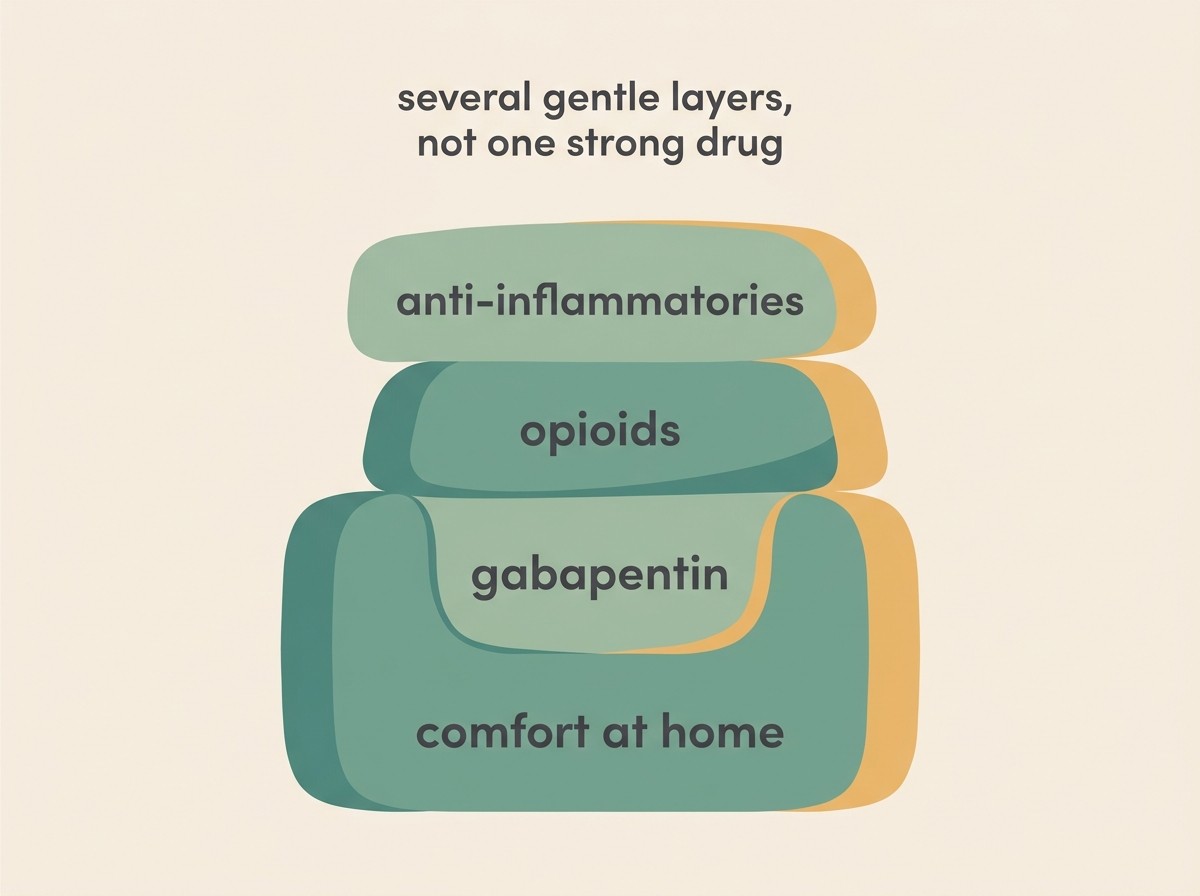
Relieving the pain itself rarely comes down to a single drug in modern practice. The profession's pain-management guidance is built around "multimodal" analgesia, layering several treatments that work in different ways so each can sit at a gentler dose, giving better relief and fewer side effects than any one drug pushed to its limit (Gruen et al., 2022). Picture a stack rather than a solitary pill.
Your vet will usually assemble that stack from a few familiar building blocks (Gruen et al., 2022):
- Anti-inflammatory painkillers (NSAIDs), such as meloxicam, carprofen or robenacoxib, are often the backbone, especially where there's inflammation or bone involvement. They work well, but they need the right dose for the right pet, which is one reason the human versions in your cupboard are dangerous (more on that below).
- Opioids, such as buprenorphine or methadone, for stronger or breakthrough pain. These are prescription medicines used carefully, often around procedures or when pain is harder to settle.
- Gabapentin, a nerve-pain medicine that's become a mainstay because it's easy to give by mouth, mixes well with other drugs, and helps with the gnawing, nerve-type pain some tumours cause.
- Adjuncts such as amantadine, layered in when pain is stubborn or has become "wound up" over time.
Cancer pain in animals is genuinely underrecognised and undertreated, partly because it's so easy to miss, so please don't hold back on reporting it. If your pet seems sore, say so, and say so again if a plan isn't working (Williams & MacDonald-Dickinson, 2023). Pain relief is meant to be adjusted and fine-tuned, never set once and forgotten.
Never reach for human painkillers
This is the warning that matters most in the whole piece, which is why it has its own section. Don't give your pet anything from your own medicine cabinet. Not to "tide them over", not at a guessed-down dose, not the children's liquid version. Veterinary specialists are blunt about it: never give human medication to your pet unless your vet has specifically told you to (Willows Veterinary Group).
Two examples make the danger plain.
Paracetamol can kill a cat. Cats lack the liver enzyme that lets people and dogs safely process paracetamol, so it builds up into toxic byproducts that damage their red blood cells and stop their blood carrying oxygen, on top of harming the liver (MSD Veterinary Manual). The signs are grim: brown or muddy gums, a swollen face or paws, laboured breathing and collapse. And it takes very little. A single 250mg tablet can be fatal to a cat (Willows Veterinary Group). One tablet. There is no safe amount of paracetamol you can give a cat at home.
Ibuprofen is toxic to both dogs and cats, causing stomach ulcers and kidney damage at doses far lower than people assume. A single 200mg tablet can poison a cat or a small dog, and cats are harmed at roughly half the dose that affects a dog (Willows Veterinary Group; MSD Veterinary Manual). Aspirin and naproxen carry the same kind of risk.
If your pet has somehow swallowed any of these, treat it as an emergency and ring your vet straight away rather than waiting to see what happens. There's no reason to run that risk anyway, because your vet has pet-safe painkillers that work, and the right one is only a phone call away.
Comfort that doesn't come in a bottle
Medicine does the heavy lifting, but a great deal of comfort comes from small, ordinary changes at home, and they count for even more when a pet's mobility or energy is fading.
- A thick, soft bed in a warm, draught-free spot, low enough to climb into without a struggle.
- Easy access to everything that matters, so food, water and (for cats) a low-sided litter tray are close by and don't need stairs. Raising bowls slightly eases a stiff neck.
- Warmth, which soothes aching joints, and a gentle, predictable routine, which lowers anxiety.
- Quiet and calm, a retreat away from children or other pets, and the steady reassurance of your company, which is its own kind of pain relief.
When pain needs more than tablets
Some cancers bring a particular kind of pain that responds well to targeted help. Bone tumours, for one, are intensely painful, and there are good options beyond daily medication. A short course of palliative radiotherapy can ease bone pain in around three-quarters of dogs, with relief often lasting a couple of months or more, and it's given purely for comfort rather than cure (Ramirez et al., 1999; Rancilio et al., 2022). Medicines called bisphosphonates can help with bone pain too, and strengthen weakened bone. Where a tumour causes pain through a fluid build-up or pressure, draining it for comfort can bring quick relief as well. All of these are worth asking your vet about, and you can read more in [radiation therapy for pets].
Knowing it's working, and what comes next
To be sure the pain plan is doing its job, keep watching the same things over time rather than judging on a single day. Tracking your pet's comfort and good days alongside their other quality-of-life signs turns a daily guess into something you can actually see and act on, and we've put together a full guide to [measuring quality of life], with a tool to help you do it.
Over a long stretch, good pain control buys exactly what comfort care is for: more genuinely good days. There may come a point where, despite everyone's best efforts, pain or decline can no longer be held comfortably, and recognising that is part of loving your pet too. You won't face it alone when you get there. We cover [the signs the cancer is winning] gently, and [the quality-of-life decision] when it arrives, with our whole End-of-Life space alongside.
For now, though, hold on to the hopeful part. Pain is the thing we can almost always do something about, and doing something about it today is one of the most loving gifts you can give your pet.
References
- Gruen ME, Lascelles BDX, Colleran E, Gottlieb A, Johnson J, Lotsikas P, Marcellin-Little D, Wright B. 2022 AAHA Pain Management Guidelines for Dogs and Cats. Journal of the American Animal Hospital Association. 2022;58(2):55-76.
- Williams JL, MacDonald-Dickinson V. Progress in palliation: managing pain caused by cancer in veterinary medicine. The Canadian Veterinary Journal. 2023;64(8):789-791. (PMID: 37529397)
- Evangelista MC, Watanabe R, Leung VSY, Monteiro BP, O'Toole E, Pang DSJ, Steagall PV. Facial expressions of pain in cats: the development and validation of a Feline Grimace Scale. Scientific Reports. 2019;9:19128.
- Evangelista MC, Monteiro BP, Steagall PV. Agreement and reliability of the Feline Grimace Scale among cat owners, veterinarians, veterinary students and nurses. Scientific Reports. 2021;11:5262.
- Feline Grimace Scale. Université de Montréal. (accessed 2026)
- Medivet. Signs of pain in cats: how to tell if your cat is in pain. (accessed 2026)
- Willows Veterinary Group. Can I give human painkillers to my pet? (accessed 2026)
- Hovda T (author); Brutlag A (reviewer). Toxicoses from human analgesics in animals. MSD Veterinary Manual. Reviewed/revised July 2024. (accessed 2026)
- Ramirez O 3rd, Dodge RK, Page RL, Price GS, Hauck ML, LaDue TA, Nutter F, Thrall DE. Palliative radiotherapy of appendicular osteosarcoma in 95 dogs. Veterinary Radiology & Ultrasound. 1999;40(5):517-522. (PMID: 10528848)
- Rancilio NJ, Ko J, Fulkerson CM. Definitive and palliative management of cancer pain in dogs and cats. Today's Veterinary Practice. 2022.
Sister tool · Sightline
Track quality of life over time
Sightline, a separate ConciergeVet tool, runs a short adaptive weekly assessment with a quality-of-life focus mode built around exactly these frameworks, tracks a single composite score over time so you can see the trend rather than judge a single bad day, and produces a Sightline Report PDF you can bring to your vet.
A written log, or our printable quality-of-life sheet, does much the same job.
See how Sightline tracks quality of lifeFound a lump? Track it, and know when to act
A lump cannot be told apart by look or feel; only your vet sampling it can. The Lump & Bump Tracker records its size and how it changes, flags when it has crossed a line worth a vet visit, and builds a clean history to take in.
Open the Lump & Bump TrackerYou're not doing this alone
Compare treatment journeys and talk to owners managing cancer. Free to join.
Join PetsLikeMine