

Mammary (Breast) Tumours in Dogs and Cats, and the Neutering Link
Alastair Greenway
BVM&S MRCVS
You're running your hand over your dog or cat and your fingers catch on something that wasn't there last month. A small firm bead, or a row of them, sitting along the line of the tummy where the teats are. That's mammary tissue, and the word that tends to arrive next is "breast cancer".
There's one thing worth knowing straight away, because it changes how you read everything else. Mammary cancer is one of the few cancers where the species in front of you really matters, and where the outlook for dogs is genuinely much better than it is for cats. So it's worth keeping the two apart from the start, because most of the fear comes from treating them as the same thing.
Where these lumps come from
Mammary tumours grow in the breast (mammary) tissue that runs in two chains down the underside of the body, from the chest to the groin. Dogs and cats both have several pairs of glands along each chain, so a lump can show up anywhere along that line, and often there's more than one. In dogs, tumours that involve more than one gland are very common, seen in roughly half to two thirds of cases (MSD Veterinary Manual, 2024).
These are overwhelmingly a disease of entire (un-neutered) and late-neutered females, and of older animals, with the average dog around eight years old at diagnosis (CVS Vets, 2024). They're far rarer in males. The reason is hormonal, and it's the same hormonal story that makes the prevention picture below such a strong one.
A dog is not a cat here
This is the thing to hold on to above all else, so it gets its own section.
In dogs, roughly half of mammary tumours are benign and half are malignant (American College of Veterinary Surgeons, 2024; Cornell Riney Canine Health Center, 2024). A benign one is not cancer, won't spread, and is usually cured by removing it. Plenty of the malignant half are slow too, and surgery deals with them. The honest caveat is that the more aggressive malignant ones can spread, and somewhere between half and three quarters of those will eventually cause real trouble by recurring or reaching the lungs within a year or two if they're left (Cornell Riney Canine Health Center, 2024). So in a dog, a mammary lump is a "get it checked soon" situation, and not usually a "panic tonight" one.
Cats are different, and harder. Over 85% of feline mammary tumours are malignant (American College of Veterinary Surgeons, 2024), and they tend to be aggressive, spreading to the lymph nodes and lungs, and they're often already advanced by the time anyone finds them (EveryCat Health Foundation, 2024). That's not meant to alarm you. It's the reason the clock runs faster: a mammary lump in a cat needs seeing quickly rather than watching, because catching it small is what most changes the outcome.
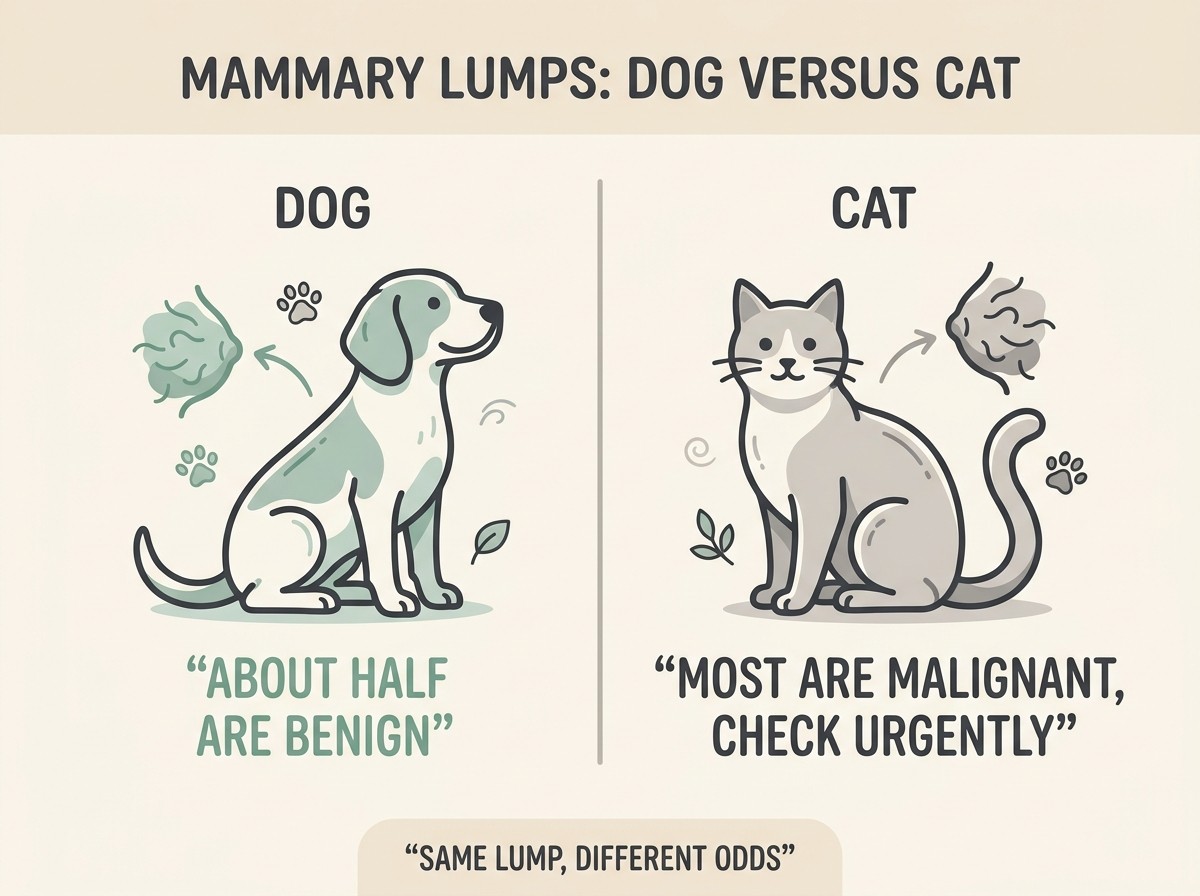
If there's one thing to carry away from this page, it's that card. The same lump, in the same spot, means two quite different things depending on whether you're stroking a dog or a cat.
The neutering link, and a prevention story most owners never hear
This is the part that genuinely puts something in your hands, especially if you have a young female pet, because mammary cancer is one of the most preventable cancers there is.
Mammary tissue is driven by the hormones of the seasons (heat cycles). Each season a female goes through adds to the hormonal exposure that, over years, can nudge cells towards a tumour. Spaying removes the ovaries and switches that driver off, and the earlier it's done, the more striking the protection.
The figures quoted across the profession, which trace back to work in the late 1960s, are hard to ignore. A dog spayed before her first season has roughly a 0.5% risk of ever developing a mammary tumour. Spayed after her first season, that rises to about 8%. After her second season, to about 26%. By around two and a half years of age, spaying no longer reduces the mammary risk much at all (American College of Veterinary Surgeons, 2024; Cornell Riney Canine Health Center, 2024; originally Schneider et al., 1969). The protection is real, then, but it's front-loaded, and it leaks away with every season that passes.
Now the caveat, because you deserve where the evidence actually stands rather than just the headline. Those classic percentages come from older studies, and careful systematic reviews have flagged that the quality of that early evidence is weaker than the confident numbers suggest, with the size of the protective effect and the exact timing still genuinely up for debate (Beauvais et al., 2012; Guirguis & Beggs, 2025). The direction is settled: early spaying lowers mammary risk. The precise figures are best treated as a strong guide rather than a guarantee. That's also why it's a conversation to have properly with your own vet, because the timing of spaying affects more than mammary cancer (joints and a handful of other cancers come into the balance for some breeds), and the right answer can come down to the individual dog.
In cats the same logic holds, and may be even stronger: spaying before six months of age has been found to cut the risk of feline mammary cancer by around 90% (Overley et al., 2005). Given how aggressive that cancer is, the prevention is well worth having.
Getting a diagnosis, and checking whether it's spread
Your vet can't tell benign from malignant by feel, any more than you can, so the lump itself needs sampling. That usually starts with a fine needle aspirate, and often moves on to a biopsy or to examining the whole lump after it's been removed, which is the definitive answer (see the article on aspirates, biopsies and what the results mean).
Because the malignant ones can spread, your vet will usually want to "stage" the cancer before or around surgery, especially in a cat or with a larger or angrier-looking canine tumour. Staging means chest images (radiographs) to look for spread to the lungs, plus checking the nearby lymph nodes, since lungs and regional nodes are where these tumours most often travel (MSD Veterinary Manual, 2024). It can feel like a lot of tests, but staging is what tells you and your vet whether surgery alone is likely to do the job (see the article on what grade, stage and prognosis actually mean).
Treatment, and where the species split shows up again
Surgery is the mainstay for both, but how much surgery differs sharply between the two, and it follows straight from the odds above.
In dogs, surgery can afford to be more measured. With so many canine tumours benign or low grade, removing the lump itself or just the affected gland is often enough (American College of Veterinary Surgeons, 2024). Your vet will usually also recommend spaying at the same time if your dog is still entire, both to take out the hormonal driver and to head off other reproductive problems. Chemotherapy isn't routine for most canine mammary tumours and hasn't reliably been shown to extend survival in dogs (CVS Vets, 2024), so it's kept for the aggressive ones on specialist advice (see the article on cancer surgery and getting clean margins).
In cats, surgery is deliberately more aggressive, because the cancer is. The usual recommendation is to remove the whole affected mammary chain, and often both chains, rather than just the lump (American College of Veterinary Surgeons, 2024). Chemotherapy after surgery comes up far more often in cats than in dogs, because it can buy useful extra time against an aggressive disease, and a specialist will help you weigh it (see the article on why pet chemotherapy is not human chemotherapy).
What the outlook actually depends on
For both species, size at the time of surgery is one of the strongest predictors, which is exactly why early action matters so much.
In dogs, the outlook is generally good when a tumour is caught and removed while it's still small, and benign ones are simply cured (Cornell Riney Canine Health Center, 2024). Larger and higher-grade malignant tumours carry more risk of spread.
In cats, the size threshold is stark, and worth knowing. A feline mammary tumour removed while it's small, under about 3cm, can be followed by a couple of years of life; once it's over 3cm at surgery, typical survival drops to somewhere in the region of four to twelve months (American College of Veterinary Surgeons, 2024; MacEwen et al., 1984). The gap between those two numbers is, in effect, the value of finding it early, and it's the whole reason a feline mammary lump should never be sat on.
What you can do
If you've already found a lump, the move is simple: get it checked soon, and sooner still if it's on a cat. Most canine ones turn out fine, and even the ones that don't are far more manageable small than large. While you wait for the appointment, you can measure it, photograph it and keep an eye on any change using the Lump & Bump Tracker, which gives you and your vet a clear record of whether it's growing.
And if you have a young female dog or cat and the lump hasn't happened yet, this is one of the rare cancers you can genuinely tip the odds against. Talk to your vet about the right time to spay her, knowing that for mammary risk earlier is more protective, and that the decision sensibly weighs up everything else about her too. Prevention is rarely this much within your reach.
References
- American College of Veterinary Surgeons. Mammary Tumors (small animal).
- Cornell University College of Veterinary Medicine, Richard P. Riney Canine Health Center. Mammary cancer.
- MSD Veterinary Manual (Reproductive System). Mammary Tumors in Dogs. (2024).
- CVS Vets (UK). Mammary (Breast) Tumours in Dogs and Cats.
- EveryCat Health Foundation. Metastatic feline mammary cancer.
- Guirguis, P., & Beggs, D.S. (2025). Systematic Review: Does Pre-Pubertal Spaying Reduce the Risk of Canine Mammary Tumours? Animals, 15(3):436. (https://pmc.ncbi.nlm.nih.gov/articles/PMC11815721/)
- Beauvais, W., Cardwell, J.M., & Brodbelt, D.C. (2012). The effect of neutering on the risk of mammary tumours in dogs - a systematic review. Journal of Small Animal Practice, 53(6):314-322.
- Schneider, R., Dorn, C.R., & Taylor, D.O.N. (1969). Factors influencing canine mammary cancer development and postsurgical survival. Journal of the National Cancer Institute, 43(6):1249-1261.
- Overley, B., Shofer, F.S., Goldschmidt, M.H., Sherer, D., & Sorenmo, K.U. (2005). Association between ovariohysterectomy and feline mammary carcinoma. Journal of Veterinary Internal Medicine, 19(4):560-563.
- MacEwen, E.G., Hayes, A.A., Harvey, H.J., et al. (1984). Prognostic factors for feline mammary tumors. Journal of the American Veterinary Medical Association, 185(2):201-204.
- PDSA. Mammary (breast) problems in dogs.
Sister tool · Sightline
Track quality of life over time
Sightline, a separate ConciergeVet tool, runs a short adaptive weekly assessment with a quality-of-life focus mode built around exactly these frameworks, tracks a single composite score over time so you can see the trend rather than judge a single bad day, and produces a Sightline Report PDF you can bring to your vet.
A written log, or our printable quality-of-life sheet, does much the same job.
See how Sightline tracks quality of lifeFound a lump? Track it, and know when to act
A lump cannot be told apart by look or feel; only your vet sampling it can. The Lump & Bump Tracker records its size and how it changes, flags when it has crossed a line worth a vet visit, and builds a clean history to take in.
Open the Lump & Bump TrackerYou're not doing this alone
Compare treatment journeys and talk to owners managing cancer. Free to join.
Join PetsLikeMine