

Lymphoma in Dogs: The Most Treatable Common Cancer
Alastair Greenway
BVM&S MRCVS
Lymphoma is one of the few cancers in dogs where treatment reliably works, and where most dogs feel genuinely well throughout. It usually announces itself as a firm, painless lump under the jaw, found while you're fussing your dog or doing up a collar, in a dog who is otherwise bright, eating and completely themselves. That contrast, a serious diagnosis in a dog who seems fine, is what makes it such a shock.
I won't pretend the rest of the story is all good news, and I'll be straight with you about the catch further down. But of all the cancers I have to talk owners through, this is the one with the most room for good time, and the most reason to take a breath before deciding anything.
What lymphoma actually is
Lymphoma is a cancer of the lymphocytes, a type of white blood cell that's part of your dog's immune system. Because lymphocytes live all through the body, in the lymph nodes, the spleen, the liver, the bone marrow and the gut, lymphoma can turn up in several places at once. That's different from a cancer that starts as one lump in one spot.
The form most owners encounter is called multicentric lymphoma, and it's the commonest version in dogs, making up around three-quarters of cases (Merck Veterinary Manual, 2023). "Multicentric" just means many centres. It shows up as swollen lymph nodes in several places at the same time, which is why you can often feel it from the outside. In most dogs these nodes aren't painful, and the dog is usually well in themselves at first, which is exactly why it's such a shock (Merck Veterinary Manual, 2023).
It's one of the most common cancers vets see in dogs, and some breeds carry more risk than others, Golden Retrievers and Boxers among them (AKC Canine Health Foundation, 2024). That isn't your fault, and it isn't anything you did or fed or missed.
The lumps you can feel, and the ones you can't
The lymph nodes that sit just under the skin are the ones your hands tend to find. There are a few obvious spots:
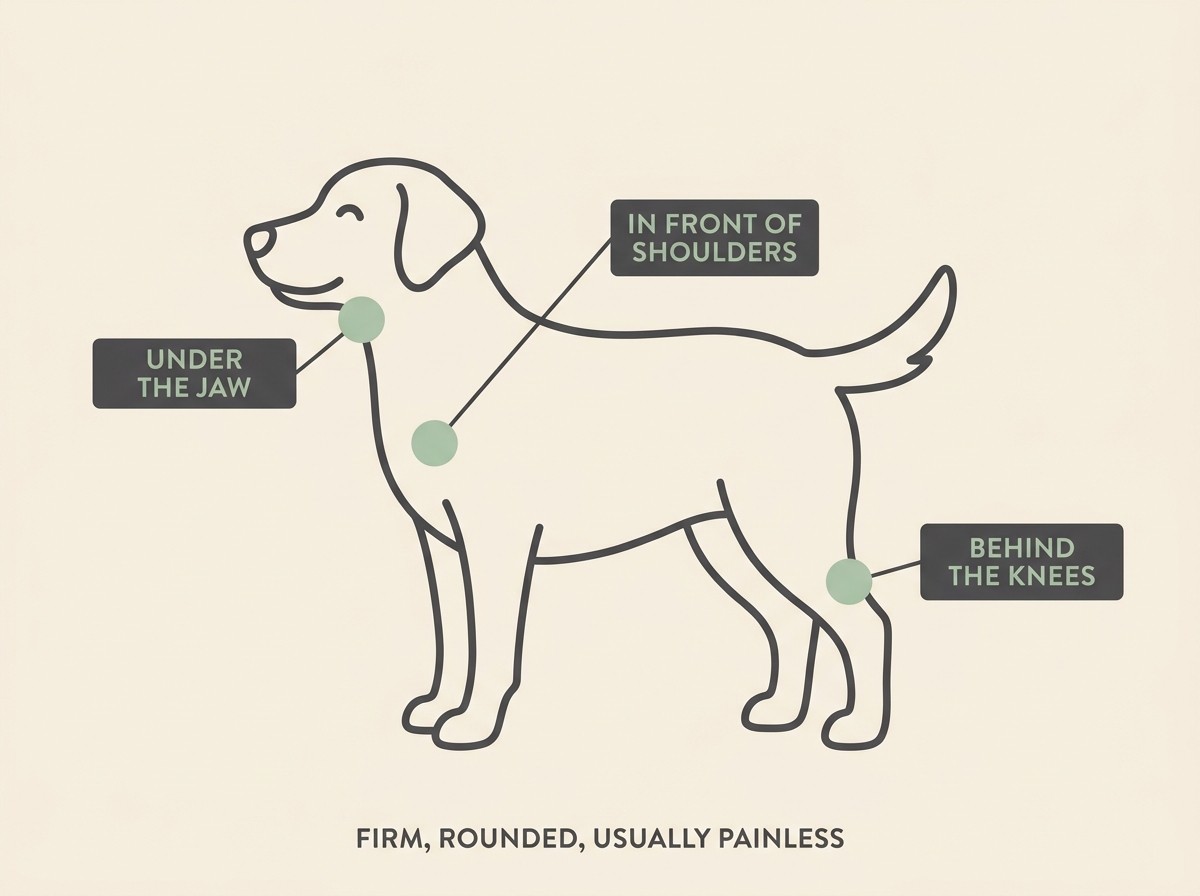
- Under the jaw and at the top of the neck
- In front of each shoulder
- Behind the knees, on the back of the hind legs
- In the groin and the armpits
If lymphoma's there, these usually feel firm, rounded and moveable, often on both sides, and your dog won't flinch when you touch them. Some dogs also have internal nodes or organs involved that you can't feel, which is part of why the vet runs more tests than just having a feel. A smaller number of dogs have other forms entirely, affecting mainly the gut, the skin, or the chest, and those look different. But if your dog has the classic swollen glands and is otherwise bright, multicentric lymphoma is the likely picture.
Getting a diagnosis, and what staging tells you
Lymphoma is usually quick and fairly easy to confirm, which is some small comfort. A fine-needle aspirate, where the vet puts a small needle into a swollen node and draws off some cells to look at under the microscope, is often enough to make the diagnosis, sometimes the same day (NC State Veterinary Hospital, 2024). It's the same gentle test we use on any lump, and you can read what's involved in our guide to [aspirates and biopsies].
Two further steps shape what happens next. The first is staging, which means working out how far the lymphoma has spread, using blood tests, sometimes a urine sample, chest X-rays and an ultrasound of the tummy (NC State Veterinary Hospital, 2024). Our guide to [what grade and stage actually mean] walks through this properly. The second is immunophenotyping, a test that tells whether the lymphoma is the B-cell type or the T-cell type. Around two-thirds to three-quarters of canine lymphomas are B-cell, and B-cell tends to respond better to treatment and gives longer survival than T-cell (NC State Veterinary Hospital, 2024). It's worth knowing your dog's type before you weigh up treatment, because it genuinely changes the expected outlook.
The hopeful part, told straight
This is the bit owners come for, so I'll give it to you with the catch included rather than buried.
With the standard chemotherapy protocol, the large majority of dogs with multicentric lymphoma go into remission, meaning the swollen nodes shrink away and the dog goes back to feeling normal, with reported remission rates of roughly 80 to 95% across studies (Merck Veterinary Manual, 2023). Most dogs tolerate it well and carry on with walks, play and family life throughout; there's a less than 25% risk of mild side effects that can be managed at home, and a less than 5% risk of more serious effects needing a vet (NC State Veterinary Hospital, 2024). For B-cell lymphoma treated with the full protocol, the average survival is around twelve months, with T-cell lymphoma usually shorter at around six to nine months (NC State Veterinary Hospital, 2024).
Now the catch, because you deserve the whole of it. These are averages, not promises, and "average" means half of dogs do better and half do less well (NC State Veterinary Hospital, 2024). The bigger thing to take in is that in dogs, lymphoma is almost always controlled rather than cured. Most dogs do eventually relapse, and the goal of treatment is good-quality extra time and feeling well, not a cure (NC State Veterinary Hospital, 2024). Our piece on [reading a prognosis] explains why a range, not a date, is the truthful answer to "how long has she got".
Both things are true at once, then. This is the cancer where treatment most reliably buys good time, and it's a cancer your dog will most likely live with rather than beat. Holding both is the right place to stand.
Your options, including doing less
There's a spread of choices here, and none of them is wrong. What's right depends on your dog, your circumstances and what you want the next stretch of life to look like.
Multi-agent chemotherapy is the gold-standard approach, a rotating combination of drugs given over several months, usually the protocol your vet will mean when they say "chemo for lymphoma" (NC State Veterinary Hospital, 2024). It gives the best remission rates and the longest average survival. Vet chemo is also nothing like the human version most people picture. It's dosed for quality of life, serious side effects are uncommon, and most dogs don't lose their coat, only the continuously-growing-coat breeds such as poodles may thin (MedVet, 2024). Our piece on [why pet chemo isn't human chemo] is worth reading before you decide, because a lot of owners say no based on a picture that simply isn't accurate.
Single-drug chemotherapy is a gentler, often cheaper option that asks less of you in visits, with somewhat shorter average remissions (NC State Veterinary Hospital, 2024).
Steroids alone (prednisolone) can make a dog feel much better and shrink the nodes for a while, typically a month or two, as a comfort-focused choice when full treatment isn't the path you're taking (NC State Veterinary Hospital, 2024). There's one practical wrinkle worth flagging. Older teaching held that starting steroids on their own before chemotherapy could make the lymphoma harder to treat later, so if you're seriously considering chemo it's been usual to hold off on steroids first (caninelymphoma.com, 2024). More recent work has questioned how much this really matters in practice, with one 2025 study of dogs with multicentric large B-cell lymphoma finding that the dose and duration of steroids given before chemotherapy had no measurable effect on outcome (Maga et al., 2025), so it's a conversation to have with your vet rather than a hard rule. The practical step is just to raise chemo as a possibility early, before steroids are started, so nothing's accidentally closed off.
Comfort-focused care, choosing to keep your dog happy and well for the time they have without pursuing the cancer itself, is a legitimate and loving choice. Our guide to [deciding whether to treat] takes it seriously, and our piece on [comfort-focused care] covers it in full.
If you do go ahead with chemotherapy, an RCVS-recognised specialist in oncology, sometimes via referral, will usually guide the protocol, and your own vet may share the care closer to home.
Life on treatment, and what comes next
Most owners are braced for misery and are surprised by how ordinary it feels. Visits are usually quick, your dog comes home the same day, and between appointments life carries on much as before, walks, dinner, the sofa (NC State Veterinary Hospital, 2024). There are regular blood checks to keep an eye on the white cells, because there's a short window after some doses where infection-fighting cells dip, and that's the time to know your emergency signs. Our piece on [cancer treatment emergencies] tells you exactly what to watch for and when to ring straight away. A full course commonly runs to several thousand pounds, which our guide to [treatment cost] sets out plainly.
When lymphoma relapses, and most do at some point, that isn't the end of the road on its own. There are often second-line, or "rescue", protocols that can win another stretch of remission, and your vet will talk you through whether that's right when the time comes (NC State Veterinary Hospital, 2024).
Through all of it, the question that matters most isn't the calendar, it's whether your dog is still enjoying their life. That's something you can actually track rather than agonise over, and our piece on [measuring quality of life] shows you how to see the trend instead of guessing day to day. Whatever you choose, and however long you get, focusing on the good days is never the wrong call.
References
- NC State Veterinary Hospital. Canine Multicentric Lymphoma.
- Merck Veterinary Manual. Lymphoma in Dogs.
- Zandvliet M. Canine lymphoma: a review. Veterinary Quarterly (2016), 36(2):76-104.
- Rocha MCP, Araújo D, Carvalho F, et al. Canine Multicentric Lymphoma: Diagnostic, Treatment, and Prognostic Insights. Animals (2025), 15(3):391.
- Maga K, et al. Dose and Duration of Upfront Steroid Administration Have no Prognostic Impact in Dogs With Multicentric Diffuse Large B-Cell Lymphoma. Veterinary and Comparative Oncology (2025).
- Zandvliet M, Rutteman GR, Teske E. Prednisolone inclusion in a first-line multidrug cytostatic protocol for the treatment of canine lymphoma does not affect therapy results. The Veterinary Journal (2013), 197(3):656-661.
- caninelymphoma.com. Canine Lymphoma Prednisone.
- MedVet. Frequently Asked Questions About Chemotherapy in Cats & Dogs.
- AKC Canine Health Foundation. Genetic and Environmental Risk for Lymphoma in Boxer Dogs.
Sister tool · Sightline
Track quality of life over time
Sightline, a separate ConciergeVet tool, runs a short adaptive weekly assessment with a quality-of-life focus mode built around exactly these frameworks, tracks a single composite score over time so you can see the trend rather than judge a single bad day, and produces a Sightline Report PDF you can bring to your vet.
A written log, or our printable quality-of-life sheet, does much the same job.
See how Sightline tracks quality of lifeFound a lump? Track it, and know when to act
A lump cannot be told apart by look or feel; only your vet sampling it can. The Lump & Bump Tracker records its size and how it changes, flags when it has crossed a line worth a vet visit, and builds a clean history to take in.
Open the Lump & Bump TrackerYou're not doing this alone
Compare treatment journeys and talk to owners managing cancer. Free to join.
Join PetsLikeMine