

Living With a Leaky Dog: Bedding, Skin Care and Night-Time Tips
Alastair Greenway
BVM&S MRCVS
A leaking dog leaves a tell-tale sign: a damp patch on her bed in the morning, or a cool wet ring on the sofa where she's been dozing. The leaking itself is one problem, and the day-to-day of it is another: the constant washing, the worry about her skin, the slightly mortifying moment when a visitor goes to sit on the throw. That practical side is what this page is for, and it's genuinely manageable once you've got a system running.
One anchor first. If your dog hasn't yet been seen about the leaking, do that before anything else, because the commonest cause in a spayed bitch is a treatable weakness of the bladder-neck muscle (urethral sphincter mechanism incompetence, the whole story is in my spayed dog is leaking urine), and a single daily medicine controls it in the large majority of dogs (the options are in treating incontinence). This page is the daily layer that sits on top of that treatment, keeping her comfortable and your home liveable while the medication does its job, or for the smaller number of dogs whose leaking is only partly controlled.
It isn't her fault, and it isn't something to put up with
It's worth saying plainly, because owners feel both of these things. Your dog isn't being lazy, spiteful or dirty, and she usually has no idea it's happened. True incontinence is passive leaking. The urine escapes while she's relaxed or asleep, so telling her off only confuses a dog who can't connect cross words to anything she chose to do. There's nothing to house-train, because she isn't choosing where to go: dogs with this sphincter weakness leak small puddles while resting and pass urine completely normally when they're up and about (Today's Veterinary Practice; MSD Veterinary Manual).
And it isn't something to grit your teeth and endure. The leaking is treatable, and the management below is about comfort and dignity, not damage limitation. If it has got worse, or it's never been properly controlled, that's a reason to go back to your vet, because the medicine can often be adjusted or a second option added (treating incontinence). One reason that matters: a dog who is often damp around the back end is more prone to soreness and infection, and a bladder infection can itself worsen the leaking, because cystitis exacerbates the dribbling in a dog whose sphincter is already weak (Today's Veterinary Practice). So good hygiene isn't just cosmetic, and a sudden change in the leaking is always worth a urine check rather than an assumption (is it incontinence or something else?).
Bedding that makes your life easier
The single biggest quality-of-life upgrade is the right bed, set up in layers so you can strip and wash the wet bit in seconds. From the bottom up:
- A waterproof base layer. A washable waterproof mattress protector or a wipe-clean dog-bed liner stops urine reaching the foam or the floor. This is the layer that saves the actual bed.
- A moisture-wicking top layer. Veterinary bedding (the fleece-backed "vetbed" type) lets moisture sink through and away from the surface but not back up, so your dog stays lying on a dry-feeling top even when she's leaked, which protects her skin (this is exactly why UK vets recommend it; Vets Now).
- Washable or disposable pads on top of, or instead of, the fleece, depending on how heavy the leaking is.
Keep two or three sets in rotation, check the bed for damp whenever she gets up, and wash it often on a hot wash. A non-biological (enzyme-free) detergent is the usual choice for skin that's easily irritated, and a pet-safe odour eliminator handles the lingering ammonia smell better than perfume does.
Looking after her skin: preventing urine scald
This is the part that genuinely matters medically. When urine sits against the skin, the ammonia in it weakens the skin's natural barrier and eventually burns the surface, a problem vets call urine scald. It shows up as red, irritated skin on the tummy, the groin and the back of the legs, sometimes with a rash or bumps and an unpleasant smell, and a dog who licks or chews the area more than usual (Buzby, ToeGrips); vets specifically check for inflamed, urine-scalded skin around the vulva when they examine an incontinent dog (MSD Veterinary Manual; Today's Veterinary Practice). Caught early it's easy to manage; left alone it can break the skin and let infection in.
The whole game is to keep urine off the skin and the skin clean and dry, which means:
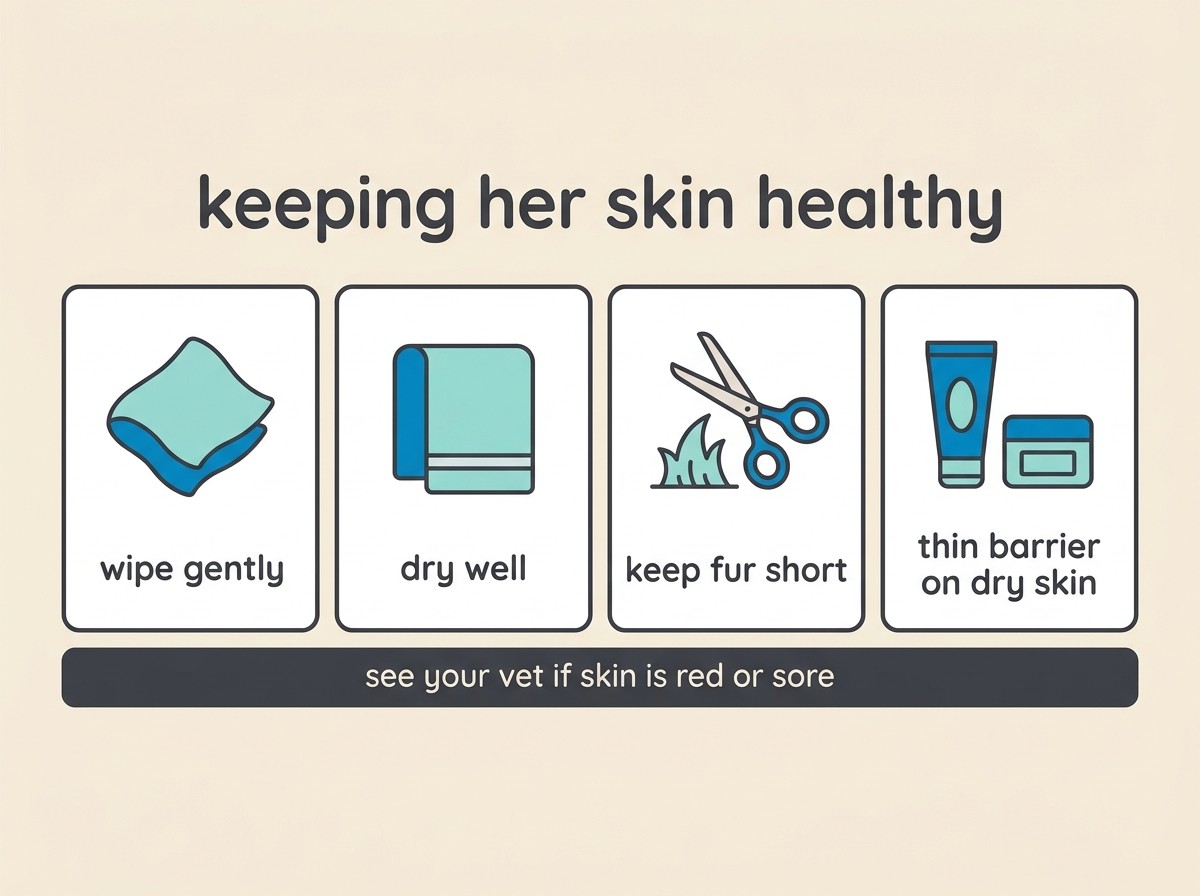
- Clean the area gently and often. Wipe the back of the legs, the tummy and around the vulva with a warm, damp cloth, pet-safe or fragrance-free baby wipes, or a mild dog shampoo, then dry thoroughly with a soft towel. Doing this after she's slept, and after any obvious leak, keeps contact time short, and washing the back of the legs regularly is exactly the step UK vets recommend to head off scald (Vets Now; Buzby, ToeGrips).
- Keep the fur short there. If she has long or feathered fur, a tidy "hygiene clip" around the back end and inner thighs means urine has less to soak into and the skin dries far faster (Buzby, ToeGrips). Your groomer or vet nurse can do this.
- Use a barrier on clean, dry skin. A thin layer of a petrolatum- or lanolin-based ointment (the plain petroleum-jelly type) over the at-risk skin stops urine touching it directly, and there are veterinary barrier creams and films made for exactly this job (Buzby, ToeGrips). Apply only to skin that's already clean and dry, never over a wet or sore patch. One warning: don't reach for a human nappy-rash cream, because many contain zinc oxide, which is toxic to dogs if they lick it off (Buzby, ToeGrips).
If the skin is already red, raw, weepy or smelly, don't try to manage it with creams alone. Get her seen, because scalded skin sometimes needs a medicated wash, a prescribed topical or, if it's infected, a short course of treatment (Buzby, ToeGrips). The sooner it's treated, the quicker it settles.
Nappies, wraps and when they help
Dog nappies and belly bands have a real place, especially overnight, on long car journeys, or when she's relaxing on furniture you can't easily wash. They contain the leak and keep your home and her bed dry.
The one rule that makes them safe rather than harmful: change them often, and never leave a wet one against the skin. A nappy that stays damp for hours is a fast track to the very urine scald you're trying to prevent, so check it at least hourly and swap a wet one straight away (BetterPet). Take it off when you're home to supervise, and clean and check the skin at every change. For most dogs a good bed plus a skin routine does the heavy lifting, and nappies are an extra tool for the trickier times rather than the main plan.
Why nights are often the worst, and how to plan for them
Leaking is classically worst when a dog is fast asleep and fully relaxed, which is exactly when you can't pop her outside, so nights take a little planning. As she settles, the pressure changes around the bladder neck and the dribble shows up as a wet patch underneath her by morning (Vets Now; Today's Veterinary Practice). A few things genuinely help:
- A proper toilet trip last thing, right before bed, so she starts the night with as empty a bladder as possible. A short walk or a few unhurried minutes in the garden does more than a quick let-out at the back door.
- Time the medication with your vet's guidance so its effect covers the overnight stretch. If she's dry by day but wet by morning, mention it, because the timing or dose can sometimes be tuned (treating incontinence).
- Set the bed up to cope, with the waterproof-plus-wicking layers above and a washable pad where her back end rests, so a leak means a quick swap rather than a 6am deep-clean.
- Don't restrict her water to keep her dry. This is the tempting mistake. Cutting water back doesn't fix sphincter-related leaking, and it risks dehydration and more concentrated, more irritating urine; UK veterinary advice is clear that reducing intake isn't the answer, because incontinence isn't usually caused by drinking too much (Vets Now). If anything, a dog who has suddenly started drinking far more needs investigating rather than rationing, and that points away from simple incontinence (bladder or kidneys?).
Keep a quiet eye on the pattern
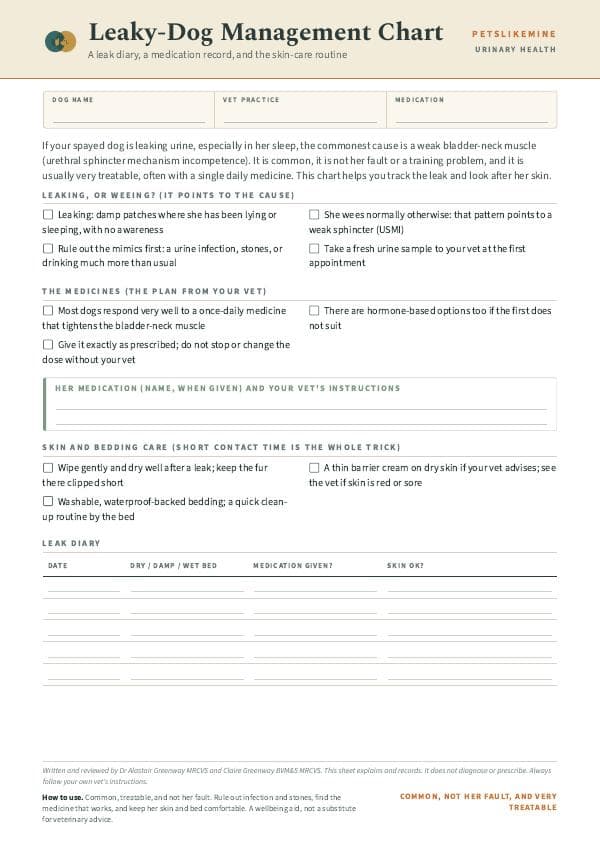
Because the leaking can drift, keep a light-touch record: roughly how often you find damp patches, whether it's better or worse than last month, and the state of her skin. Jotting it in our urinary tracker does two jobs. It shows you and your vet whether the medicine is holding the line or needs adjusting (treating incontinence), and it flags a sudden change, a jump in leaking, a new smell, straining or blood, which means a urine check rather than more washing, because that can signal a real infection sitting on top of the sphincter weakness (is it incontinence or something else?). Our dog incontinence management and medication chart download gives you a ready-made grid for the leak diary and the medicine record.
That's really the whole of it: a bed in sensible layers, a two-minute clean-and-dry routine, a barrier where it's needed, and a toilet trip last thing at night. Get that running and a leaky dog is a very liveable companion, comfortable, dignified, and still very much herself. And whenever the leaking changes rather than just continues, that's your cue to check in with your vet.
Cross-links for the integrator: D1 (my spayed dog is leaking urine / USMI explained), D2 (treating incontinence), D3 (is it incontinence or something else?), O3 (bladder or kidneys?), the FIC & Water tracker tool (the general urinary log), and the dog incontinence management and medication chart download.
References
- *Diagnosing and Managing Urinary Incontinence in Canine Patients.* Today's Veterinary Practice. (USMI dogs "void small urine puddles while resting but are continent when active and engaged"; "cystitis can exacerbate leakage or trigger urge incontinence in dogs with mild USMI"; screening for UTI; examining for inflamed or urine-scalded perivulvar skin.)
- *Disorders of Micturition in Dogs and Cats.* MSD Veterinary Manual. (USMI dogs "unconsciously leak urine when sleeping or recumbent but are able to void normally otherwise"; "perivulvar or peripreputial dermatitis can result from urine scalding".)
- Buzby J (DVM). *Urine Scald in Dogs: Prevention and Treatment.* Dr. Buzby's ToeGrips for Dogs. (The ammonia mechanism and weakening of the skin barrier; signs of scald and skin infection; hygiene clipping of long fur; gentle cleansing with a warm damp cloth or baby wipes and thorough drying; petrolatum/lanolin barrier ointments and barrier films; the warning that zinc oxide is toxic to dogs if ingested; see the vet promptly if scald is suspected.)
- Vets Now. *Urinary incontinence in dogs: why is my dog peeing inside?* (UK advice: leaking shows as a wet patch on the bedding at night; vetbed/moisture-wicking bedding that draws moisture away from the skin; washing the back of the legs regularly to reduce urine scald; not reducing water intake because incontinence isn't usually caused by excessive drinking.)
- BetterPet. *A guide to belly bands for dogs.* (Practical hygiene point: a soiled band worn too long risks urine scald and infection, so check at least hourly and replace a wet band promptly.)
Free downloads
Companion worksheets to put what you've read into practice. Free PDFs, print at home.
Keep track of how your pet is doing
The owners who cope best are the ones who notice changes early. A simple health log shows you what is working, and what is not, before the next vet visit.
Start tracking, freeYou're not doing this alone
Compare treatment journeys and talk to owners managing urinary health. Free to join.
Join PetsLikeMine