

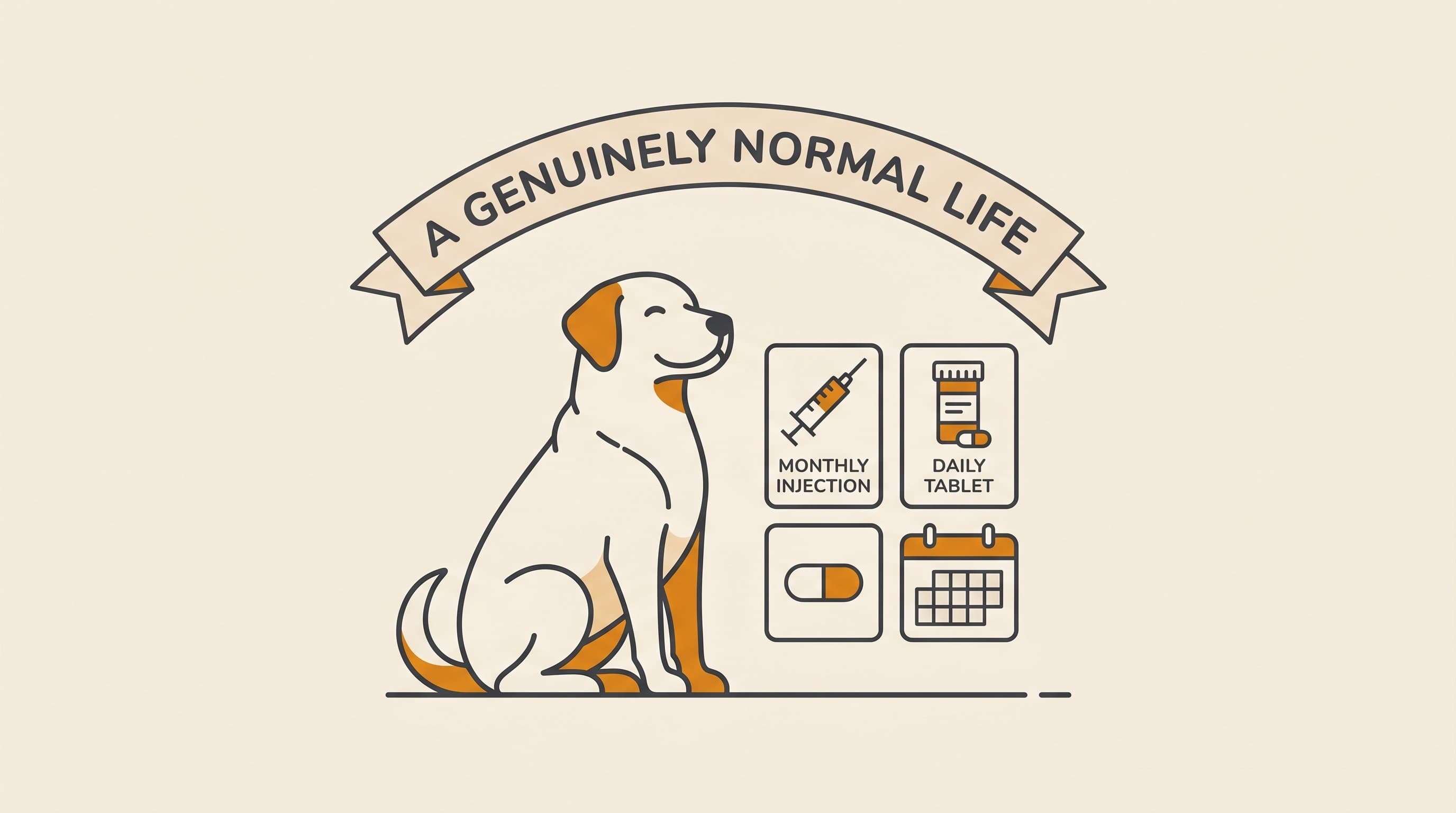
Living with Addison's: injections, tablets and a genuinely normal life
Alastair Greenway
BVM&S MRCVS
If your dog has just been diagnosed with Addison's, here's the part that often gets lost in the worry: this is one of the most rewarding chronic conditions there is to manage. Once your dog is stabilised on the right replacement hormones, the prognosis is excellent and life expectancy is essentially normal. Most treated Addison's dogs go on to live full lives and eventually die of something else entirely, usually the ordinary problems of old age (Merck Veterinary Manual; Lathan & Thompson 2018). One large group reported a median survival of about 4.7 years from diagnosis, and a 2025 study found a median of 5.7 years, with a median age at death of nearly 12 (Today's Veterinary Practice 2022; Sherrod et al. 2025). Because those numbers start counting from a dog that's often already middle-aged, they describe a normal lifespan, not a shortened one.
So this article isn't about the crisis. That's covered in our piece on diagnosing and surviving an Addisonian crisis. This is about the calm, daily reality of living with a treated dog: the two ways the missing hormones get replaced, the one safety rule you must not improvise, and the gentle rhythm of rechecks that the whole thing settles into.
What you're actually replacing
Typical (primary) Addison's means the adrenal glands have stopped making enough of two hormone types, so treatment simply puts both back (Lathan & Thompson 2018; AAHA 2023):
- A mineralocorticoid, which keeps your dog's salt balance right, the sodium and potassium that keep the heart and kidneys steady.
- A glucocorticoid, which is cortisol, the hormone that helps the body cope with stress and illness.
There are two routes for the mineralocorticoid: a long-acting injection called DOCP, or a daily tablet called fludrocortisone (Lathan & Thompson 2018; Today's Veterinary Practice 2022). Which one your vet reaches for shapes the day-to-day routine, so it's worth understanding both.
Route one: the monthly injection (DOCP) plus a small daily steroid
DOCP (desoxycorticosterone pivalate, sold as Zycortal or Percorten-V) is now the more commonly used option and is generally regarded as the more complete mineralocorticoid replacement. In a 2025 outcomes study, 86% of dogs were managed on DOCP for the long term, against 16% on fludrocortisone (Sherrod et al. 2025; Today's Veterinary Practice 2022). It's given by injection under the skin, roughly once a month to start with, and many owners are taught to give it at home once they're confident (Zycortal SPC; VCA Animal Hospitals). One firm rule: this injection goes under the skin, never into a vein, because an intravenous dose can cause collapse (Zycortal SPC). Your vet or nurse will show you the technique properly before you ever do it alone.
Here's the genuinely reassuring part. The dose and the gap between injections get personalised over the first few months. The starting dose is often tuned downwards to the lowest amount that holds your dog steady, which works just as well and costs less (Sieber-Ruckstuhl et al. 2019). And the injection often lasts longer than a calendar month, so many dogs comfortably stretch to six weeks or beyond once they're stable. In one study the average individualised interval worked out at about every eight weeks, cutting the yearly drug cost by more than half (Jaffey et al. 2017). Your vet works out your own dog's interval from simple blood tests, so don't be surprised if "monthly" gradually becomes "every six or seven weeks".
The one thing DOCP does not do is replace cortisol. It has almost no glucocorticoid activity, so a dog on DOCP also needs a small daily glucocorticoid tablet, usually prednisolone (Zycortal SPC; AAHA 2023). This is non-negotiable for typical Addison's: skip it and your dog is left short of cortisol. Helpfully, the maintenance dose is tiny, kept at the lowest amount that keeps your dog comfortable, and many dogs do well on very little indeed (Today's Veterinary Practice 2022). Keeping it low is deliberate, because it sidesteps the familiar steroid side effects of extra thirst, hunger and panting.
Route two: the all-in-one tablet (fludrocortisone)
Fludrocortisone (fludrocortisone acetate, often sold as Florinef) is the oral alternative, given by mouth twice a day. Its appeal is that it carries both mineralocorticoid and glucocorticoid activity in one tablet, so some dogs need no separate steroid, or only a little (Today's Veterinary Practice 2022; Lathan & Thompson 2018). No injections, ever, which suits owners who simply can't face giving one.
The trade-offs are real, and this is where a side-by-side comparison helps. The fludrocortisone dose often has to creep upwards over the first 6 to 12 months. Its built-in steroid activity makes side effects like excess thirst, weeing and appetite more likely, and harder to dose around, because you can't separate the salt-balancing job from the cortisol job. And in larger dogs it can work out more expensive per month (Today's Veterinary Practice 2021; Lathan & Thompson 2018). DOCP's advantage, by contrast, is that the salt balance and the steroid are two separate dials your vet can turn independently.
Neither route is universally "the best". DOCP is a monthly injection plus a separate small steroid, very tunable. Fludrocortisone is a daily tablet, all in one, but fiddlier and more prone to side effects. The right choice depends on your dog, your budget and whether you're happy to inject. It's a conversation worth having properly with your vet rather than a foregone conclusion. On cost, weight matters a lot and prices vary, so ask your own practice for a realistic figure for your dog rather than trusting a number off the internet.
The one rule to never improvise: stress-dosing
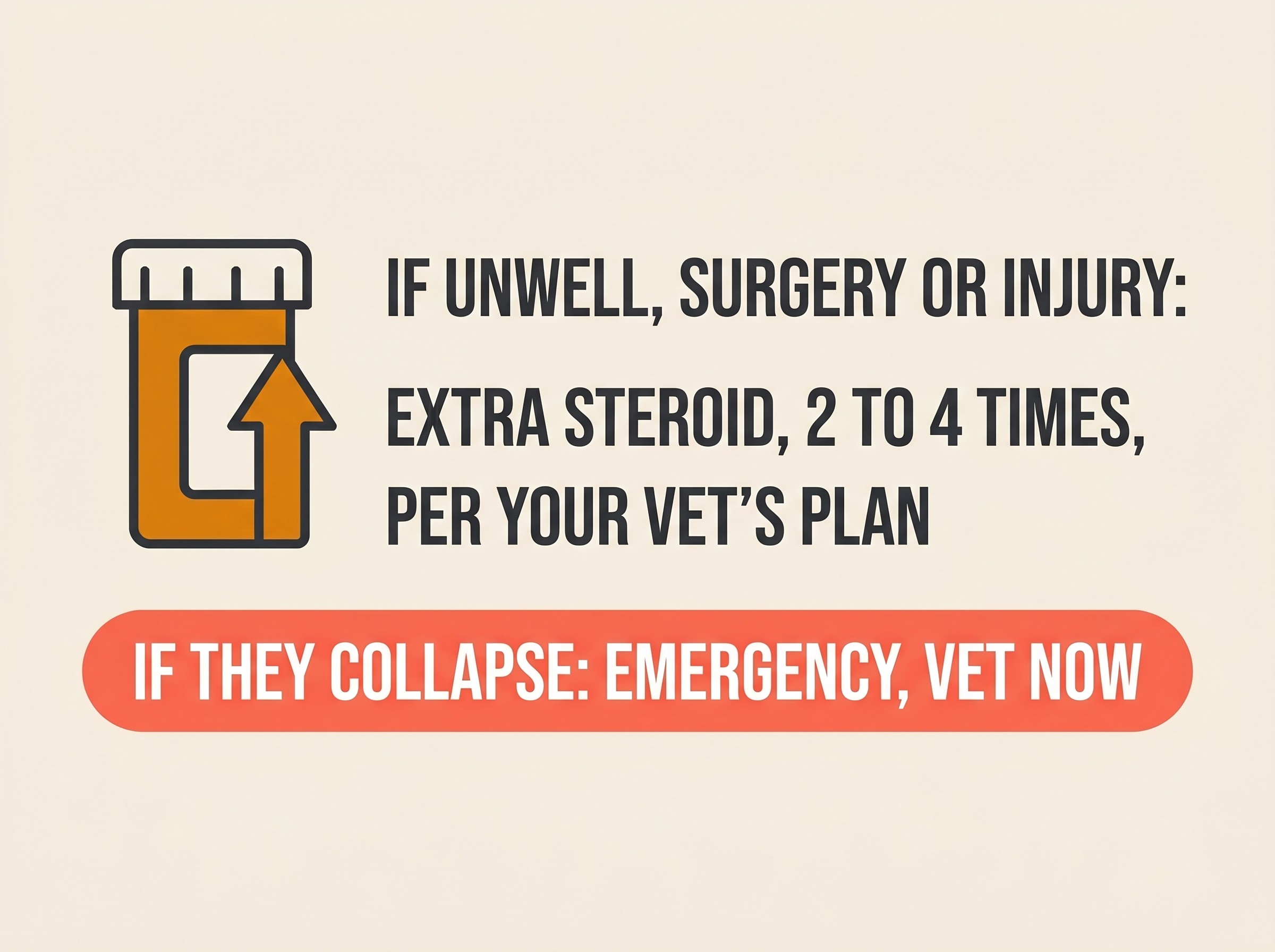
This is the single safety message of living with Addison's, so here it is plainly. At times of real physical stress, surgery, another illness, an injury, or a significant tummy upset, your dog's daily glucocorticoid needs to be temporarily increased, commonly to roughly two to four times the usual maintenance dose, for as long as that stress lasts and exactly as your vet has planned (AAHA 2023; Lathan & Thompson 2018; Zycortal SPC). A healthy dog makes extra cortisol automatically when it's poorly. Yours can't, so you supply it. It's the steroid tablet you increase, not the DOCP injection.
Keep a small supply of the tablets at home and the plan written down, so you're never guessing at an awkward moment. Ordinary psychological stress, like a stay in kennels, doesn't usually need a top-up on its own, but practice varies and many vets do advise covering boarding or travel, so follow the situations your own vet flags rather than a blanket rule (Lathan & Thompson 2018; AAHA 2023).
And keep an eye out for breakthrough signs between doses: a return of the old vague symptoms, low energy, going off food, vomiting or diarrhoea, or weakness. These can mean your dog is under-dosed or starting to slide, so ring your vet promptly. An actual collapse is an emergency, vet now, not a wait-and-see (Merck Veterinary Manual; AAHA 2023). That register matters, but it's the exception in a condition that is otherwise calm to live with.
The rhythm of rechecks
Monitoring is busiest at the start and then quietens right down. With DOCP, your vet checks the salts (sodium and potassium) around day 10 to 14 to set the dose, and again around day 25 to set the interval (Zycortal SPC; Today's Veterinary Practice 2022). After that, once your dog is settled, electrolyte and kidney checks drop back to roughly every few months and then to about twice a year (Merck Veterinary Manual; Today's Veterinary Practice 2022). The vet uses those salt levels to fine-tune the injection, nudging the dose or stretching the gap as your dog tells them.
Two things owners are often relieved to hear. The steroid is adjusted by how your dog is actually doing, by clinical signs, not by repeating tests. And the expensive ACTH stimulation test used to diagnose Addison's is not repeated for routine monitoring once the diagnosis is confirmed (Today's Veterinary Practice 2022; AAHA 2023). So the ongoing checks are the straightforward, affordable kind.
This is exactly the kind of pattern our Thirst & Wee tracker is built for: logging your dog's water intake and energy between visits gives you and your vet an early read on whether a dose needs tweaking. It's a small habit that turns "I think he's a bit off" into something you can actually show.
For a one-page reminder of the stress-dose rule and the breakthrough signs to keep on the fridge or in the car, our Addison's Crisis card download lays it out clearly. Print it, write your dog's plan on it, and then get on with the rest of it, because the rest of it, for the great majority of these dogs, is a genuinely normal, happy life.
References
- Lathan P, Thompson AL. "Management of hypoadrenocorticism (Addison's disease) in dogs." Veterinary Medicine: Research and Reports. 2018;9:1–10. DOI: 10.2147/VMRR.S125617
- Today's Veterinary Practice. "Diagnosis and Management of Hypoadrenocorticism in Dogs" (2022).
- 2023 AAHA Selected Endocrinopathies of Dogs and Cats Guidelines — Canine Hypoadrenocorticism: Therapy.
- Sherrod S, et al. "Clinical characteristics, treatment, and outcomes of hypoadrenocorticism in dogs." Journal of Small Animal Practice. 2025. DOI: 10.1111/jsap.13870
- Zycortal (desoxycorticosterone pivalate injectable suspension) Prescribing Information / SPC, Dechra. DailyMed.
- Sieber-Ruckstuhl NS, et al. "Evaluation of a low-dose desoxycorticosterone pivalate treatment protocol for long-term management of dogs with primary hypoadrenocorticism." Journal of Veterinary Internal Medicine. 2019;33(3):1266–1271. DOI: 10.1111/jvim.15475
- Jaffey JA, et al. "Desoxycorticosterone Pivalate Duration of Action and Individualized Dosing Intervals in Dogs with Primary Hypoadrenocorticism." Journal of Veterinary Internal Medicine. 2017;31(6):1740–1746. DOI: 10.1111/jvim.14828
- Today's Veterinary Practice. "Desoxycorticosterone Pivalate for Dogs With Addison's Disease" (2021).
- Merck Veterinary Manual. "Addison Disease (Hypoadrenocorticism) in Animals."
- VCA Animal Hospitals. "Desoxycorticosterone Pivalate (DOCP)" client handout.
Keep track of how your pet is doing
The owners who cope best are the ones who notice changes early. A simple health log shows you what is working, and what is not, before the next vet visit.
Start tracking, freeYou're not doing this alone
Compare treatment journeys and talk to owners managing hormone health. Free to join.
Join PetsLikeMine