

Living with a treated thyroid cat: tablets, gels, rechecks and the long game
Alastair Greenway
BVM&S MRCVS
Once your cat's hyperthyroidism is diagnosed and you've settled on a treatment, the day-to-day becomes quite manageable. If you've chosen medication rather than a one-off cure like radioiodine or surgery (weighed up in the four-way treatment compare), this article is about doing that medication well over the years. That means giving it consistently, understanding what the recheck bloods are actually looking at, and keeping half an eye on the long game. Hyperthyroidism is common, very treatable, and most cats do well for years on medication with sensible monitoring (Vaske 2014).
Tablets that control, not cure
Methimazole (sometimes called thiamazole) and carbimazole don't cure an over-active thyroid, they control it. The thyroid keeps overproducing hormone underneath, so the medicine has to be given for life, with regular monitoring (Vaske 2014; AAFP 2016). Carbimazole is a precursor that the body converts into methimazole, so the two are really the same active drug reached by slightly different routes (Frénais 2008).
The standard tablet is started low, usually around 1.25 to 2.5 mg per cat, and your vet adjusts it up or down from there based on the blood tests rather than the bathroom scales (AAFP 2016). One point is worth getting right: it's normally given twice a day. Splitting the dose controls the thyroid better and is gentler than the same total in a single hit (AAFP 2016; Vaske 2014). The answer to "can't I just give it once a day?" is that some stable, well-controlled cats can move to a single daily dose for the sake of convenience, but twice daily is the better-controlling and kinder default (AAFP 2016). There's also a controlled-release tablet designed specifically for once-daily dosing, which trickles the drug out slowly through the day instead of in a sharp peak (Frénais 2008). Whichever form you use, the dose is set and fine-tuned by your vet, not by you.
The gel, for cats who fight the tablet
If pilling your cat has become a twice-daily wrestling match, there's a genuine alternative. Methimazole can be made up as a gel that you rub onto the inside of the ear flap, alternating ears each time (Sartor 2004). It's a small measured dab rather than a tablet, and it's noticeably easier on the stomach: cats on the gel get fewer tummy-related side effects than cats on tablets (Sartor 2004).
Two caveats come with it. First, the gel is a little slower to take hold. At two weeks the tablet has usually brought more cats into the normal range, but by about four weeks the gel has caught up and the difference disappears (Sartor 2004). Second, the gel is no more "set and forget" than tablets are. In a long-term follow-up of 60 cats treated this way for nearly two years, almost all of them needed their dose adjusted at some point to keep the thyroid in range, although serious side effects were rare (a little ear-flap redness in a couple of cats, mild passing tummy upset in a few) (Boretti 2014). One practical tip: wear a glove or finger cot to apply it. It's a real medicine and you don't want it absorbing into your own skin.
Side effects: what to watch for, and when
Most side effects appear in the first four to six weeks and become uncommon after a couple of months (AAFP 2016). The common ones are mild and usually settle: a bit of tummy upset or reduced appetite, some lethargy, or an itchy face (AAFP 2016).
The serious reactions are genuinely rare, but they're worth knowing because they're the reason a blood count is part of the monitoring. Methimazole can occasionally upset the liver or knock back the blood cells (AAFP 2016). So ring your vet, the same day rather than in a panic, if your cat goes persistently off food or starts vomiting, looks yellow around the gums or eyes, develops unexplained bruising, bleeding or very pale gums, or begins scratching at its face hard enough to break the skin. That last one, severe self-trauma to the face, is a recognised methimazole reaction that usually means the drug has to be stopped (AAFP 2016; Vaske 2014). None of these is common, and none is the sort of midnight emergency you'll meet in the adrenal conditions, but each is a clear "stop and phone the vet" sign.
The rechecks: what the bloods are really checking
The recheck visits are where treatment is actually steered, so they matter as much as the tablets. Early on they come more often: the first thyroid level is usually checked a couple of weeks after starting, with a few more checks while the dose is found. Once your cat has settled into a stable dose, the rhythm eases to roughly every six months (AAFP 2016; Vaske 2014).
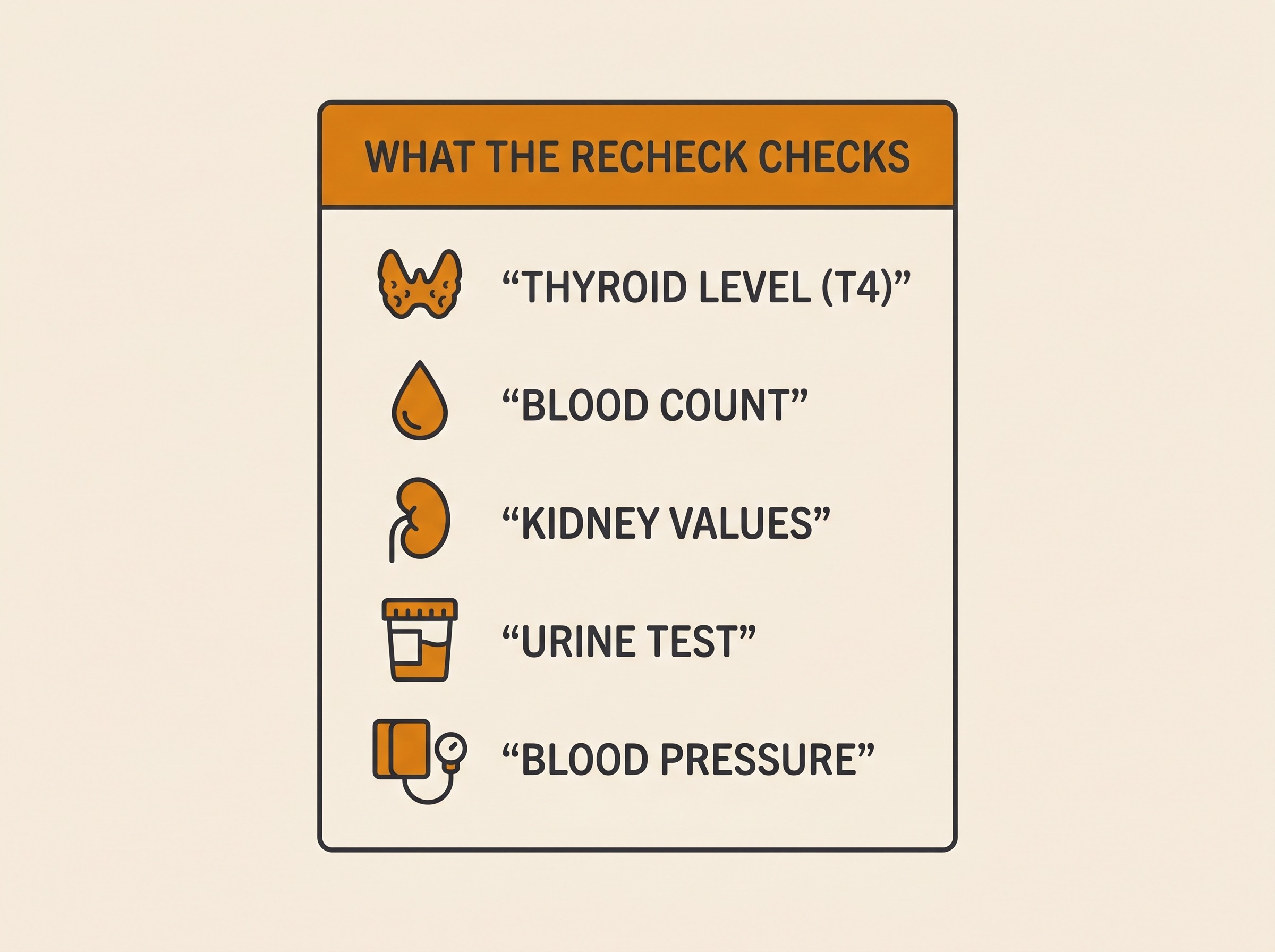
A full recheck is much more than the thyroid number. Your vet will typically run the total T4 (the thyroid level itself), a blood count (the safety net for those rare blood effects), a chemistry panel that includes the kidney values, a urine test, and a blood pressure reading (AAFP 2016).
The aim is control, not zero. The target is to bring the thyroid level down into the lower half of the normal range, not to crush it as low as it will go (Vaske 2014; AAFP 2016). There's one important exception, and it's all about the kidneys: if the kidney values are struggling, your vet will deliberately aim a little higher, in the upper half of the range, to avoid tipping the cat under-active and leaning harder on the kidneys (AAFP 2016). Sometimes a second thyroid hormone called TSH is measured alongside, as a way of checking the cat hasn't been pushed too far the other way into an under-active state (AAFP 2016).
The long game: kidneys, over-treatment and blood pressure
This is not something to dread, but the reason behind all that monitoring.
An over-active thyroid artificially boosts the blood flow through the kidneys, which can hide kidney disease that's quietly present underneath. When you treat the thyroid, that flattering effect comes off, and kidney trouble that was masked can come to light (AAFP 2016). This is exactly why the kidney values are checked before treatment starts and again at every recheck. It's covered in full in the kidney catch article, but the practical consequence lives here in the monitoring. It's also a good argument for starting with medication, which is reversible: you can see what lowering the thyroid does to the kidneys, and ease back if you need to, before committing to a one-way cure (AAFP 2016).
Over-treating carries its own cost, which is why "control, not zero" matters. Pushing the thyroid too low, a state called iatrogenic hypothyroidism, is linked to the kidneys becoming azotaemic and to shorter survival, so the dose is deliberately eased back if the level drops too far (Williams 2010). Good steady control beats maximum suppression every time.
Blood pressure earns its place on the recheck list too. It can stay high, or even creep up, after the thyroid is controlled, so it's measured even once your cat seems perfectly well. Around one in five cats who started with normal blood pressure go on to develop hypertension after treatment (ISFM 2017). It's easily monitored and, if it does rise, easily treated.
What the years actually look like
Here's the realistic long view. With good management, many treated cats live well for years, and the single biggest factor in how long is usually the state of the kidneys rather than the thyroid itself once it's controlled (Vaske 2014). You may come across survival figures, a median of around two years on tablets alone in some older referral studies, but take those with real caution. They come from elderly cats who often had other age-related illness, they're population averages rather than a forecast for your particular cat, and plenty of well-controlled cats live well beyond them (Vaske 2014). Where the kidneys can take it, the definitive cures tend to give the longest survival of all: radioiodine alone cures roughly 95% of cats with a single treatment (Cornell), and it's weighed up properly in the treatment-compare and radioiodine articles.
For now, the recipe is unglamorous and it works. Give the medicine consistently, keep the recheck appointments even when your cat seems fine, and jot down how your cat is doing between visits: appetite, weight, drinking and energy. Those notes are often what catches a drift early, and the tracker makes them easy to keep. A treated thyroid cat, monitored sensibly, is usually just a cat getting on with a good life.
References
- Vaske HH, Schermerhorn T, Armbrust L, Grauer GF. Diagnosis and management of feline hyperthyroidism: current perspectives. Vet Med (Auckl) 2014;5:85-96.
- Carney HC, Ward CR, Bailey SJ, Bruyette D, Dennis S, Ferguson D, Hinc A, Rucinsky AR. 2016 AAFP Guidelines for the Management of Feline Hyperthyroidism. J Feline Med Surg 2016;18(5):400-416.
- Frénais R, Burgaud S, Horspool LJI. Pharmacokinetics of controlled-release carbimazole tablets support once daily dosing in cats. J Vet Pharmacol Ther 2008;31(3):213-219.
- Sartor LL, Trepanier LA, Kroll MM, Rodan I, Challoner L. Efficacy and safety of transdermal methimazole in the treatment of cats with hyperthyroidism. J Vet Intern Med 2004;18(5):651-655.
- Boretti FS, Sieber-Ruckstuhl NS, Schäfer S, Gerber B, Baumgartner C, Riond B, Hofmann-Lehmann R, Reusch CE. Transdermal application of methimazole in hyperthyroid cats: a long-term follow-up study. J Feline Med Surg 2014;16(6):453-459.
- Williams TL, Elliott J, Syme HM. Association of iatrogenic hypothyroidism with azotemia and reduced survival time in cats treated for hyperthyroidism. J Vet Intern Med 2010;24(5):1086-1092.
- Taylor SS, Sparkes AH, Briscoe K, Carter J, Cervantes Sala S, Jepson RE, Reynolds BS, Scansen BA. ISFM Consensus Guidelines on the Diagnosis and Management of Hypertension in Cats. J Feline Med Surg 2017;19(3):288-303.
- Cornell University College of Veterinary Medicine — Feline Hyperthyroidism (a single I-131 treatment cures ~95% of cats).
Keep track of how your pet is doing
The owners who cope best are the ones who notice changes early. A simple health log shows you what is working, and what is not, before the next vet visit.
Start tracking, freeYou're not doing this alone
Compare treatment journeys and talk to owners managing hormone health. Free to join.
Join PetsLikeMine