

From a Blood Test to a Biopsy: The Liver Workup, Step by Step
Alastair Greenway
BVM&S MRCVS
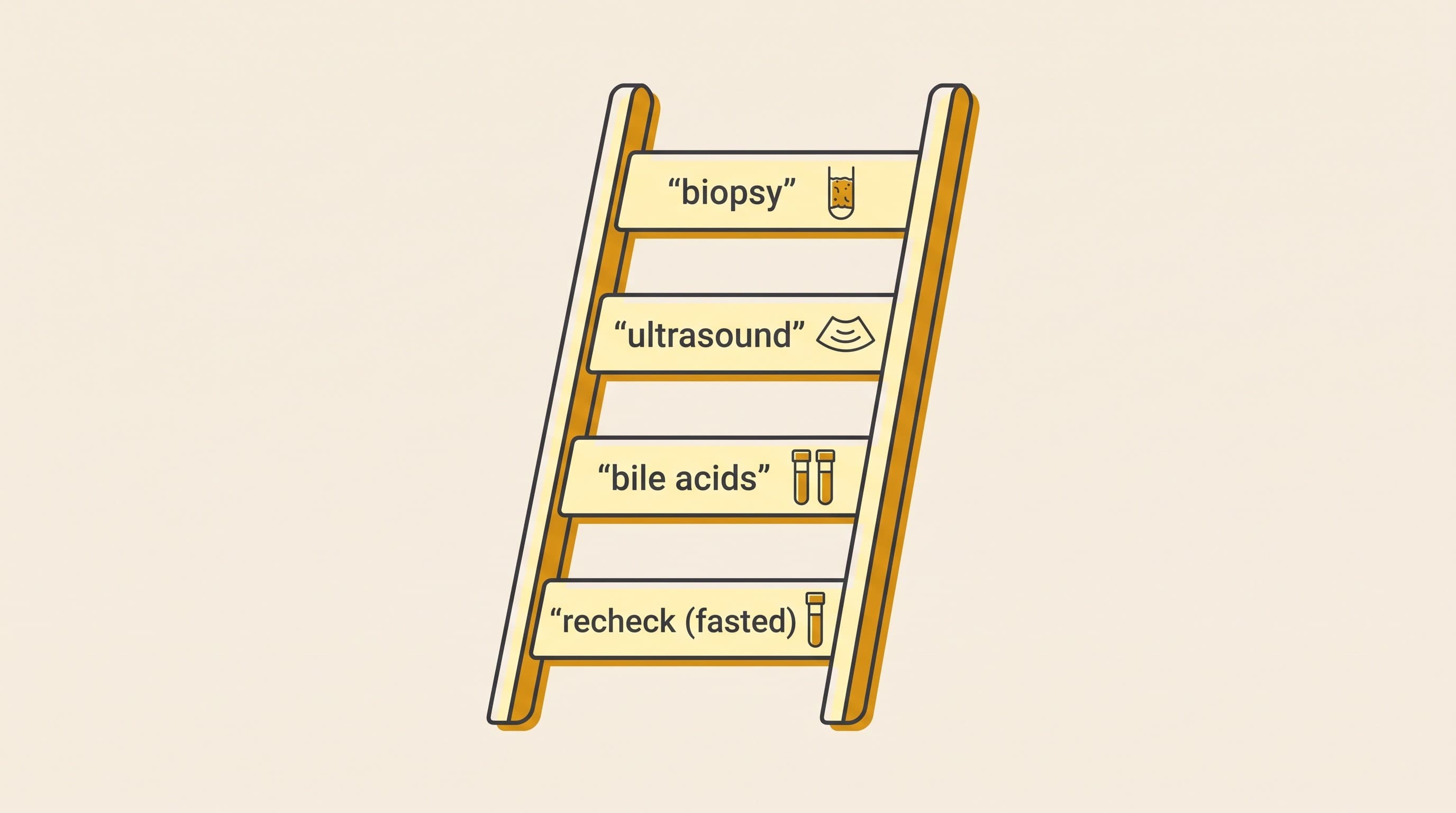
Once a raised liver value refuses to go away, the conversation shifts from "what does this number mean?" to "what's the next test?" And that's a harder place to sit, because each step sounds a little bigger than the last, the word "biopsy" is hovering somewhere ahead, and nobody has drawn you the whole map. You're being asked to say yes to one rung at a time without seeing the ladder.
So let me draw the ladder. There are four rungs, they go in a sensible order, each one answers a different question, and, this is the part that matters most, most pets never reach the top. You climb only as far as you need to, and at every rung there's a real chance the answer is reassuring enough to stop. Knowing the whole route in advance means "the next test" stops feeling like a lurch into the dark and starts feeling like a plan you're part of.
The one idea that makes the ladder make sense
Before the rungs, hold on to why there even is a ladder. Your pet's first blood test measured leak: enzymes like ALT and ALP spilling from irritated liver cells. Leak is a useful alarm, but it can't tell you three things you'll eventually want to know: is the liver actually working, what does it look like, and what is happening inside it at a microscopic level? Each rung of the ladder is designed to answer one of those questions that the enzymes couldn't. That's the logic. You're not repeating the same test more expensively; you're asking progressively more specific questions, and only going deeper when the answer justifies it.
Rung 1: recheck the bloods, fasted
The first step is the cheapest and the one most likely to end the whole process happily: repeat the blood test, with your pet fasted.
It answers a deceptively important question: is this real, is it still there, and is it moving? A single raised enzyme is a snapshot, and snapshots can mislead. Food in the system, a transient irritation, or normal day-to-day variation can nudge a number up. Fasting removes food as a source of noise, and repeating the test after a few weeks tells you whether you're looking at a one-off blip or a genuine trend.
This is where a lot of well pets step off the ladder. If a mild elevation has settled, or is stable and low with normal function markers (albumin, glucose, urea, bilirubin), that's often reassuring enough to keep watching rather than investigate further. If the number is clearly high, rising, or your pet has any clinical signs, you move to rung two. Our piece [High liver enzymes but my pet seems fine: do I panic?] covers exactly how that watch-versus-work-up decision is made.
Rung 2: bile acids, the function test
If the elevation is real and needs chasing, the next rung usually isn't imaging, it's another blood test, but a cleverer one: a bile acid stimulation test.
It answers the question the enzymes couldn't: is the liver actually working, and is blood flowing through it properly? Enzymes measure leak; bile acids measure function and blood flow. It's a paired test, a fasted sample, then a small fatty meal, then a second sample about two hours later, and it's non-invasive and relatively inexpensive.
This is the rung that decides whether the pricier imaging is worth doing. A normal result is genuinely reassuring about liver function and can let you step off the ladder. A high result, especially a markedly high post-meal value in a young dog, points toward reduced function or abnormal blood flow (the classic flag for a portosystemic shunt) and justifies the next step. What bile acids cannot do is name the disease or measure copper, which is why the ladder continues. There's a full walkthrough in [The bile acids test, explained].
Rung 3: abdominal ultrasound, the look at structure
The third rung is abdominal ultrasound, and it answers a different question again: what does the liver actually look like?
A skilled ultrasonographer can assess the liver's size, shape and texture, examine the gallbladder and bile ducts (this is where a gallbladder mucocoele is often spotted, see [Gallbladder mucocoele: the senior-dog surprise on the scan]), look at the blood vessels (helping to hunt for a shunt), and check for masses, changes in the liver's echotexture, or fluid in the abdomen. It's non-invasive and usually needs no more than a clip of fur and a cooperative, sometimes lightly sedated, patient.
But here's the honest limit, and it's a crucial one: ultrasound shows structure, not diagnosis. A liver can look abnormal on a scan while the microscopic cause remains unknown, and, importantly, a liver can look fairly normal on ultrasound while genuine disease is present inside it. Ultrasound narrows the field and guides the next step; it rarely closes the case on its own. That's why, for a definitive answer, there's a fourth rung.
Rung 4: liver sampling, the microscopic answer
The top rung is sampling the liver tissue itself, and it's the only step that gives a definitive, microscopic diagnosis. There are two levels.
A fine-needle aspirate (FNA) takes a small sample of cells with a thin needle, usually guided by ultrasound. It's less invasive and can be helpful for some conditions, but it collects loose cells rather than intact tissue, so it can miss the architecture of the liver and often can't give the full answer.
A biopsy takes an actual piece of tissue, either with a larger needle (a Tru-cut style core), during keyhole surgery (laparoscopy), or during open surgery. It's more involved and, because the liver is where clotting factors are made, your vet will usually check your pet's clotting before doing it. In return, a biopsy is the only test that can:
- Name the disease by showing the pattern of inflammation and cell change under the microscope (for example, distinguishing the types of chronic hepatitis, our [Chronic hepatitis in dogs: the honest UK picture] piece explains why this matters).
- Stage the scarring (fibrosis), which shapes the prognosis.
- Quantify copper in the tissue. This is the big one and it can't be done any other way. Measuring copper on the biopsy is how we tell whether a dog genuinely has copper-associated liver disease rather than assuming it from breed or a headline. Our piece [Copper and the liver: the dog-food copper debate, honestly] explains why this test, not guesswork, settles the copper question.
That copper measurement is worth pausing on, because it's often the reason a biopsy is worth doing at all. Treating copper the wrong way, either missing it or over-restricting when it isn't there, does harm, and only the biopsy tells you which situation you're in.
How far up will my pet actually go?
This is the question owners really want answered, and the honest reply is: usually not far. Plenty of pets never leave rung one, because a mild elevation settles or stays stable in a well animal. Many stop at rung two, reassured by normal bile acids. Ultrasound is common when there's a real signal to chase. A biopsy is reserved for the cases where a definitive diagnosis will genuinely change what you do, treating an immune-mediated hepatitis, confirming copper, planning around a shunt, rather than being done reflexively.
You get to be part of each decision. Fair questions to ask at every rung are: What is this test trying to find out? What would change depending on the result? And what happens if we wait and recheck instead? A good vet will welcome all three, because they're the same questions we ask ourselves.
Where this leaves you
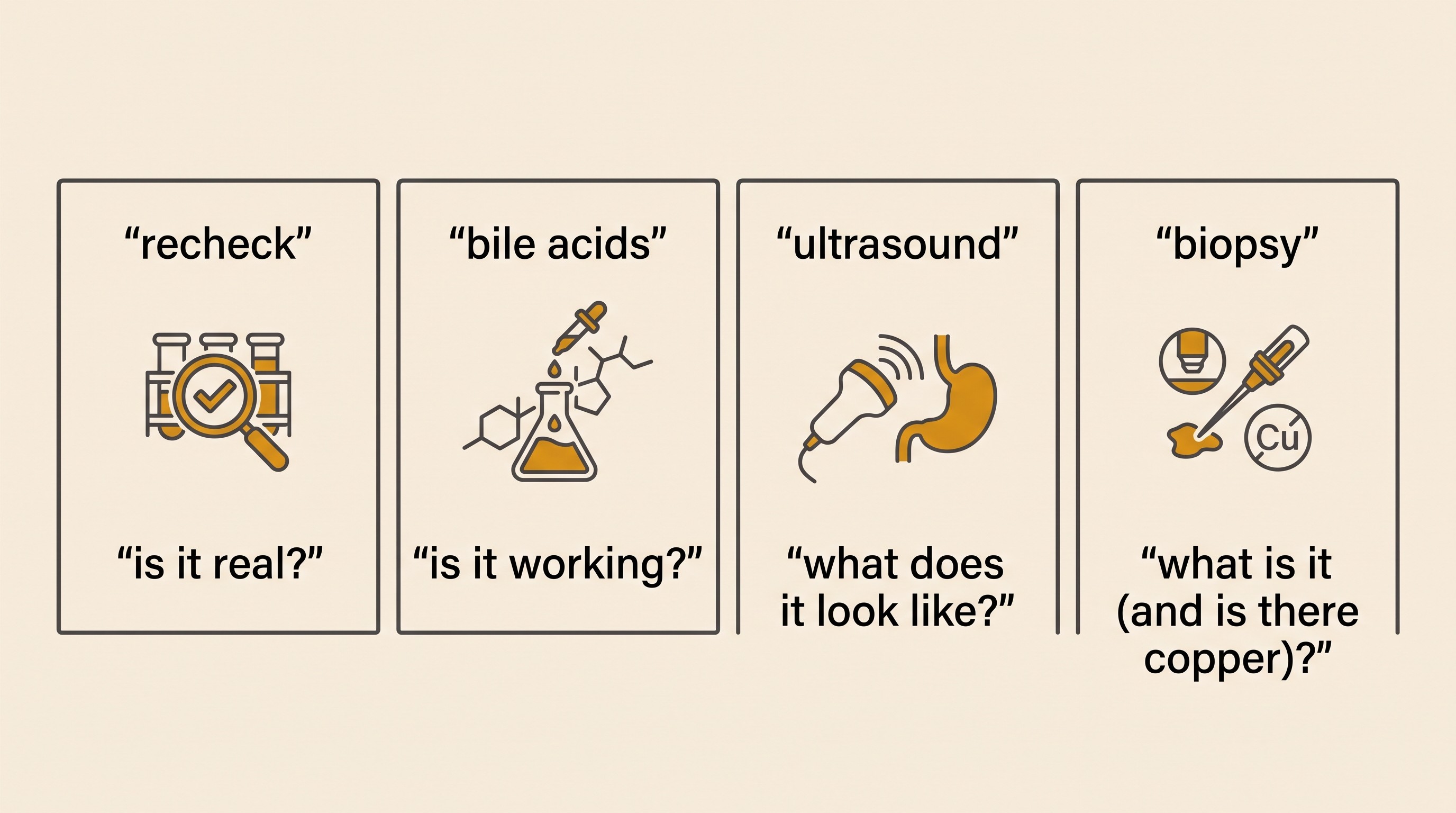
The workup isn't a conveyor belt toward a biopsy. It's a series of increasingly specific questions, and you climb only as high as the answers require. Recheck asks is it real, bile acids ask is it working, ultrasound asks what does it look like, and biopsy asks what is it, and is there copper. Most pets get their answer, or their reassurance, well before the top.
As you go, log every result in the Liver Values Tracker. A workup unfolds over weeks and months, and being able to see the whole sequence, the falling enzyme after treatment, the stable albumin, the bile acid result sitting next to the ultrasound date, turns a stressful series of appointments into a story you can actually follow. And if at any point your pet becomes genuinely unwell, jaundiced, vomiting, off food, a swollen belly, or neurologically odd, step off the ladder and ring your vet the same day. The workup is for the well pet with a puzzling number; the unwell pet needs care now.
References
- Fasting to reduce pre-analytical variability (including lipaemia) before hepatic biochemistry rechecks.
- Bile acid stimulation testing (paired fasting/post-prandial) as an assessment of hepatic function and portal circulation.
- Elevated post-prandial bile acids as an indicator of portosystemic shunting.
- Abdominal ultrasound for hepatobiliary structure; limitations in providing a microscopic diagnosis; possible need for sedation.
- Fine-needle aspiration versus histopathology (biopsy) for hepatic diagnosis; coagulation assessment prior to biopsy.
- Webster CRL, Center SA, Cullen JM, et al. ACVIM consensus statement on the diagnosis and treatment of chronic hepatitis in dogs (biopsy for diagnosis, fibrosis staging, and quantitative hepatic copper). *J Vet Intern Med.* 2019;33(3):1173-1200.
Free downloads
Companion worksheets to put what you've read into practice. Free PDFs, print at home.
Keep track of how your pet is doing
The owners who cope best are the ones who notice changes early. A simple health log shows you what is working, and what is not, before the next vet visit.
Start tracking, freeYou're not doing this alone
Compare treatment journeys and talk to owners managing liver & gallbladder. Free to join.
Join PetsLikeMine