

Life After Shunt Surgery: What Recovery Really Looks Like
Alastair Greenway
BVM&S MRCVS
You have made the decision, or you are close to making it, and your dog is going to have shunt surgery. Now you want the honest version of what comes next. Not the leaflet, not the best-case story, but the realistic picture: the first anxious days, the specific things to watch for, how long the medication and diet carry on, and what "recovered" actually means for a dog whose liver has spent its whole life being bypassed.
This piece is that version. It assumes you have already read about the surgery-versus-medical-management decision and understand what a portosystemic shunt is; here we pick up at the point of the operation and follow the road afterwards. As always, the specifics for your dog come from your surgeon and your vet, who know your dog's anatomy and how the operation went. What follows is the map, not the turn-by-turn.
The first days: why they matter most
The riskiest part of shunt surgery is often not the operation itself but the period straight afterwards. For your dog's whole life, the liver has been small and underused because blood was bypassing it. When the shunt is closed, blood is redirected back through a liver that is not yet ready for it, and the body has to adjust. This is exactly why surgeons usually close the vessel gradually rather than all at once, using devices that narrow it over weeks, so the liver is not overwhelmed.
Expect your dog to stay in the hospital for a few days for close monitoring. The team will be watching for a small number of specific complications, and knowing what they are watching for helps you understand the questions when you get your updates and the things to watch for yourself once your dog comes home.
Broadly, the concerns in that early window are three. There is portal hypertension, where too much blood is suddenly forced through a liver that cannot yet accept it, which is exactly what gradual closure is designed to avoid. There are the ordinary risks of any major abdominal surgery, bleeding, pain, and infection, which the team manages with monitoring and medication. And there are the post-attenuation neurological signs, including seizures, which are important enough and specific enough to shunt surgery that they deserve a section of their own. None of this is meant to frighten you; it is the reason the hospital stay exists, and it is why your dog is somewhere they can be helped immediately if any of it happens.
Post-attenuation seizures: the one to understand
This is the complication that owners most need to know about, because it is specific to this surgery and it can be frightening if it takes you by surprise. A proportion of dogs develop seizures in the days after shunt attenuation, sometimes called post-attenuation seizures or post-ligation neurological signs. Confusingly, these can happen even when the dog's ammonia levels are normal, so they are not simply hepatic encephalopathy coming back; the exact mechanism is not fully understood.
The important practical points are these. The seizures usually appear in the first few days after surgery, which is one reason your dog is kept in hospital during that window, where they can be treated immediately if they occur. When they do happen they are serious and need urgent veterinary treatment, which is precisely why the early monitoring exists. And this risk is one of the specific things worth asking your surgeon about beforehand, because it is a real part of the honest picture of shunt surgery rather than a footnote.
If your dog comes home and later shows any neurological change, staring, circling, disorientation, or a seizure, treat it as urgent and contact your vet or emergency service straight away rather than waiting to see if it settles. The piece on hepatic encephalopathy describes what those signs look like and includes the emergency guidance.
Coming home: the recovery weeks
Once your dog is discharged, you move into the ordinary but important business of post-operative recovery. That means restricted activity to let the surgical site heal, keeping the wound clean and checked, and giving medications on time. Your surgeon will give you specific instructions on exercise restriction and when to return for checks, and it is worth following them to the letter even when your dog starts to seem brighter, because the internal healing and the liver's adaptation are happening on their own timetable, not your dog's mood.
In practice, the first few weeks at home usually look like lead-only walks kept short, no running, jumping or rough play, and a calm household, which is easier said than done with a young dog who is starting to feel well. A crate or a small pen can be genuinely helpful here, not as a punishment but as a way to enforce the rest your dog cannot understand they need. Keep the wound dry, use whatever collar or bodysuit stops your dog licking it, and look each day for redness, swelling, discharge or gaping, reporting anything that worries you rather than waiting for the check-up. Appetite is worth watching too: a dog who goes off food after surgery needs a call to the vet, both because it can signal a problem and because, in a liver patient, not eating is never something to leave.
A point that surprises people: the medication and the special diet do not stop the day your dog comes home. The shunt has been closed but the liver needs time to grow into its new role, and the blood flow is still being redirected gradually if a gradual-closure device was used. So the lactulose, any antibiotics, and the protein-moderated diet typically continue for weeks after surgery, and are then weaned only when your vet judges the liver is coping, guided by rechecks and bloodwork. Do not stop these yourself. Coming off them too early, before the liver has taken over, can bring the encephalopathy signs back.
And remember, protein was moderated, not eliminated, before surgery, and that principle holds afterwards too. A protein-free diet is not the goal and is not safer; the aim is the right amount of good-quality protein, adjusted by your vet as your dog's liver recovers.
How you tell whether it is working: the trend
The reassuring thing about recovery is that you are not judging it by eye alone. The liver's progress is followed with repeat blood tests, and often a repeat bile acids test, over the weeks and months after surgery. This is where the trend matters far more than any single number. What everyone is hoping to see is the liver's function markers improving and the bile acids coming down as the liver takes over the job it never properly had before.
This is exactly the situation the Liver Values Tracker is built for. Rather than trying to remember whether last month's number was better or worse, you can plot the serial results and see the trend for yourself, which also makes the recheck conversations with your vet more useful. Keeping to the recheck cadence your vet sets is one of the most valuable things you can do in this period; it is how a problem gets caught early and how success gets confirmed.
What "recovered" actually means
Here is the honest range of outcomes. For many dogs with a suitable single congenital shunt that is successfully closed, the results are genuinely good, and some go on to lead essentially normal lives, eventually off medication and off the special diet. That is the hopeful end of the story and it is real.
But it is not guaranteed, and honesty matters more than cheerfulness here. Some dogs need to stay on some level of management long-term, because the shunt could only be partially closed, or because the liver does not fully take over, or because other small vessels open up over time. That is not a failure on your part or your dog's; it is the biology of a difficult condition, and a dog who still needs some management can still do well.
The practical takeaway is to keep expectations realistic and keep monitoring. Do not assume the surgery has fixed everything and quietly drop the diet and the rechecks; equally, do not assume the worst if your dog needs ongoing support. The trend, followed over months, tells the true story.
Living with it, once the dust settles
Beyond the immediate recovery, life with a post-shunt dog is mostly a matter of steadiness. Keep to whatever diet and medication plan you end up with, keep the recheck appointments, and stay alert to the signs of encephalopathy in case they ever return, because early recognition is everything. Know your dog's normal so you notice when something is off. The red flags to keep in mind sit alongside the general liver red-flag list, and the hepatic encephalopathy piece is the one to reread if you ever see the vacant, circling, head-pressing picture again.
One kindness to yourself in all of this: the weeks after shunt surgery can be anxious, and it is normal to watch your dog like a hawk and to feel a jolt every time they seem a little quiet. That vigilance is not a bad thing, but try to pair it with the reassurance of the numbers. If the recheck bloods are moving the right way and your dog is eating, playing within their restrictions, and behaving normally, that is real evidence things are going well, and it is allowed to reassure you. The trend on the page is there partly to give you permission to breathe.
A note on the long game, too. Even dogs who do beautifully and come off all medication benefit from staying on their vet's radar, because the occasional recheck can catch the rare dog whose situation changes over the years. This does not mean living in the clinic; it means not vanishing entirely once the crisis has passed. Your vet will tell you what long-term cadence makes sense for your dog.
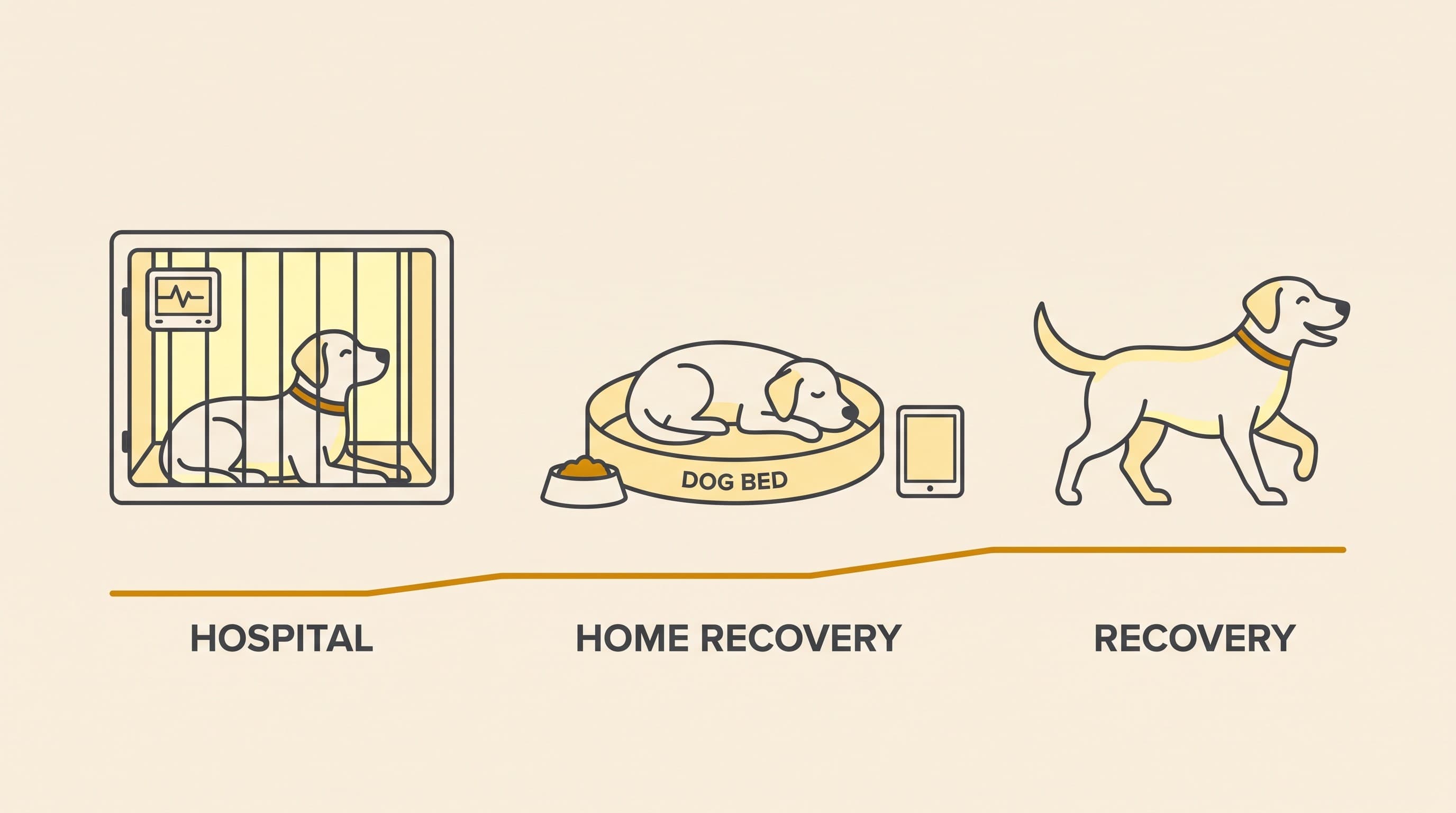
Recovery from shunt surgery is not a single moment; it is a slope, from the close-watched first days, through weeks of careful home care and continued medication, to a gradual weaning as the liver proves it can cope. If you know the shape of that slope in advance, the anxious parts are far less frightening, because you know what is normal and what is not. The next thing worth having clear in your mind is the emergency picture, so read the hepatic encephalopathy piece if you have not already, and lean on the Liver Values Tracker to watch the trend that tells you your dog is getting better.
References
- Webster CRL, et al. ACVIM consensus statement on the diagnosis and treatment of chronic hepatitis in dogs. *J Vet Intern Med* 2019;33(3):1173–1200.
Keep track of how your pet is doing
The owners who cope best are the ones who notice changes early. A simple health log shows you what is working, and what is not, before the next vet visit.
Start tracking, freeYou're not doing this alone
Compare treatment journeys and talk to owners managing liver & gallbladder. Free to join.
Join PetsLikeMine