

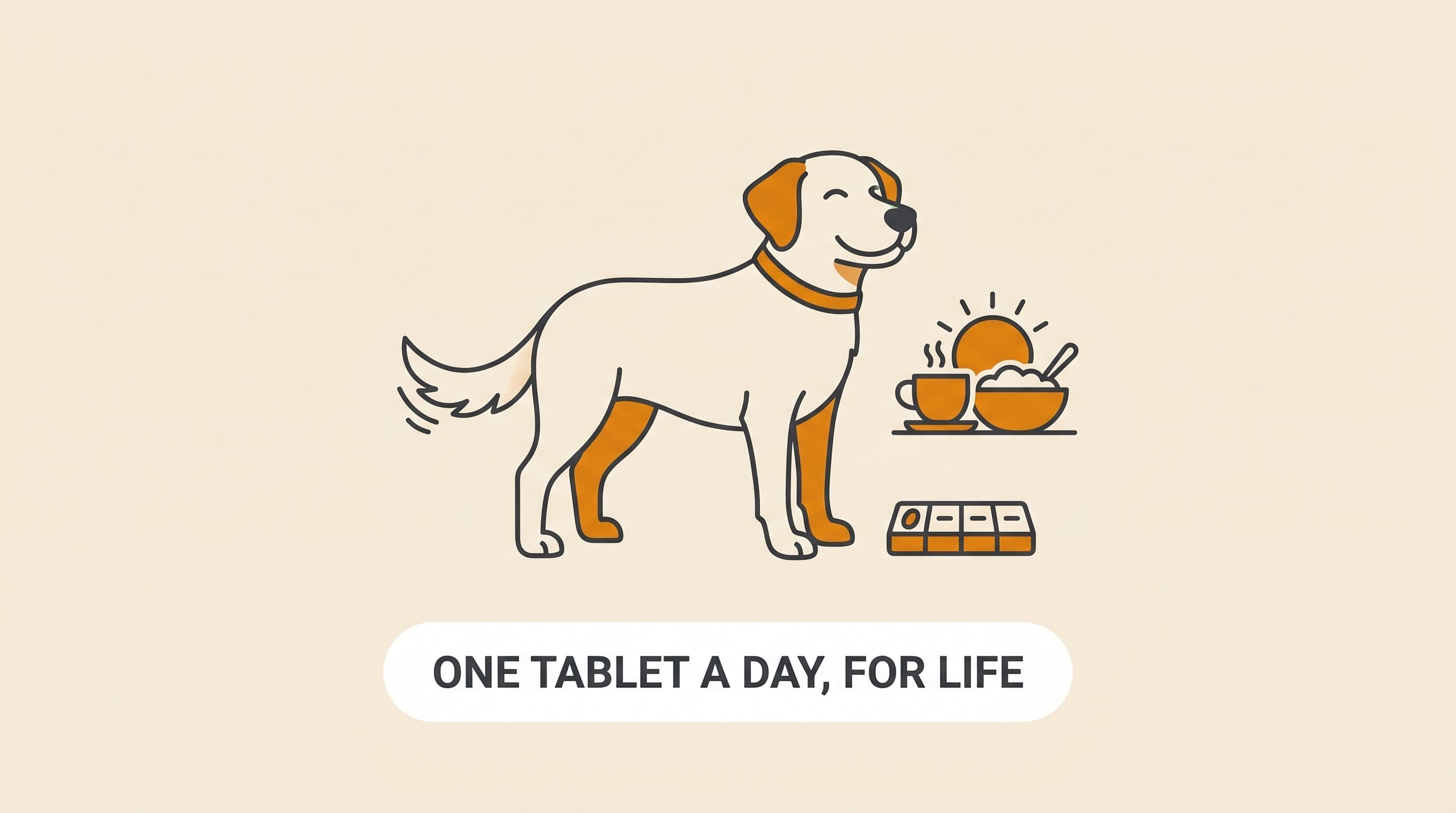
Levothyroxine for life: getting the dose right and what to expect
Alastair Greenway
BVM&S MRCVS
This is one of the genuinely happy stories in this part of the site. Once your dog has a properly confirmed diagnosis of an under-active thyroid, the treatment is a small daily tablet that's cheap, safe and usually transformative, and most dogs brighten up noticeably over the following weeks (Heseltine, Today's Veterinary Practice). The catch, and it's a small one, is that it's for life and the dose has to be tuned to your individual dog. Here's how that works, and what you can expect.
One quick caveat first. This piece assumes the diagnosis was done properly. A single low total T4 on its own isn't enough to commit a dog to lifelong tablets, because other illnesses and some common drugs lower thyroid results without the thyroid being to blame. If you're unsure it was fully confirmed, read "Getting the thyroid diagnosis right: the tests, and the traps" first.
What the tablet actually is
Levothyroxine (you may also see it written as levothyroxine sodium, L-thyroxine or L-T4) is a synthetic copy of the hormone your dog's own thyroid is no longer making enough of, thyroxine (T4) (FDA). You're not adding a foreign drug so much as topping up a hormone the body should be producing itself. Once it's on board, the body converts some of it into the more active form, T3, as needed, which lifts the metabolic rate back up and, in time, restores how nearly every organ system ticks over (Forthyron SPC).
There's no cure for hypothyroidism, so your dog will need to stay on replacement for the rest of their life (FDA; AKC, vet-reviewed). That sounds daunting written down, but it's one of the easiest long-term conditions to live with: a tablet a day, the odd blood test, and a dog that feels like itself again.
The starting dose, and why vets often begin twice a day
The usual starting point is around 0.02 mg per kilo of body weight, and vets commonly begin twice a day (every twelve hours) before settling many dogs onto a once-daily routine once they're stable (Heseltine, Today's Veterinary Practice; AAHA 2023). Don't reach for the calculator, though: the exact figure, the product and the frequency are your vet's call, and the number above is just to give you a feel for the scale.
The reason not to treat that as gospel is that dogs vary enormously in how they absorb and clear this drug, so two dogs of the same weight on the same dose can end up with very different blood levels, and the starting dose nearly always needs adjusting before your dog is fully right (Forthyron SPC). That's why the dose is set by the blood test rather than the bathroom scales, and why very large and giant-breed dogs aren't simply scaled straight up: there's a practical ceiling per dog of around 0.8 mg a dose, and big dogs are titrated up carefully rather than started high (AKC, vet-reviewed).
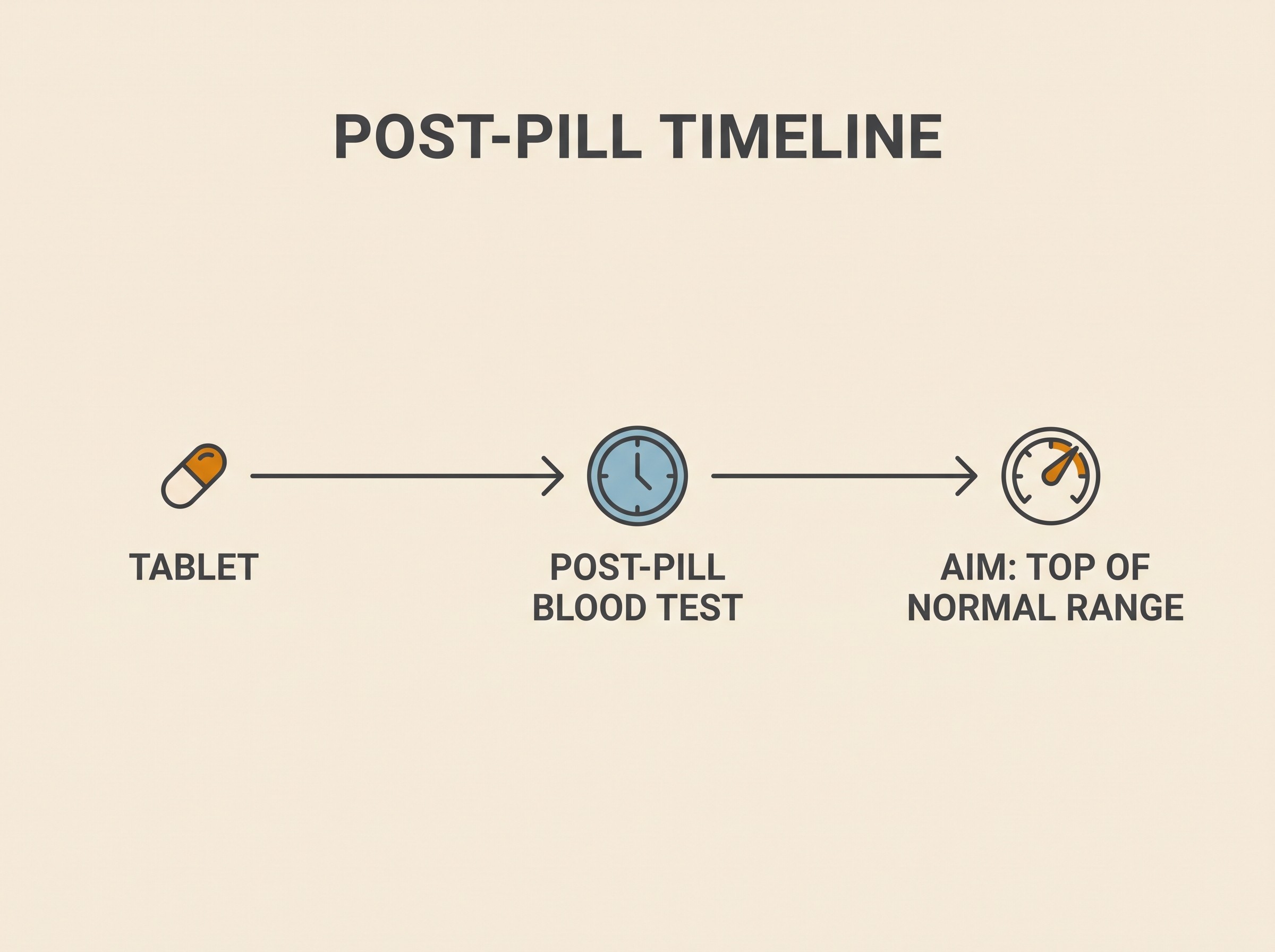
How the dose gets fine-tuned: the post-pill blood test
You can't reliably judge the dose by watching the dog alone, so it's confirmed with a recheck blood test (AAHA 2023; Forthyron SPC). The right dose is the one that both puts the thyroid level where it should be and clears the signs you were worried about.
The clever part is the timing. To check the dose, your vet takes a blood sample a few hours after the tablet has been given, the so-called "post-pill" sample, because that's roughly when the level peaks (Thyro-Tabs label; Heseltine, Today's Veterinary Practice). The exact gap depends on the product, so your practice will tell you when to give that morning's dose relative to the appointment. It's worth getting right, because a sample taken at the wrong point can make a good dose look too low or too high.
What's the vet aiming for? Broadly, a level at the top of the normal range, or just a touch above, a few hours after the dose, rather than sky-high (Heseltine, Today's Veterinary Practice; Forthyron SPC). If your dog's TSH was raised at diagnosis, the vet may also check that, since it should settle back to normal once the dose is right (Thyro-Tabs label; AAHA 2023). The target numbers vary by lab and assay, so they're not something to chase yourself.
Expect the rechecks to come thick and fast at first. Typically there's a blood test every four to eight weeks while the dose is being dialled in, a repeat a couple of weeks after any change, and then, once your dog is settled on a maintenance dose, monitoring eases off to roughly every six to twelve months (Thyro-Tabs label; Heseltine, Today's Veterinary Practice; Forthyron SPC; AKC, vet-reviewed).
What gets better, and when
The first thing you'll usually notice, often within a couple of weeks, is your dog brightening up: more get-up-and-go, less of the flat, slept-all-day demeanour (Heseltine, Today's Veterinary Practice). There's good evidence that activity and behaviour shift for the better on levothyroxine (Hrovat et al. 2019), and most of the classic signs improve within about four to six weeks (Heseltine, Today's Veterinary Practice). The weight tends to come off over the first few weeks to a couple of months as the metabolic engine speeds back up (Merck Veterinary Manual), gradually and alongside sensible feeding rather than instead of it.
The coat is the slowcoach. Skin and coat changes are the last to recover and usually take several months (Heseltine, Today's Veterinary Practice; Merck Veterinary Manual). The coat can even look a little worse before it looks better, with a flush of shedding as the old hair is replaced, which is a normal part of recovery. So don't judge whether the tablet's working by the coat in the first few weeks. If the coat is your main concern, "The thyroid and the skin: coat changes, recurrent infections and the derm overlap" picks that thread up.
Two safety stories worth knowing
The tablet is safe, but there are two things every owner should have straight.
Some dogs need a gentle start. If your dog also has a significant heart condition, is frail, is very elderly, or has another illness on the go, your vet will usually begin at a lower dose and build up slowly (FDA; Forthyron SPC; Thyro-Tabs label). The reason is sensible: levothyroxine speeds the heart up and raises the body's demand for oxygen, which can strain a heart that's already struggling (Forthyron SPC). The same go-slow approach applies with diabetes or kidney or liver trouble, because those change how the drug is handled (Forthyron SPC); if diabetes is in the mix, the Diabetes space covers that overlap.
There's one specific rule that matters. A dog that has both an under-active thyroid and Addison's disease must have the Addison's treated and stabilised first, before the thyroid tablet is started, because starting thyroid replacement in an unstable Addison's dog can tip it into an Addisonian crisis, which is a medical emergency (Forthyron SPC; Thyro-Tabs label). The levothyroxine is then added in slowly afterwards. It's a real safety point, but a rare combination and entirely manageable once your vet knows about both; the crisis itself is covered in the Addison's section.
Knowing what "too much" looks like. Give too much thyroid hormone over a long stretch and you can get thyrotoxicosis, the signs of an over-active thyroid. The reassuring news is this is uncommon in dogs from mild over-dosing, because dogs are very good at breaking down and excreting any excess (Forthyron SPC). When it does happen with genuine, sustained over-supplementation, the things to watch for are: drinking and weeing a lot more, panting, losing weight despite a good appetite, and a fast heart rate with restlessness or jitteriness (Forthyron SPC; AKC, vet-reviewed; Heseltine, Today's Veterinary Practice). It's the mirror image of this whole section: too little thyroid hormone gives you the slowed-down dog, too much starts to look like the over-active cat from the thyroid section.
If you spot those signs, don't stop or change the dose on your own hunch. Ring your vet, who'll check a thyroid blood level to confirm it, then stop or reduce the dose, let things settle over days to weeks, and restart lower with close monitoring (Forthyron SPC). It's reversible.
And to defuse the most common worry: a single extra or missed tablet is very unlikely to harm an otherwise-healthy dog. Even several-fold overdoses over weeks caused no significant problems in healthy dogs in testing (Forthyron SPC). So if you forget a dose, don't double up the next one to catch up; just give the next one as normal, or ring the vet if you're unsure (practice convention). The one exception is a dog with untreated Addison's or another illness, as above, where the margins are tighter.
The small habits that keep it working
Three easy routines make the difference between a dose that holds steady and one that keeps needing tweaking.
Be consistent about food. Food affects how much of the tablet your dog absorbs, so the trick isn't a particular time of day, it's giving it the same way every day, for example always just before breakfast (Forthyron SPC). The dose was tuned to that routine, so keeping the routine keeps it accurate.
Stick to the same product. Different levothyroxine products aren't guaranteed to deliver the hormone identically, so keep your dog on the same one where you can, and have the blood level rechecked if the brand or formulation ever changes (ScienceDirect; FDA).
Keep up the rechecks. They're how the vet keeps the dose right as your dog ages, changes weight or develops other conditions. Logging your dog's energy, weight and any thirst changes between visits, with the Thirst & Wee tracker or a simple note, gives your vet a much richer picture than a single snapshot in the consulting room.
The "Levothyroxine and rechecks" download summarises the routine and the signs to report on one page. But the headline is simple and worth holding onto: a confirmed under-active thyroid is one of the most rewarding conditions to treat. Get the diagnosis right, get the dose right, keep the routine, and most dogs go back to being entirely themselves.
References
- Heseltine J. Canine Hypothyroidism: Diagnosis and Treatment. Today's Veterinary Practice.
- FDA. Hypothyroidism in Dogs - There are FDA-Approved Drugs to Treat It. Animal Health Literacy.
- Forthyron 200 microgram tablet - UK Summary of Product Characteristics (SPC). Eurovet Animal Health; VMD.
- AKC. Levothyroxine for Dogs: Uses, Side Effects, and Dose Monitoring (vet-reviewed; Dr Rebecka Hess DACVIM, Dr Orla Mahony).
- Bugbee A, Rucinsky R, Cazabon S, et al. 2023 AAHA Selected Endocrinopathies of Dogs and Cats Guidelines. J Am Anim Hosp Assoc 2023;59(3):113-135.
- Thyro-Tabs Canine (levothyroxine sodium tablet) - US label, DailyMed (Lloyd Inc.).
- Hrovat A, et al. Behavior in dogs with spontaneous hypothyroidism during treatment with levothyroxine. J Vet Intern Med 2019;33(1):64-71.
- Merck Veterinary Manual. Hypothyroidism in Animals.
- Levothyroxine - an overview. ScienceDirect Topics (Veterinary Science and Veterinary Medicine).
Keep track of how your pet is doing
The owners who cope best are the ones who notice changes early. A simple health log shows you what is working, and what is not, before the next vet visit.
Start tracking, freeYou're not doing this alone
Compare treatment journeys and talk to owners managing hormone health. Free to join.
Join PetsLikeMine