

Is My Large-Breed Puppy at Risk of Hip Dysplasia? Early Signs and Prevention
Alastair Greenway
BVM&S MRCVS
A large or giant-breed puppy comes with a fair question attached: how worried should you be about hip dysplasia? Genetics set the baseline, but how you feed, exercise and grow your puppy really shifts the odds. This guide explains who is most at risk, the early signs to watch for between roughly four and twelve months, and what truly helps.
Who is actually at risk
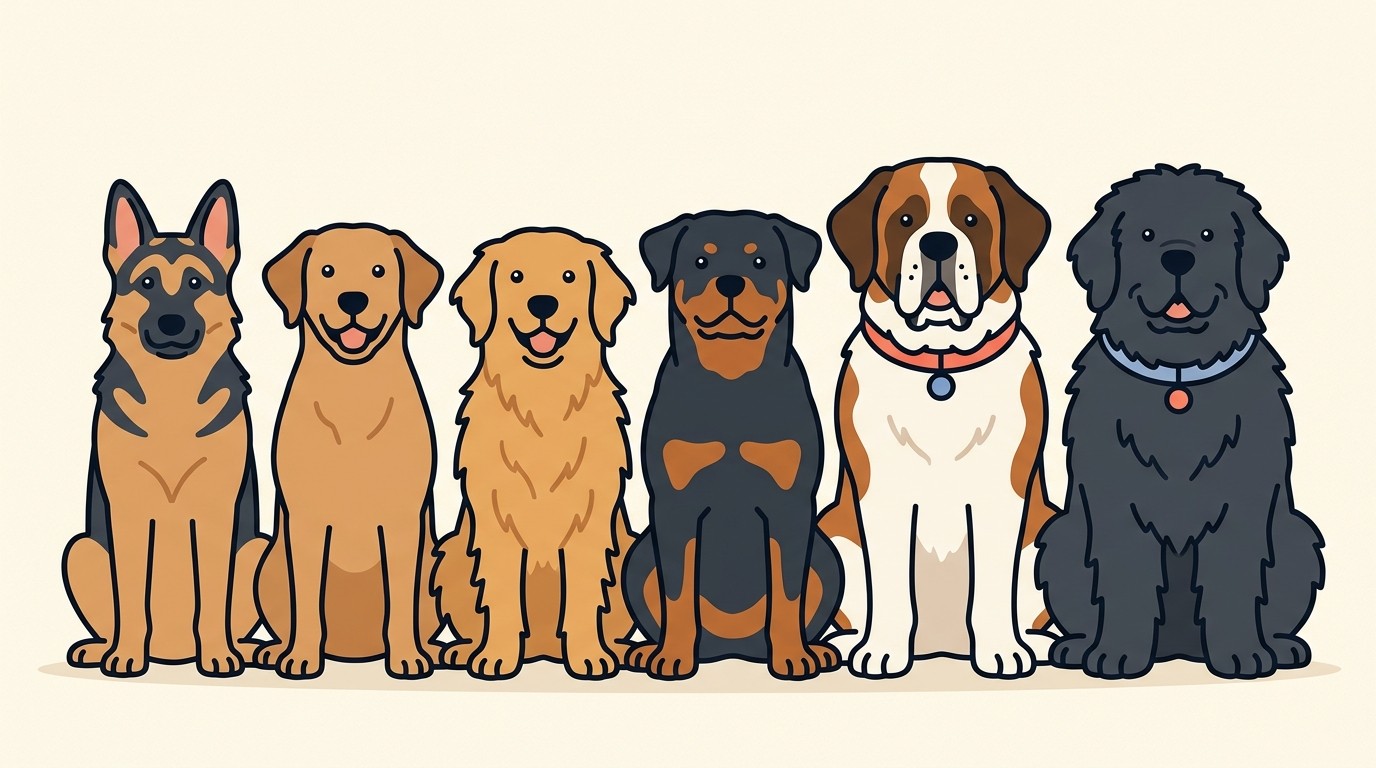
Hip dysplasia is far more common in large and giant breeds. The American College of Veterinary Surgeons and Cornell University's Riney Canine Health Center both describe it as occurring most commonly in larger dogs. Breeds you will see named again and again include German Shepherds, Labrador Retrievers, Golden Retrievers, Rottweilers, Saint Bernards and Newfoundlands. Still, no breed has a guarantee either way. Hip dysplasia has been recorded in small dogs and even cats, so size raises the odds rather than deciding the outcome.
The single biggest risk factor is the one you cannot change. Cornell describes hip dysplasia as fundamentally a genetic condition that is then modified by environmental influences such as nutrition and growth rate, and the ACVS calls heredity the biggest single risk factor. In plain terms, your puppy inherits a tendency towards a loose, poorly fitting hip joint, and the world around them either softens or sharpens that tendency.
That is why a puppy's parents matter so much. Pups whose sire and dam were never hip scored, or were scored poorly, carry a higher background risk than pups from two well-scored parents. If you are still at the choosing stage, or want to understand what a hip score actually means, our guide to hip scoring and buying from a responsible breeder walks through it in detail.
The other built-in risk factor is growth itself. Large and giant-breed puppies pile on bodyweight at a remarkable rate, and a hip joint that is growing fast is a hip joint under stress. A rapidly growing pup, particularly one being fed generously, sits at higher risk than a litter-mate grown more slowly and kept lean.
What you can change
Several of the strongest environmental levers are squarely in your hands. None of them rewrites your puppy's genes, but together they meaningfully reduce the chance of trouble and, where trouble is coming anyway, can delay it and soften it.
Grow your puppy slowly and keep them lean. This is the most powerful thing most owners can do, and the evidence behind it is unusually good. A landmark long-term study by Kealy, Smith and colleagues followed 48 Labradors from eight weeks of age, with each pair of dogs split so one was fed freely and the other fed 25 per cent less. The leaner-fed dogs had markedly less radiographic hip osteoarthritis over their lives, around half the prevalence seen in the freely fed group and less severe with it, they developed it later, and they lived a median of almost two years longer, around 13 years against roughly 11. Few interventions in veterinary medicine produce numbers that clean.
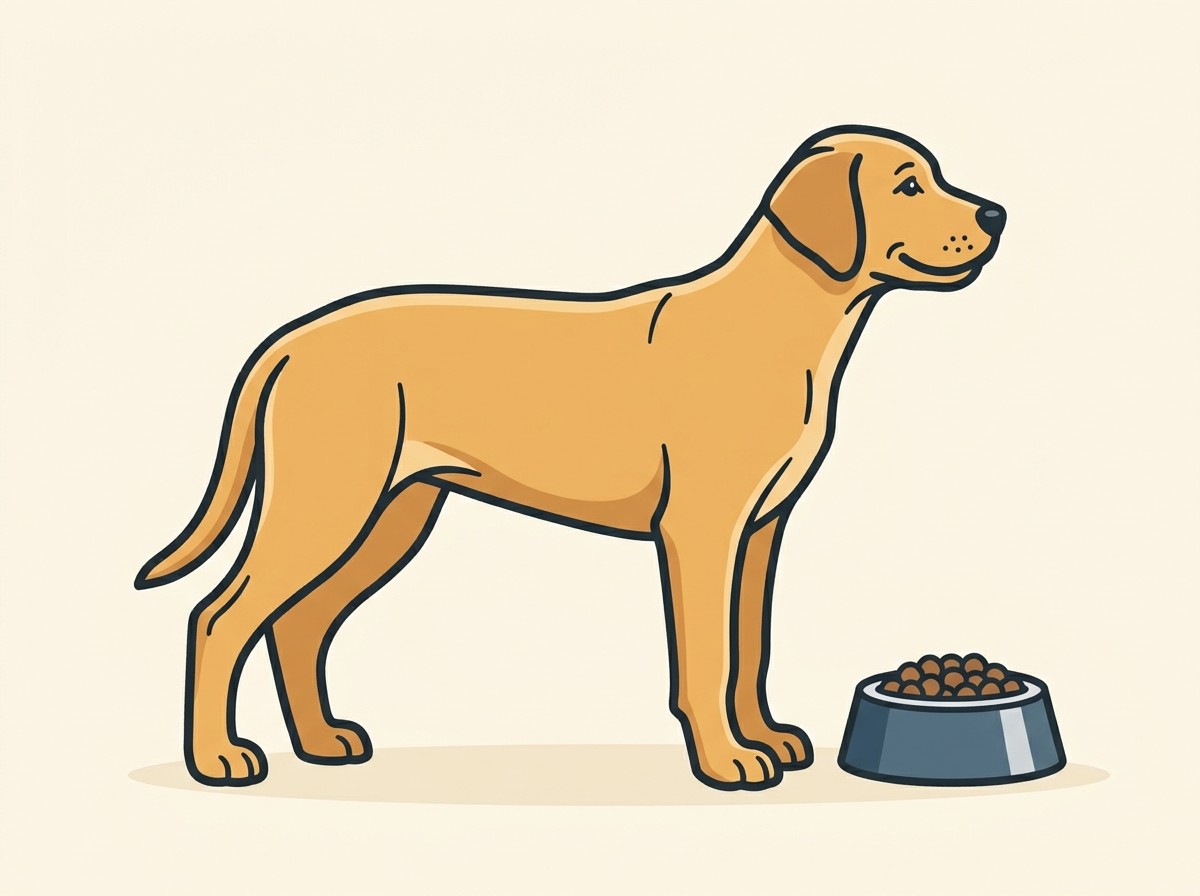
The practical message is not to starve a puppy, but to avoid over-rapid growth and the soft, rounded, chubby look that owners often mistake for a thriving pup. You want to be able to feel the ribs easily under a thin layer of fat, and to see a waist when you look down from above. If your puppy looks rounded rather than athletic, that is a signal to ease back, and your vet or veterinary nurse can talk you through body condition scoring at a routine visit.
Feed a diet built for large-breed puppies. Cornell and the ACVS both point to nutrition and growth rate as key modifiable factors, and the detail that matters most is calcium. A properly formulated large or giant-breed puppy food is designed with controlled energy and a controlled, balanced calcium content so your puppy grows at a sensible pace. The classic well-meaning mistake is adding calcium, vitamin D or generic supplements on top of a complete diet. Cornell specifically advises against supplementing growing puppies with calcium and vitamin D, because a growing skeleton cannot regulate excess calcium well and the surplus can actively harm joint development. Keep treats to a small share of the daily ration too, since they quietly add calories and unbalance an otherwise sensible diet.
Get the exercise balance right. Movement is good for a growing puppy, but the type and intensity matter while the joints and growth plates are still developing. The aim is plenty of gentle, self-directed activity and very little forced, repetitive or high-impact work. Free play with other friendly dogs on soft, non-slip ground, pottering walks where your puppy sets the pace, and gentle exploration are all excellent. What you want to avoid during the main growth period is forced jogging beside a bike or runner, repetitive ball or frisbee chasing with hard turns and skids, jumping on and off furniture or out of car boots, and structured agility or long-distance hikes. A common rule of thumb owners are given is to let walk length build gradually with age rather than asking for big distances early, but the underlying principle matters more than any formula: let the puppy choose to rest, and keep the high-impact, jarring activity to a minimum until they are more mature.
Neutering timing: a conversation worth having
This is an area where advice has shifted in recent years, and it deserves a careful word. A series of studies from the University of California, Davis, led by Professor Benjamin Hart, has linked neutering before around a year of age to a higher rate of joint disorders, including hip dysplasia, in several larger breeds. In their 2013 study of 759 Golden Retrievers, the incidence of hip dysplasia in males neutered before one year of age was roughly double that of intact males. Their later 2020 work across many breeds found that the effect was concentrated in heavier dogs, those over about 20 kg, while smaller dogs did not show the same pattern.
A few caveats matter here. The risk is breed-specific and individual, not a blanket rule. The UC Davis team is explicit that the right age varies greatly from breed to breed, and their guidance to consider delaying neutering past a year applies chiefly to dogs that will grow large. Neutering also carries its own benefits and a separate set of risks that have nothing to do with hips, so this is a balanced decision rather than a simple do-or-don't. The sensible approach is to raise the timing question directly with your own vet, who can weigh your specific breed, your puppy's sex and temperament, and your circumstances. Please do not read this as a reason to avoid neutering, only as a reason to discuss when.
Early signs between four and twelve months
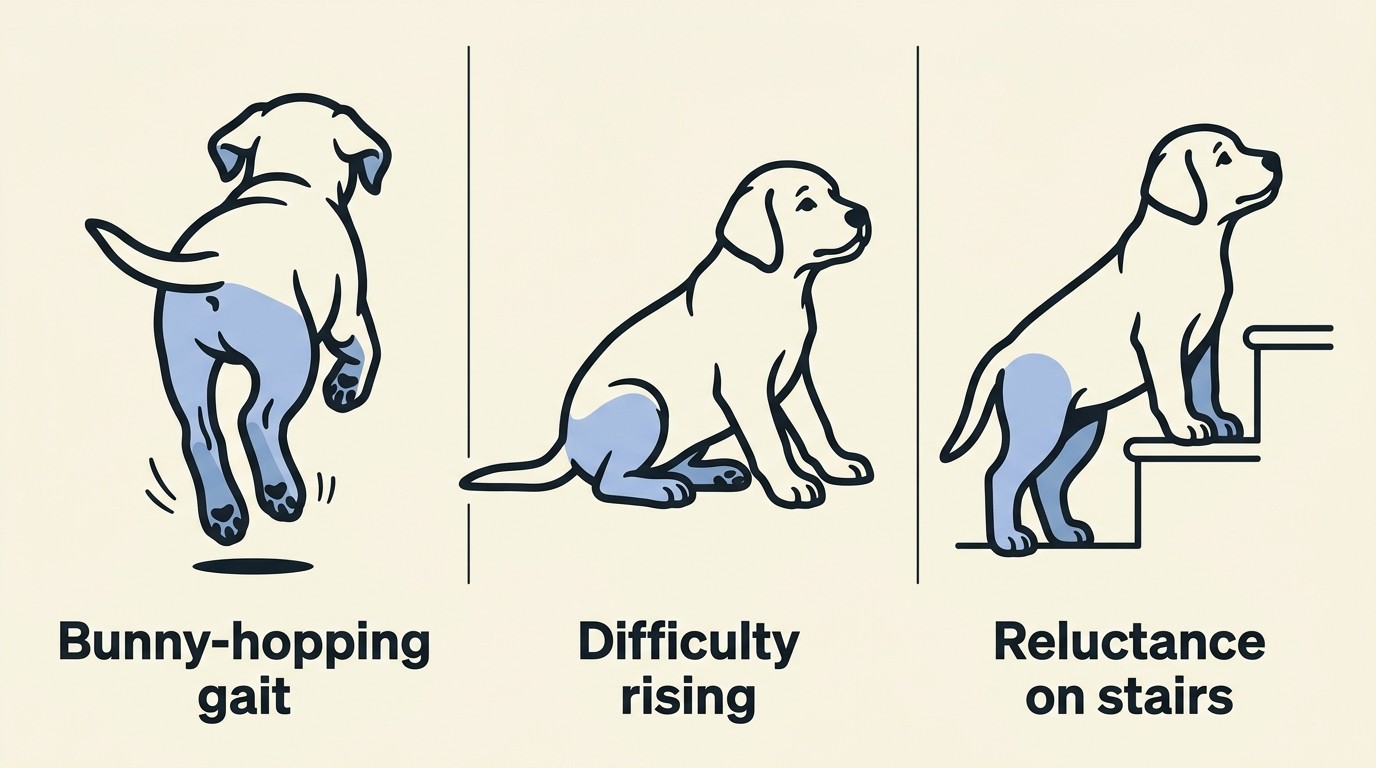
Many young dogs with hip dysplasia show subtle signs or none at all, which is exactly why the rearing measures above matter even when a puppy seems fine. But there is a recognisable cluster of early signs that tend to appear in the first year, often somewhere between four and twelve months, as a loose joint starts to cause discomfort. Worth watching for:
- A bunny-hopping gait, where both back legs swing forward together rather than alternating, especially when running or going upstairs.
- Difficulty or reluctance getting up after rest, or a slow, stiff start that loosens off once moving.
- Reluctance to climb stairs or to jump, for instance hesitating at the car or the sofa where they used to leap without thinking.
- A swaying, wobbly or loose-looking back end when walking.
- Reduced exercise tolerance, tiring or wanting to stop sooner than you would expect for a young dog.
- An audible click from the hips in some pups as they move.
None of these is proof of hip dysplasia on its own. Young dogs strain muscles, go through clumsy growth spurts and have off days. But if you are seeing one or more of these signs persist, particularly in an at-risk breed, it is worth a proper look rather than waiting to see.
If you are worried
Start with a veterinary examination. Your vet will watch your puppy move and feel how the hips behave, including gently checking for joint laxity. One specific test, the Ortolani sign, looks for the telltale slipping of a loose hip back into place, and the surgical literature notes it is reasonable to screen at-risk pups for a positive Ortolani sign between about twelve and sixteen weeks. From there your vet will advise whether imaging or referral to an orthopaedic specialist is the sensible next step.
For a high-risk puppy, early screening earns its keep, because some of the corrective options only exist in a narrow puppy window. PennHIP is the screening method most able to measure hip laxity in a young dog, and Today's Veterinary Practice notes it can be carried out in young puppies, with results most reliable from around sixteen weeks. That matters because a procedure called juvenile pubic symphysiodesis, which can improve hip development, has to be done very early, ideally between twelve and eighteen weeks, before most pelvic growth is complete. The UK BVA and Kennel Club Hip Scoring Scheme and the American OFA scheme assess hips later, with OFA grading from two years of age, so they are tools for confirming status and informing breeding rather than catching the early treatment window. The full mechanics of these procedures, how a loose joint leads to arthritis, and what each operation involves, are covered in our companion deep-dive on understanding hip dysplasia and its surgical options, so we will not repeat them here.
If a diagnosis does come, please do not panic. A great many dysplastic dogs live full, comfortable lives with weight control, sensible exercise and good pain management, and surgery is reserved for those who need it. Our guide for owners whose puppy has just been diagnosed talks through the immediate decisions, and our piece on conservative management for a young dysplastic dog covers the non-surgical path in depth.
Where that leaves you
Good rearing reduces risk, sometimes substantially, but it cannot fully override genetics. A puppy from poorly scored parents can develop hip dysplasia despite faultless feeding and exercise, and a puppy from excellent stock can occasionally be unlucky. What you control is the loading you put on the dice. Keeping your puppy lean, growing them slowly on an appropriate large-breed diet, going easy on high-impact exercise during growth, and discussing neutering timing with your vet are all evidence-backed ways to give those young hips the best possible start. And because so much of the risk is decided before you ever bring a puppy home, the most powerful prevention of all happens at the choosing stage, which is exactly why our guide to hip scoring and responsible breeders is worth reading before your next dog, not after.
References
- American College of Veterinary Surgeons. Canine Hip Dysplasia. ACVS Small Animal Topics.
- Cornell University College of Veterinary Medicine, Riney Canine Health Center. Canine hip dysplasia (CHD).
- Smith GK, Paster ER, Powers MY, et al. Lifelong diet restriction and radiographic evidence of osteoarthritis of the hip joint in dogs. Journal of the American Veterinary Medical Association. 2006;229(5):690-693.
- Kealy RD, Lawler DF, Ballam JM, et al. Effects of diet restriction on life span and age-related changes in dogs. Journal of the American Veterinary Medical Association. 2002;220(9):1315-1320.
- Today's Veterinary Practice. Hip Dysplasia: Navigating Surgical Options and Timing. 2022.
- Torres de la Riva G, Hart BL, Farver TB, et al. Neutering dogs: effects on joint disorders and cancers in golden retrievers. PLOS ONE. 2013;8(2):e55937.
- Hart BL, Hart LA, Thigpen AP, Willits NH. Assisting Decision-Making on Age of Neutering for 35 Breeds of Dogs (and mixed breeds by weight category). Frontiers in Veterinary Science. 2020.
- British Veterinary Association. BVA/Kennel Club Hip Dysplasia Scheme for dogs.
Keep track of how your pet is doing
The owners who cope best are the ones who notice changes early. A simple health log shows you what is working, and what is not, before the next vet visit.
Start tracking, freeYou're not doing this alone
Compare treatment journeys and talk to owners managing hip dysplasia. Free to join.
Join PetsLikeMine