

Keeping it off: preventing the rebound
Alastair Greenway
BVM&S MRCVS
The diet isn't over, it's just changed jobs
The ribs are back, the waist has come in, and the number on the scale finally says what you've been working towards. That's a real win after a lot of hard work, and it's worth a moment to enjoy it.
Now for the bit nobody mentions at the weigh-in. Hitting target isn't the finish line; it's a handover. The diet carries on, but its job changes from "take the weight off" to "keep it off", and keeping it off turns out to be the part most of us get wrong.
It's the same story in people. Most human dieters who lose weight drift back to where they started, not through some single binge but through eyeballed portions creeping up and treats sneaking back in. Pets do exactly the same thing, for exactly the same reasons. In one long follow-up of dogs that had successfully slimmed down, only about 42% held their new weight, while around 48% regained more than 5% of it over the next couple of years (German et al., 2012). Cats are no different. In the matching feline study, about 39% maintained and roughly 46% regained more than 5%, and of the cats that did rebound, well over half put back more than half the weight they'd lost (Deagle et al., 2014).
Written down, that sounds bleak. It isn't, and here's why. Regain is common, but it's also very preventable, and it's nobody's personal failing. It happens because the lighter body genuinely needs fewer calories than it used to, and because the habits that took the weight off quietly loosen once the pressure's off. The fix isn't a new diet or more willpower. It's keeping the same handful of habits you already have, just at a gentler maintenance setting. Let's walk through them.
Keep the five habits that got you here
Nothing here is new. These are the same things you've been doing, dialled back to a holding pattern.
Keep weighing, just less often. While your pet was actively losing, every couple of weeks was the right rhythm so you could catch a stall early. In maintenance you can ease off to a monthly weigh-in (Cline et al., 2021). That's frequent enough to spot a drift before it becomes a problem, and infrequent enough that you'll actually keep doing it. Log every weight in the [Healthy Weight Tracker] so the line stays unbroken, because a gap in the record is exactly where creep hides.
Keep measuring in grams. This is the one that slips first. The kitchen scale gets put away, the scoop comes back out, and "about a scoopful" quietly becomes a generous one. It matters more than you'd think, given that only about 3% of cat owners and 16% of dog owners weigh their pet's food at all (APOP, 2025). The scale is a thirty-second job and it's the difference between holding the line and watching it drift. Keep weighing the day's ration the way you have been.
Keep the treat budget. Treats should still be no more than about 10% of the day's calories (Cline et al., 2021). You don't have to stop treating, you just keep counting, the same as you have been (see [The treat budget: keeping treats without blowing the diet]). The 10% slips back up the moment you stop paying attention to it.
Recalculate the ration for the new weight. A lighter pet needs more food than it did mid-diet but still less than the over-feed that put the weight on in the first place. The maintenance ration sits in between. Don't guess it. Pop the new target weight into the [Feeding Calculator] and let it work out the maintenance grams for the food you're already buying. This is the single most useful thing you can do at handover, and it takes a minute.
Flip the goal from "lose" to "hold". The job has changed and so has the target. You're no longer chasing a falling line, you're defending a level one. That's a different mindset, and a kinder one, because a steady line is a win every single month it stays steady.
Watch the body, not just the bottom line
The scale is honest, but it's also a little bit deaf. It can read the same week after week while the body underneath it quietly changes shape, because muscle and fat don't weigh the same and a slow swap between them barely moves the number.
So don't trust the number alone. Re-score the body condition every so often, the same hands-on check you learned earlier in the programme (see [Body condition score: how to score your dog or cat at home]). You're aiming to hold a 4 to 5 on the 1 to 9 scale (Cline et al., 2021). Feel the ribs, look for the waist from above, check the tummy tuck from the side, and take your side-on and top-down photos in the same spot and the same light each time. The change is far easier to see in a pair of photos than in a single digit.
This is your early-warning system, and it matters because the creep is so easy to miss. Around 82% of UK owners don't actually know their pet's body condition score (PDSA, 2024). That isn't carelessness; it's just that a pet you see every day drifts heavier so gradually your eye recalibrates to it. The score, tracked over time, is what catches the drift your eye can't. The [Healthy Weight Tracker] stores the score and the photos alongside the weight, so the body and the bottom line sit side by side and you can see if one is wandering off while the other holds still.
Re-audit when life changes
Rebound rarely arrives as one dramatic lapse. It creeps in after a change, when the careful routine that was holding the weight quietly stops fitting the new normal.
So the trick is to know the moments that reset the maths and to re-check after each one. The usual culprits:
- A new home or a new routine. A house move, a change of working hours, a different walking schedule, anything that shifts the rhythm of the day.
- A new person feeding. A partner, a house guest, a dog-walker or a pet-sitter who doesn't know the budget and feeds with their heart.
- A second pet's bowl. Where there are two bowls, there's a dieting pet hoovering up the other one's leftovers. Worth watching closely.
- Winter. Shorter, wetter days mean less exercise and more time indoors, and the ration that balanced an active autumn now tips over.
- A change of food. This is the sneaky one. A new bag, even a "lighter" one, has its own kcal per 100g, so the same weight of food is a different number of calories. Switch food and you have to re-weigh the ration to match.
- A child or a grandparent topping up. The kindest hands in the house are often the ones quietly undoing the budget, a biscuit here and a bit of toast there.
After any of these, do two quick things. Re-run the family briefing so everyone who feeds the pet knows the budget again (see [Getting the whole family (and the dog-sitter) on board]), and re-weigh the food. A two-minute re-audit at the moment of change is what stops a small drift becoming a full rebound.
A lapse is not a relapse, catch it early
A couple of pounds creeping back on is a wobble, not a write-off. Almost everyone has one. The thing that separates a wobble from a full rebound is how early you catch it, and that's where the trend matters more than the daily number.
Don't read the scale day to day, because daily weights bounce around with a full bladder, a big drink or a damp coat, and the noise will either panic you or fool you. Watch the line over weeks instead (see [Is it working? Reading the trend, not the daily number]). A trend that's quietly ticking upward is your cue to tighten the same five habits, and catching a 5% regain at that point is a fortnight of going back to basics, not starting the whole programme over.
What you must not do is crash-cut the food in a panic to fix it. Slow got the weight off and slow takes it off again, at about 1 to 2% of body weight a week for dogs and a gentler 0.5 to 1% a week for cats (VCA Animal Hospitals; Cornell Riney Canine Health Center). Sudden, severe cuts backfire, and in cats they're genuinely dangerous.
Cats: the one red line. Never starve a cat back into shape. A cat dropped onto far too little food, or one that simply stops eating, can develop hepatic lipidosis (fatty liver), and it can turn life-threatening within days. An overweight cat that won't eat for 24 to 48 hours is a vet trip today, not a diet that's working (VCA Animal Hospitals). If a rebounding cat needs to lose weight again, do it slowly, keep food going in every day, and never withhold it (see [Never crash-diet a cat: the hepatic lipidosis rule]). For the safe re-loss rates for both dogs and cats, see [How much to lose and how fast: safe rates for dogs and cats].
The maintenance mindset (and where to go next)
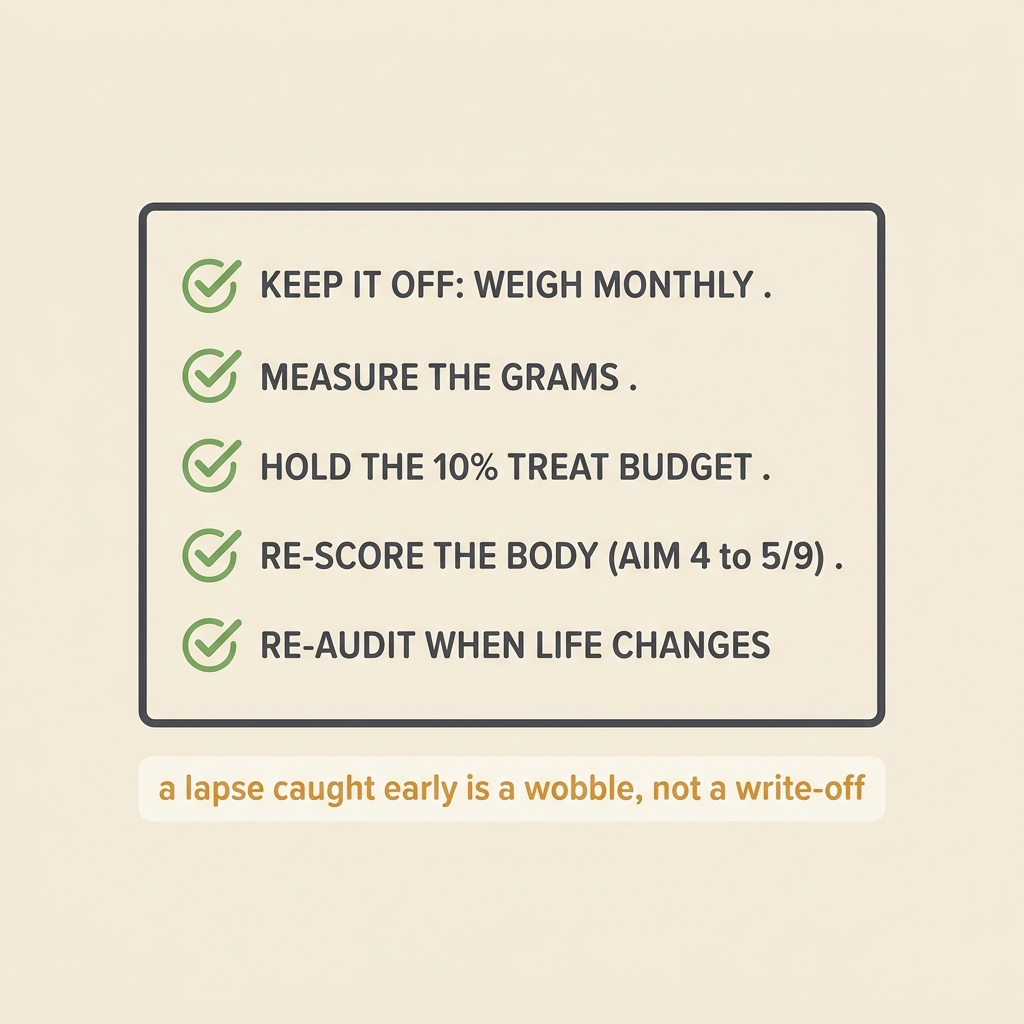
Hold on to this shift. Lean isn't a finish line you cross and leave behind, it's the new normal you defend. And defending it is genuinely lighter work than getting there was, because the hard part, the actual losing, is done. The same calm habits still work: weigh monthly, measure the grams, hold the treat budget, watch the body, re-audit when life changes. That's the whole job.
And it's worth defending for a reason you can see every day, not just one you read in a study. A pet that stays lean keeps moving. It keeps jumping onto the sofa, climbing the stairs, getting in and out of the car and coming back from the walk wanting more. That's the prize, right now, in front of you. The longer life that tends to come with it is a lovely bonus, but it's the bonus, not the reason.
If a change is coming up or the line has started to drift, here's where to go next. To loosen the reins safely at handover, see [They've hit target: switching safely to maintenance]. To read the line properly, see [Is it working? Reading the trend, not the daily number]. To redo the sums as the ration changes, see [Recalculating as they shrink: why the ration has to change]. And keep both tools in easy reach, the [Feeding Calculator] for the maintenance grams and the [Healthy Weight Tracker] for the line you're holding.
References
- German AJ, Holden SL, Morris PJ, Biourge V. (2012). Long-term follow-up after weight management in obese dogs: the role of diet in preventing regain. Vet J. 192(1):65-70.
- Deagle G, Holden SL, Biourge V, Morris PJ, German AJ. (2014). Long-term follow-up after weight management in obese cats. J Nutr Sci. 3:e25.
- Cline MG, Burns KM, Coe JB, Downing R, Durzi T, Murphy M, Parker V. (2021). 2021 AAHA Nutrition and Weight Management Guidelines for Dogs and Cats. J Am Anim Hosp Assoc. 57(4):153-178.
- Association for Pet Obesity Prevention (APOP) (2025). 2025 Pet Obesity and Nutrition Survey.
- PDSA (2024). PAW Report 2024 (PDSA Animal Wellbeing Report).
- VCA Animal Hospitals. Tips for Successful Weight Loss in Dogs and Cats.
- Cornell Riney Canine Health Center. Obesity and Weight Loss in Dogs.
Keep track of how your pet is doing
The owners who cope best are the ones who notice changes early. A simple health log shows you what is working, and what is not, before the next vet visit.
Start tracking, freeYou're not doing this alone
Compare treatment journeys and talk to owners managing weight management. Free to join.
Join PetsLikeMine