

Is My Dog Actually Overweight? How to Tell at Home
Alastair Greenway
BVM&S MRCVS
There's a ten-second check that tells you more about your dog's weight than the scale ever will, and you can do it right now, with your hands, on the dog in front of you. Maybe you've half-noticed they look a bit round, or someone at the vet's said "overweight" and it stung. Either way, you're not in trouble and neither is your dog. This is one of the most common things we see. It creeps up so slowly that almost nobody spots it on their own pet, and it's very fixable. The hard part is looking properly, and you're already doing that.
You're in good company, and it's not your fault
Around half of UK dogs and cats are carrying more weight than they should. In the PDSA's most recent welfare report, veterinary professionals estimated that roughly 46% of dogs and 43% of cats are overweight or obese, and when pets were actually weighed and scored, 45% came out at a body condition score of 6 or more, which is the "overweight" mark (PDSA, 2024). So if your dog is one of them, that puts them squarely in the majority. This is normal, not negligent.
What catches almost everyone out is the next bit. Among owners whose pets a vet has classed as overweight, around 9 in 10 had judged their pet to be a normal weight (APOP, 2014). Nine in ten. It isn't carelessness. It's how we're wired. The PDSA found that 82% of UK owners didn't know their pet's body condition score at all (PDSA, 2024), and a peer-reviewed study of pet owners found roughly a quarter underestimated their pet's condition across the board (Diez et al., 2023). We see our dogs every single day, the weight goes on a few grams at a time, and our eye quietly resets what "normal" looks like. By the time it's visible, it's been there a while.
None of that is a telling-off. It's the opposite. It means that if you couldn't see it, you're completely typical, and it means the fix has nothing to do with willpower or guilt. It starts with simply checking properly.
The three checks, done with your hands
Forget what the dog looks like for a moment. The eye is the least reliable tool you've got, for exactly the reasons above. What vets actually do is feel and look in three specific places. You can do all three on the kitchen floor in under a minute.
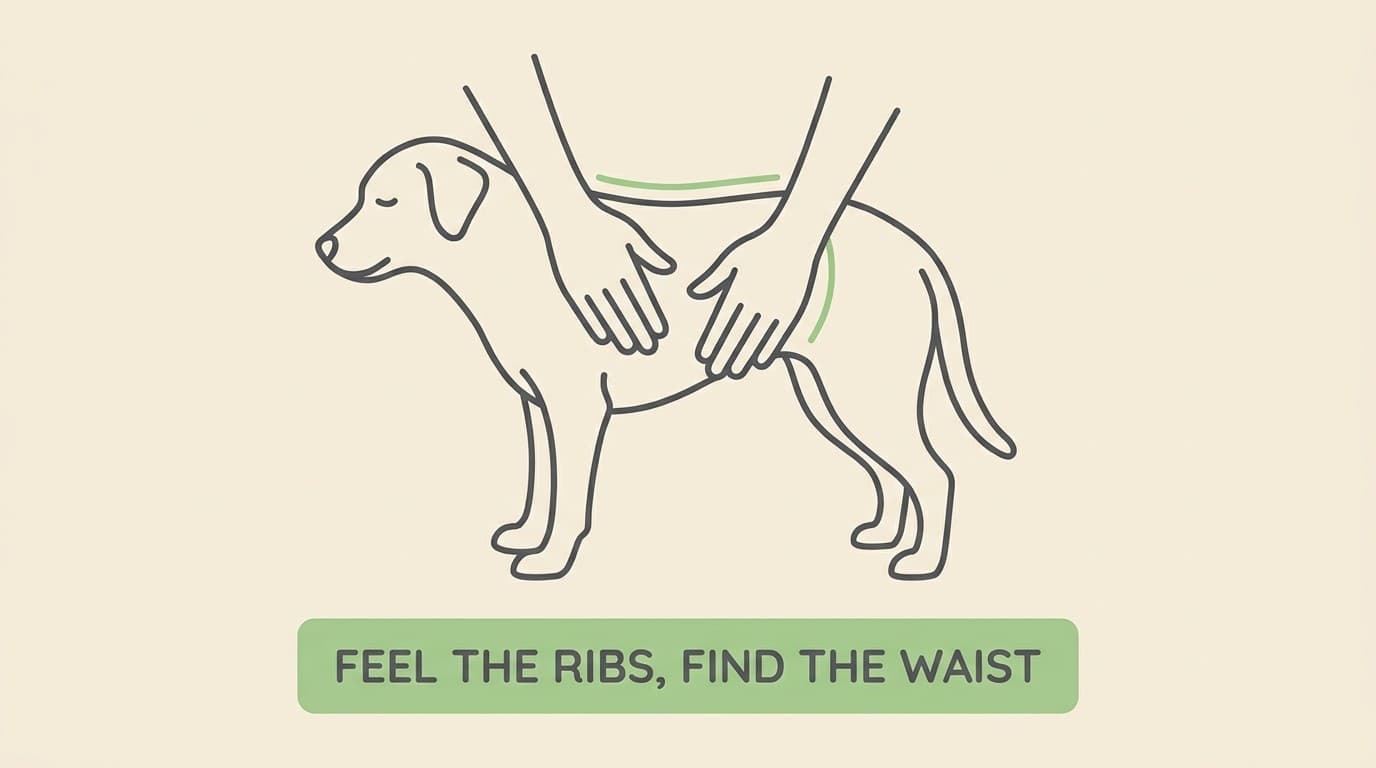
1. The ribs. Run the flats of your hands along both sides of your dog's chest, with light pressure, the way you'd stroke them. At a healthy weight you should be able to feel each rib easily, with just a thin layer over the top, a bit like feeling the bones on the back of your own hand. You shouldn't have to press or dig to find them, and you shouldn't see them standing out either. If you have to push through a soft, padded layer before you reach rib, that padding is fat. The WSAVA's reference describes the ideal as "ribs palpable without excess fat covering" (WSAVA Global Nutrition Committee, 2024). This single check is the most useful one, so trust your hands here over the mirror.
2. The waist, from above. Stand over your dog while they're standing, and look straight down at their back. You want to see a waist: the body should narrow in behind the ribs, an hourglass tucking in before the hips. A straight line from ribs to hips, or worse a body that bulges out wider at the middle, means there's no waist to find.
3. The tummy tuck, from the side. Now crouch and look at your dog side-on. Behind the ribcage, the underline of the belly should rise up towards the back legs, not hang level or sag down. That upward sweep is the abdominal tuck. A belly that runs flat, or droops, has lost its tuck.
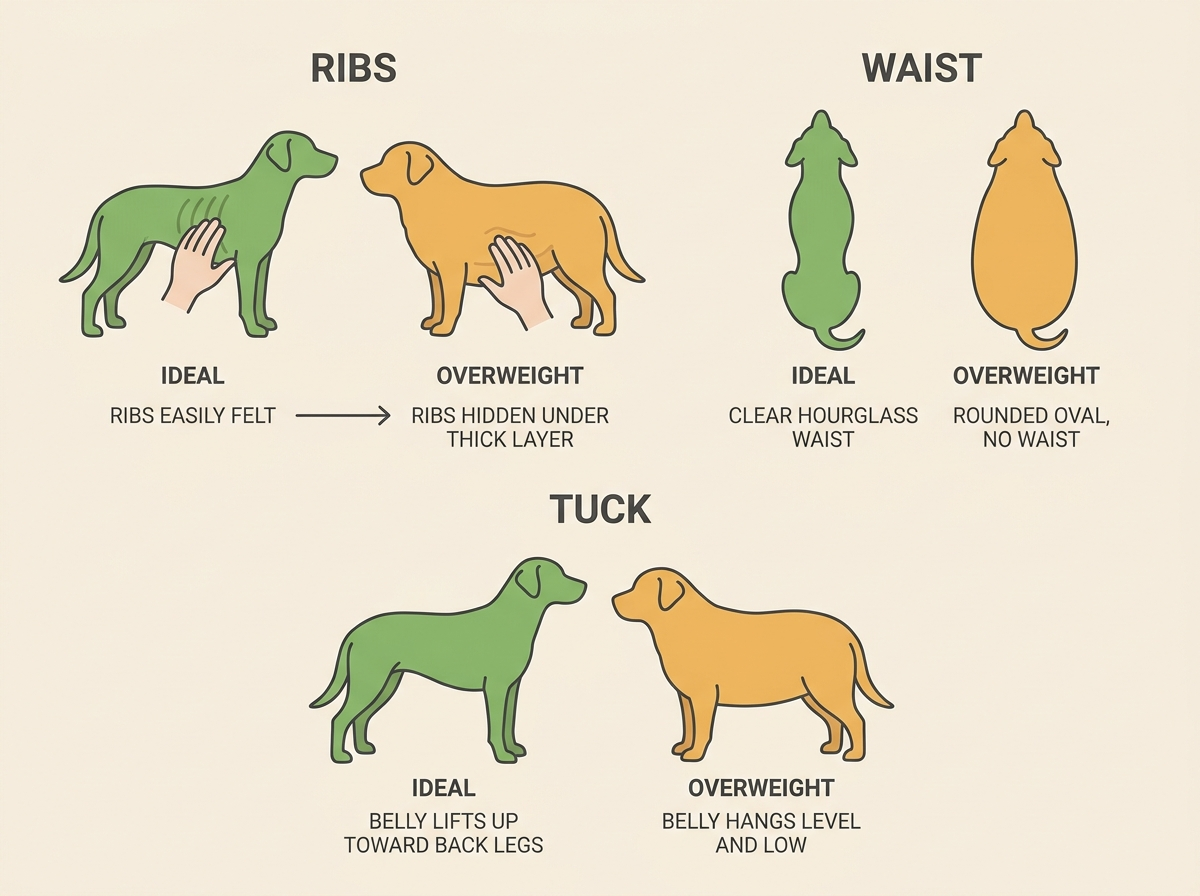
Easy ribs, a visible waist, a clear tuck: that's a dog in good shape. Hard-to-find ribs, no waist, a level or sagging belly: that's a dog carrying too much. You don't need a number yet. You just need a clear read from your own hands.
Why this beats the scale and the mirror
You might wonder why we don't just weigh the dog. The trouble is that a number in kilograms means almost nothing on its own, because breeds vary so enormously. Eighteen kilos is lean on one dog and overweight on another, and even within a breed the right weight for your individual dog isn't a fixed figure you can look up. The scale is brilliant for tracking change over time once you know your dog, but it can't tell you, today, whether your dog is the right weight. Your hands can.
The eye, as we've seen, lies to us kindly. We acclimatise to our own dog, and to a "normal" that has slowly drifted heavier. That is the whole reason the rib-and-waist check exists. It takes "does he look fat to me", which our brains are hopeless at, and replaces it with something physical you can actually feel. This hands-on assessment is the basis of the formal body condition score your vet uses, which puts your dog on a 1-to-9 scale with 4 to 5 as the ideal. If you'd like to turn your at-home read into that proper number you can track, that's the next step, and we walk through it in how to body condition score your dog or cat at home.
A quick word if you've got a cat
The same rib-and-waist check works for cats, and the same gentle truth applies: a very round cat is everywhere online and treated as adorable, but in the consulting room it's a genuine welfare problem, and one worth taking seriously rather than laughing off. Feel for the ribs and look for the waist. The principles don't change.
One catch trips up nearly every cat owner, though. Cats have a normal flap of loose skin and a little fat along the lower belly called the primordial pouch. It hangs down and swings gently when they walk, and it's completely normal, present even in lean, athletic cats, so it is not a sign your cat is overweight (VCA Hospitals, 2024). You can tell it apart by feel: the pouch is soft, loose and floppy, and it moves freely, whereas genuine belly fat is firmer and packed on, and it comes alongside ribs you can no longer feel easily (PetMD, 2023). So judge a cat by the ribs and the waist, never by the tummy. For the full picture there's when round is a real problem for cats and the same body condition scoring guide.
So your dog is overweight. Now what?
If your check came back "yes", here's what that actually means, and what it doesn't. It is not a crisis. It is not your fault. And it is very, very treatable, usually by measuring and gently cutting back the food you already buy, no special purchase required.
It's also worth doing, and not for some abstract reason decades away. The payoff is how your dog moves and feels in the coming weeks. Carrying less weight takes load off the joints and eases the day-to-day stiffness, and the effect is bigger than most owners expect: studies have found that losing as little as around 6% of body weight produces a measurable improvement in arthritis lameness (Marshall et al., 2010). That's a noticeable difference in comfort from a loss most dogs can reach. If your dog is already slowing down or stiff, that link is worth reading in full in weight and arthritis: the single best thing you can do.
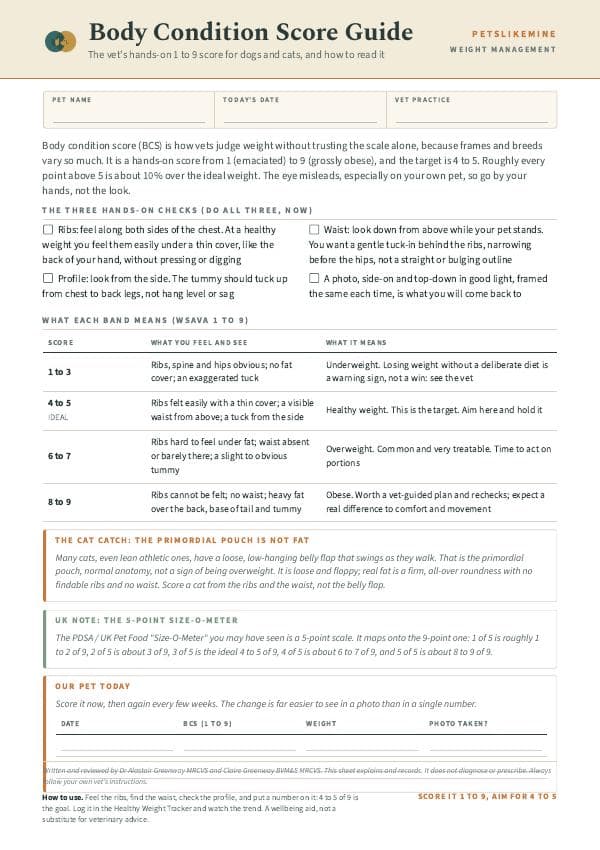
The practical next move is simple. Turn your at-home check into a proper starting point so you've got something to measure against. Get a body condition score, take a starting weight, and you've got a baseline to beat. The easiest way to do both, and to keep them in one place over time with photos so you can actually watch the change, is the Healthy Weight Tracker, and you can print off a body condition score chart to keep on the fridge. From there, body condition scoring, scoring a cat and weighing your pet at home take you through each step.
You've already done the part most people never do. You looked.
References
- People's Dispensary for Sick Animals (PDSA) (2024). PAW Report 2024 / Big Weigh In: UK pet wellbeing, body condition and owner awareness.
- Association for Pet Obesity Prevention (APOP) (2014). Pet Obesity Survey: owner misperception of overweight pets.
- Diez M, et al. (2023). The Perception of the Body Condition of Cats and Dogs by French Pet Owners and the Factors Influencing Underestimation. Animals 13(23):3646.
- WSAVA Global Nutrition Committee (2024). Body Condition Score charts (dog and cat), 9-point scale.
- VCA Hospitals (2024). What is the primordial pouch in cats?
- PetMD (2023). The Cat Primordial Pouch: what it is and why cats have it.
- Marshall WG, et al. (2010). The effect of weight loss on lameness in obese dogs with osteoarthritis. Veterinary Research Communications 34:241-253.
Free downloads
Companion worksheets to put what you've read into practice. Free PDFs, print at home.
Keep track of how your pet is doing
The owners who cope best are the ones who notice changes early. A simple health log shows you what is working, and what is not, before the next vet visit.
Start tracking, freeYou're not doing this alone
Compare treatment journeys and talk to owners managing weight management. Free to join.
Join PetsLikeMine