

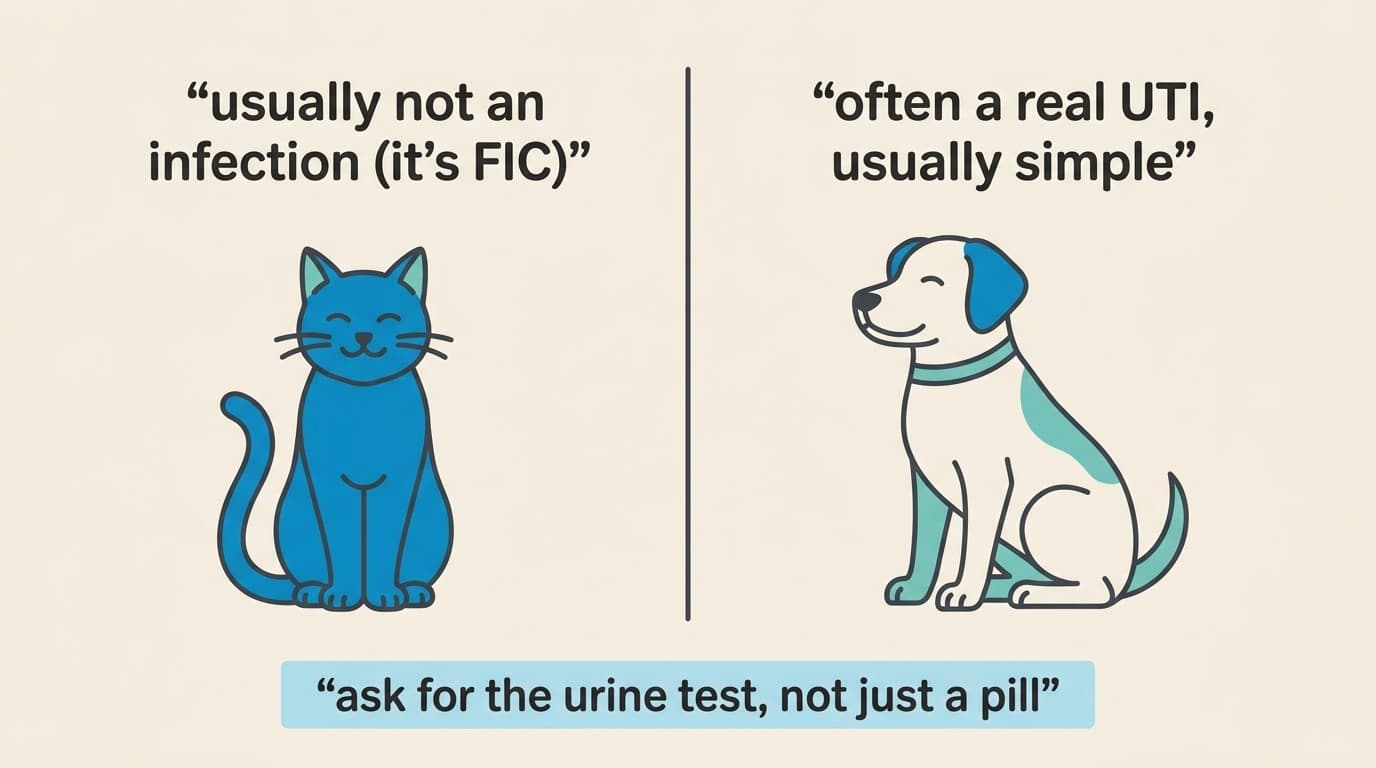
"Is It a UTI?" Why Your Cat Probably Hasn't Got One (and Your Dog Might)
Alastair Greenway
BVM&S MRCVS
Frequent dashes to the litter tray, a spot of blood, and one word lands in your head straight away: "UTI". It's the obvious guess. It's what we get as humans, it's what the search box suggests, and it's what a lot of pet websites will tell you to treat. So it comes as a surprise when your vet runs a urine test, finds no infection, and doesn't reach for the antibiotics.
That isn't your vet being unhelpful. In cats, a true bladder infection is genuinely uncommon, and most of the time those classic "UTI" signs are something else entirely. In dogs the picture flips, real infections are common, but even there, antibiotics aren't always the right answer. Here's the straight version for both species, without making you feel daft for thinking "UTI" in the first place, because it was a perfectly sensible first guess.
The short answer, both species
"UTI" gets used as a catch-all for any urinary sign, the straining, the blood, the endless trips to the tray or the garden. But a urinary tract infection means one specific thing: bacteria growing where they shouldn't, in the bladder or urethra. That's just one of several causes of those signs, and in cats it's an uncommon one.
So your straining cat very probably doesn't have an infection. The far more likely explanation is feline idiopathic cystitis, a stress-linked, sterile inflammation of the bladder (much more on that below, and in our piece on feline idiopathic cystitis). Your dog, on the other hand, genuinely might have an infection. Same two words, "urine infection", and almost opposite odds depending on which animal is sitting in front of you.
Cats: why it's usually not an infection
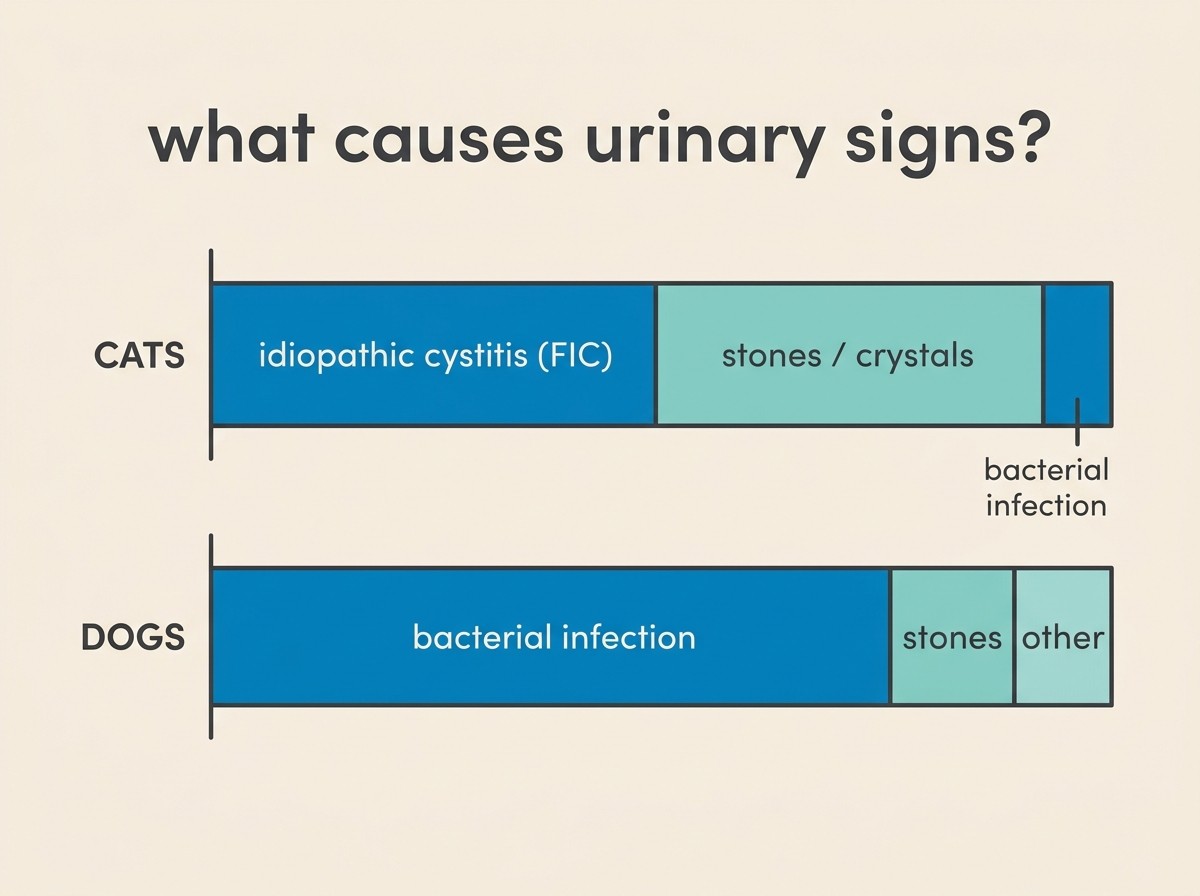
In otherwise-healthy young and middle-aged cats, bacterial urinary tract infections are uncommon. Most cats with lower urinary signs don't have an infection at all; their urine is sterile. Idiopathic cystitis alone accounts for somewhere between roughly 55 and 65% of these cases, and true bacterial infection is found in well under one in ten of them. The international veterinary infectious-disease guidelines say it plainly: in cats, a genuine bacterial bladder infection is uncommon, so it's reasonable to hold off on antibiotics until a urine culture comes back (ISCAID guidelines, Weese et al. 2019).
So what is it, if not an infection? Usually feline idiopathic cystitis, or FIC. The bladder lining becomes inflamed and painful, the cat strains, passes small amounts, sometimes with blood, and often starts weeing outside the tray, all of which look exactly like an infection. The crucial difference is that there's nothing to kill. The trigger is stress, not bacteria, which is why the genuine treatment is more water and a calmer environment, not a course of tablets (we walk through that in managing FIC with MEMO and water, diet and your cat's bladder).
This is the real reason antibiotics so often seem to "not work" in cats. It isn't that the wrong antibiotic was chosen. It's that there was no infection there to treat in the first place, and the flare was going to settle on its own anyway. That's also why a urine test matters before anyone reaches for medication. The single drawing you want in your head:
When a cat genuinely is at risk
Here's the important exception, and it's the bridge to the rest of your pet's health. The picture changes with age and illness. Older cats, and cats with certain conditions, do get real bacterial infections, sometimes with no obvious signs at all.
The big three predisposing illnesses are chronic kidney disease, diabetes and an overactive thyroid (hyperthyroidism). In cats with these conditions, true infections are found far more often, around one in eight cats with diabetes or hyperthyroidism (12% of each) and roughly one in five with kidney disease (22%) in one Cornell study (Mayer-Roenne et al. 2007). In fact, when a cat does turn out to have a urinary infection, there's an underlying condition alongside it most of the time, around four in five cats in one German series (Dorsch et al. 2016). That's why a vet faced with a senior cat will often run a urine culture even when the cat seems otherwise fine, and why an infection in an older cat is a prompt to look for what's underneath it.
Now to separate two things that sound similar but aren't. If your older cat is drinking a lot more, losing weight and seeming generally off, that points up the urinary tract towards the kidneys, not at a simple bladder problem, and it belongs with our kidney (CKD) guidance and our boundary article, bladder or kidneys?, rather than here. The bladder is not the kidney, and "drinking more, getting thinner, older cat" is a different conversation that deserves its own work-up. If your cat also has diabetes or thyroid disease, the diabetes and hormone health guides are worth a look too, because controlling the underlying illness is part of preventing the infections.
Dogs: common, and usually simple
Dogs really do get bacterial urinary infections, and they're common. The often-quoted estimate is that roughly one in seven dogs (about 14%) has at least one in its lifetime, and bitches get them more often than males because of their shorter, wider urethra. The bug behind most of them is the same one that causes a lot of human UTIs, Escherichia coli, which accounts for around half of canine cases (ISCAID guidelines, Weese et al. 2019).
The signs are what you'd expect, and what brought you here: frequent squatting, straining, only small amounts coming out, an urgent need to go, sometimes blood, sometimes accidents in the house from a previously clean dog. The good news is that the large majority are what vets call sporadic or uncomplicated, a single, one-off episode in an otherwise-healthy dog that clears up with the right, short course of treatment.
It only gets complicated when infections keep coming back, or when there's something underlying, stones, an anatomical quirk, diabetes, Cushing's disease or a problem higher up. Repeated or stubborn infections deserve a proper work-up rather than another round of the same tablets, which we cover in urinary tract infections in dogs. And one important note for dog owners who've landed here from a different worry: a leaking spayed bitch who's otherwise well usually doesn't have an infection at all, she more often has a treatable weakness of the bladder-neck muscle, which is its own thing (see my spayed dog is leaking urine).
Why "no antibiotics" can be the right call
This is the part that feels counter-intuitive when you came in expecting a prescription. Sometimes the best medicine is no antibiotic, and that's good practice, not penny-pinching.
Giving antibiotics for feline idiopathic cystitis, or for vague urinary signs without a confirmed infection, doesn't help your pet. There's nothing for the drug to act on, so your cat carries on flaring while the real triggers, stress and dilute-enough urine, go unaddressed. And every unnecessary course nudges bacteria, in your pet and in the wider world, towards resistance, so the antibiotics we genuinely need work less well when it counts. That's a real and growing problem, and it's exactly why modern veterinary guidance is to test before treating, and not to treat infections that are only found by chance with no signs to go with them (ISCAID guidelines, Weese et al. 2019). A large UK study of cat urine samples found that of the bugs grown, a meaningful share were resistant to commonly used antibiotics such as amoxicillin and cephalexin, which is precisely the situation responsible prescribing is trying to slow (D'Août et al. 2022).
So how do you be a good advocate for your pet? Ask for the test, not the pill. A urine sample, and where appropriate a culture (the lab test that actually grows and identifies any bacteria), tells everyone whether there's an infection to treat, which antibiotic would work if there is, and whether to look elsewhere if there isn't. If your vet suggests a urine test before, or instead of, antibiotics, that's them practising careful medicine on your pet's behalf. (Our guide on how to describe urinary signs to your vet and collect a sample makes the test much easier to get right, and our urine sample collection how-to download walks you through it.)
What to do while you wait
Whatever the cause turns out to be, a few things are sensible from today, and none of them is a tablet.
Get more water in. It's the cheapest and most useful thing you can do for any bladder, dog or cat, because more dilute urine is less irritating and less likely to form crystals or plugs. Wet food, a fountain and several water stations all help (the full playbook is in why getting more water in is the best thing you can do for your pet's bladder, with practical tips in our water-intake boosting download). For a cat, reducing stress genuinely matters too, since that's what drives most feline flares (managing FIC with MEMO).
And know the one red line that overrides everything on this page. If a male cat is straining in the tray and passing little or nothing, crying, off his food, vomiting or hiding, that is not a UTI and it is not something to wait on. It can be a urethral blockage, a true emergency that can be fatal within about a day, and it needs a vet today, out of hours if needed. Please read is this an emergency? straight away, or run our Blocked-Cat triage tool, if that sounds like your cat.
For everyone else: it was a fair guess, it's usually not an infection in a cat, it often is in a dog, and the right next step is a urine test, not a panic. Start with more water, keep an eye on the signs, and let the test, not the assumption, decide what happens next.
References
- *Prevalence, Risk Factors, Pathophysiology, Potential Biomarkers and Management of Feline Idiopathic Cystitis: An Update Review.* Frontiers in Veterinary Science, 2022;9:900847. (Open-access review confirming FIC accounts for ~55-67% of feline lower urinary tract disease.)
- Weese JS, Blondeau J, Boothe D, et al. *International Society for Companion Animal Infectious Diseases (ISCAID) guidelines for the diagnosis and management of bacterial urinary tract infections in dogs and cats.* The Veterinary Journal, 2019;247:8-25. (open PDF: https://www.vdl.ndsu.edu/wp-content/uploads/2022/02/ISCAID-Urinary-Guidelines-2019.pdf)
- Dorsch R, Teichmann-Knorrn S, Sjetne Lund H. *Urinary tract infection and subclinical bacteriuria in cats: a clinical update.* Journal of Feline Medicine and Surgery, 2019;21(11):1023-1038.
- Dorsch R, von Vopelius-Feldt C, Wolf G, Mueller RS, Straubinger RK, Hartmann K. *Urinary tract infections in cats: prevalence of comorbidities and bacterial species, and determination of antimicrobial susceptibility to commonly used antimicrobial agents.* Tierärztliche Praxis Ausgabe K, 2016;44(4):227-236. (78.4% of cats with a UTI had a relevant comorbidity.)
- Mayer-Roenne B, Goldstein RE, Erb HN. *Urinary tract infections in cats with hyperthyroidism, diabetes mellitus and chronic kidney disease.* Journal of Feline Medicine and Surgery, 2007;9(2):124-132. (UTI in 12% with hyperthyroidism, 12% with diabetes, 22% with CKD.)
- Ling GV. *Therapeutic strategies involving antimicrobial treatment of the canine urinary tract.* JAVMA, 1984 (origin of the ~14% canine lifetime UTI estimate); and Thompson MF, Litster AL, et al. *Canine bacterial urinary tract infections: new developments in old pathogens.* The Veterinary Journal, 2011.
- Cornell Riney Canine Health Center. *Urinary Tract Infections (dogs).*
- International Cat Care (iCatCare/ISFM). *Feline idiopathic cystitis (FIC) in cats.*
- D'Août C, Taylor SS, Gelendi S, Atkinson C, Defauw P. *Bacteriuria in Cystocentesis Samples from Cats in the United Kingdom: Prevalence, Bacterial Isolates, and Antimicrobial Susceptibilities.* Animals (Basel), 2022;12(23):3384. doi:10.3390/ani12233384.
- *Prevalence of Bacterial Urinary Tract Infections in Dogs and Cats with Lower Urinary Tract Diseases and Other Illnesses: A Systematic Review and Meta-Analysis.* Animals (Basel), 2025;15(23):3456. doi:10.3390/ani15233456. (Pooled UTI prevalence ~44.6% in dogs vs ~18.6% in cats.)
Keep track of how your pet is doing
The owners who cope best are the ones who notice changes early. A simple health log shows you what is working, and what is not, before the next vet visit.
Start tracking, freeYou're not doing this alone
Compare treatment journeys and talk to owners managing urinary health. Free to join.
Join PetsLikeMine