

Injection-Site Sarcoma in Cats: The One You've Never Heard Of
Alastair Greenway
BVM&S MRCVS
A week or two after your cat's routine vaccinations, you run a hand over her and feel a small lump under the skin, right where the needle went in. The visit had gone fine. Then you look it up, and a phrase you've never come across appears: injection-site sarcoma. All of a sudden a tiny bump feels enormous, and a worrying thought follows close behind, the one we most want to head off here, which is "should I just stop vaccinating?"
A lump after an injection is almost always nothing to worry about, the cancer this page is about really is rare, and dropping your cat's core vaccines would swap a very small risk for some far larger ones. What's genuinely useful is a simple way to tell which lumps are worth keeping an eye on, and that's most of what you'll find below.
Feline injection-site sarcoma in plain terms
A feline injection-site sarcoma, usually shortened to FISS, is a cancer that grows from the connective tissue under the skin at a spot where an injection has been given. Most are a type called a fibrosarcoma (NC State University College of Veterinary Medicine). The current thinking is that it begins as a reaction to inflammation at the injection site, which very occasionally, over months to years, tips over into a tumour.
What makes it worth taking seriously, rare as it is, comes down to how it behaves. FISS is locally aggressive. Rather than sitting as a tidy ball, it sends roots out into the surrounding tissue, and that's exactly what makes it so hard to remove fully. It can spread to other parts of the body, in up to around a quarter of cats, but its main habit is returning to the same spot if it wasn't taken out widely enough first time (NC State University College of Veterinary Medicine). That local stubbornness is why vets treat it with such respect.
Vaccines are the injections most people talk about, but FISS has been linked to other injected products as well, including some long-acting medications. The common thread is the injection and the inflammation it sets off, not vaccines as such.
So how rare is it?
Rare. The honest difficulty is that the published estimates spread across a fairly wide range, because the condition is uncommon enough that it's hard to count with any precision. A solid UK study put the risk somewhere between 1 in 5,000 and 1 in 12,500 vaccination visits (Dean, Pfeiffer & Adams, 2013). The American Veterinary Medical Association puts it at roughly 1 cat in every 10,000 to 30,000 vaccinations (AVMA). Whichever figure you take, the great majority of cats vaccinated each year never develop one.
The risk has also been falling. The AVMA notes that better vaccines and better technique have cut it sharply. That includes newer vaccine technology (the so-called recombinant, non-adjuvanted vaccines, which leave out the irritant "adjuvant" that older killed vaccines used to boost the response) and more thoughtful schedules, where your vet gives only the vaccines your individual cat actually needs (AVMA).
The lump after a jab, and the rule that tells you what to do
A small, soft, slightly tender swelling at an injection site in the first days or weeks afterwards is usually just the body's normal reaction, and it settles by itself. There's no need to panic over it. What you do is watch it, and apply a simple rule that vets use, often called the 3-2-1 rule.
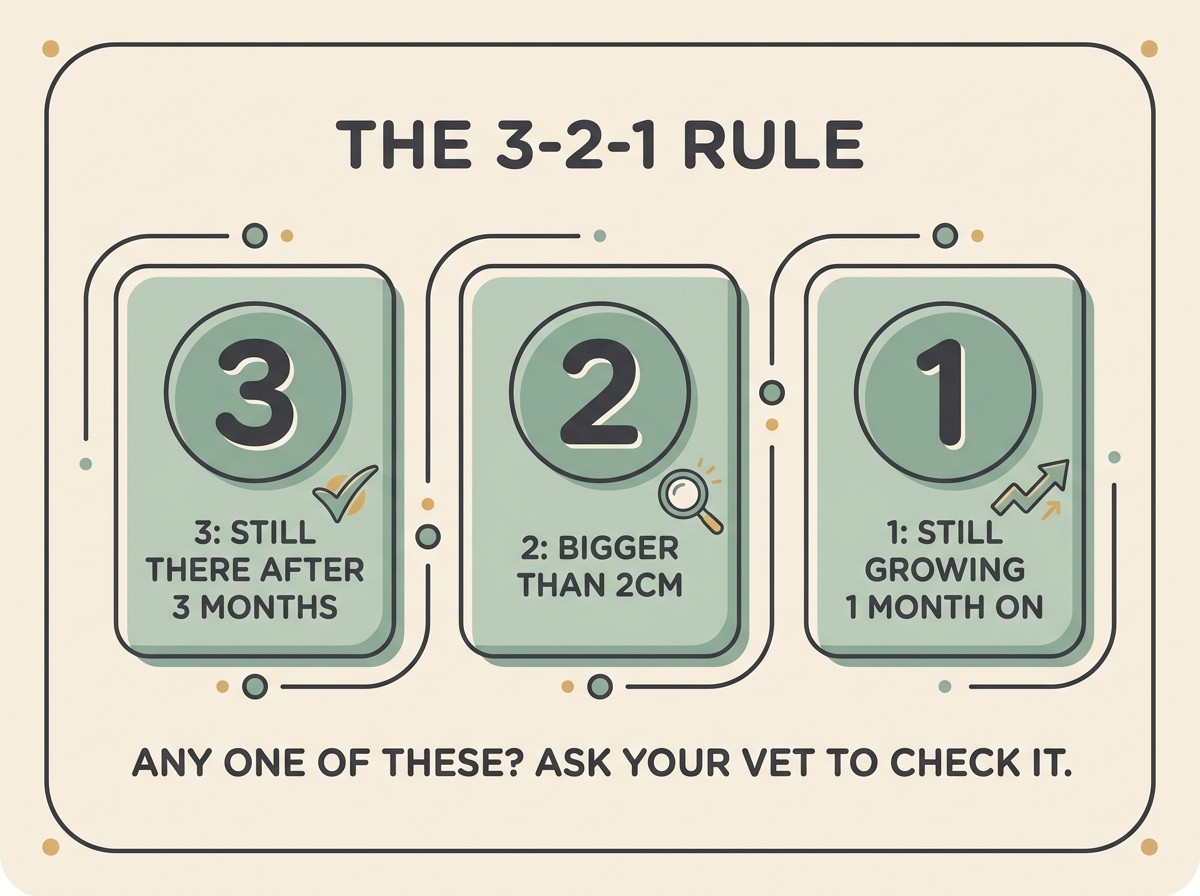
The 3-2-1 rule says to have a lump at an injection site checked, and usually sampled or biopsied, if any one of these is true (Today's Veterinary Practice, 2021):
- it's still there 3 months or more after the injection,
- it's bigger than 2 centimetres across, or
- it's still growing 1 month after the injection.
Tick any one of those boxes and it's worth a proper look, which usually means a sample to find out what the lump is made of (you can read what that involves in our guide to aspirates and biopsies). Most lumps that get checked turn out to be harmless. But catching a FISS while it's early and small makes it so much easier to treat, and that's why this is the rare situation where watching and hoping really isn't the plan. A handy way to stay on top of it is to note where each injection went and to measure and photograph any lump in the Lump & Bump Tracker, so you and your vet can see at a glance whether it's changing.
Why a quick "lumpectomy" isn't enough
If a sample does confirm a sarcoma, the thing to grasp is that this is not a lump you simply pop out. Because FISS sends those finger-like roots into the surrounding tissue, a small "shell it out" operation almost always leaves cancer cells behind, and it grows straight back.
What actually works is wide, sometimes radical, surgery. The surgeon takes a generous margin of normal-looking tissue all around and beneath the tumour, often around 5cm in every direction and a layer or two of muscle deep (NC State University College of Veterinary Medicine; Today's Veterinary Practice, 2021). Done thoroughly, the great majority of tumours are fully removed, with one approach achieving complete margins in around 97% of cases, though even then about 14% still come back, which is why follow-up matters (Today's Veterinary Practice, 2021). It's often paired with radiotherapy before or after the operation to mop up stray cells, and sometimes chemotherapy too, particularly for higher-risk tumours (NC State University College of Veterinary Medicine). Handled this way by a specialist team, many cats do well: surgery alone gives an overall survival of around 12 to 16 months, and adding chemotherapy and radiation can stretch the tumour-free interval to roughly 18 to 24 months (NC State University College of Veterinary Medicine). It all comes back to the first surgery being the best chance, so a confirmed FISS belongs with a surgeon or oncologist who treats them, not a wait-and-see plan (our article on cancer surgery and clean margins explains why that first attempt counts for so much).
Please keep vaccinating: weighing the real risks
The diseases that core vaccines prevent (things like feline panleukopenia, cat flu and rabies where it's relevant) are common, they spread easily, and they kill cats. Set against that, the risk of a sarcoma is very small. As one university cancer centre puts it, the risk of not vaccinating against certain diseases may be far higher than the risk of a tumour developing (NC State University College of Veterinary Medicine). Leading veterinary bodies agree: vaccination remains one of the most important parts of keeping a cat healthy, and you should keep vaccinating (AVMA). Giving up your cat's vaccines to dodge a rare cancer would mean trading a small risk for some genuinely large ones.
What is reasonable, and worth a relaxed chat with your vet, is making sure your cat gets the vaccines she actually needs for her lifestyle and no extras, and asking whether the newer non-adjuvanted vaccines are an option. You may also notice your vet now gives injections low down on a leg, or even into the tail, rather than between the shoulder blades. Nothing is wrong when they do that. It's a deliberate, sensible change, so that in the very unlikely event a sarcoma ever did form, it would be somewhere it could be removed completely (AAHA/AAFP, 2020; Today's Veterinary Practice, 2021).
Where that leaves you
Keep it simple. Carry on protecting your cat with the core vaccines she needs, and treat a fresh post-jab lump as a watch-and-check rather than a crisis. Make a mental note of roughly where each injection goes, run any lump past the 3-2-1 rule, and if it ticks even one box, ask your vet to take a sample rather than leaving it. You can log and photograph it in the Lump & Bump Tracker in the meantime so the picture stays clear. The reassuring truth is that almost every lump you'll ever feel after an injection is harmless, and the rare one that isn't is most beatable exactly when it's caught the way this page describes: early, and small.
References
- NC State University, College of Veterinary Medicine, Veterinary Hospital (Medical Oncology). Feline Injection Site Sarcoma. (FISS arises from connective tissue, most commonly a fibrosarcoma; "spread to distant sites in the body occurs in up to 25% of cats"; wide surgical resection given the high local recurrence rate; "despite the association with vaccination, the risk of not vaccinating for certain diseases may be much higher than the risk of tumor development"; "surgery alone can offer an overall survival of 12-16 months" and "combining surgery, chemotherapy, and radiation therapy increases the tumor-free interval to 18-24 months").
- Today's Veterinary Practice (2021). Feline Injection Site Sarcomas: Risk Factors, Diagnosis, Staging, and Treatment Algorithm. (the 3-2-1 rule for biopsy: a mass present ≥3 months, larger than 2cm, and/or still increasing 1 month after injection; radical excision with at least 5cm margins around the palpable tumour edge and up to 2 fascial planes deep, giving complete margins in 97% of cases; recurrence despite radical excision in 14% of cases; post-operative radiation typically begun within 10 to 14 days; recommended vaccine sites in the distal limbs).
- Dean, R.S., Pfeiffer, D.U., & Adams, V.J. (2013). The incidence of feline injection site sarcomas in the United Kingdom. BMC Veterinary Research, 9, 17. (PMID 23339769) ("The incidence risk of FISS per year was estimated to be 1/16,000–50,000 cats registered by practices, 1/10,000–20,000 cat consultations and 1/5,000–12,500 vaccination visits").
- American Veterinary Medical Association. Vaccines and sarcomas: a concern for cat owners. (injection-site sarcomas are uncommon, with the chance occurring in "about 1 cat per 10,000 to 30,000 vaccinations"; "improvements in vaccines and vaccination techniques have greatly reduced the risk"; vaccination remains important and owners should monitor for suspicious lumps and seek care early).
- 2020 AAHA/AAFP Feline Vaccination Guidelines (Stone AES, et al.). Vaccination site recommendations. J Feline Med Surg, 2020;22(9):813-830. (vaccination low on the distal limbs, below the elbow or stifle, rather than the interscapular region, to facilitate complete tumour removal including by limb amputation should a FISS develop; tail, in its distal third, as an alternative site; interscapular injection not recommended).
Sister tool · Sightline
Track quality of life over time
Sightline, a separate ConciergeVet tool, runs a short adaptive weekly assessment with a quality-of-life focus mode built around exactly these frameworks, tracks a single composite score over time so you can see the trend rather than judge a single bad day, and produces a Sightline Report PDF you can bring to your vet.
A written log, or our printable quality-of-life sheet, does much the same job.
See how Sightline tracks quality of lifeFound a lump? Track it, and know when to act
A lump cannot be told apart by look or feel; only your vet sampling it can. The Lump & Bump Tracker records its size and how it changes, flags when it has crossed a line worth a vet visit, and builds a clean history to take in.
Open the Lump & Bump TrackerYou're not doing this alone
Compare treatment journeys and talk to owners managing cancer. Free to join.
Join PetsLikeMine