

Is It Incontinence or Something Else? Ruling Out Infection, Stones and Behaviour
Alastair Greenway
BVM&S MRCVS
A damp patch on the bed, a leaking spayed dog, and a tidy explanation that it's a weak bladder-neck muscle. That fits most cases, and it's reassuring. But before you settle on it, it's worth being sure, because a handful of other things can produce much the same picture, and each one needs a different fix. The medicine for a weak sphincter won't touch an infection, a stone, or a behaviour problem.
Telling them apart is usually straightforward, and most of it turns on one question you can start answering at home tonight: is she leaking, or is she weeing? Those sound like the same thing. They aren't, and the difference sends your vet down completely different paths.
Leaking versus weeing: the question that splits everything
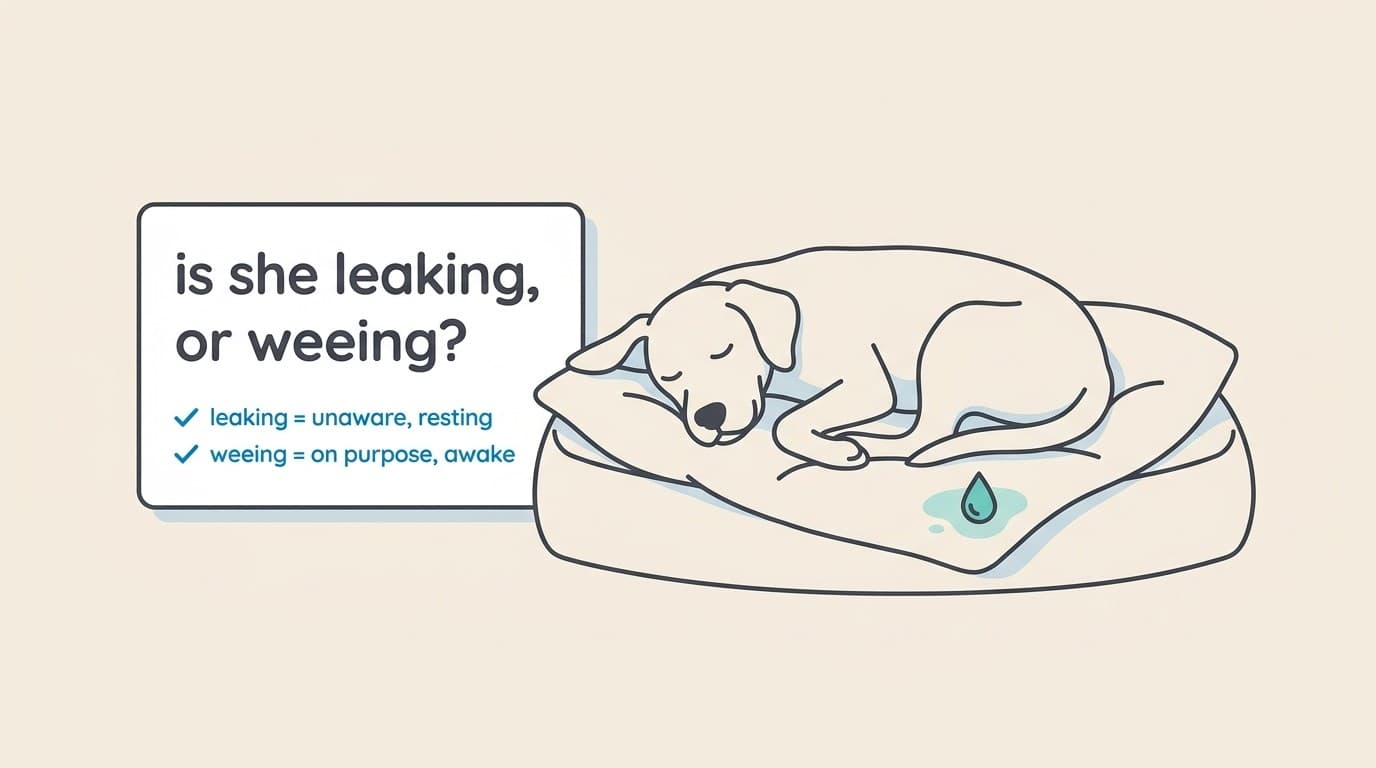
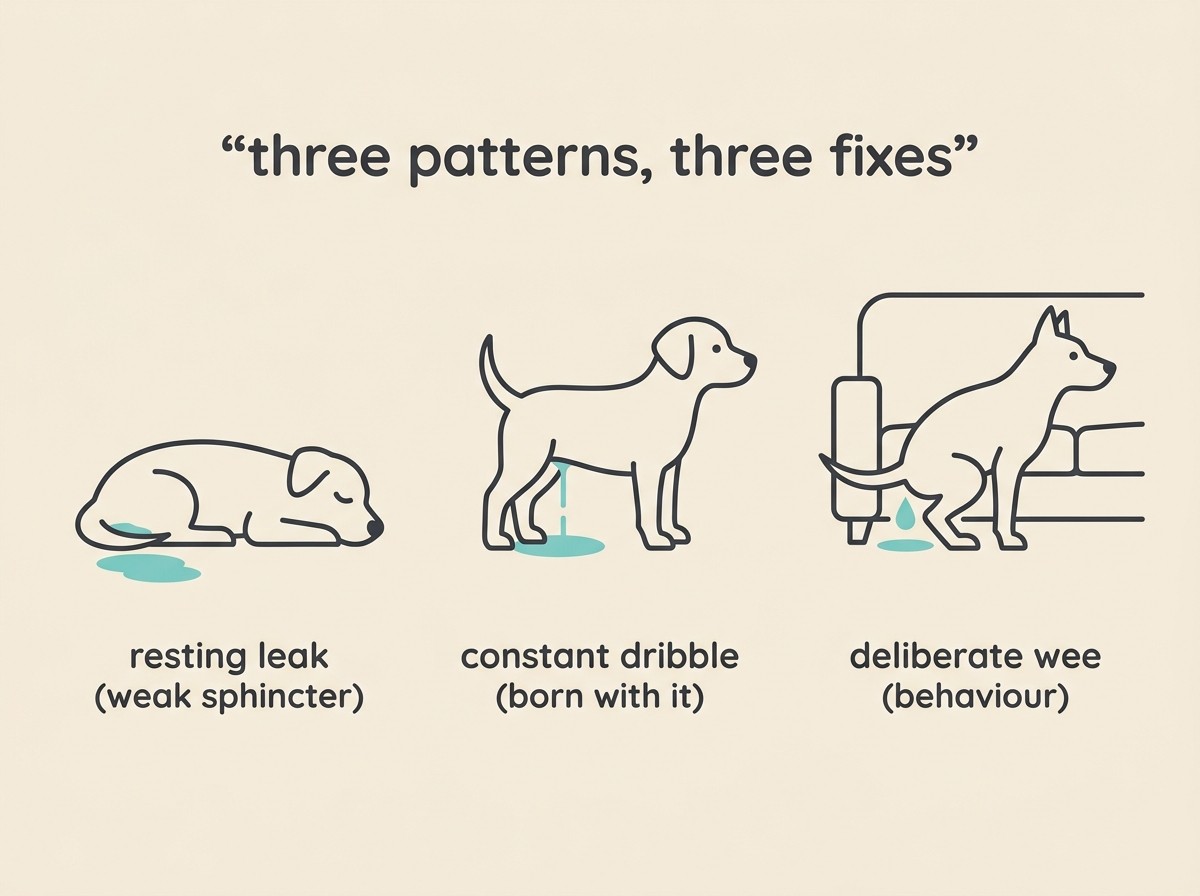
True incontinence means urine escaping without your dog meaning it to, and usually without her even knowing. The classic picture is a passive leak while she's relaxed, lying down or fast asleep, leaving a wet patch she didn't feel happen and a dog who's a bit puzzled by the damp bed (UC Davis Veterinary Medicine; MSD Veterinary Manual). She squats and wees perfectly normally the rest of the time. That pattern, dry and continent when she's up and about, leaking when she's resting, is the signature of urethral sphincter mechanism incompetence, USMI, the weak bladder-neck muscle covered in my spayed dog is leaking urine.
Now picture a dog who is consciously passing urine in the wrong place: cocking a leg against the sofa, squatting on the carpet while wide awake, or producing small dabs on upright surfaces. Vets call that periuria, and it's a different animal entirely. It might be a house-training gap, marking, excitement or submissive weeing, or a sign she suddenly can't hold on (Today's Veterinary Practice). The volume and the posture are the tell. A relaxed leak is passive and she's unaware; a deliberate wee involves her getting into position and emptying out.
So before anything else, watch her for a few days and note three things: when it happens (asleep and resting, or up and active), whether she seems aware of it, and whether the urine is a puddle she's lain in or a deliberate squat or cock of the leg. That little log does more to sort this out than almost any test, and it's exactly what your vet will ask. Our dog incontinence management and medication chart download has a simple leak diary you can use, and how to describe urinary signs to your vet walks through what's worth noting.
The medical mimics: what else makes a dog leak or wet
Even when it does look like a passive leak, a handful of medical problems can copy it or pile on top of it. This is what your vet rules out before reaching for the incontinence tablets, because if one of these is at play, the tablets alone won't fix it.
A urine infection. A bladder infection irritates the bladder lining and can make a dog wee small amounts, urgently, often with a bit of blood, and sometimes have accidents she can't help. The nuance that catches people out, though: in a dog with USMI, an infection is more often a consequence of the leaking than its cause. A bladder that doesn't empty crisply, and a weak sphincter that lets bacteria creep up, together make infection more likely (Today's Veterinary Practice). In one small study of bitches with a congenital weak sphincter, every one of the six that had a urine culture grew bacteria (Acta Veterinaria Scandinavica). Either way, an infection can make the leaking worse, so it's checked and treated, but treating it usually settles the flare without curing an underlying sphincter weakness. (The whole "is it a UTI?" question, and why it's a different story in cats, is in "is it a UTI?".)
Bladder stones. Stones scratch and irritate, so they tend to cause straining, frequent small wees and blood rather than a silent resting leak. Occasionally a stone or other blockage stops the bladder emptying, it overfills, and urine dribbles out under pressure, which can masquerade as incontinence. So stones are on the list, especially if there's straining or blood alongside the leaking. The type of stone then decides the plan, which is the whole point of bladder stones in cats and dogs.
Drinking, and weeing, far more than usual. This one matters, and it's easy to miss. If your dog is suddenly drinking a lot more and producing far more urine, a perfectly normal bladder can simply be overwhelmed, especially overnight, and leak (MSD Veterinary Manual). But the real question then isn't the bladder, it's why is she drinking so much. Excessive thirst and urination in a dog points at conditions higher up or further afield, kidney disease, diabetes or Cushing's disease among them, and those need their own work-up. This is the bladder-is-not-the-kidney line we draw throughout this space: if the leaking comes with obvious extra thirst, weight change or an off dog, that's a flag to look past the bladder. Our bladder or kidneys? article covers when urinary signs are really pointing somewhere else.
When she's young: think ectopic ureters
One mimic is really about age. If the dog leaking urine is young, a puppy or a dog under a year, and especially a young bitch who has dribbled more or less constantly since you got her, the cause is more likely to be a plumbing fault she was born with: an ectopic ureter (Merck Veterinary Manual; American College of Veterinary Surgeons).
The ureters are the two tubes carrying urine from the kidneys down to the bladder. Normally they empty into the bladder, where a working sphincter holds it in. With an ectopic ureter, one or both tubes bypass that storage system and open further down, past the bladder neck or even into the vagina, so urine trickles out continuously with no way to hold it (ACVS). The give-away is a young dog who dribbles steadily, awake or asleep, often with a damp, sore patch of skin from the constant wet, rather than the occasional resting puddle of USMI (Today's Veterinary Practice).
It's largely a young female's problem, females are affected many times more often than males, and several breeds carry a higher risk, including the Labrador and Golden Retriever, the Siberian Husky, the Newfoundland and the West Highland White Terrier (Merck Veterinary Manual). It's frequently mistaken at first for a puppy who's just slow to house-train, which delays getting it looked at. Naming it here matters because the fix is completely different: a weak sphincter responds to a daily medicine, but an ectopic ureter usually needs a procedure to reroute or seal off the misplaced tube, and your vet will want to find it rather than treat for the wrong thing. So if your leaking dog is young and has always dribbled, say so, it changes the plan.
And sometimes, yes, it really is behaviour, but rule the body out first
It does happen that an otherwise-healthy dog wees indoors for reasons that aren't about the bladder at all: incomplete house-training, marking, the puddle of excitement when you walk in, or the submissive crouch-and-wee when she's told off or feels cornered (Today's Veterinary Practice; VCA). In an older dog, a sudden change in toileting can occasionally tie in with canine cognitive decline. These are real, and they're solvable, but they're handled with training, management and patience, not a sphincter tablet.
Here is the order that matters, and it's the same rule we apply to a cat weeing outside the litter tray: rule out the medical causes first, always (this is the spine of weeing in the house and the principle behind our whole start-here funnel). An adult dog who was reliably clean and has started having accidents deserves a vet check and a urine test before anyone calls it "naughty" or "spite", because she may have an infection, a stone, a sphincter that's weakening, or be drinking more because something else is brewing. Telling her off for something her body is doing isn't just unfair, it can make a frightened, submissive wetter far worse. Get the body checked, and then, if everything comes back clear, the behavioural angle is the right place to look.
How your vet sorts it out
You don't have to crack this at home, and the work-up is usually quick and low-drama. Armed with the history you've gathered, your vet will:
- Examine her, often watching her wee if they can, and feeling the bladder and the area around it.
- Test a urine sample. This is the workhorse. A urinalysis screens for infection, blood and crystals, and a culture, the lab test that actually grows any bacteria, settles whether there's a genuine infection to treat (Today's Veterinary Practice). A fresh sample from you makes this far easier, and our urine sample collection how-to download shows you how.
- Run bloodwork if she's drinking more, to check the kidneys and look for diabetes or other systemic causes of all that extra urine.
- Scan her with ultrasound to look at the bladder, check it's emptying properly, and hunt for stones or an obvious abnormality (Today's Veterinary Practice).
- Go a step further when it's needed, with a detailed ultrasound, contrast imaging, or a camera passed into the bladder (cystoscopy) if a young dog might have an ectopic ureter. Cystoscopy is the most reliable way to confirm one, though a careful ultrasound now picks up many of them too (Today's Veterinary Practice; Veterinary Radiology & Ultrasound).
For the great majority of middle-aged spayed bitches with a classic resting leak and a clear urine test, that's as far as it goes: the picture fits USMI, and the next step is treatment rather than more tests (UC Davis Veterinary Medicine). The work-up isn't about putting your dog through a battery of investigations, it's about making sure the simple, treatable answer really is the right one before you start the medicine.
And that's the reassuring shape of all this. Most of the time the leak is exactly what it looked like, a treatable weakness of the bladder-neck muscle that responds well to a once-daily tablet in the large majority of dogs (the standard medicine controls the leaking in around 85 to 90% of spayed bitches in studies) (UC Davis Veterinary Medicine; Today's Veterinary Practice). The other causes are worth excluding precisely because they're fixable too, just in a different way. So gather a few days of notes on when and how she leaks, book a visit with a urine sample, and let the test, not the guesswork, point you to the right next step. If it is USMI, treating incontinence: the medicines that work is where you go next; if she's young and has always dribbled, flag the ectopic-ureter possibility; and either way, living with a leaky dog has the day-to-day kit to keep her comfortable and dry-bedded while you sort it.
References
- Today's Veterinary Practice. *Diagnosing and Managing Urinary Incontinence in Canine Patients.* (True incontinence vs periuria; USMI vs ectopic ureter signalment and pattern; UTI as a consequence of UI; diagnostic workup including urinalysis, culture, ultrasound, post-void residual and cystoscopy.)
- MSD/Merck Veterinary Manual. *Disorders of Micturition in Dogs and Cats.* (Incontinence as unconscious passage during storage; differentiation from polyuria/polydipsia, UTI and behavioural problems; USMI, ectopic ureter, detrusor instability and overflow.)
- University of California, Davis, School of Veterinary Medicine. *Urinary Incontinence in the Dog.* (Owner-facing definition; USMI as a diagnosis of exclusion in spayed females; larger-breed risk; phenylpropanolamine effective in over 85% of cases.)
- Merck Veterinary Manual. *Ureteral Anomalies in Animals.* (Ectopic ureters: congenital, juvenile presentation, female predominance, and the familial breed list, including Labrador and Golden Retrievers, Siberian Huskies, Newfoundlands and West Highland White Terriers.)
- American College of Veterinary Surgeons. *Ectopic Ureter.* (What an ectopic ureter is, continuous dribbling and urine scald, young female predominance roughly 20 times that of males, surgical and laser correction.)
- Byron JK, Taylor KH, Phillips GS, Stahl MS. *Urethral Sphincter Mechanism Incompetence in 163 Neutered Female Dogs: Diagnosis, Treatment, and Relationship of Weight and Age at Neuter to Development of Disease.* Journal of Veterinary Internal Medicine, 2017;31(2):442-448. (USMI as the commonest cause of incontinence in neutered bitches, most common in dogs over 20 kg.)
- Langer P, Porsmoguer C, Bolen G, Hamaide A, Noël S. *Congenital urethral sphincter mechanism incompetence: observational clinical findings and treatment outcomes, a small retrospective study in 19 bitches.* Acta Veterinaria Scandinavica, 2026. DOI 10.1186/s13028-025-00841-6. (All nine bitches that had a urine culture were culture-positive.)
- Taylor O, Knight R, Genain M-A, Owen L. *Ultrasonography as a sensitive and specific diagnostic modality for the detection of ectopic ureters in urinary incontinent dogs.* Veterinary Radiology & Ultrasound, 2022;63(3):328-336. DOI 10.1111/vru.13055.
- Today's Veterinary Practice. *Canine House Soiling: Back to Basics.* (Behavioural urination, marking and submissive urination; a vet should evaluate every house-soiling dog to rule out medical causes first.)
- VCA Animal Hospitals. *Dog Behavior Problems: House Soiling.* (Distinguishing marking, excitement and submissive urination from medical causes; check for physical illness when adult-onset soiling starts suddenly.)
Keep track of how your pet is doing
The owners who cope best are the ones who notice changes early. A simple health log shows you what is working, and what is not, before the next vet visit.
Start tracking, freeYou're not doing this alone
Compare treatment journeys and talk to owners managing urinary health. Free to join.
Join PetsLikeMine