

IMHA in Dogs: When the Immune System Attacks the Red Blood Cells
Alastair Greenway
BVM&S MRCVS
Immune-mediated haemolytic anaemia (IMHA) is a serious illness in which a dog's own immune system attacks and destroys its red blood cells faster than the body can replace them. The result is severe, sometimes life-threatening anaemia. If you suspect it, treat it as a same-day emergency and ring your vet straight away.
A new IMHA diagnosis, or the news that your vet is investigating one, is frightening, and you are right to take it seriously. It is one of the more alarming conditions we see in general practice. Even so, I want to walk you through it calmly, because understanding what is happening inside your dog, and why your vet is doing what they are doing, genuinely helps. This guide explains what IMHA is, why it is dangerous, the signs to watch for, and how it is diagnosed. Two companion pieces carry the story forward: our guide to treating IMHA, and our guide to IMHA recovery and relapse.
What IMHA actually is
Your dog's red blood cells are the body's oxygen couriers. They are made in the bone marrow, they live in the bloodstream for a few months, and they carry oxygen from the lungs to every tissue. Normally the immune system leaves them alone. In IMHA, something goes wrong: the immune system mistakenly tags red blood cells as foreign and destroys them. That destruction is called haemolysis, and when it outpaces the marrow's ability to make replacements, the dog becomes anaemic.
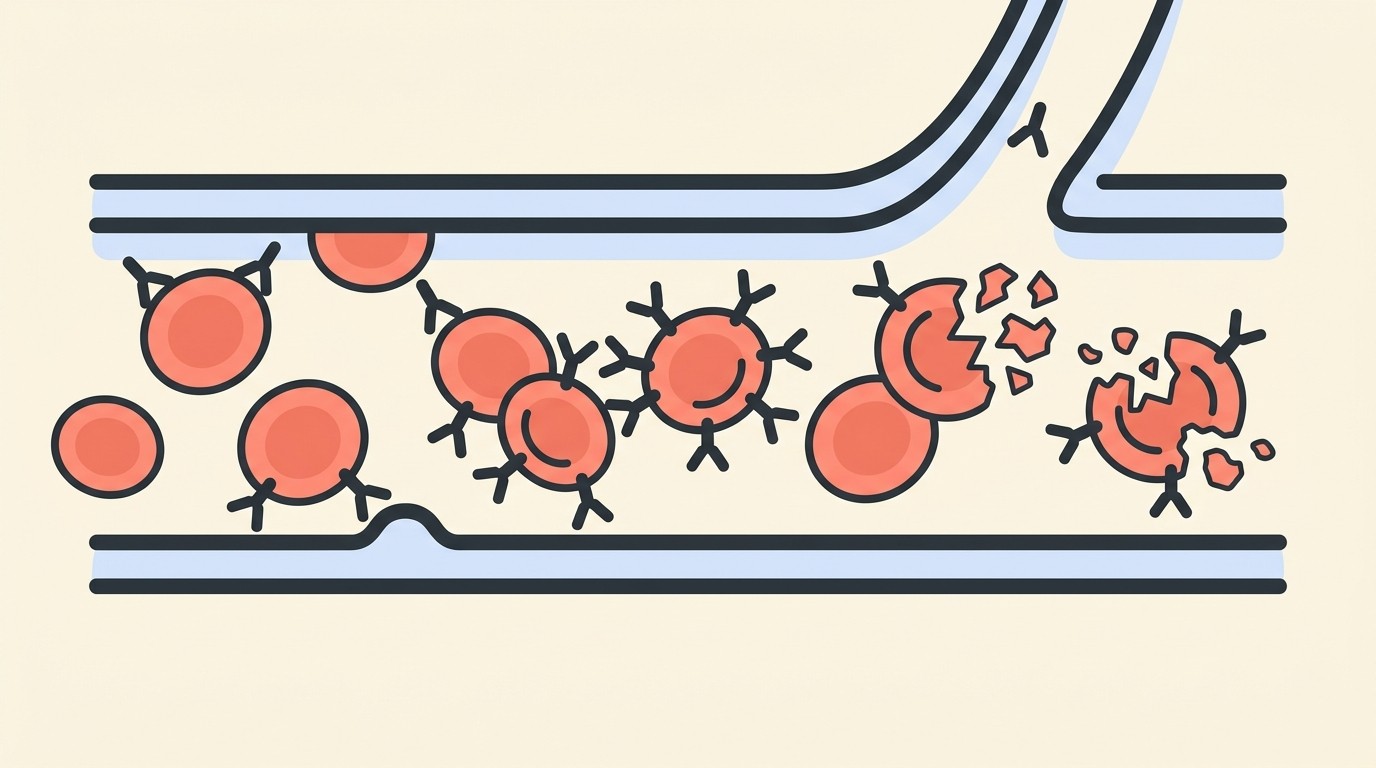
Red cells can be destroyed in two places. Some are flagged with antibodies and cleared by the spleen and liver, which is called extravascular haemolysis. Others burst open inside the blood vessels themselves, which is called intravascular haemolysis and tends to make the dog more acutely unwell. The freed pigment from ruptured cells, called haemoglobin, is processed into bilirubin, which is why many affected dogs look yellow (jaundiced) and may pass dark or orange urine. None of this is the dog's fault, and nothing you did caused it.
The bone marrow does try to fight back. In response to anaemia it pushes out young red cells faster, and your vet can often see this regeneration on a blood test, which is reassuring because it tells us the marrow is responding. There is a catch worth knowing about, though. In roughly a third of dogs the anaemia looks non-regenerative at first, meaning the marrow has not yet caught up or is itself involved (Garden et al., 2019). That does not rule out IMHA, and your vet will interpret it alongside everything else.
Two forms, and why your vet hunts for a cause
IMHA comes in two broad forms, and telling them apart shapes the whole treatment plan.
Primary, or idiopathic, IMHA is the commoner form in dogs. Here the immune system malfunctions on its own with no identifiable trigger. The word idiopathic simply means we cannot find an underlying cause despite looking properly. In the most recent veterinary consensus the experts prefer the term non-associative, but the meaning is the same: the immune system has turned on the red cells for reasons we do not fully understand (Garden et al., 2019).
Secondary IMHA is triggered by something else that sets the immune system off against the red cells. Recognised and suspected triggers include:
- Infections, particularly tick-borne parasites. The blood parasite Babesia gibsoni has strong evidence as a cause in dogs, and other tick-borne organisms such as Ehrlichia, Anaplasma and Mycoplasma are also implicated (Garden et al., 2019).
- Certain drugs, including some antibiotics. The evidence is strongest for specific cephalosporin antibiotics, and other drugs have been associated more loosely (Garden et al., 2019).
- Toxins, such as zinc (for example from swallowed coins or hardware), and onion or garlic, which damage red cells directly and can drive a secondary immune response.
- Bee stings and some snake bites, where the venom appears to act as a trigger in susceptible dogs.
- Cancer, which can occasionally provoke an immune attack on the red cells.
All of this is why your vet will want to run a broader workup rather than simply starting treatment. Finding and removing a trigger, treating the tick-borne infection, removing the swallowed zinc object, stopping the implicated drug, can change the outlook and the treatment entirely. If a cause is found, the underlying problem must be tackled alongside calming the immune system. If none is found after a sensible search, the case is treated as primary. How deep that search goes is always a judgement call your vet will make with you, balancing what is informative against what each test costs.
The signs owners notice, and why this is a same-day emergency
IMHA can come on over a few days or seem to appear almost overnight. Because the dog is short of the oxygen-carrying cells it relies on, the signs reflect a body running low on oxygen and working hard to compensate. Look for:
- Marked lethargy, weakness and exercise intolerance. Many owners describe a dog that suddenly cannot manage the stairs or a normal walk, or that is flat and reluctant to move.
- Pale gums, or gums and the whites of the eyes that look yellow (jaundiced). Lift the lip and look at the gum colour; healthy gums are a salmon pink.
- Fast breathing or a racing heart, as the body tries to push the remaining red cells around more quickly.
- Collapse or fainting, which is a clear emergency.
- Reduced or absent appetite.
- Dark, orange or port-wine coloured urine in some dogs, from the pigment released when red cells break down.
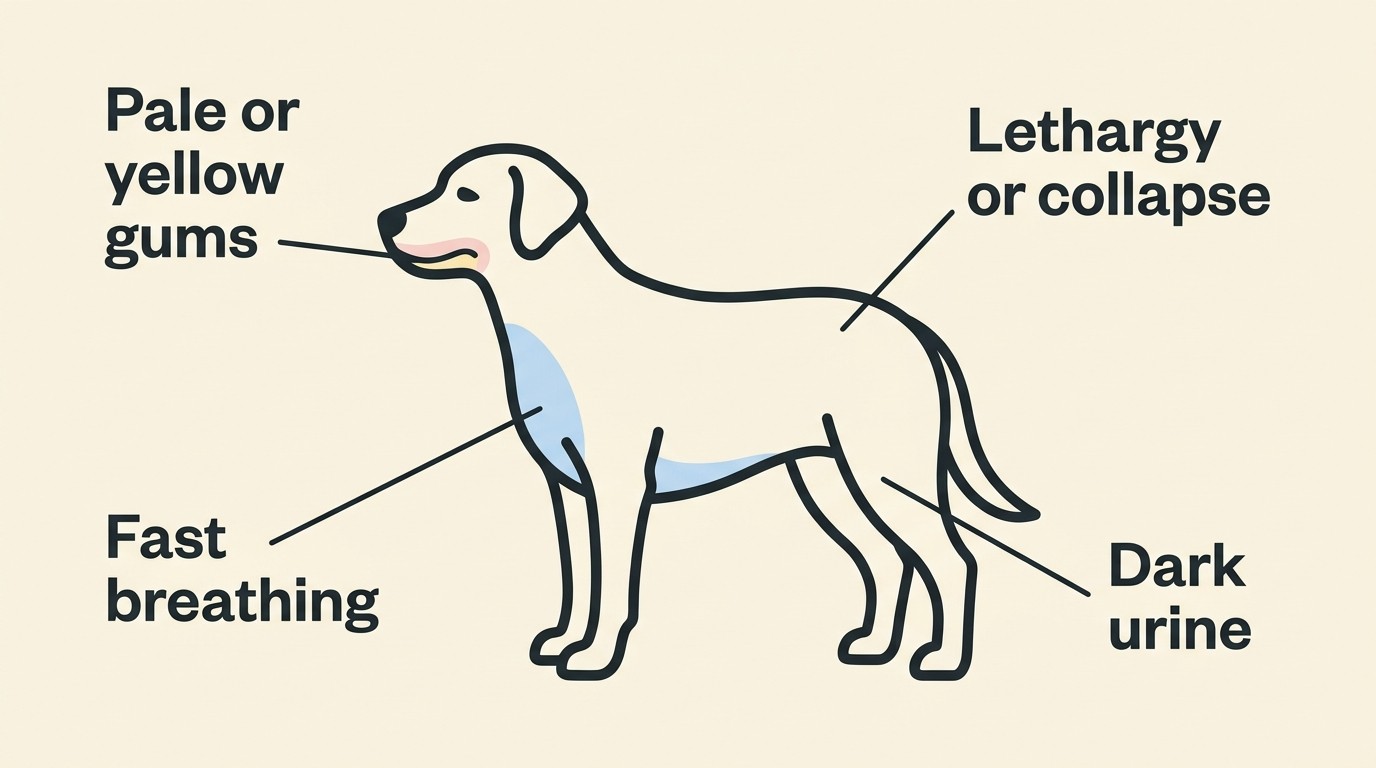
Please do not wait and watch with these signs. IMHA is a same-day emergency. The anaemia can deepen quickly, and the sooner treatment starts the better the chance of stabilising your dog. If it is out of hours, ring your nearest emergency vet rather than waiting for the morning. Bring a note of any recent medicines, possible toxins your dog might have swallowed, and any tick exposure or travel, because all of that helps the team look for a trigger.
Where the real danger lies
There are two dangers running in parallel, and both are serious.
The first is the anaemia itself. When red cell numbers fall far enough, the tissues simply cannot get enough oxygen. A dog can become critically unwell and, in the worst cases, the anaemia alone can be fatal without prompt support, which may include a blood transfusion to buy time while treatment takes effect.
The second danger is less obvious to owners but is, in many studies, the leading cause of death: abnormal blood clotting, known as thromboembolism. For reasons still being unravelled, dogs with IMHA develop an over-active clotting system. As Cornell University's veterinary college puts it, affected dogs have "over-active clotting systems that lead to abnormal blood clot formation," and these clots "can be fatal if they block off the blood supply" to vital organs. Clots in the lungs (pulmonary thromboembolism) are an especially feared and recognised cause of death in canine IMHA (Swann et al., 2019; Today's Veterinary Practice). Cornell researchers are studying why clots fail to break down properly in these dogs, with early work pointing to very high levels of a clotting protein called PAI-1 (Cornell Riney Canine Health Center).
This clotting risk is the reason your vet may start medicines to thin the blood or reduce clotting at the same time as the drugs that calm the immune system. The most recent treatment consensus strongly recommends anti-clotting therapy for most dogs with IMHA (Swann et al., 2019). It can feel surprising to be giving a blood-thinner to a dog who is already dangerously anaemic, but it is a deliberate, evidence-based part of keeping your dog alive. Our guide to treating IMHA goes through these decisions in more detail.
Honesty matters here, so I will be straight with you about the numbers. IMHA is a high-stakes illness, and historically mortality has been high, with some sources describing more than half of affected dogs dying and others reporting a wide range depending on the study and the era, from a minority of dogs dying around the time of diagnosis up to much higher figures over the following months (Today's Veterinary Practice; Swann et al., 2019). Most deaths happen in the first weeks to months. I share this not to frighten you but because you deserve a realistic picture. Many dogs do come through, go into remission and live well, and modern care, early diagnosis and anti-clotting treatment are all aimed at improving those odds.
Which dogs are more at risk
IMHA can affect any dog of any age, breed or sex, so none of these patterns rule it in or out. That said, some are over-represented.
Breed matters. Cocker Spaniels stand out, and in some case series the American Cocker Spaniel alone has made up a striking proportion of cases. Springer Spaniels, Poodles and Old English Sheepdogs are also reported more often than chance would predict, and genetic studies in Cocker Spaniels have found immune-related gene variants that may help explain this, pointing to a heritable component in some lines (Today's Veterinary Practice; Garden et al., 2019).
Age tends to cluster in young adult to middle-aged dogs, with several studies reporting an average age around six years, though it certainly occurs in older and younger dogs too.
Sex shows a modest skew, with a number of studies finding IMHA somewhat more common in female dogs, though this is a tendency rather than a rule (Today's Veterinary Practice).
If you own a breed on that list, please do not lie awake worrying, because the great majority of these dogs never develop IMHA. The value of knowing is simply that, if your dog shows the warning signs above, you and your vet have one more reason to act quickly.
Reaching the diagnosis
Diagnosing IMHA is a matter of building a picture from several tests rather than relying on a single result, because every test can occasionally mislead. Your vet works through a logical sequence (Garden et al., 2019).
Confirming the anaemia. A packed cell volume (PCV), sometimes called haematocrit, measures the proportion of blood made up of red cells. In IMHA this is often markedly low. It is a quick, inexpensive test that can be run in the practice and repeated to track progress.
Looking for evidence of immune destruction. A drop of blood is examined under the microscope on a blood smear. Two findings are particularly telling. Spherocytes are small, dense red cells produced when the immune system has partly nibbled away at them, and seeing them in numbers strongly supports IMHA in dogs. Autoagglutination is visible clumping of red cells caused by antibodies sticking them together. Your vet can also run a simple saline agglutination test, mixing blood with saline on a slide, to check whether that clumping is true agglutination rather than normal stacking. Genuine, persistent agglutination is highly specific for IMHA (Garden et al., 2019; Today's Veterinary Practice).
Confirming the marrow is responding. Signs of regeneration, such as larger young red cells and raised reticulocyte numbers, tell us the bone marrow is trying to replace what is being lost. As mentioned, a non-regenerative result early on does not exclude IMHA.
Supporting tests. A direct antiglobulin test, often called the Coombs test, can detect antibodies bound to the red cells when the simpler tests are inconclusive. Beyond confirming IMHA, your vet will usually run wider tests to hunt for a secondary trigger: blood biochemistry, tick-borne disease testing, imaging such as X-rays (which can reveal a swallowed zinc object) and an abdominal ultrasound to look for hidden cancer or other disease. The aim is to answer two questions at once: is this IMHA, and is there a cause behind it.
You may not need every test, and your vet will tailor the workup to your dog and discuss the cost with you honestly. Diagnosis and stabilisation of a seriously anaemic dog can be expensive, often involving hospitalisation and sometimes a transfusion, and it is fair to talk openly about that early.
What happens next
If IMHA is confirmed, treatment centres on calming the overactive immune system, usually starting with steroids such as prednisolone, often alongside a second immune-suppressing drug and the anti-clotting medication discussed above, plus supportive care and transfusion if needed. Around eight in ten dogs show an initial response to steroid-based treatment, which is genuinely encouraging, although the road to stable remission can be long and needs careful monitoring (Swann et al., 2019). Every one of these choices is one to make together with your vet, weighing your individual dog, the likely cause, the response so far and the cost.
For the detail of those medicines, transfusions, hospital care and what to expect week by week, read our guide to treating IMHA. And because IMHA is a condition that can return, our guide to IMHA recovery and relapse explains how remission is judged, how treatment is tapered, and the signs that should prompt you to ring your vet again.
The most important message is simple: if you see the warning signs, do not wait. IMHA is frightening, but it is treatable, and acting quickly gives your dog the best possible chance.
References
- Garden, O.A., Kidd, L., Mexas, A.M., et al. ACVIM consensus statement on the diagnosis of immune-mediated hemolytic anemia in dogs and cats. Journal of Veterinary Internal Medicine. 2019.
- Swann, J.W., Garden, O.A., Fellman, C.L., et al. ACVIM consensus statement on the treatment of immune-mediated hemolytic anemia in dogs. Journal of Veterinary Internal Medicine. 2019.
- Today's Veterinary Practice. Immune-Mediated Hemolytic Anemia. Today's Veterinary Practice. 2020.
- Cornell University College of Veterinary Medicine (Richard P. Riney Canine Health Center). Investigating the cause of blood clotting in dogs with IMHA. Cornell University. 2023.
Keep track of how your pet is doing
The owners who cope best are the ones who notice changes early. A simple health log shows you what is working, and what is not, before the next vet visit.
Start tracking, freeYou're not doing this alone
Compare treatment journeys and talk to owners managing immune & blood. Free to join.
Join PetsLikeMine