

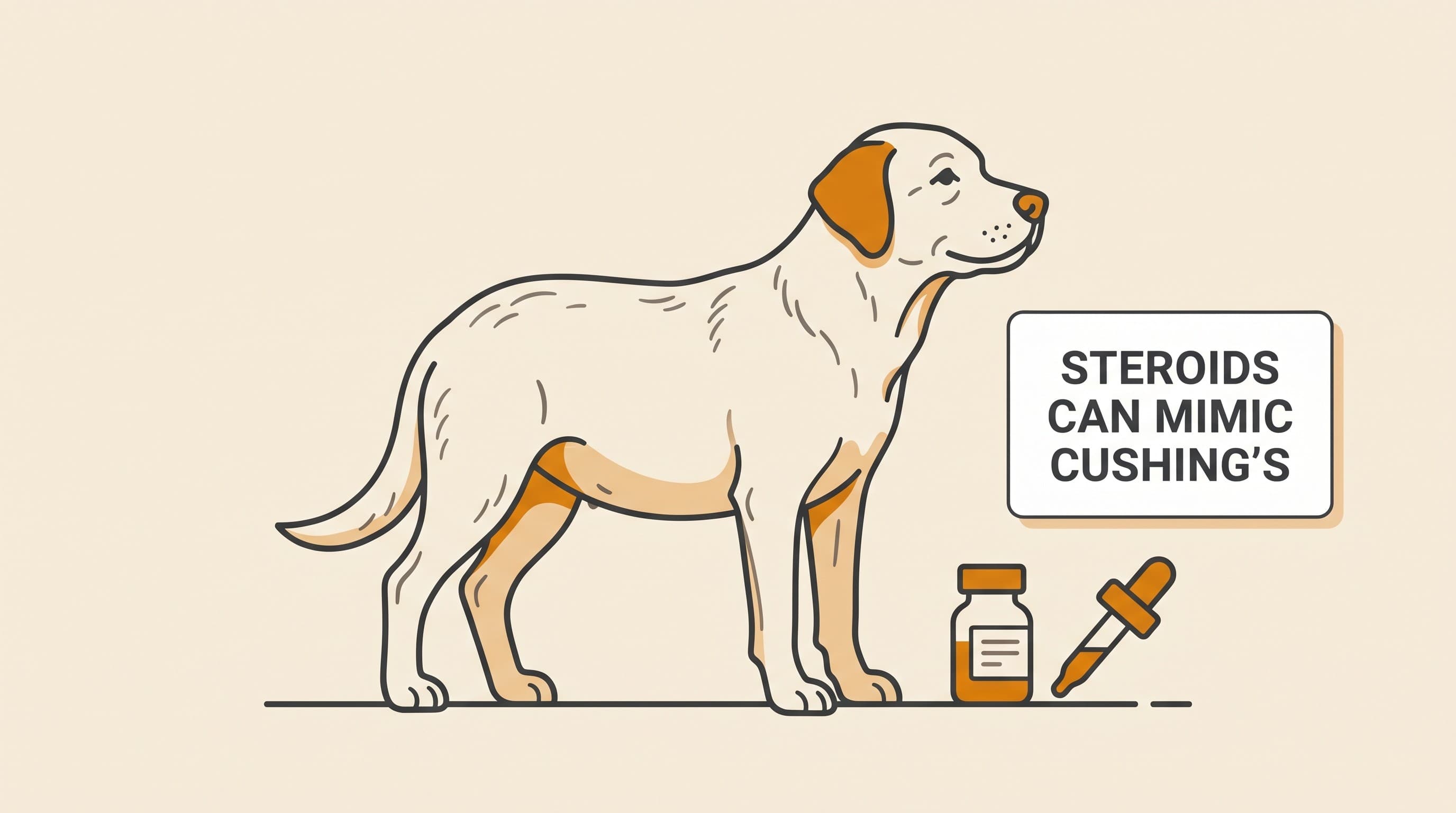
Cushing's from steroids: the iatrogenic kind owners cause by accident
Alastair Greenway
BVM&S MRCVS
If your dog has been on steroids for a while, for itchy skin, an immune problem or joint disease, and is now starting to look a bit Cushing's-like, this is the article for you. The medical name is iatrogenic hyperadrenocorticism, which just means Cushing's caused by treatment rather than by a tumour. This is common, it is usually the price of a steroid course your dog genuinely needed, and it is largely reversible once the medication is safely wound down. There is no room for guilt here, only a plan.
Before anything else: never stop long-term steroids abruptly. Always taper, under your vet. We will come back to why.
The same dog on the outside, the opposite on the inside
The outward picture is the ordinary Cushing's picture, and the resemblance is the whole reason it gets noticed. In a case series of 28 affected dogs, the commonest signs were skin and coat changes (27 of 28), drinking more (21 of 28), weeing more (19 of 28) and lethargy (16 of 28), along with the typical "steroid liver" blood changes such as a raised ALP (Huang et al. 1999). In plain terms: a pot belly, a thinning coat, more thirst, more panting, less energy. If you have read our piece on the thirsty, pot-bellied, balding dog, none of this will be new.
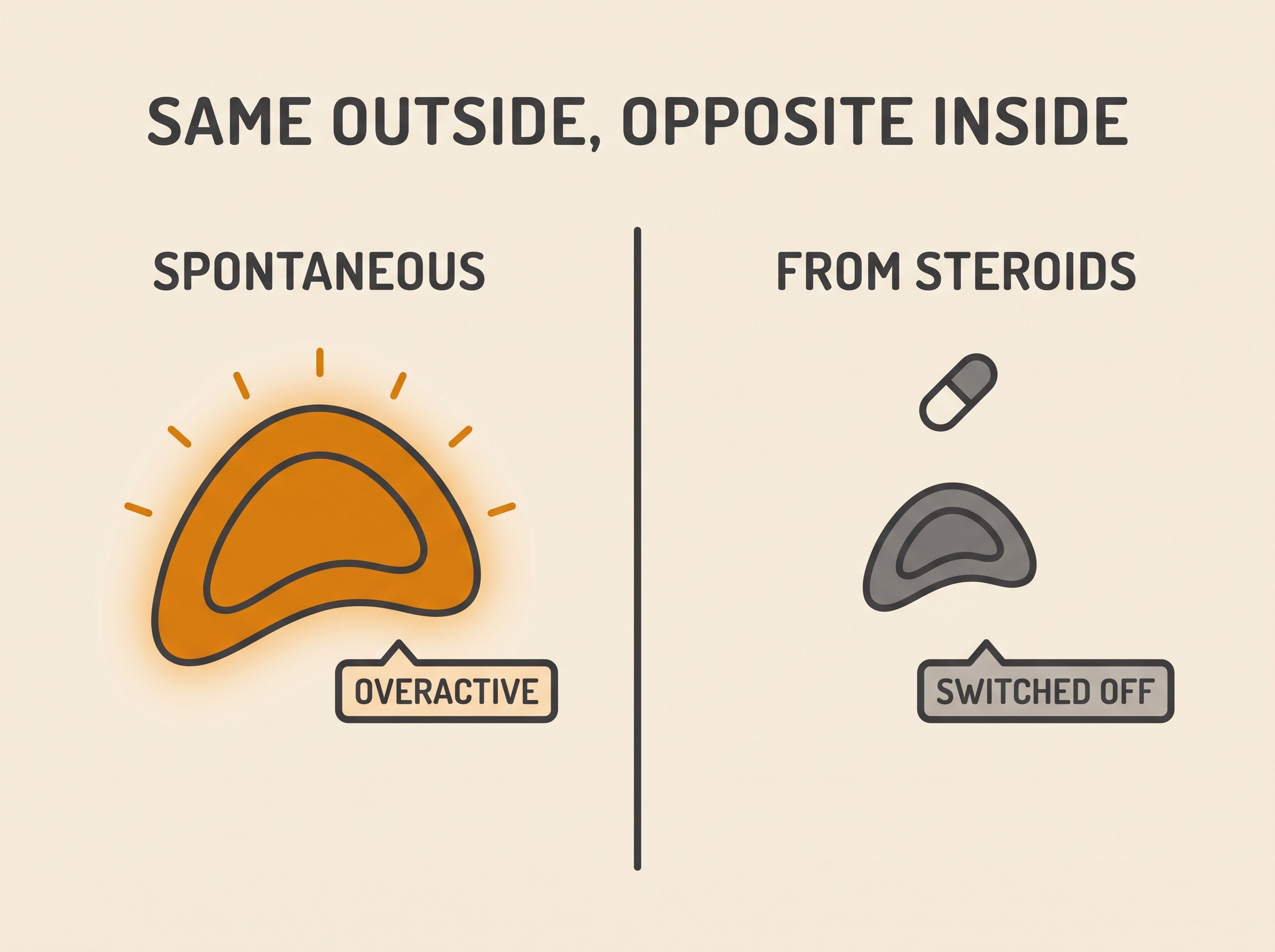
What is completely different is what is happening underneath. In spontaneous Cushing's the adrenal glands are overactive and pumping out too much cortisol of their own. In the iatrogenic kind it is the steroid drug doing the impression, while the dog's own system is switched off. Exogenous steroids press on the pituitary's feedback loop, the drive to the adrenal glands falls away, and those glands actually shrink, which is called adrenal atrophy. So your dog looks flooded with cortisol but its own glands are quietly suppressed and undersized, making barely any (MSU Veterinary Diagnostic Laboratory). Same dog on the outside, opposite on the inside. That flip is exactly why the management is not the same as for tumour Cushing's.
Even the eye drops count
This is not only a problem with steroid tablets and injections. Steroids given by any route can do it, including topical ones, the skin creams, the ear drops and the eye drops (MSU Veterinary Diagnostic Laboratory). The instinct that a drop or a cream must be "safer because it isn't a tablet" is understandable and wrong. These preparations are absorbed into the body and can suppress the adrenal glands just the same.
It is not theoretical. In a study of a potent steroid eye drop in dogs, treated animals showed suppression of that adrenal feedback axis, and some developed full iatrogenic Cushing's. One small dog on long-term drops developed widespread hair loss and a pot-bellied look with increased drinking and weeing, and across the dogs that developed skin changes the median time on treatment first was around 550 days (Quantz et al. 2021). No single product is uniquely to blame, the point is the class. If your dog is on a long-running steroid drop or cream for the eyes, ears or skin, it counts as a long-term steroid, and the same caution applies.
Telling the two kinds apart
You do not need to follow the lab detail, but it helps to know there is a clean way to separate the man-made kind from the tumour kind. The test of choice is the ACTH stimulation test, which can tell naturally-occurring disease from iatrogenic disease (MSU Veterinary Diagnostic Laboratory). With the iatrogenic kind the result is a flat line: the cortisol is low to begin with and the dog's own glands barely respond when prodded, because they have been switched off and have shrunk. In the 28-dog series, every dog's baseline cortisol sat at the low end of the range with a suppressed or absent response (Huang et al. 1999). That flat, suppressed pattern is the fingerprint of suppressed adrenals.
One small thing your vet may do that can look fussy. Some steroids, prednisolone among them, cross-react in the cortisol test and can falsely lift the reading (MSU Veterinary Diagnostic Laboratory). So your vet may switch the steroid or time the test around the dose to keep the numbers clean. It is not red tape, it is making sure the test means what it says.
Why you never stop steroids cold: the taper
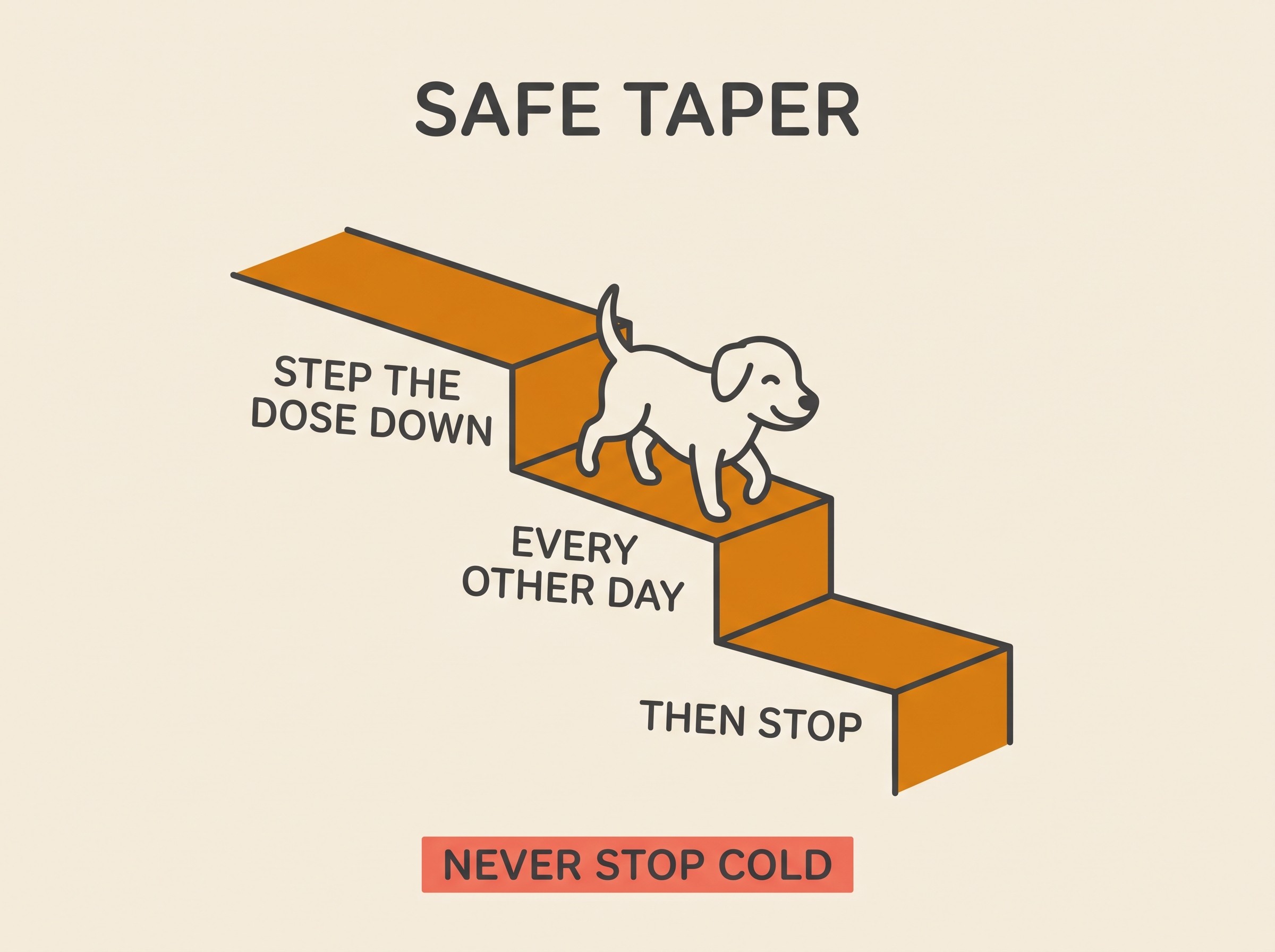
Because the adrenal glands have shrunk and gone quiet, they cannot suddenly make cortisol on demand. If the steroid is stopped abruptly, the dog can swing the other way, into a cortisol-deficient state that behaves like Addison's disease (MSU Veterinary Diagnostic Laboratory). In fact, abruptly stopping long-term steroids is one of the recognised causes of this kind of secondary adrenal insufficiency (Lottati and Bruyette 2014). The fix is the opposite of dramatic: a gradual step-down to low physiologic doses over several weeks, often coming down a level, then moving to every-other-day dosing, then stopping, with your vet setting the exact schedule (Lottati and Bruyette 2014). Tapering is, in effect, free insurance. It gives those sleepy glands time to wake back up.
Let me be straight about the risk so the rule keeps its credibility. In dogs, an actual collapse-type adrenal crisis from stopping steroids is uncommon. More often a dog that comes off too fast simply goes off-colour, with vague tummy signs (Lottati and Bruyette 2014). So if you realise you have missed a step on the taper, the right move is to ring your vet, not to panic. The taper rule stands not because disaster is likely, but because the downside is severe and the precaution costs you nothing.
That worst case is real enough to name, though, and it is the one the rule guards against.
Emergency. If your dog collapses, is profoundly weak, is vomiting or has diarrhoea, or seems cold or shocky, this could be an adrenal crisis. Ring your vet or the nearest emergency clinic now. Do not wait.
This kind of "cushingoid first, crisis if stopped abruptly, especially during an illness or other stress" sequence is well described in the wider medical literature, including human case reports (Shanavas Khan et al. 2025). The dog evidence points the same way, and it is why the wind-down matters most when your dog is also unwell.
The good news: it usually comes good
This is where iatrogenic Cushing's earns a calmer ending than the tumour kind. Once the steroid is safely withdrawn, it improves and usually resolves completely. In the 28-dog series the average time to the first signs of improvement after stopping the steroid was about 6 weeks, with full resolution taking roughly a further 12 weeks on average (Huang et al. 1999). The glands themselves bounce back too, regaining size within a couple of weeks of the dose coming down in one controlled study (Boretti et al. 2025). So the realistic picture is weeks to a few months to come good, on a planned taper, not a switch you flip overnight.
One caveat on the numbers. The familiar "about 80 to 85% pituitary, 15 to 20% adrenal" split you may have read about applies to spontaneous Cushing's. The iatrogenic kind is a separate, man-made category that sits outside that split entirely, so do not picture it as a slice of that pie.
If your dog is on long-term steroids for skin or immune disease, it is worth reading this alongside Allergies & Skin's guidance on long-term steroids, since that is the commonest reason a dog ends up here. And if the thirst is the sign that is bothering you most, you can put a number on it. More than roughly 100 ml per kg per day counts as drinking too much, and our "drinking and weeing far more than usual" piece and the Thirst & Wee tracker will help you measure it properly and share the trend with your vet.
The next step is simple and not at all alarming. If your dog is on steroids and looking cushingoid, do not stop the medication yourself. Book a conversation with your vet about whether the dose can come down and how to taper it safely. In most dogs, that planned wind-down is all it takes for the pot belly, the coat and the thirst to fade back to normal.
References
- Huang HP, Yang HL, Liang SL, Lien YH, Chen KY (1999). Iatrogenic hyperadrenocorticism in 28 dogs. Journal of the American Animal Hospital Association 35(3):200-207.
- Michigan State University Veterinary Diagnostic Laboratory - "Adrenal Testing in Dogs."
- Quantz K, Anderson AL, Harman CD, et al. (2021). Localized alopecia and suppression of hypothalamic-pituitary-adrenal (HPA) axis in dogs following treatment with difluprednate 0.05% ophthalmic emulsion (Durezol). BMC Veterinary Research 17:366.
- Lottati M, Bruyette D (2014). Canine Hypoadrenocorticism: Overview, Diagnosis, & Treatment. Today's Veterinary Practice.
- Shanavas Khan S, Yadav R, Maali N, Warrier V, Almezel A (2025). Cushingoid Features and Addisonian Crisis Following Abrupt Withdrawal of Potent Topical Corticosteroids: A Case Report. Cureus 17(11):e97749.
- Boretti FS, Harburger L, Riond B, Neubert E, Hofmann-Lehmann R, Unterer S, Dennler M, Sieber-Ruckstuhl NS (2025). Effects of long-term high-dose prednisolone in Beagle dogs on structural and functional responses of the HPA axis. BMC Veterinary Research 21:480.
Keep track of how your pet is doing
The owners who cope best are the ones who notice changes early. A simple health log shows you what is working, and what is not, before the next vet visit.
Start tracking, freeYou're not doing this alone
Compare treatment journeys and talk to owners managing hormone health. Free to join.
Join PetsLikeMine