

The under-active thyroid in dogs: the over-diagnosed, very-treatable one
Alastair Greenway
BVM&S MRCVS
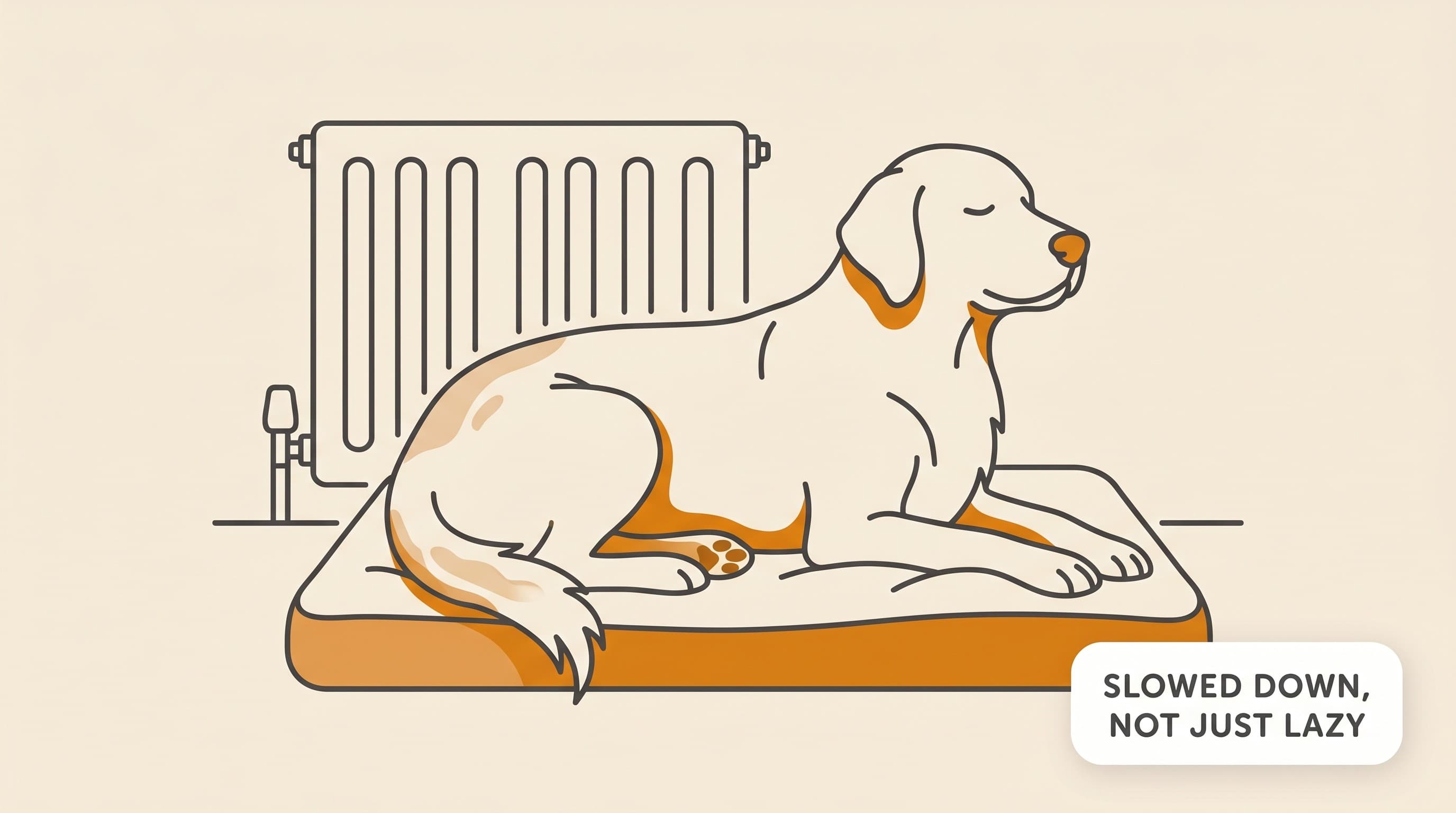
If your dog has slowed down, put on weight without eating any more than usual, started seeking out warm spots, and lost coat in a thin, balding pattern that doesn't seem to itch, hypothyroidism is a fair thing to wonder about. It's a real condition, it's common, and here's the genuinely good news up front: when it truly is an under-active thyroid, a cheap daily tablet often transforms the dog back to themselves.
There's a catch worth knowing before you start, though. Canine hypothyroidism is also one of the most over-diagnosed conditions in dogs (AAHA 2023). Plenty of healthy-thyroid dogs get a low result on a blood test and end up on lifelong medication they never needed. So the message is two-sided: take it seriously, and also make sure it's actually confirmed before your dog is committed to tablets for life.
The picture that points to a slow thyroid
Hypothyroidism is classically a disease of middle-aged dogs, with a mean age at diagnosis of around seven years, and it turns up more often in medium-to-large breeds (Vet Times). Breeds reported as predisposed include the Dobermann and the Golden Retriever, though any breed can be affected and the breed lists vary between countries, so they're a nudge to think of it, not a rule (Vet Times).
The hormone the thyroid makes sets the pace of the whole body's metabolism, so when there's too little of it, everything idles too low. The signs follow from that (Merck Veterinary Manual):
- Lethargy and mental dullness, a dog that's lost its sparkle and is reluctant to exercise.
- Weight gain without eating any more than before. This one matters: the weight creeps on even though the appetite hasn't gone up (Today's Veterinary Practice).
- Seeking out warmth and seeming to feel the cold, curling up by the radiator more than they used to.
- Coat and skin changes, which we'll come back to because they're a leading feature.
You'll notice "drinking and weeing a lot" isn't on that list, which is deliberate. The thirsty, frequent-urination picture belongs to other hormone problems (diabetes, Cushing's, an over-active thyroid) and to kidney disease, not to an under-active thyroid (Today's Veterinary Practice). If big thirst is your dog's main sign, the under-active thyroid is probably a red herring, and our "Drinking gallons, always hungry, or fading?" funnel piece, with the Thirst & Wee tracker, is the better starting point.
What's actually happening
In dogs, hypothyroidism is nearly always what's called acquired primary disease: the thyroid gland itself is gradually destroyed, so it simply can't make enough hormone (Merck Veterinary Manual). The two usual culprits are an immune-mediated inflammation of the gland (lymphocytic thyroiditis) and a quiet shrinking-away of the gland tissue (idiopathic atrophy), and the great majority of canine cases are this primary type (Veterian Key).
If you've read about the over-active thyroid in older cats, this is its mirror image. The cat's gland makes too much hormone and revs everything up; the dog's gland makes too little and lets everything wind down. Hyperthyroidism is the commonest hormonal disease of older cats (Carney et al. 2016); hypothyroidism is one of the commonest in middle-aged dogs. Same gland, opposite problem.
The over-diagnosis trap (the part most pages skip)
Here's where the full version diverges from the breezy "low T4, here's a pill" version.
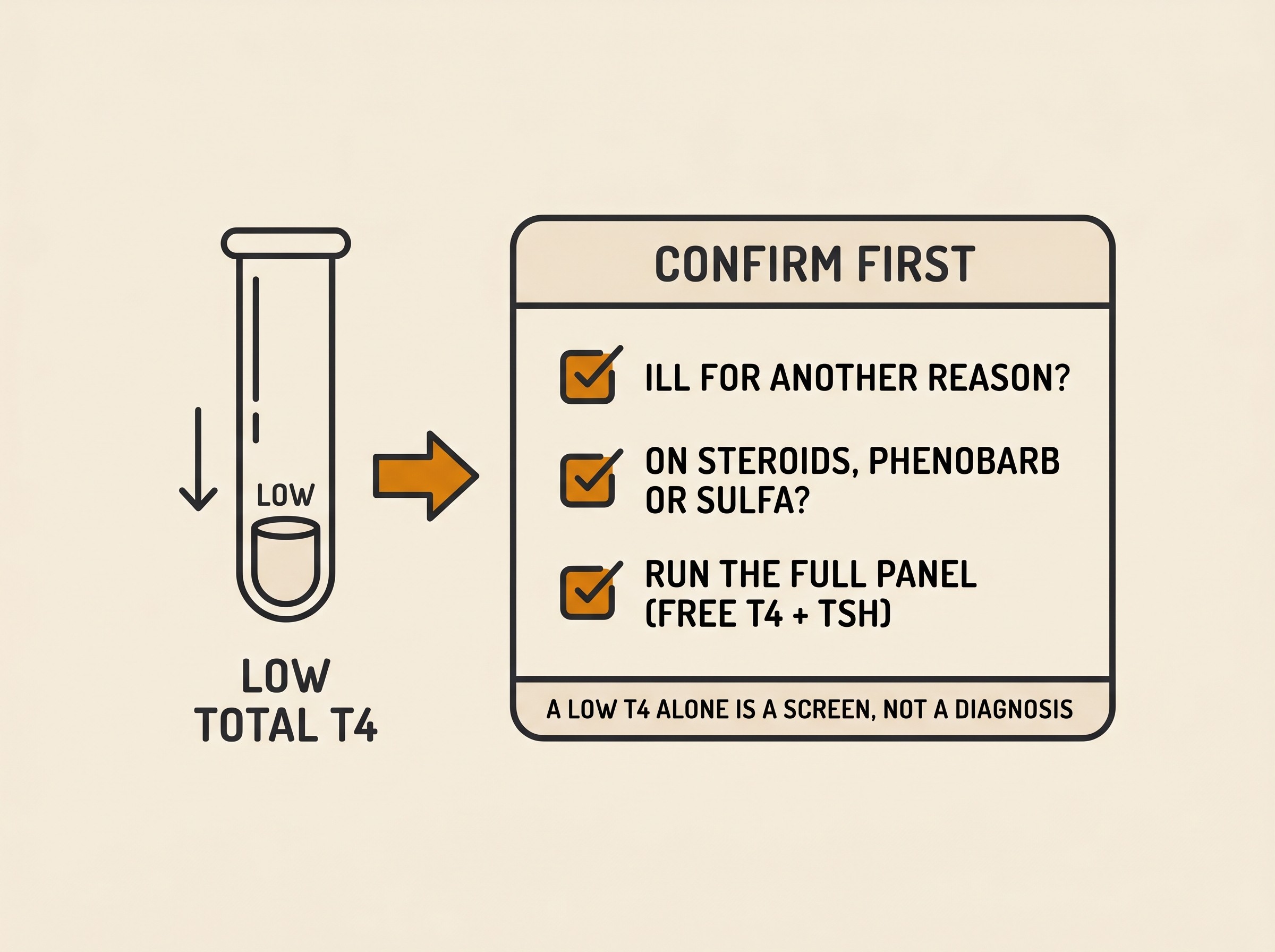
The test most often used to screen for hypothyroidism is total T4 (the total amount of thyroid hormone in the blood). A genuinely hypothyroid dog will usually have a low result, which makes it a useful screen. The problem is the other direction: plenty of dogs that do not have thyroid disease also show a low total T4, so a low result on its own throws up a fair number of false alarms (AAHA 2023). Studies put the specificity of total T4 at only around 73 to 82 per cent, which is exactly why a low reading alone isn't enough to commit a dog to treatment (Clinician's Brief; Peterson et al. 1997).
Two big things drag thyroid results down without any thyroid disease at all:
Being ill for another reason. When a dog is unwell with almost anything else, the body deliberately turns its thyroid readings down. This is called non-thyroidal illness, or "euthyroid sick" syndrome, and it preferentially knocks the total T4 below normal (AAHA 2023). So testing a dog's thyroid in the middle of another illness is a classic way to land a false hypothyroid label, and if a low result turns up in a poorly dog the sensible move is usually to treat the other problem and re-test once they've recovered (AAHA 2023).
Certain medications. Some common drugs can lower thyroid results too, depending on the drug, the dose and how long it's been given. Steroids, the epilepsy drug phenobarbital, and sulphonamide ("sulfa") antibiotics are the ones most worth knowing about (Bolton and Panciera 2023). It isn't true that any dog on a steroid course will test falsely low, the effect depends a lot on dose and duration, but it's enough that, where it's practical, a dog on one of these drugs is often better not having a thyroid test at all, because the result is so likely to be misread (Bolton and Panciera 2023).
Put those together and you can see how an over-diagnosis happens: a slightly overweight, slightly tired older dog, perhaps a bit under the weather or on a course of tablets, gets a single low total T4 and walks out on lifelong medication. In one specialist review, a large share, roughly half, of dogs labelled hypothyroid were judged not to have needed the medication, though that figure comes from a referral population and the everyday rate is hard to pin down (Clinician's Brief). The exact number matters less than the principle: a low total T4 by itself is a screen, not a diagnosis.
Getting the diagnosis right
None of that means hypothyroidism isn't real or shouldn't be treated. It means the diagnosis is worth getting right, because the treatment is for life.
When a total T4 comes back low, or when the picture is genuinely suggestive, the way to firm it up is to look further than that one number: a fuller panel that adds free T4 measured by equilibrium dialysis and canine TSH, read alongside the dog's actual signs (AAHA 2023). Free T4 by that method is a more reliable single test than total T4, and in the classic comparison far fewer healthy dogs slipped through with a misleadingly low free T4 than with a low total T4 (Peterson et al. 1997). The supportive pattern for true disease is a low free T4 with a raised TSH in a dog whose signs fit.
Even then it isn't always one clean test. Around 20 to 40 per cent of genuinely hypothyroid dogs have a normal TSH despite low thyroid hormones, the same pattern you can see in a dog that's simply unwell, so the vet weaves the numbers together with the clinical picture rather than ruling on any single value (AAHA 2023). The takeaway for you is simple: if your dog is about to start lifelong tablets on the strength of one low T4, it's entirely reasonable to ask whether the diagnosis has been confirmed on the fuller panel and whether your dog was well when the blood was drawn. We go through the tests and the traps properly in our companion piece on getting the thyroid diagnosis right.
The good news: once it's confirmed, it's very treatable
This is the half of the story that deserves equal billing. When it genuinely is hypothyroidism, treatment is one of the most satisfying in veterinary medicine.
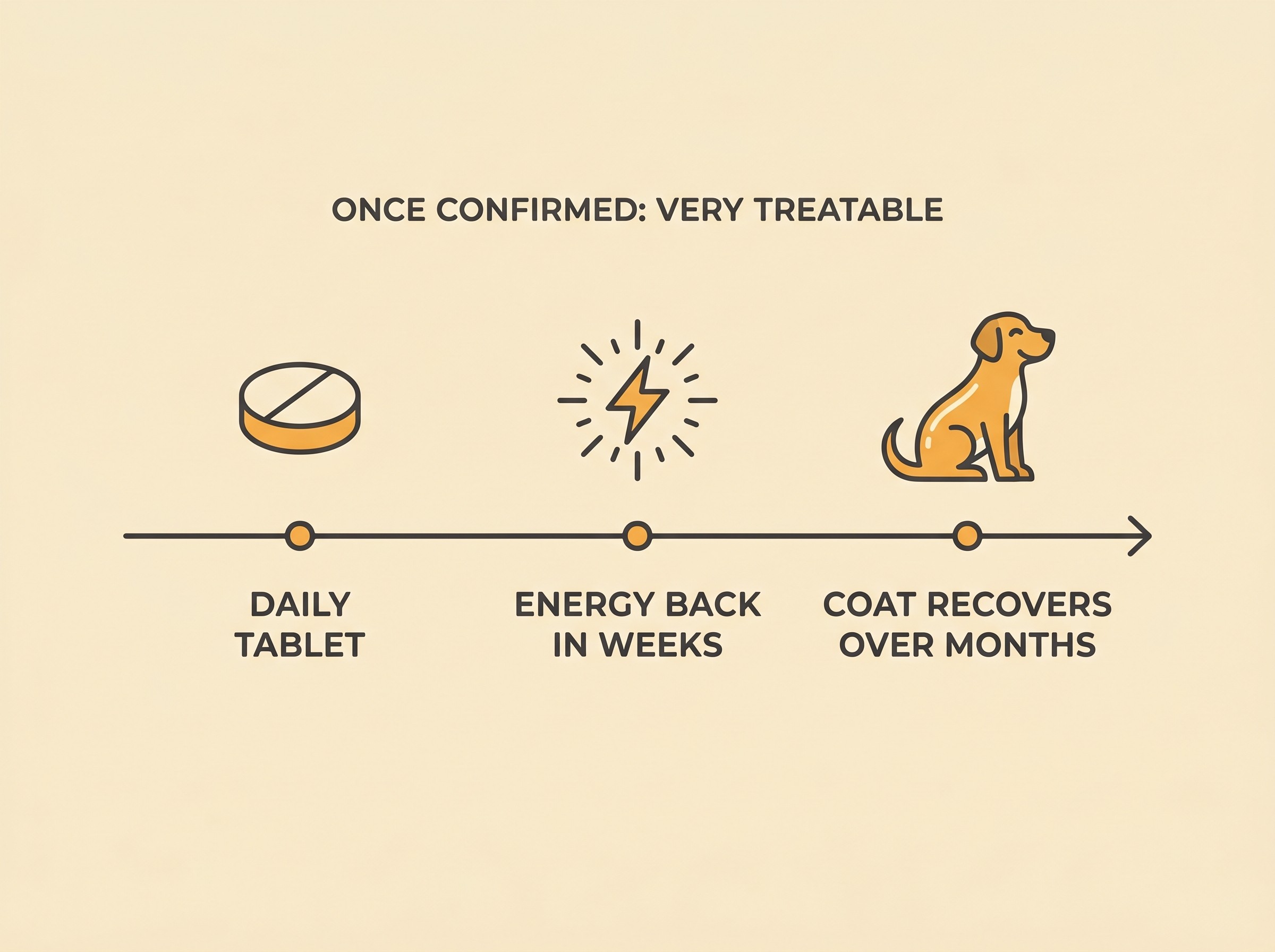
The medication is levothyroxine, a synthetic version of the hormone the thyroid should be making. It's given as a daily tablet, it's inexpensive, and it's very safe. Your vet will set the dose (commonly starting around 0.02 mg/kg, often twice daily to begin with) and then fine-tune it using a blood test taken a few hours after a dose, rechecked at about four weeks and adjusted from there (Today's Veterinary Practice; AAHA 2023). The point for you isn't the exact numbers, it's that the dose is titrated to your individual dog rather than guessed, which is another reason confirming the diagnosis first is worth it.
What to expect is an improvement that arrives in stages. The energy and brightness often come back within a few weeks, most signs improve within roughly four to six weeks, and the coat and skin take the longest, often a few months, to fully recover (Today's Veterinary Practice). With proper treatment the outlook is excellent: signs resolve, quality of life is restored, and these dogs go on to a normal life expectancy (Vet Times). We cover dosing and what the first months look like in our levothyroxine guide.
One quick reassurance. You may see the word "myxoedema" attached to hypothyroidism. In its everyday form that just describes a puffy, slightly droopy "tragic" look to the face that some affected dogs develop, a cosmetic change that reverses with treatment (Merck Veterinary Manual). That's quite different from "myxoedema coma", a rare and serious decompensation in severely untreated dogs. It's genuinely uncommon and not where the typical newly diagnosed dog is heading, so the puffy face is a sign to treat, not a cause for alarm.
The skin and coat link
It's worth saying a bit more about the coat, because for a lot of dogs it's the sign that brings them in. Hypothyroidism is one of the leading hormonal causes of non-itchy, symmetrical hair loss in dogs (Vet Times). The classic pattern is thinning or balding on both sides of the body, often over the trunk, the backs of the thighs and the tail (the so-called "rat tail"), with a dull, dry coat and sometimes darkened skin. Crucially, this hair loss usually doesn't itch, which helps separate it from an allergy, and recurrent skin or ear infections can be part of the same picture. Skin and coat signs show up in a large majority of hypothyroid dogs, roughly 60 to 80 per cent (Vet Times; Merck Veterinary Manual).
That's exactly why an under-active thyroid sits right next to the dermatology work-up. If your dog has symmetrical hair loss that isn't itchy, our Allergies & Skin material on hair loss without itching walks through the wider list of causes, and a thyroid test is one of the things that pattern should prompt. We go deeper into the coat, the recurrent infections and the overlap in our piece on the thyroid and the skin.
So, the bottom line: don't dismiss the under-active thyroid, and don't rush into it either. If the signs fit, push for the diagnosis to be confirmed properly rather than taken from a single low reading, especially if your dog was unwell or on medication when the blood was drawn. Get that right, and a once-a-day tablet usually gives you your dog back.
References
- 2023 AAHA Selected Endocrinopathies of Dogs and Cats Guidelines. J Am Anim Hosp Assoc 2023;59(3):113-135.
- Bolton TA, Panciera DL. Influence of medications on thyroid function in dogs: An update. J Vet Intern Med 2023;37(5):1626-1640.
- Peterson ME, Melian C, Nichols R. Measurement of serum total thyroxine, triiodothyronine, free thyroxine, and thyrotropin concentrations for diagnosis of hypothyroidism in dogs. J Am Vet Med Assoc 1997;211(11):1396-1402. PMID: 9394888.
- Clinician's Brief - Hypothyroidism in Dogs: Is It Overdiagnosed?
- Today's Veterinary Practice - Canine Hypothyroidism: Diagnosis and Treatment.
- Vet Times - Diagnosis and treatment of canine hypothyroidism.
- Merck Veterinary Manual - Hypothyroidism in Animals.
- Veterian Key - Canine Hypothyroidism.
- Carney HC, Ward CR, Bailey SJ, et al. 2016 AAFP Guidelines for the Management of Feline Hyperthyroidism. J Feline Med Surg 2016;18(5):400-416.
Keep track of how your pet is doing
The owners who cope best are the ones who notice changes early. A simple health log shows you what is working, and what is not, before the next vet visit.
Start tracking, freeYou're not doing this alone
Compare treatment journeys and talk to owners managing hormone health. Free to join.
Join PetsLikeMine